
ChatGPT Pro 500: Same Budget, Fewer Providers
Pro 500 offers 25× the Plus allowance. Optional Ultrafast consumes included usage at 8× and purchased credits at 6× Standard. Is the $700 Claude–Codex pair a better use of the trio’s budget?

Three days ago, the interesting part of ChatGPT's leaked $500 plan was what OpenAI had not said. Now the plan is official, and the interesting part is how the numbers fit together.
The official name is Pro 500: a ChatGPT subscription that includes Codex, rather than a separate Codex-only plan. It includes 25 times the ChatGPT Plus allowance and access to Astra Ultrafast. Yes, the allowance is larger. That does not make it a $500 credit wallet, and against the old advertised 20× rate-limit offer, 25× is a much smaller increase than the jump in price. OpenAI's September 29 announcement
For my desk, this opens a specific question. Could Claude at $200 plus Codex through ChatGPT Pro at $500 replace the Claude–Codex–Grok trio?
My answer today: the pair is worth considering, but the launch does not yet justify dropping the third provider. The proposed pair has the same headline monthly cost as the trio I previously described. It concentrates more of that budget in OpenAI. Whether that is a good exchange depends on what actually stops work: Codex's allowance, time waiting for tokens, or the availability of an independent reviewer.
The same $700 buys a different arrangement
In I Love Trios, I used this public subscription comparison:
These are subscription figures before taxes and extras, not an invoice or a claim that all usage is covered. The $300 that would leave the Grok seat would move into the OpenAI seat. Calling that a saving would be wrong.
Nor does one provider's usage multiplier translate into another provider's work. Claude's allowance is not a unit I can add to Codex's allowance. A third subscription is not automatically valuable merely because it exists. The useful comparison is accepted work and review coverage for the whole budget.
The pair could be a better arrangement. But it has to earn that conclusion.
What changed since the leak
My September 26 article was about a leaked price and unresolved limits. OpenAI now lists three Pro prices: $100, $200 and $500 a month. Astra Ultrafast is a Pro 500 feature among those personal tiers; buying extra credits on Pro 100 or Pro 200 does not unlock it. Current Pro tier documentation
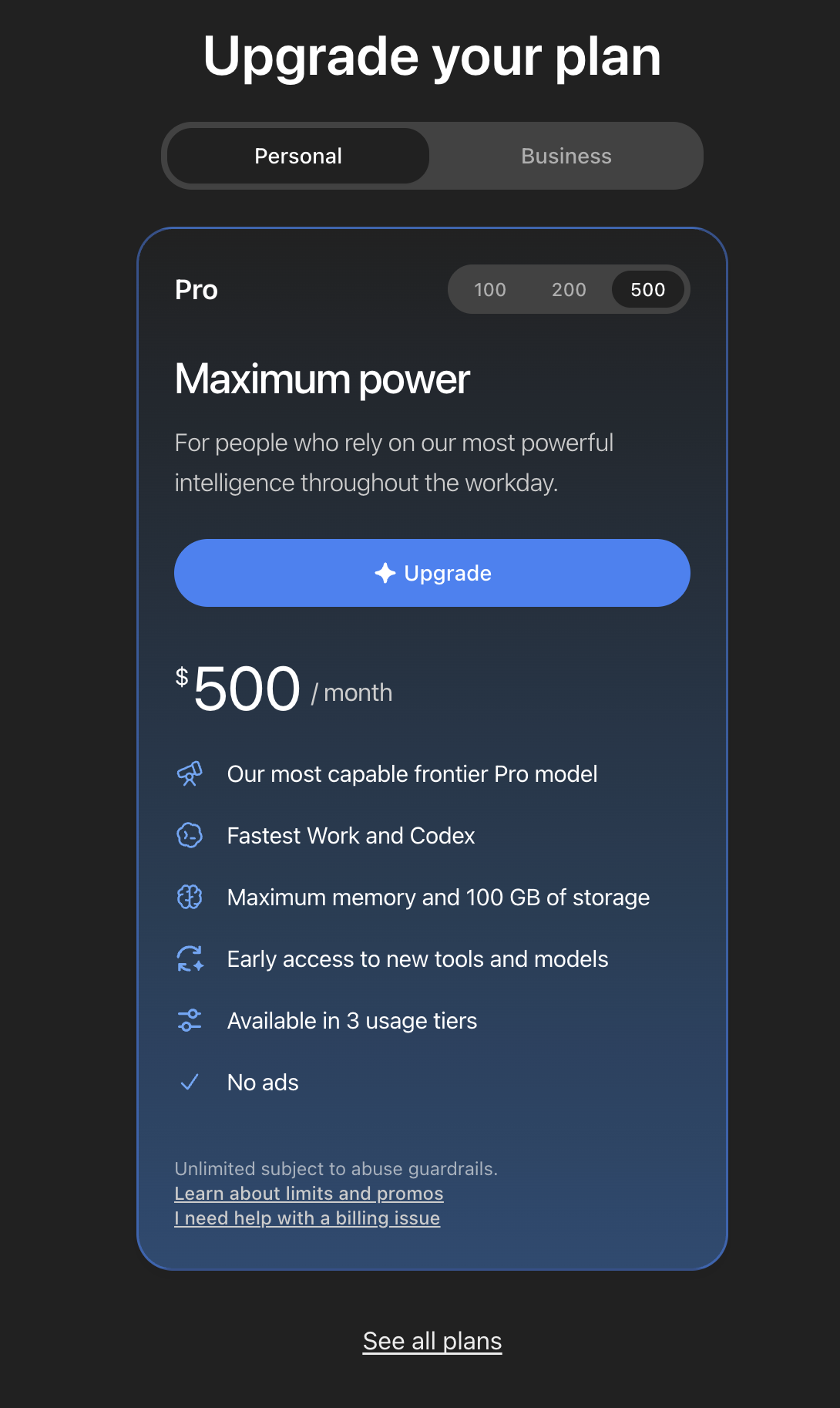
The upgrade screen calls the selected tier “Maximum power” and includes 100 GB of storage. Storage is a separate product feature; that number is not a token allowance or a 100 GB model context window. The capacity comparison comes from the plan and usage documentation, not that line on the card.
There is also a consequential change to the old $200 comparison. OpenAI says Pro 200 has reopened with a lower allowance. Eligible customers who had Pro 200 at the cutoff, or during the preceding seven days, retain the previous allowance through October 29, 2026, provided the subscription stays active. After that, the lower allowance applies at the same $200 price. The public explanation does not state the exact cutoff timestamp. Pro 200 transition terms
That makes “the $200 plan” ambiguous for the next month. It can mean the new allowance or an eligible existing subscriber's temporary previous allowance. I would check the account's actual entitlement before making a comparison, and would not assume that upgrading and later downgrading restores the old one.
The official pricing page I archived for the September 26 piece offered Pro at 5× or 20× the Plus rate limits. Today's announcement says 25× Plus for Pro 500. If the advertised Plus baseline is comparable across those dates, dividing the headline multipliers gives 1.25, or a 25% higher headline multiplier, for a price that is 2.5 times $200. That is a comparison with the historical 20× rate-limit offer, not a claim about the reopened Pro 200 allowance or a promise of 25% more completed tasks. The plans also differ in speed access and current limit structure. Earlier sourced comparison, official Pro 500 announcement
Launch-day discussions call the new $200 allowance 10× Plus. The current public Pro help page I checked confirms the reduction but does not give that exact multiplier. I am not promoting a community number into a verified plan term. That is a missing detail readers should check in their own plan screen.
Another correction to the old article's numbers: the current Codex pricing documentation says Pro plans have no five-hour limit at present. Weekly limits may still apply. The old five-hour message estimates should not be carried into a Pro 500 forecast. Work and Codex also share usage; switching between those surfaces does not create a second allowance. Current usage documentation
Three different things get called credits
This is where the plan discussion becomes slippery. There is included subscription usage, there are purchased usage credits, and there is separately billed API usage.
Included usage is the allowance bundled with the subscription. OpenAI publishes relative allowances and shows the account's remaining usage and reset times. The pages I checked do not publish a fixed monthly Pro 500 credit grant that can be divided by a token rate to promise a number of jobs.
Purchased credits are additional usage after the included allowance is exhausted. They can support several eligible agentic features on the same account, so a balance bought for Codex can also be consumed elsewhere. They are not API credits, and a ChatGPT wallet balance in dollars is a separate thing. How personal-plan credits work
API usage follows API billing. An estimate that a session would have cost a certain number of API dollars does not tell me how much of a Pro subscription it consumed. OpenAI explicitly separates those concepts in its pricing documentation.
So “$500 worth of credits” is not a description of Pro 500. It is a $500 subscription with an included allowance and feature access, plus the ability to spend beyond that allowance where supported.
Ultrafast changes two clocks
The attraction is understandable. OpenAI advertises up to 8× faster token generation for Astra Ultrafast in Codex. That is not a promise that a repository task, a browser workflow or a reviewed change finishes eight times faster. Tests, downloads, external tools and my own reading still take time. Ultrafast documentation
Then there is the consumption clock. Relative to Standard speed on the same model, the current billing rules are:
The earlier leak article’s single 2.5× Fast figure also needs this update: it describes included usage; purchased-credit Fast is now listed at 2×.
Those are billing multipliers. The separate “up to 8×” speed claim describes token generation. The two eights happen to match; they describe different things. Speed and billing rules
This also explains a mistake in some launch-day arithmetic. Dividing the included 25× allowance by the 6× purchased-credit multiplier mixes two billing systems. Included Ultrafast uses 8×. Even dividing 25 by eight would only produce a normalized allowance calculation, not a reliable multiple of Plus tasks: models, context, tools and the actual workload still matter.
For capacity, I would compare Standard with Standard first. For latency, I would ask which waits are expensive enough to justify Ultrafast's consumption. A focused interactive task blocking the next decision is a stronger candidate than an unattended queue I will read tomorrow.
This is independent of reasoning effort. My reasoning-effort setting, ultra, and OpenAI’s speed mode Ultrafast are different controls. A speed mode is not evidence of a smarter model, and this article does not change my model or effort policy.
What a purchased-credit example can tell us
The published Standard Astra rates are 250 credits per million uncached input tokens, 25 per million cached input tokens and 1,250 per million output tokens. There is no separate cache-write charge in Codex credit billing. Official token rate card
Take an illustrative billing example: 100,000 uncached input tokens, 200,000 cached input tokens and 20,000 output tokens, with identical billed token counts in each speed mode.
- Uncached input: 100,000 ÷ 1,000,000 × 250 = 25 credits.
- Cached input: 200,000 ÷ 1,000,000 × 25 = 5 credits.
- Output: 20,000 ÷ 1,000,000 × 1,250 = 25 credits.
That is 55 credits at Standard, 110 at Fast or 330 at Ultrafast under the purchased-credit multipliers. It is arithmetic, not a measured session, a typical-task estimate or a prediction of included subscription consumption.
To turn that into dollars, I need the actual credit purchase offer. If checkout offers C credits for P dollars, the example costs 55 × P ÷ C dollars at Standard or 330 × P ÷ C at Ultrafast. A universal dollar conversion would require a universal purchase price; OpenAI says purchase amounts and prices can vary by account, region and plan. Credit purchase terms
That creates a useful alternative to evaluate: keep Pro 200 and buy occasional extra capacity. The $300 monthly upgrade difference can be compared with the account's actual credit offer and observed overage needs. It cannot buy Ultrafast eligibility on Pro 200. Capacity and access are separate purchases.
There are a few details worth knowing before treating credits like a safety net. They expire 12 months after purchase, are nontransferable and are generally nonrefundable, subject to law, contract and stated exceptions. Optional automatic reload has its own monthly cap, which does not cap separate manual purchases; enabling reload below its threshold can trigger an immediate purchase. Concurrent tasks can also leave a negative balance that a later purchase first offsets. These are documented billing behaviors, not settings I have enabled. Personal credit rules
The community split is about the work
The most useful launch-day discussion was not a universal verdict on the price. It was a disagreement about waiting.
In this Codex discussion of Ultrafast, some commenters value shorter interactive waits because the human is blocked. Others say they already switch tasks while agents run, or that builds, tests and staged review dominate the loop. One thread can contain both experiences without either being wrong.
The broader launch roundup also shows frustration with the reduced $200 allowance and uncertainty about the new numbers. These are launch-day reactions, not controlled comparisons, representative survey results or proof that one provider now wins.
My reading is that Ultrafast's value depends on the fraction of the workflow spent waiting for generation. As a toy example, suppose a task takes ten minutes and only four are generation. Even a full eightfold improvement to those four minutes leaves the six other minutes intact. The total becomes six and a half minutes: about 1.54× as fast, or 35% less elapsed time. That is an illustration of a bottleneck, not a benchmark of Codex.
If the agent is already ahead of my review queue, making it produce faster can simply move the queue.
What disappears when the trio becomes a pair
The case for three providers was never that three answers agreeing must be true. They can share blind spots, and a reviewer can accept a bad premise. Evidence, tests and the human decision still matter.
The practical benefit is another independent route. With Claude and Codex available, the pair can retain a cross-provider review step. If one is exhausted or unavailable, a fresh child from the remaining provider is still a separate pass, but it is not another provider's opinion. A third seat gives that fallback sequence another option. Why I built the trio
More Codex capacity can reduce some interruptions. It cannot manufacture a third provider's judgment or availability. Parallel Codex agents are useful, but they do not add provider diversity.
That does not make Grok's seat untouchable. If its incremental reviews rarely change the outcome, and it rarely keeps work moving when the other two cannot, the subscription deserves scrutiny. I do not have a controlled measurement in this article showing that it is either indispensable or redundant.
The same standard applies to Pro 500. The fact that I can spend the same $700 on two subscriptions is not evidence that I finish more good work.
The decision I would make
I would keep the current arrangement while collecting a short baseline, then consider the pair if Codex is the demonstrated bottleneck. The October transition makes the timing relevant: an eligible old Pro 200 subscriber has a different comparison before and after the previous allowance ends.
I would record a small set of facts from ordinary work:
- Which accepted tasks were delayed by a Codex limit, and for how long.
- How much blocking time was generation rather than tools, tests or human review.
- Whether the third provider found a material issue or supplied a review when the other two were unavailable.
- What additional credits would actually cost at the account's checkout offer.
Keep task quality and reasoning effort comparable. Count corrections and accepted outcomes, not just messages or tokens generated. This is a proposed observation period, not an experiment I am claiming to have run.
The pair becomes attractive if more Codex capacity removes frequent real interruptions and Claude supplies enough independent review coverage. Ultrafast adds value when generation latency is itself on the critical path. The case is weaker when work is mostly asynchronous, review is already the bottleneck, or the third provider is often the available second opinion.
If I later choose a paid trial, I would budget it honestly. Keeping all three seats while raising OpenAI to $500 would be $1,000 a month at those list prices, before taxes, credits and any prorating. The $700 pair assumes the $300 seat is removed; an overlap test does not have that same recurring total.
For now, I would not drop Grok merely to make the new pricing card fit the budget. Pro 500 has made the two-provider arrangement plausible. It has not established that the third provider is expendable.
The $300 upgrade buys a larger included allowance and an optional faster lane that consumes it at 8× Standard when selected. I would trade a third provider for it only when the work shows that this is the exchange I need.