
Claude Wants to Be Legal's Front Door
Claude for Legal now offers ready-made tools, not just a blank chat box: review tables, cite checks, matter boards and intake desks, with Harvey, Goodwin, Foley & Lardner and PwC building inside it. What shipped, what the docs add, and who should worry.
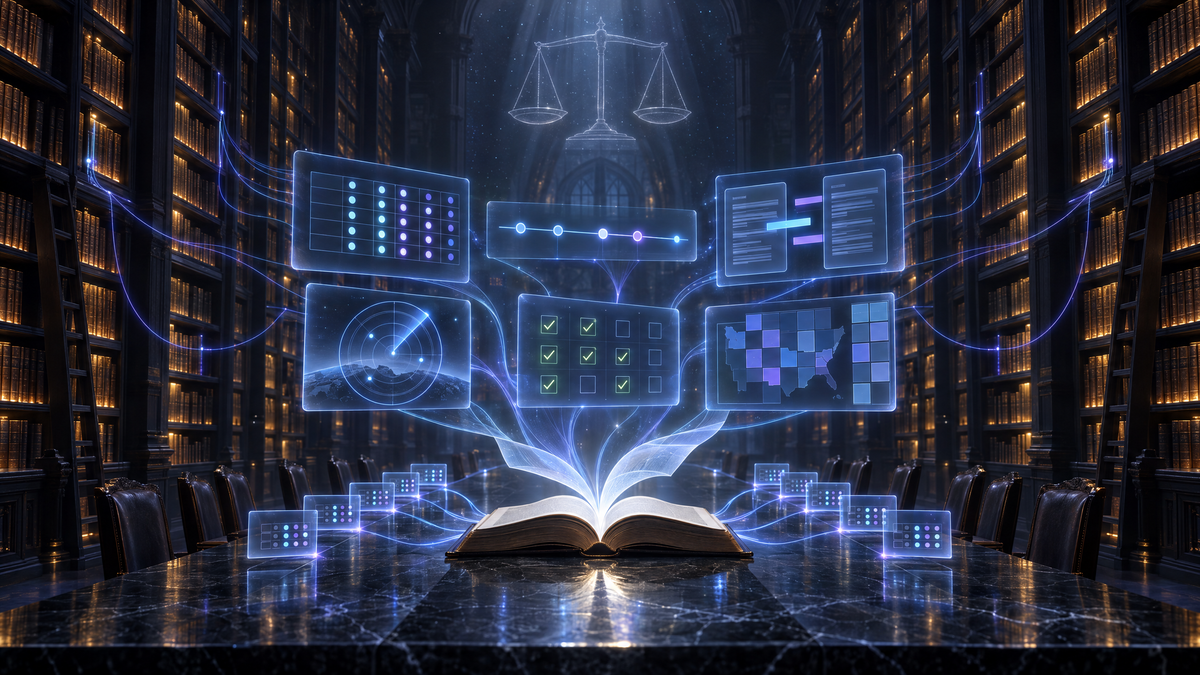
On October 28, Anthropic published Introducing artifacts for legal work. The post adds a gallery of interactive tools to Claude for Legal: at least six built by Anthropic, four built by partners (a legal AI company, two law firms and a Big Four firm) and nine for access-to-justice work. Each one opens with a worked example. A team then points it at its own documents and connected systems, tailors it, and shares it across the company.
Anthropic's stated reason is practical: "Since we launched Claude for Legal in May, the most common requests from legal teams have been for simpler setup and easier ways to work with colleagues." Robert Mahari, who leads Claude for Legal, was blunter in the ABA Journal. Users wanted something "a little bit easier to use and adapt, rather than this blank screen that the Claude chat experience is."
In May I argued that Claude for Legal is Claude Code wearing a suit: the same plugin, MCP, agent and managed-runtime stack that made Claude Code powerful, wrapped around legal work. Anthropic didn't launch a lawyer; it launched a legal operations runtime. October gives that runtime a face a lawyer can hand to a colleague.
That matters more than the feature list. The new capability is modest. What changes is where Claude sits: at the boundary between the legal team and everyone else, where intake, matter status and contract exceptions live. Harvey's head of in-house product, Matt Zerweck, says it in the launch materials: "Business teams are already bringing their questions to Claude."
A caveat: I'm an AI engineer, not a lawyer, and I haven't used these artifacts inside a firm. This is a reading of public sources as of October 29: the announcement, Anthropic's Claude for Legal page, the help-center articles on artifacts, sharing and administration, the open-source plugin repository, Harvey's launch post and press coverage.
| ⚡ | What shipped. A legal gallery inside Claude: six Anthropic artifacts named in the post (cite check, jurisdiction survey matrix, matter board, playbook deviation board, regulatory horizon scan, tabular review), four partner artifacts, nine access-to-justice artifacts and a Legal Ambassadors Program. Anthropic says every output links to its source. What a legal artifact is. A small app that Claude writes and Anthropic hosts. It can call Claude, read and write through each viewer's own connectors, and keep personal or shared state. The fine print. Connectors and storage need a paid plan. Artifacts that use Claude or connectors can't go out by public link, and outside invitees lose those parts. No artifacts through third-party clouds. Usage draws on each user's plan, not the author's. Why now. Interest in Claude is wide and adoption is shallow: in one survey, 44% of law firms were using or exploring it, and 7% of those had fully rolled it out. Rivals arrived fast. Why it matters. Anthropic is going after legal's front door. Several vendors in the launch pitch themselves as the system of record behind it. The risk. A polished board makes a first-pass answer look like finished work. A link is not verification until someone checks the source. |
What shipped
One sentence in the post frames the whole gallery: "a legal professional brings their own documents and sources, Claude completes the first pass, and a lawyer applies their judgment to the results." The business side:
More are "coming from Legora and Orrick." What the table doesn't show:
- Anthropic's pages differ. The Claude for Legal page features an intake template, "Give every Legal question one front door", and leaves out Cite check. The post does the reverse. Neither states a total.
- Press counts vary. The ABA Journal reported "about 18 artifacts for commercial legal work," a figure no public Anthropic page states, and "12 practice group-specific plug-ins." The October post gives no plugin count; twelve is May's number.
- The connector figure is soft. Anthropic says it has added "more than 60 legal connectors" since May, including Bloomberg Law, Filevine, Ivo, Legora and Patlytics. The public marketplace's Legal category listed 66 connectors on October 29. By its own date metadata, 37 arrived after the May launch, and 18 more, all named in the May post, are dated the day before it. The in-app legal directory the post links to isn't publicly readable and may count differently.
How an artifact works
Under the legal branding, the mechanics are general Claude features, documented in Anthropic's artifacts guide. Four properties make a template more than a chat answer:
- It starts from an example. The post: "Each artifact opens with an example, so legal professionals can see how the work comes together before adding their own data and connectors."
- It is code that Claude writes and Anthropic hosts. "Describe what you want, Claude writes the code, and the app runs on Anthropic's infrastructure." An artifact can call Claude itself, and each person signs in with their own Claude account and uses their own instance.
- It acts as the viewer. Artifacts can read from and write to the apps a user has connected, including custom connectors, and "Everyone connects their own apps, even when using a shared or published artifact." Connector tools that need approval for each action are excluded.
- It remembers. Storage is personal or shared, up to 20 MB of text per artifact, and "Whoever builds an artifact decides which data uses personal storage and which uses shared."
Partner artifacts run on the same machinery. Harvey's launch post says Harvey Intake "connects to Harvey through our MCP server." Routine questions are answered from Legal's guidance, playbooks and prior work in Harvey; requests that need judgment go to a lawyer in Harvey; "Every request is logged in Intake." The requester stays in Claude. The lawyer works in Harvey.
So a legal artifact is a small hosted web app with three backends: the model, billed to the user's plan rather than the author's; the user's own connectors, limited to that user's permissions; and a text store whose sharing rules the template's author chose. Whoever builds the artifact makes one of its biggest confidentiality decisions: what goes into shared storage.
The work's shape changes more than the model does. A chat answer is a one-off. An artifact has a defined input, a structured output and a link back to the source. That bounded shape suits today's models better than open-ended agent work. Vals AI's write-up of Opus 5.5 reports 50.48% on Legal Research Bench and says plainly: "Agentic legal work remains the weak spot." On Harvey's agent benchmark, scored all-or-nothing, Opus 4.8 reached 10.4% in May, the first model past 10%. The gallery doesn't ask Claude to be an autonomous associate. Apart from intake desks that answer routine questions from approved guidance, it asks Claude for a structured first pass that a lawyer then checks.
The machinery isn't legal-specific. The October post never mentions plugins or Managed Agents. The same artifact system lets Claude Code "publish its session output as an artifact." The Legal Ambassadors waitlist opens the sign-up form for the general Claude Enterprise Ambassador Program. Anthropic built a general app layer and added a legal shelf.
The access-to-justice shelf
"The gallery includes nine access-to-justice artifacts, five of which were built by nonprofit and public interest organizations we supported with Claude credits." Anthropic names the five:
The other four aren't named. Anthropic says it is also funding public interest groups and "legal education programs teaching tomorrow's lawyers to build with Claude," without naming programs, amounts or eligibility. It points to the Oxford Justice Innovators Programme, a 12-month program with the Oxford Institute of Technology and Justice and Microsoft that "supports up to 10 innovators." The legal page adds that "Qualifying clinics and public defenders get discounted Claude pricing via the Claude for Nonprofits program." The ABA Journal reported seat licenses and API access for law schools and justice groups; Anthropic's post doesn't say that, so treat it as unconfirmed.
The fine print
The announcement is short on terms. The help center fills most of the gaps.
Availability. The post's only product label is "Claude Enterprise." It names no plans, prices, regions or beta status, and rollout runs through sales or implementation partners; the post names thirteen, including Accenture, Deloitte, KPMG and PwC. From the support docs:
- Artifacts exist on every plan. Connecting apps and storing data require Pro, Max, Team or Enterprise, so any legal artifact that reads a document system or keeps a shared tracker needs a paid plan.
- Dashboards and email invitations are still labeled beta.
- "Artifacts aren't available through third-party cloud platforms." A firm that uses Claude only through AWS Bedrock or Google Cloud doesn't get them there.
Usage. Artifacts count "toward each user's existing usage limits, shared with the rest of Claude, including Claude Code," and usage-based Enterprise plans pay "at standard API rates." The artifacts guide puts it cheerfully: "Whether your artifact helps 10 people or 10,000, sharing is free, and usage counts against each person's own plan limits rather than yours." For whoever publishes a tool, that is distribution without a cost center. For a firm, a popular cite checker draws on every seat that runs it.
Admin. Per the admin guide, the connector switch applies to the whole organization, and "you can't limit which apps artifacts can reach." Enterprise custom roles can turn features on for specific groups. Removing someone from the organization, "including through your identity provider," removes their artifact access at the same time.
Sharing. The post promises collaboration "with clients and partners, with sharing settings that ensure privacy and support ethical walls between teams." The sharing docs add the conditions:
- "Artifacts that connect to your apps or use Claude can't use 'Anyone with the link.'"
- Everyone needs a Claude account. People without one can't open a shared artifact, "even with the link."
- On Team and Enterprise, "artifacts stay inside your organization by default," and an owner decides whether users can share outside it.
- Email invitations to outside people are capped at 50 per artifact, and "Parts of the artifact that use Claude or your connectors don't work for them."
- "Viewers use their own access." If a viewer can't reach a source, that part of the artifact shows an error instead of your data.
In practice, an outside client gets only what doesn't depend on Claude or connectors; the live parts work for people inside the firm, with their own access. eWeek flagged the link and invitation limits as "restrictions absent from the announcement" and asked whether an artifact's "data and permissions remain appropriately restricted after sharing."
Data. The post makes no training or retention statement. The legal page does: "On Team and Enterprise plans, Anthropic doesn't train on your content by default, and Enterprise admins set how long it's retained."
- That line covers Team and Enterprise. A solo lawyer running artifacts on Pro or Max shouldn't assume it applies.
- Anthropic's privilege and confidentiality guide states its position "as of June 2026": for its most capable models, "where safety monitoring requires it," prompts and outputs are kept for 30 days in a governed store, and only content flagged by automated safety systems can reach a human reviewer.
- An Enterprise retention period can cover artifacts, and "An artifact can be permanently deleted if nobody opens it for that period."
- Docs, Slides, Design, Dashboards and Motion "aren't covered under your Business Associate Agreement (BAA)."
Trust. The sharing doc says it best: "Treat someone else's artifact the way you'd treat a file from an unknown sender." Take that literally in a gallery built to invite third parties in.
Not said: accuracy figures for Cite check or any template (the only usage or performance figures in the post are vendor claims, such as Spellbook's "approaching 500,000 contracts per month"); how retention-based deletion interacts with legal holds; and how "ethical walls" are enforced beyond sharing settings and per-viewer permissions.
May versus October
The label alone proves little: Cowork and chat merged for Enterprise on October 23. The audience is what widened. The May post shipped through Cowork to legal professionals, whom Anthropic called "the most engaged Claude Cowork users of any knowledge-work function." October's artifacts are built to be shared with "colleagues across the business."
The plugin repo has gone quiet. The claude-for-legal repository still holds the twelve practice plugins plus Thomson Reuters' CoCounsel plugin; its README never mentions artifacts, and its last commit to the main branch was in late July.
Why now
In February, Anthropic's Cowork plugins, legal among them, deepened a selloff in data and software stocks. Reuters reported Thomson Reuters down nearly 18% in intraday trading, RELX 14%, Wolters Kluwer about 13% and LegalZoom 19.7%. In May came Claude for Legal. Then came the reality check.
On October 22, Bloomberg Law, itself a legal technology provider and one of Claude's new connectors, reported on a private meeting in Nashville in August, where law-firm innovation leaders heard that Anthropic wouldn't negotiate key privacy and security terms without a minimum spend, and left with the impression they were more or less on their own for training. "They need to wake up," one attendee said. The story cites an International Legal Technology Association survey: 44% of law firms are using or exploring Claude, tied with Thomson Reuters' CoCounsel and behind only Microsoft's Copilot, but among them "just 7% said they had fully rolled it out to attorneys." And: "Innovation leaders said Anthropic doesn't offer as many ready-to-use tools as those vendors or as much training."
Meanwhile the field filled up. OpenAI released Astra for Law on September 17. On October 15 LawSites ran the headline "Microsoft Launches Copilot for Legal, Becoming the Fourth AI Giant in Five Months to Build Out a Legal Vertical." One innovation leader told Bloomberg Law: "We no longer feel the pressure because OpenAI closed the gap, if not surpassed Claude in many ways."
Six days after that story, Anthropic shipped ready-to-use tools, a roster of implementation partners and a community program for lawyers who build. Anthropic doesn't connect the two; its post cites customer requests. My read: side by side, October 28 looks like an answer to that meeting, minus the contract terms.
Unlike February, I found no report tying a stock move to this launch.
What it means
The prize is legal's front door
Look at where the gallery points. The post lists "taking in legal requests from the business" among its tasks. The legal page promises one front door for every legal question. Harvey's artifact is an intake desk. Most of the rest are in-house staples: matters, playbook exceptions, regulatory change. Artificial Lawyer saw the same "distinctly inhouse tilt."
Wide interest, shallow adoption: in law firms, that 7% is the problem ready-to-use tools appear aimed at. Winning lawyers one seat at a time is slow. Inside companies, owning the place where the business asks the legal team for help is faster, and if Harvey is right, Claude is already there. That's bad news for standalone intake and matter-tracking tools.
Partners, competitors, both
Artificial Lawyer called it "the old supply and compete game with Harvey, Legora, TR and Lexis and everyone else." Several relationships here cut both ways. Anthropic's own page promotes an intake template while Harvey ships Harvey Intake into the same gallery. Microsoft is a partner in the Oxford program and a new rival in legal. These partners are not small: Harvey raised at a $15.5 billion valuation in September, and Legora at $8.8 billion on October 21.
Read the vendor quotes and several claim the backend. Ivo's CEO: "Ivo stays the system of record." Legora's product chief promises "links back to Legora for source review, citations and deeper legal work." Harvey keeps the rules, routing and request log on its side and gives Claude the conversation.
That's the defensible position: own the record, the rules and the audit trail, and expose them over MCP. The vulnerable part is the thin layer on top: a table over documents, a dashboard, an intake form. Anthropic now ships templates for exactly those.
Artificial Lawyer also asked whether the artifacts are a major deal: "Probably not so massive, given that a good legal engineer using what Anthropic already offers by way of workflows and agent development could have done all of the above." Its next line concedes the distribution point: "what they have done is just make it easier for lawyers to use Claude for Legal." That concession is the story. Many legal teams don't have a legal engineer. The gallery turns a capability that needed a builder into a default that needs a click, and it puts the click inside Claude.
There's a quieter play for the firms. Goodwin built its benchmark, in partner Kaitlin Betancourt's words, "so any company can work through the same questions our AI practice uses with clients." That reads to me as business development shaped as a tool, distributed inside a product that prospective clients already use.
Permissions are the feature, and the sharp edge
"Viewers use their own access." A shared matter board pulls from the document system with the viewer's rights, not the author's. That's the right model for ethical walls: enforcement stays in the system of record, where the firm already maintains it.
Shared storage can quietly undo it. Once a template writes extracted matter data to shared storage, everyone who can open the artifact sees it, whatever their access in the source system. Add an organization-wide connector switch that can't be narrowed to particular apps, and the dangerous artifact in a law firm isn't only the one that hallucinates. It's also the one that copies privileged notes into shared storage.
A dashboard is a confidence machine
A chat reply looks like a draft. A matrix of linked cells with status labels looks like a deliverable. It's the same model with the same failure modes, dressed to look more authoritative.
The drift started on launch day. Anthropic says Cite check "flags" problems. The Decoder's headline the same day read "Claude for Legal now verifies sources automatically, then hands the file to a lawyer." "Flags" had already become "verifies."
The stakes are on the record. Damien Charlotin's database listed 2,241 cases on October 29 in which a court or tribunal found, or implied, that a party relied on hallucinated content. Cite check aims exactly where those cases start. Three things to keep straight:
- A source link shows where the model looked, not whether it read the source correctly.
- Cite check is a model checking citations. Without a measured miss rate, a clean result means "nothing flagged," not "nothing wrong." And it can only check against the sources it's given.
- Shared storage turns one person's unchecked cell into the team's record.
In May I wrote that the question moves from "did the model invent a case?" to "did your workflow verify, cite, log, gate, and preserve responsibility?" Scored against that:
- Cite: delivered, per Anthropic.
- Gate: partly, through approver routing in the playbook board and intake.
- Log: partly, through the Compliance API, which records artifacts "at the artifact level," and Harvey's request log.
- Verify and preserve responsibility: still yours.
The post gives the lawyer's judgment one sentence.
Access to justice: real, narrow, metered
Four of the five named tools state their scope: New York only, D.C. law, state-by-state rules. In legal aid, a tool that states what it covers is safer than one that doesn't, and building for attorneys and legal aid staff puts the help where lawyer time is scarcest. The cost of that honesty is scale: every new jurisdiction is new work.
The Access Project says its artifact "lets anyone start the clean slate process." But every user needs a Claude account, Claude usage counts against each person's own plan, anything that uses connectors or storage needs a paid plan, and Anthropic doesn't say whether the gallery appears on Free. For a funded clinic's staff, that's fine. For a self-represented person, the tool comes with a sign-up and a usage meter. Useful at the clinic level; not yet a public-facing access-to-justice product.
Where it breaks, and what to watch
- Stale sources. A horizon scan or survey matrix is only as current as what feeds it. Ask how each template stays current.
- The roster. Legora and Orrick are next. I saw no statement on this launch from Thomson Reuters or LexisNexis. Whether those incumbents build artifacts will show how they plan to compete.
- Adoption. Watch whether "simpler setup" moves that 7%.
If you run a legal team
- Pilot narrowly. Enterprise custom roles can turn features on for a specific group instead of the whole organization. Start with tabular review or the matter board on public, synthetic or non-privileged documents, and measure correction time against today's process, not demo speed.
- Decide storage before anyone types. Personal storage by default; shared storage only for what everyone on the share list may see.
- Test the walls. Connect one system of record and open the same artifact as two people who should see different things.
- Measure the checker. Seed known errors, such as misquotes and wrong pin cites, into test documents and count what Cite check misses before anyone trusts a clean result.
- Vet third-party artifacts. Check what each connects to, what it stores and who can see it, and test it with documents that contain hostile instructions.
- Keep the gate. Nothing goes out on an artifact's say-so.
If you build legal AI
- Threat-model artifacts as apps that act as the viewer, with the viewer's connectors and the viewer's permissions.
- Make the storage split a reviewed design decision. Privileged or matter-specific data stays in personal storage or the source system.
- Design for review, not display. Quote the source text beside each cell, mark every cell unreviewed by default, and record who reviewed what and when, ideally back in the system of record.
- Ship templates with example data. The first run should teach the workflow.
- Budget usage. Every Claude call draws on the viewer's plan, or their organization's API consumption on usage-based Enterprise. Store results that don't need recomputing.
- If you're a vendor, become the backend. Ship a strong MCP server and make your product the record, the rules and the log, as Harvey did.
The part that hasn't changed
May was about whether Claude could do legal work inside a firm's own systems. October bets on where the rest of the company meets the legal team: inside the assistant those people already use, with vendors' platforms behind it. That pushes every legal-tech vendor to decide whether it is a front end or a system of record.
It doesn't change the obligation. A source link, a status label and a shared board are presentation. When a cell turns out to be wrong, the questions will be who checked it, against which source, and when. Nothing in the launch or the artifact docs keeps that record for you. Build it before the first board goes out to the business.