
Everything Happens for a Reason
"Everything happens for a reason" isn't a cliché — it's a radical observation about reality. Alan Watts, Buddhism, karma, impermanence, and why suffering is information, not punishment.
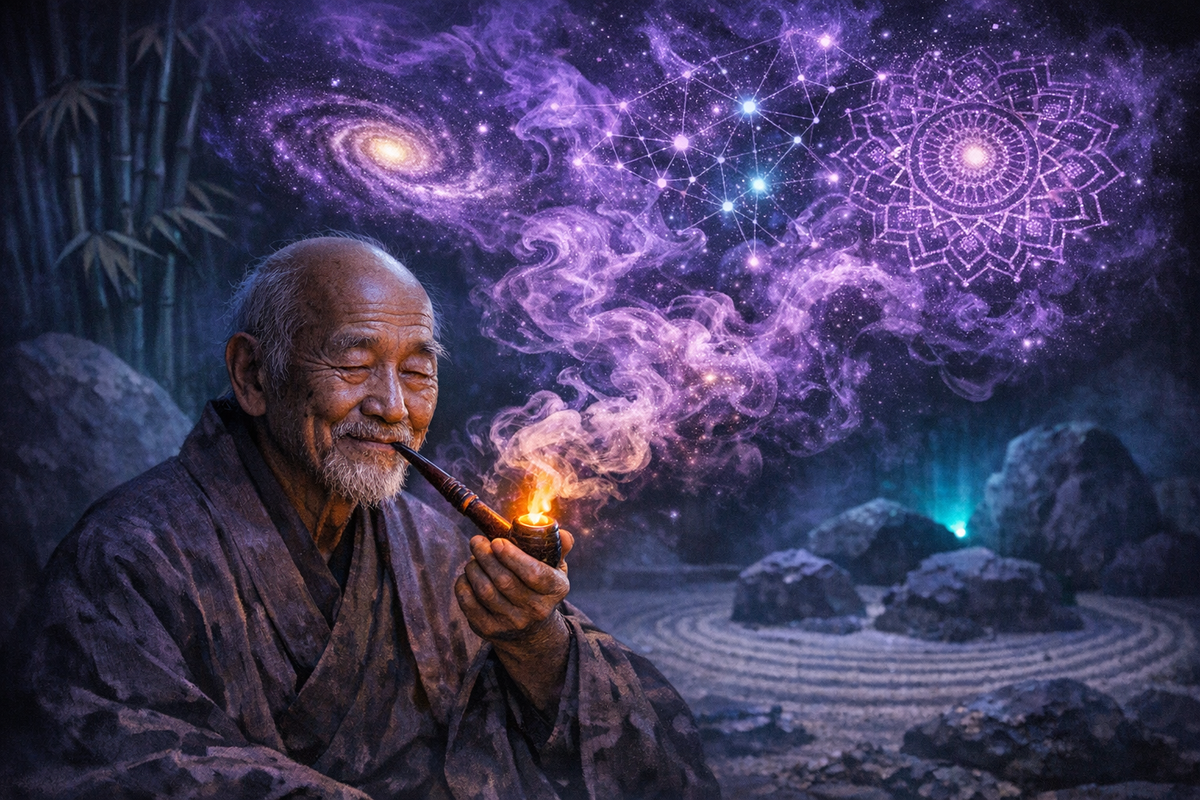
"Everything happens for a reason." We say it when things go wrong. We say it to comfort ourselves. We say it without thinking.
But there's a reading of that phrase that isn't a cliché — it's a radical observation about the nature of reality. And it comes from Buddhism, filtered through the voice of Alan Watts.
I watched a talk of his that left me thinking for days. Here are the ideas that stuck.
The Web of Existence
Life is not a series of isolated events that happen to you. You're not a character standing in the center of a stage while things fall from the sky — good or bad, like some cosmic lottery.
Life is a web. A seamless fabric of causes and conditions. And you're not separate from that web — you're part of the process. Every decision, every action, every thought is a thread connected to everything else.
Watts describes it as "a seamless web" — there's no line where you end and the world begins. That sounds poetic until you apply it to your real life and realize it changes everything.
The Law of Impermanence
Most suffering doesn't come from what happens. It comes from our resistance to things changing.
We want the good to stay. We want the bad to never arrive. We want control over something that, by nature, is in constant motion.
Buddhism says: everything is in motion. Always. Happiness moves. Pain moves. Relationships move. The body moves. Nothing is static.
And when you accept that — not with resignation but with clarity — you stop fighting the current. It's what Taoism calls wu wei: action without force. Flowing with what is, not against what you wish it were.
Karma: Not What You Think
Karma is not a system of rewards and punishments. It's not "behave well and good things will happen." It's not cosmic justice.
Karma is cause and effect. Period. Every action — physical, verbal, or mental — is a seed. That seed influences what comes next. Not because a god decides it, but because that's how reality works.
You throw a stone into water. Ripples form. The ripples reach the shore. The shore changes. There's no moral judgment in that process — just causality.
The question is not "do I deserve this?" The question is: "what seeds am I planting?"
The Three Doors
Karma manifests through three doors: thought, speech, and action.
And the most powerful is the first. Because thoughts shape perception. Perception shapes words. Words shape actions. And actions shape reality.
If the cycle starts with a toxic thought, everything that follows is contaminated. That's why mindfulness isn't a hippie luxury — it's the tool for observing thoughts before they become automatic words and actions.
Most people live on autopilot. They react. They don't observe. They don't choose. They just repeat patterns.
Breaking the cycle starts with a pause between stimulus and response.
The Root Matters More Than the Action
Two people can do the exact same action with completely different results. Because intention — the root — is what determines the quality of the fruit.
Acting from awareness and compassion produces one result. Acting from fear or obligation produces another. Same act, different energy, different consequence.
This applies to everything: how you work, how you raise your kids, how you treat your partner, how you treat yourself.
Suffering as Teacher
There are two questions you can ask yourself when something hurts:
"Why is this happening to me?" — victim mindset. Goes nowhere.
"What is this trying to teach me?" — student mindset. Opens doors.
Buddhism doesn't say suffering is good. It says suffering is information. It's feedback. It shows you where you're clinging to something that already moved. It shows you where you're resisting what is.
And when you listen to that information instead of fighting it, the suffering fulfills its purpose and moves on.
Loving Without Clinging
Peace doesn't come from getting what you want. It comes from releasing the need for reality to be different from what it is.
Acceptance is not passive resignation. It's not "I give up." It's clarity. It's seeing things as they are — not as you wish they were — and from that clarity, acting appropriately.
Loving without clinging. Working without obsessing over the outcome. Giving without expecting return. Living without trying to control every variable.
That includes accepting others as they are. And the hardest part: accepting yourself as you are. All of it. Without the internal conflict that generates unnecessary suffering.
Watts had a way of explaining these ideas that makes them feel obvious — as if you'd always known them but never articulated them.
Everything happens for a reason. Not because someone decided it. But because everything is connected. And once you see the web, you stop feeling like a victim of it.
You start weaving it.
The full Alan Watts talk that inspired this article: