The Mouth That Stayed Shut
My code-built film studio could draw particles, not characters. A kit for lit 3D characters, a craft checklist from the twelve principles of animation, and a shader bug that only a real render could show.
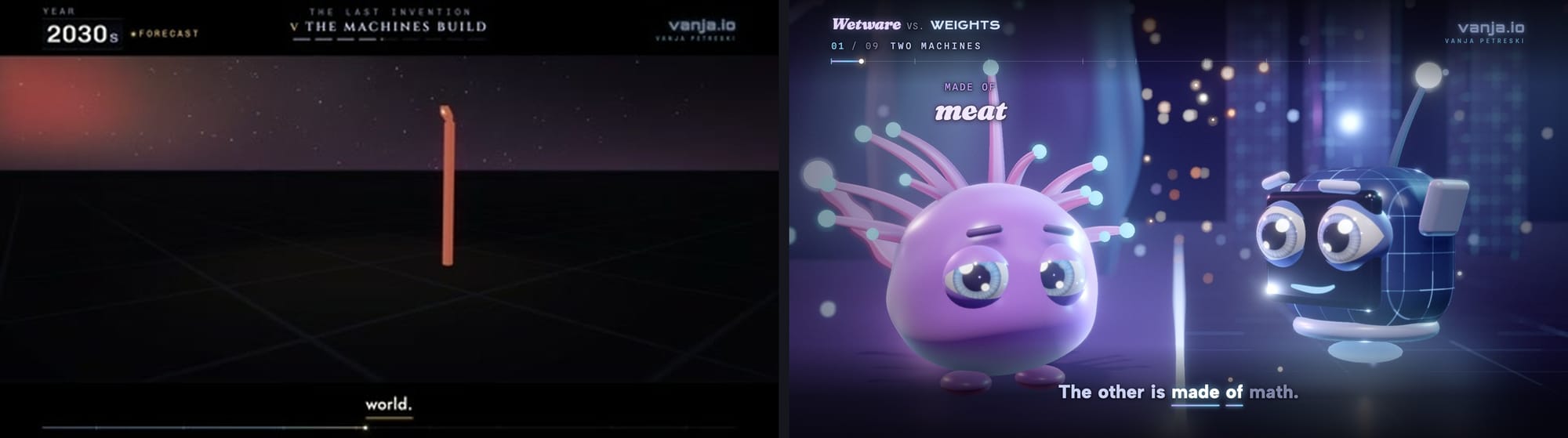
My film studio could already make a narrated explainer and a beat-timed motion film. Every frame is drawn by code an agent writes: React components, three.js, a narration timeline as the clock. What it could not do was make anything you would call a character. The 3D in my earlier films was particles, glowing lines and unlit shaders. It looked like a screensaver with a voice.
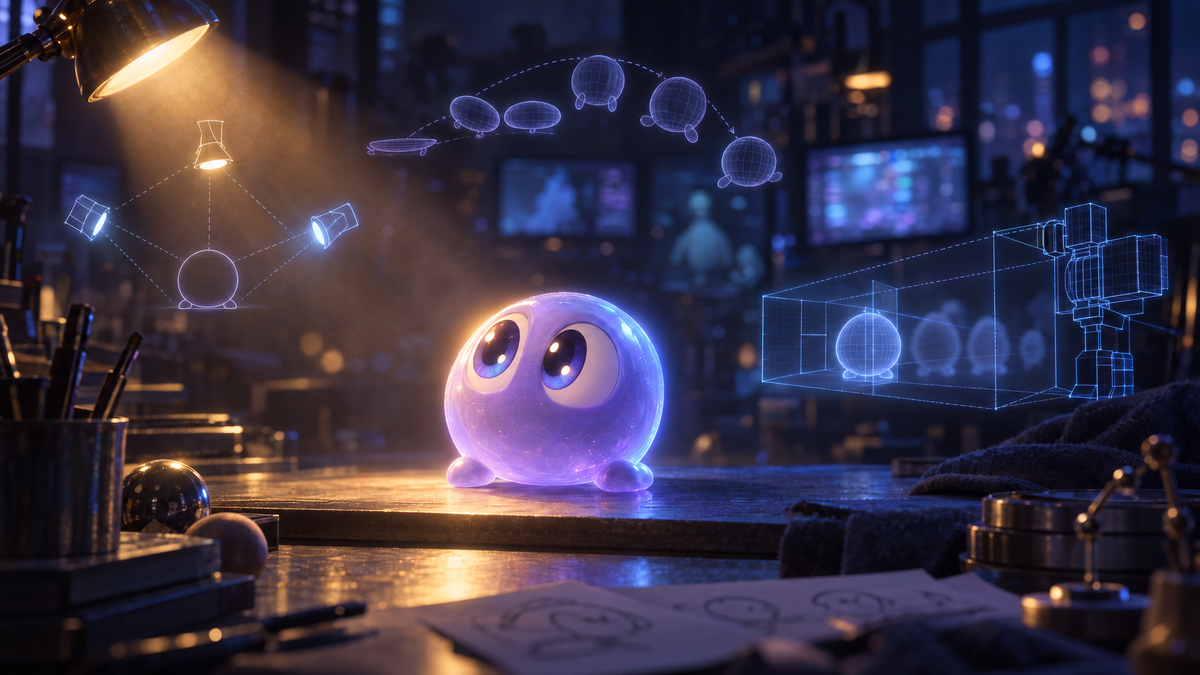
So when I asked for a documentary in "Pixar style" for Wetware vs. Weights, I did not try a better prompt. I had the studio itself upgraded first: a kit for lit 3D characters that blink, look, squash and act, with a physical camera and a proper lighting pipeline. Two agents on Claude Fable 5.2 did the work, one to build the kit and one to make the first film on it. Both ran on the same day.
| 🧭 | Start here: one acting character in your own Remotion project 1. Project. 2. The GPU. Render with 3. The frame is the only clock. Every pose, blink, glance and camera move is a function of 4. One character. A round body, a feature that owns the silhouette (hair, an antenna), and eyes with two catchlights: a big one on the key-light side, a small one low on the other. 5. Three lights, written as data. A warm key 30 to 45 degrees up and to the side, a cool fill at up to half the key, a rim from behind to separate the character from the background. Keep the rig a plain object so the agent changes values, not scenes. 6. No changing values through 7. Stills before motion. Render stills of each set and character and have the agent judge them against a written checklist kept in a file it must read, not in the prompt. Then take the busiest frame from inside a real render and compare it byte for byte with the same frame rendered as a still. |
Why the old 3D could not carry a character
The earlier 3D films drew points and shaded lines with no light model. That is cheap, deterministic and easy for an agent to get right, and it reads as "data" or "space". It can never read as a creature, because a creature needs three things particles do not have: surfaces that catch light, a face that can look at something, and motion with weight.
There was also a quieter problem. On my Mac, Chrome renders WebGL in software by default. Particle scenes are light enough that it did not show. A lit scene with ambient occlusion and depth of field is not. GPU rendering is now a per-film setting that the new template turns on; the global default did not change, so every earlier film renders exactly as before.
What the kit adds
The kit lives inside the same studio, as one module the film's scenes import. It is not a second engine. In plain terms:
- A stage. One canvas per shot, drawn exactly once per video frame by a post-processing chain: an HDR frame with multisampling, ambient occlusion, depth of field from the shot's lens, then one finishing pass with bloom, exposure, a filmic tone curve (AgX by default), grade, vignette and static grain. The environment light is built in code and prefiltered once, so there is no downloaded HDR image.
- Lighting rigs. Four named rigs (studio, cavern, cathedral, night) that return plain data: key, fill, rim, second rim, environment, fog and shadow colour, all from the site's palette. Plus visible lights: practicals, light shafts through haze, floating motes that turn into bokeh.
- Materials. Clay, soft plastic, a "goo" with a subsurface look for skin and jelly, a bioluminescent glow with a bright edge, glass, brushed metal, and a lattice of glowing lines with travelling light.
- Characters. A creature is anything whose pose is a function of the frame. Tendrils, for hair, dendrites, antennae and tails, are spring chains simulated from the pose history, so they trail, overshoot and settle.
- Faces. Two eyes with white, iris, pupil and two catchlights drawn in the eyeball's shader, so the highlights turn with the eye. Lids on a natural blink schedule plus chosen blinks, saccades, a cheated eyeline, brows, seven named expressions, and mouth shapes from the narration's word timing.
- Acting. Helpers for anticipation, action, overshoot and settle on any channel, a hop with squash and stretch that keeps volume, arcs, follow-through and an idle that never loops.
- A camera with a lens. A shot has a focal length in millimetres, an f-stop and a focus distance; depth of field follows. Dolly, push-in, crane, orbit, whip, track, handheld and rack focus are functions too.
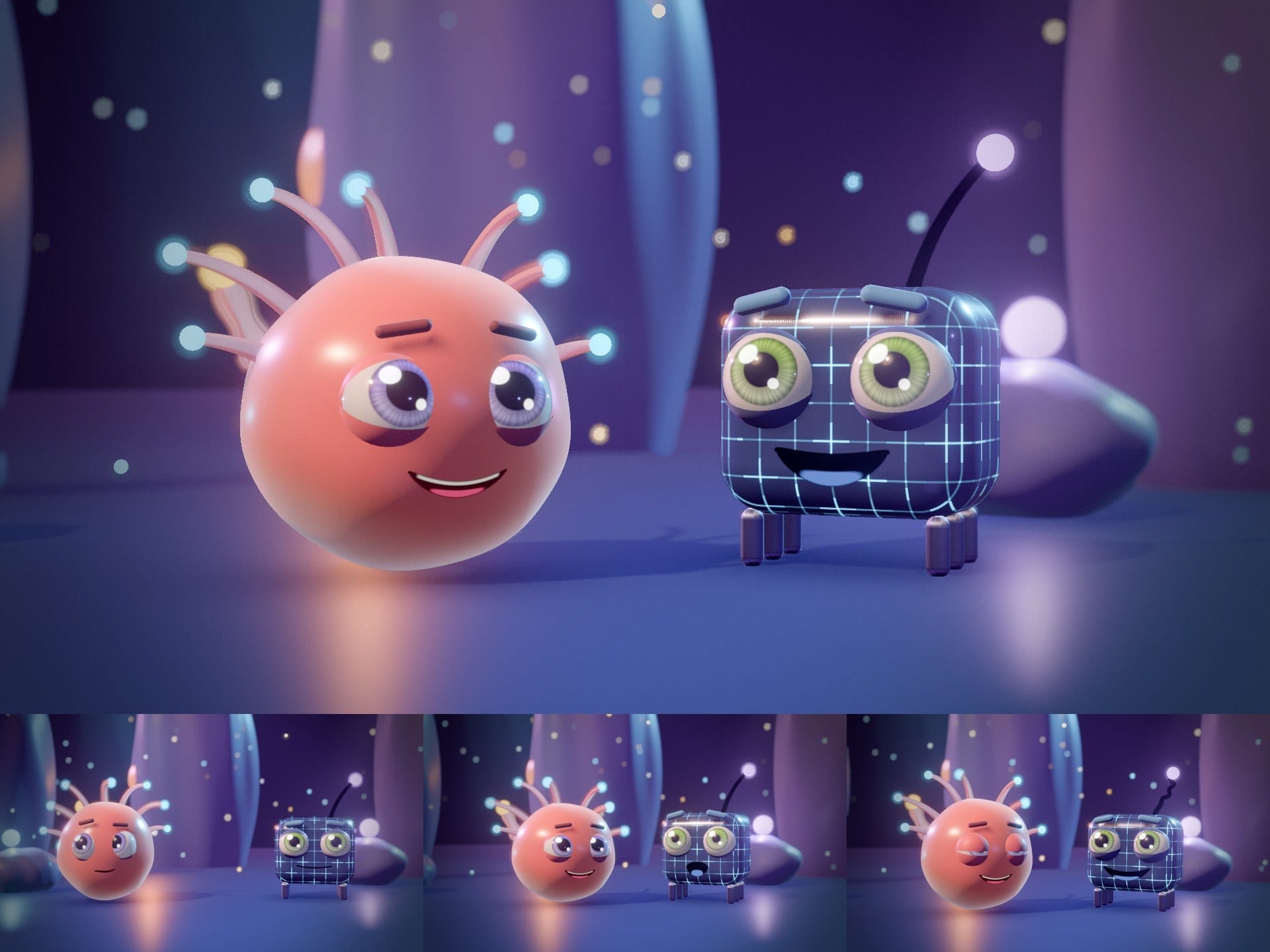
A new film can start from a template that renders a ten-second styleframe right away: two placeholder creatures in a lit set, one acting beat, a blink, a look and a rack focus.
Determinism is the hard part
A film studio that renders in parallel browser tabs has one rule that everything else serves: frame 8,182 must come out the same whether it is rendered alone as a still, or in the middle of a render where another tab happened to draw the frames before it.
Three things in the 3D libraries had to be handled:
- A noise seed from the clock. The ambient-occlusion library seeds its noise from
performance.now(). The stage pins it. - A black frame. The post-processing library's bloom effect drew a black frame on this version of three.js. The kit has its own bloom.
- The mouth that would not open. This one is the reason the check exists. In stills of the starter styleframe, the character's mouth was open. In a full render, it stayed shut. react-three-fiber copies a shader material's uniforms only when the prop object changes identity, so values updated in place never reached the shader. A still is mounted on its own frame, so it always looked right. Only a frame taken from inside a real render showed the bug. The kit now creates its shader materials itself, and the test compares frames rendered as stills with the same frames from inside a three-tab render, byte for byte.
On the kit's styleframe, five frames came out byte-identical both ways. On the first cut of the film, seven frames across the busiest shot and a scene cut were byte-identical. One frame differed by 1/255 in about two pixels, which the build agent attributed to a flat SVG glow drawn over the 3D, not to the kit; that is an inference. On the final cut, five frames of the closing two-shot were byte-identical.
Taste goes in a checklist
An agent will not develop taste by being told to. What it can do is follow a written craft checklist and judge its own stills against it. The studio's rulebook now carries one, built from the twelve principles of animation in Thomas and Johnston's "The Illusion of Life" (via Wikipedia's summary; the book itself was not read for this) and the basics of three-point lighting, plus rules of thumb from making the styleframes:
- Appeal and shape. Two or three rounded masses, one feature that owns the silhouette, big eyes set low and wide, no perfect symmetry.
- Squash and stretch, anticipation, follow-through. Squash on contact, stretch at speed, never both at rest. The crouch before the hop. Eyes lead, then the head, then the body, then the trailing parts.
- Staging. One idea per shot. The pose must read as a black silhouette. Two characters side by side get a cheated eyeline, or both turn to profile and the eyes are lost.
- Eyes. Two catchlights. The upper lid touches the iris at rest. Eyes turn at most about 25 degrees before the head turns. Blink on head turns and changes of thought.
- Light. Warm key against cool fill and rim, tinted shadows, never black. The characters are the brightest, most saturated thing in the frame.
- Lens. 35 to 50 mm for a two-shot, 85 mm for a close-up, f/2.8 to f/4 to keep two characters sharp, and rack focus on the story beat, not before it.
The kit's starter went through four art passes against that checklist, with stills read at full size. They fixed, besides the bloom and mouth bugs above:
- a ground washed in the shadow colour with no contact shadows
- a flat pastel image (too much fill, a saturated key)
- faces in profile and a side-eye
- beige eye whites
- a zigzag antenna
Then an independent review of the code found a callback registered after the draw it was supposed to precede, camera roll that only worked looking down one axis, and eyes that aimed from the creature's centre instead of its head. All fixed before landing.
The first film
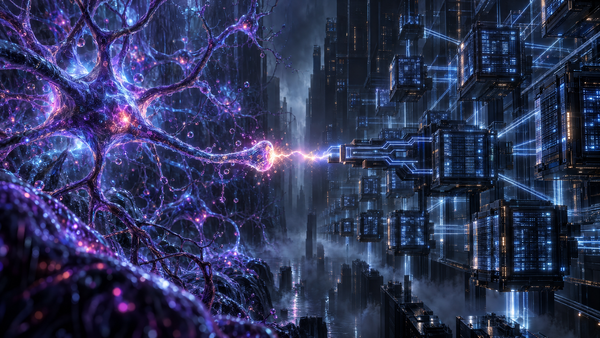
Wetware vs. Weights explains the brain and large language models side by side. Two wordless characters act it like a silent short while the narrator explains. Spike is a bioluminescent neuron with dendrite hair and an axon tail. Token is a small machine of glowing weight lattice with an attention antenna. They live in a split world, wet and organic on the left, dry silicon on the right, with a living seam between them.
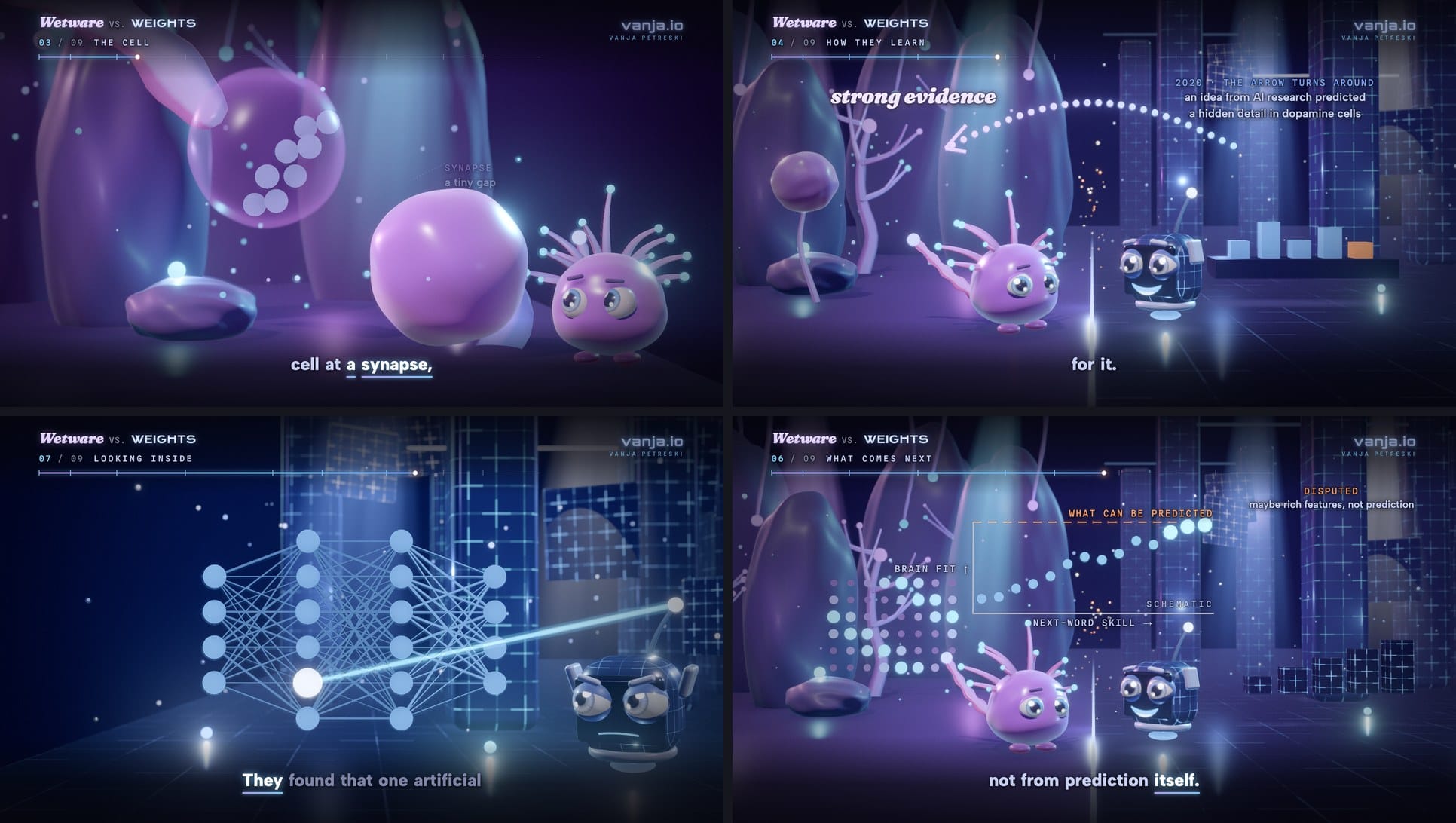
The numbers, all from one Apple M4 Max:
Where it falls short
It is a real-time rasterised picture with the grammar of a feature-animation frame, not a path-traced one. There is no bounced light. Only one key light casts shadows. The subsurface look on skin is a fresnel approximation, not real scattering. Judge it as a stylised cousin of a feature frame.
Some parts are not proven yet. Sixty frames per second, a cut between two separate stages, the glass and soft-plastic materials and speech mouth shapes are not covered by the kit's own test yet. And the build agent judged the film from stills, sampled contact sheets and QA sheets. It did not watch its own film in motion or listen to it. I read full-resolution stills of every chapter and checked every on-screen number against the film's facts table, and the independent review of the Wetware vs. Weights article then caught narration lines that stated my opinions as facts. Those were fixed in the film before it shipped.
What I take from it
This section is my opinion.
The prompt was not the bottleneck here. "Make it look like a feature film" gives a model little it can act on. What moved the result was turning taste into things that can be checked: a lighting rig with numbers, a lens with an f-stop, a rule that eyes turn at most about 25 degrees before the head follows, a styleframe that must be read before anything moves, and a test that compares a frame with itself.
That is the same pattern I keep finding in agent work. The checklist, the review loop and the tests are where the judgment lives, and they are the part you have to build yourself. They are also what the next film inherits: a rule edited or a test added today carries into every later film.
The weak spot is just as clear. The loop is only as good as what it looks at, and this one looked at stills. The next useful step is a review that watches the film move.