Wetware vs. Weights
One runs on 20 watts and never stops learning. The other trains once on trillions of tokens, then freezes. How the brain and an LLM really work, side by side, from ELI5 to the frontier, and what nobody understands yet.
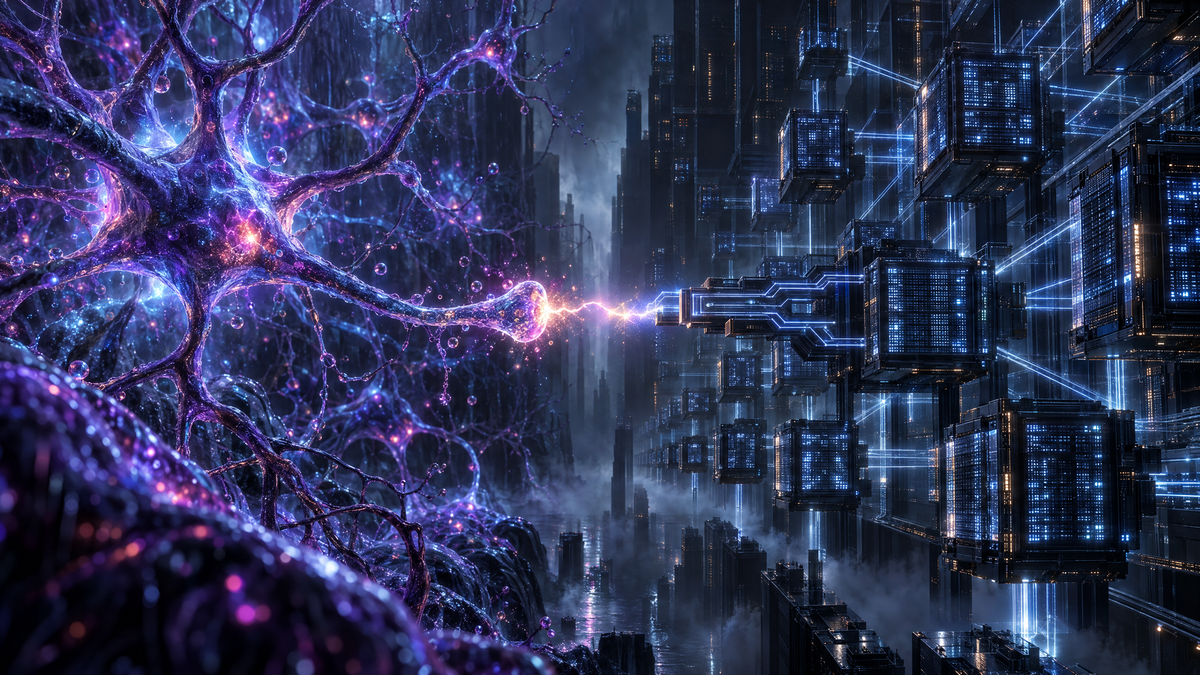
Somewhere behind your eyes, a cell just fired. Two thousandths of a second of voltage, a pulse of salt water racing down a fibre thinner than a hair. Other cells felt it, or didn't; the brain runs on maybes.
In a data centre somewhere, a chip just did something like a quadrillion arithmetic operations. A data-centre GPU is rated for roughly that many per second (NVIDIA's figure), and it will keep going until somebody pulls the plug or the model finishes its sentence.
Both are called neural networks. Both learn, predict, and store what they know in the strength of their connections, not in any one place you could point to. And neither one is fully understood by the people who study it. One of them was built by evolution. The other took, by my count, about eighty years of research and a growing share of the world's data-centre electricity.
This is a field guide to both, side by side. It starts at the level of a five-year-old and climbs to the open problems researchers are working on this year. Every result is linked to its source. Where the evidence is disputed, I say so.
The brain, for a five-year-old
| 🧠 | Your brain is a city of tiny cells called neurons. There are about 86 billion of them. Each one listens to its neighbours through little branches. When it hears enough, it fires a tiny electric spark down a long wire and passes the message on. When two cells talk to each other a lot, the connection between them gets stronger. That is how you learn: not by adding new files, but by changing which roads in the city are wide and which are narrow. |
An LLM, for a five-year-old
| 🤖 | A large language model is a giant pile of numbers. Each number says how much one signal should matter to the next. To train it, you show it a piece of text with the next word hidden, and it guesses. Usually it guesses wrong. So you nudge every number a tiny bit, so that next time the guess is a little less wrong. Then you do it again, over trillions of words. When you are done, the numbers stop changing, and the model is just very, very good at guessing what comes next. |
Both stories end in the same place. Knowledge lives in the connections. The brain changes its connections. The model changes its numbers. Almost everything else is different.
One screen: brain vs. LLM
Level 1: the cell and the number (high school)
The neuron
A neuron is a cell with a strange shape. Branches called dendrites collect signals from other cells; in the first nanoscale map of human cortex, each neuron had thousands of weak connections. The signals change the voltage across the cell's membrane. At rest it sits around −70 millivolts. If enough input pushes it up to a threshold, around −55 millivolts, voltage-gated sodium channels snap open and the cell fires an action potential: the voltage spikes to about +30 millivolts and falls back, all within roughly two milliseconds. The spike is all or nothing. A stronger input does not make a bigger spike.
The spike runs down the axon, a cable that can be very long. Thin, bare axons carry it at about walking speed, around 1 metre per second. Thick axons wrapped in insulating myelin carry it at more than 100 metres per second. Hodgkin and Huxley worked out the mathematics of the spike in 1952, from the squid's giant axon, and shared a Nobel Prize for it in 1963. Mammalian brain cells turned out to be more complicated than the squid's axon: the squid's spike uses two kinds of voltage-dependent channel, while mammalian central neurons typically carry more than a dozen.
The synapse
At the end of the axon is a synapse, a tiny gap between one cell and the next. The spike does not jump it. Calcium rushes into the terminal, and small bubbles called vesicles fuse with the membrane and spill neurotransmitter molecules into the gap. They drift across and bind to receptors on the other side. Some transmitters push the next cell toward firing. Others, like GABA, open chloride channels and push it away. At a fast central synapse at body temperature, the response starts about 150 microseconds after the incoming spike begins.
Here is the first big surprise for anyone who thinks a synapse is a reliable wire. At individual contacts on hippocampal neurons, more than half of the arriving spikes fail to produce any response. Release is a coin flip, and each terminal tunes its own odds. The brain computes with unreliable parts, on purpose or by necessity; nobody is fully sure which.
The artificial neuron
In 1943, McCulloch and Pitts noticed that if spikes are all or none, then "neural events and the relations among them can be treated by means of propositional logic." Their model neuron took a weighted sum of binary inputs and produced a binary output. Frank Rosenblatt's perceptron followed in 1958. Every neural network since is a descendant of those ideas.
A modern artificial neuron multiplies each input by a weight, adds the results and a bias, and passes the sum through a simple nonlinear rule. A popular rule is ReLU: if the sum is negative, output zero; otherwise, pass it through. The feed-forward layer of the original 2017 transformer is max(0, xW₁ + b₁)W₂ + b₂. A layer is a bank of these units reading the same input. Stack enough layers and you get a deep network; residual connections let researchers train image networks 152 layers deep in 2015. The weights and biases are the model's parameters. GPT-3 had 175 billion of them. Open models of about a trillion now exist; OpenAI stopped disclosing model size.
The 2024 Nobel Prize in Physics, awarded to John Hopfield and Geoffrey Hinton, describes the analogy in one sentence: nodes influence each other "through connections that can be likened to synapses and which can be made stronger or weaker." Note the word likened.
Why a synapse is not a parameter
The tempting comparison goes like this: about 1.5 × 10¹⁴ synapses in the neocortex alone, about 10¹² parameters in the largest open models, so the brain is "a hundred times bigger." That arithmetic hides two things.
First, a synapse is a dynamic, probabilistic chemical machine, not a stored number. Second, the neuron it feeds is not a simple summing unit. In 2021, Beniaguev, Segev and London tried to teach a deep network to reproduce what a detailed model of one cortical pyramidal neuron does with its inputs, millisecond by millisecond. They needed a temporal convolutional network with five to eight layers. Remove one kind of receptor (NMDA) from the model neuron, and one hidden layer was enough.
A year earlier, Gidon and colleagues recorded from human cortical tissue removed during surgery and found dendrites that fire a graded kind of calcium spike. Those dendrites let a single human neuron classify inputs that are not linearly separable, the XOR problem. XOR is the textbook example of what a single artificial neuron cannot do; it is the limitation Marvin Minsky and Seymour Papert's 1969 book made famous, which the Nobel Committee credits with a funding hiatus for neural networks.
A 2026 preprint from Beniaguev, Segev, London and colleagues, not yet peer-reviewed, reports a detailed neuron model classifying images and audio and solving 10-bit parity. Treat it as a lead, not a result.
My reading of these results: one real neuron is closer to a small network than to one of its units. The fair comparison is not synapses to parameters.
Three myths, while we are here
- "100 billion neurons." The measured figure is 86.1 ± 8.1 billion. The authors note the "widespread quotes" of 100 billion while the real number "remains unknown."
- "Ten times more glia than neurons." The ratio is about one to one; histology "always supported" it.
- "We only use 10% of our brain." We use all of it. What is true is that only a small fraction of neurons fire at any one moment, for reasons of cost (Level 4).
Also worth knowing: the cortex is 82% of the brain's mass but holds only 19% of its neurons. About 69 billion of the 86 billion sit in the cerebellum.
Level 2: how they learn (undergraduate)
Hebb, LTP and timing
In 1949, the psychologist Donald Hebb wrote down an idea that still anchors the field: "When an axon of cell A is near enough to excite a cell B and repeatedly or persistently takes part in firing it, some growth process or metabolic change takes place in one or both cells such that A's efficiency, as one of the cells firing B, is increased." The six-word version, "cells that fire together, wire together," is a later summary, not his wording.
In 1973, Bliss and Lømo found the physical effect. A short burst of high-frequency stimulation made a pathway in the rabbit hippocampus respond more strongly, for periods from 30 minutes to 10 hours. Long-term potentiation, LTP, became a central candidate for how memories are stored.
Then timing turned out to matter. In cultured hippocampal neurons, Bi and Poo found that if the receiving cell fires within about 20 milliseconds after its input, the synapse strengthens; within 20 milliseconds before, it weakens. Markram and colleagues had reported the same principle in cortex the year before. Spike-timing-dependent plasticity rewards causation: strengthen the inputs that predicted its firing, weaken the ones that came too late.
Every one of these rules is local. A synapse changes based on what happens at that synapse.
Backpropagation
Machines learn with one global rule. The model makes a prediction. A loss function measures how wrong it is; for a language model, it is cross-entropy on the next token. Then the chain rule of calculus computes, for every single weight, how much a small change in that weight would change the loss. Each weight moves a little downhill. Repeat.
Rumelhart, Hinton and Williams showed in 1986 that this procedure, backpropagation, makes hidden units "come to represent important features of the task domain." They did not invent it; the Nobel Committee notes they "reinvented a scheme for this, which had previously been applied to related problems by others." What they showed was that it works for networks with hidden layers, which is everything since.
Picture a ball rolling downhill on a landscape with hundreds of billions of dimensions.
The credit assignment problem
Here is the problem. Backpropagation needs every connection to receive a precise error signal from the output, carried backwards through exact copies of the forward weights. Lillicrap and colleagues describe that requirement as "a precise, symmetric backward connectivity pattern, which is thought to be impossible in the brain." Hinton himself wrote in 2022 that "there is no convincing evidence that cortex explicitly propagates error derivatives or stores neural activities for use in a subsequent backward pass."
So how does a synapse deep in your head know it contributed to a mistake you made a second later? This is the credit assignment problem, and it is open. Candidate answers:
- Random feedback works surprisingly well. Lillicrap's group found that multiplying errors by random fixed backward weights "performs as effectively as backpropagation on a variety of tasks".
- Feedback may encode errors as differences. A 2020 review argues that cortical feedback may "induce neural activities whose differences can be used to locally approximate these signals."
- Predictive coding can converge to backprop. Networks that only use local, Hebbian-style updates while minimising prediction errors can, for certain parameters, match backprop's weight changes.
- Two forward passes. Hinton's Forward-Forward algorithm replaces the backward pass with one positive and one negative forward pass; he describes it as working "well enough on a few small problems to be worth further investigation."
None of these is established as what the brain does.
Dopamine: where the equations met
The cleanest bridge between brains and learning machines is a chemical. In 1997, Schultz, Dayan and Montague showed that dopamine neurons in primates signal "changes or errors in the predictions of future salient and rewarding events." Not the reward. The surprise.
That is the error signal of temporal-difference learning, an algorithm Sutton published in 1988, which learns from "the difference between temporally successive predictions." Recordings from biology matched an equation computer science already had.
Then the arrow reversed. AI researchers developed distributional reinforcement learning, which learns the whole spread of possible rewards instead of the average. In 2020, Dabney and colleagues tested whether dopamine neurons do the same, and found that the brain appears to represent future rewards "not as a single mean, but instead as a probability distribution." An AI idea predicted a property of the brain, and the recordings gave "strong evidence" for it.
Never stops vs. frozen
Your brain never stops learning. Even its wiring is temporary: in the adult mouse hippocampus, dendritic spines have a mean lifetime of about one to two weeks, "a near full erasure of the synaptic connectivity pattern" within weeks. In the human prefrontal cortex, pruning of spines continues through the third decade of life.
A deployed language model is frozen. GPT-3's few-shot results came "without any gradient updates or fine-tuning"; what looks like learning inside a conversation happens in activations computed over the context, and disappears with the context. Talking to a model does not change its weights.
And if you do keep training a network on new tasks, it tends to forget the old ones, abruptly. That is catastrophic forgetting, first described (as "catastrophic interference") by McCloskey and Cohen in 1989. The leading theory of how the brain avoids it is two learning systems: a fast hippocampus that stores new episodes, and a slow neocortex that absorbs them gradually as the hippocampus replays them, interleaved with old memories. That replay is real: hippocampal cells that fired together while an animal explored show an increased tendency to fire together again during sleep.
AI borrowed from this too. DeepMind's Atari-playing DQN used experience replay, described in its Nature paper as "a biologically inspired mechanism" after hippocampal replay. Elastic Weight Consolidation protects important weights with "an algorithm analogous to synaptic consolidation."
Level 3: how they see, and how they predict (graduate)
The visual hierarchy
In 1959, David Hubel and Torsten Wiesel published recordings of single cells in the visual cortex of cats. The Nobel press release of 1981 describes the result with a beautiful metaphor: some cells "read the simple letters in the message and compile them into syllables that are subsequently read by other cells, which, in turn, compile the syllables into words." Lines and edges first, then combinations, then objects. The primate visual system turned out to be a deep hierarchy: 32 visual areas, 305 connections, 10 levels of cortical processing, most of them wired in both directions.
In 1980, Kunihiko Fukushima built a network on that idea, the Neocognitron, which after training had "a structure similar to the hierarchy model of the visual nervous system proposed by Hubel and Wiesel." Yann LeCun's convolutional networks followed, and LeCun, Bengio and Hinton later wrote that ConvNet layers are "directly inspired by the classic notions of simple cells and complex cells." In 2012, AlexNet won the ImageNet competition with a top-5 error of 15.3%, against 26.2% for the runner-up, and the deep-learning era took off.
In 2014, Yamins, DiCarlo and colleagues trained networks only to recognise objects, never on brain data, and found that the network's top layer was "highly predictive of IT spiking responses" in the monkey's inferior temporal cortex, and its middle layers predicted area V4.
Inside a transformer
A language model reads tokens: word pieces from a fixed vocabulary, built with a compression algorithm repurposed for text. Llama 3 uses 128,000 of them. Each token becomes an embedding, a long vector of numbers: 12,288 numbers per token in GPT-3. The vector for each position flows up through the layers in a running sum interpretability researchers call the residual stream.
Each layer does two things. Attention lets every token look at every earlier token and decide what matters, by comparing a query against keys and taking a weighted average of values: softmax(QKᵀ/√dₖ)V. Then an MLP, the feed-forward block from Level 1, transforms each position on its own. At the end, the model gives a probability to every token in the vocabulary, and one is sampled. That's the whole loop, run once per token.
Scale did the rest. Loss falls as a smooth power law in parameters, data and compute. Chinchilla showed that "for every doubling of model size the number of training tokens should also be doubled" (the famous "20 tokens per parameter" is a rule of thumb read off its tables, not a sentence in the paper). Llama 3's largest model has 405 billion parameters trained on 15.6 trillion tokens.
The prediction machine
An influential school of neuroscience treats the brain as, at bottom, a prediction machine. In Rao and Ballard's 1999 model of visual cortex, feedback connections carry predictions and feedforward connections carry the residual errors. Friston generalised this into the free-energy principle, which he titled as a question: "a unified brain theory?" The evidence is still argued over; a 2020 review notes these models are "criticized for lacking the empirical support to justify their status."
In 2021, Schrimpf, Fedorenko and colleagues tested many language models against recordings of human brains processing sentences. The best transformers predicted "nearly 100% of explainable variance in neural responses to sentences," and how well a model fit the brain tracked its skill at next-word prediction, "but not other language tasks."
Other labs found the same shape. Caucheteux and King, recording 102 people, found that model-brain similarity "primarily depends on their ability to predict words from context." Goldstein and colleagues recorded with electrodes placed directly on the brains of nine people listening to a podcast and found three shared principles: brain and model both predict the next word before it arrives, measure their surprise after it lands, and represent words by their context. Caucheteux, Gramfort and King found that the brain goes further than the model: it seems to predict "a hierarchy of representations that spans multiple timescales," with frontal and parietal areas forecasting further ahead than temporal ones.
Then models started choosing the stimuli. In 2024, a GPT-based model chose new sentences predicted to drive or quiet the human language network. In new volunteers, those sentences did exactly that: they "strongly drive and suppress the activity of human language areas."
Two cautions. Antonello and Huth argue the fit may come from rich features, not from prediction itself: within a model, the representations best at predicting future words are "strictly worse brain models than other representations." And brain fit saturates early: models trained on about 100 million words already reach near-maximal fit, an amount the authors compare to a child's first ten years of input. Prediction is clearly part of the overlap. Whether it is the cause is still open.
Attention has a cousin in memory
The transformer was built without the brain in mind. It turned out to have a relative in one of the oldest memory models in the field anyway. In 2020, Ramsauer, Hochreiter and colleagues showed that the update rule of a modern Hopfield network, a descendant of the associative memory John Hopfield described in 1982, "is equivalent to the attention mechanism used in transformers." Attention is a memory lookup: give it a partial cue, and it retrieves the stored pattern that best matches.
The hippocampus shows up here too. Whittington, Warren and Behrens showed that transformers with a particular kind of position encoding "replicate the precisely tuned spatial representations of the hippocampal formation; most notably place and grid cells", the brain's inner GPS, whose discovery won the 2014 Nobel Prize. They are careful to say the link is mathematical, not proof that the brain is a transformer. Grid-like cells also appeared in recurrent networks trained to navigate, and Schaeffer, Khona and Fiete answered that such results "may be more strongly driven by particular, non-fundamental, and post-hoc implementation choices than fundamental truths about neural circuits." Several of these convergence claims have a published counter-claim.
Level 4: the frontier (PhD)
Opening the black boxes
Until recently, both systems were black boxes. Both are being opened now, with similar aims: map the wiring, then trace what it does.
Connectomics maps the physical wiring. In 2024, the FlyWire consortium published the complete wiring diagram of an adult fruit fly brain: 139,255 neurons and about 50 million synapses, after roughly 33 person-years of human proofreading. The same year, a team including Google researchers and Lichtman's lab reconstructed one cubic millimetre of human cortex removed during surgery: about 57,000 cells and 150 million synapses, 1.4 petabytes of data, 326 days of imaging. In 2025, the MICrONS project published about a cubic millimetre of mouse visual cortex with more than 200,000 cells and 0.5 billion synapses, aligned with recordings of about 75,000 neurons taken while the awake mouse viewed natural and synthetic stimuli.
Mechanistic interpretability does the same for models, and it describes itself in biological terms. Olah and colleagues' 2020 "Zoom In" asked what would happen "if we instead take an approach inspired by neuroscience or cellular biology — an approach of zooming in?" Anthropic's 2025 paper is titled "On the Biology of a Large Language Model" and compares its output to neuroscientists' "wiring diagram."
What they found:
- Superposition. Networks store more features than they have neurons, overlapping them like many radio stations on few frequencies. One neuron, many unrelated meanings.
- Features, pulled apart. In 2023, sparse autoencoders pulled a small layer apart into interpretable features: "Just 512 neurons can represent tens of thousands of features." In 2024 the same methods built a dictionary of about 34 million features in Claude 3 Sonnet, many of them multilingual and multimodal. The authors think they are still "orders of magnitude short" of the full set.
- Golden Gate. One feature responded to the Golden Gate Bridge. Clamped to ten times its maximum, the model started to self-identify as the bridge; in a version Anthropic released for people to try, replies to most queries mentioned it. It is hard not to think of Penfield's 1950s brain-stimulation experiments, which sometimes evoked memories in patients, though mostly vague ones. That comparison is mine, not Anthropic's.
- Planning and reasoning. Asked for a rhyming couplet, Claude 3.5 Haiku activates "rabbit" and "habit" before writing the second line; suppress "rabbit" and it rewrites toward "habit." It also represents "Texas" internally on the way from "Dallas" to "Austin."
- Confabulation. It adds 36 + 59 through parallel approximate and exact-digit paths, but when asked how, it describes the school method of carrying the 1. Anthropic suggests this "may reflect" that the model learned to explain math by imitating human explanations, while learning to do it differently "in its head."
- Concept neurons. In 2005, Quian Quiroga and colleagues found human neurons that fire for one person across very different pictures, even the written name. In 2021, OpenAI found similar multimodal neurons in CLIP and compared them directly, while warning not to overinterpret them.
Two limits. The attribution-graph method gives "satisfying insight for about a quarter of the prompts" its authors tried. And in Anthropic's introspection experiments, Claude Opus 4.1 noticed a concept injected into its own activations only about 20% of the time.
Separately, in July 2026, Anthropic reported a small set of reportable internal representations in Claude that it compares to a "global workspace", a theory from neuroscience; that is one lab's research, not yet independently replicated.
In a model, every weight is visible and exact, and meaning is still hard to read. In a brain, even the wiring is hard to see.
The energy bill
The brain runs on about 20 watts, roughly 20% of the body's oxygen and calories from about 2% of its mass. Cortical grey matter uses around 3 of those watts, and communication costs about 35 times more power than computation.
Spikes are the expensive part. Lennie estimated that their cost limits, "possibly to fewer than 1%," the share of cortical neurons that can be strongly active at once. Attwell and Laughlin's energy budget points the same way: it favours codes with 15% or fewer of neurons active.
A data-centre GPU can draw up to 700 W (NVIDIA's figure). Meta trained Llama 3's 405-billion-parameter model on up to 16,000 of them. By my arithmetic that is about 11 megawatts for the GPUs alone, the power budget of roughly half a million brains. All data centres together used about 415 TWh in 2024, around 1.5% of the world's electricity, with AI the biggest driver of growth (IEA). Per query it is small: Google puts its median Gemini text prompt at 0.24 Wh (Google's figure).
Dense models multiply almost every weight for every token. Mixture-of-experts models are sparser: DeepSeek-V3 activates 37 billion of its 671 billion parameters per token, about 5.5% by my arithmetic. I'd call that a loose echo of sparse firing, not a copy of it.
Brain-inspired hardware exists. Intel's Hala Point packs 1.15 billion artificial neurons into a system that draws up to 2,600 W (Intel's figures). IBM's NorthPole chip, which removes off-chip memory, reports 25 times better frames per second per watt than a comparable GPU on one image benchmark (IBM's own paper). Spiking networks are hard to train with gradients, because a spike's all-or-nothing step has zero derivative almost everywhere; researchers use smooth "surrogate" gradients to get around it.
The data bill
A child hears about 2 to 7 million words a year, so, by the challenge organisers' arithmetic, 24 to 84 million by age twelve. Llama 3 trained on 15.6 trillion tokens. Frank puts the gap at "four or five orders of magnitude" and lists the usual suspects for children's efficiency: prior knowledge, grounding in the senses, and learning through social interaction.
Where the machines learned from the brain, and where they didn't
Brain-inspired: the artificial neuron, convolution and pooling, experience replay, synaptic consolidation. Converged from both sides: the temporal-difference error and dopamine. Not brain-inspired: dropout, whose authors motivate it with the role of sex in evolution (genes, not neurons). Found later to resemble the brain: attention as Hopfield memory, transformers and grid cells.
No brain analogue, according to the researchers quoted above: exact symmetric backward weights and a separate stored backward pass. No analogue I know of: a global clock that computes every layer in lock-step, and weights that freeze after training.
What nobody knows
- Credit assignment. How the brain gets error information to the right synapses is still open.
- Memory. Patient H.M. lost the ability to form new long-term memories after surgery in 1953, which established memory as "a distinct cerebral function". Decades later, researchers are "beginning to define" the engram, the physical trace of a memory.
- Recognition. Even for object recognition, the brain's algorithm "remains poorly understood."
- Models. Interpretability tools still explain only a fraction of what models do (Level 4).
- Consciousness. In 2015, Adolphs wrote that there is "so little agreement" on theories of consciousness. In 2025, a preregistered adversarial test of two major theories, integrated information theory and global neuronal workspace theory, produced results that challenged key tenets of both. On the machine side, a 2023 report by Butlin, Long and colleagues wrote that its analysis "suggests that no current AI systems are conscious, but also suggests that there are no obvious technical barriers" to building systems that meet their indicators.
Where I land
This is my opinion, not a finding.
The brain and the transformer are not the same machine. The hardware could hardly be more different: wet, slow, noisy, sparse and always learning on one side; dry, fast, exact, dense and frozen on the other.
What overlaps is the problem, and that overlap keeps producing similar answers. Train a network to see, and it grows something that predicts the visual cortex. Train one to predict the next word, and it grows something that predicts the language network. Build attention, and it turns out to match a classic model of memory. I don't read that as evidence that brains are transformers. I read it as evidence that similar problems, under similar constraints, push both systems toward similar solutions.
What I find most interesting is that ideas now flow both ways. AI borrowed the neuron, the hierarchy and replay from neuroscience. Now an AI idea predicted a property of dopamine neurons, a language model picks sentences that drive human cortex, and interpretability researchers are running biology experiments on silicon.