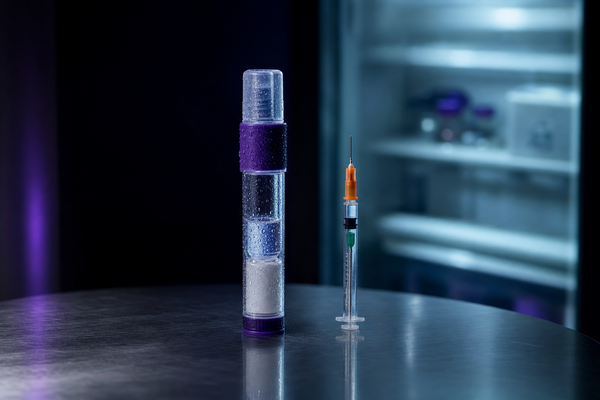
Final NAD+ Adjustment
The NAD+ protocol moves to 100mg Wed-Sun AM: same 500mg weekly exposure, 60% lower per-session peak, cleaner timing, simpler hardware, and a monitoring window to prove it.

The Move
The NAD+ protocol is getting its final adjustment.
The original schedule was 500mg once weekly. On May 3, it moved to 250mg twice weekly: Tuesday and Friday. That was RELOCK 2. It reduced the weekly spike, but the rush still showed up hard enough to expose the real variable.
Not total weekly dose.
Peak.
So the definitive version is now 100mg daily, five times a week, always in the morning. Same weekly AUC: 500mg. Per-session Cmax cut by 60%. Working hypothesis: 70-90% reduction in flush probability and severity.
This is a prescribed, monitored protocol — a working log, not a recommendation.
New Weekly Plan
The five NAD+ days are Wednesday through Sunday. Monday and Tuesday stay NAD+-free.
Total: 25 sticks per week, up from 22.
Monday already carries Retatrutide, Testosterone, BPC-157, and TB-500. Tuesday already carries HCG plus the start of the CJC/Ipamorelin cycle. Adding NAD+ to those two days pushed them to five sticks each. Moving NAD+ to Wednesday through Sunday keeps the two heaviest days at four sticks and uses the lighter weekend slots that were sitting empty.
Same weekly NAD+ exposure. Lower early-week load. Better adherence.
Why 100mg Daily Replaces 250mg Twice Weekly
The flush is rate and dose dependent.
The useful model is niacin-flush biology: GPR109A/HCA2 signaling, COX activity, and PGD2/PGE2 prostaglandin release. The Journal of Clinical Investigation has mapped this pathway clearly in the niacin literature — GPR109A activation drives flushing through prostaglandin signaling, especially PGD2 and PGE2. NAD+ is not identical to niacin, but the practical signal is close enough for protocol design: lower peak, slower push, less vasodilatory response.
The old split protocol gave 250mg per session. The new version gives 100mg.
That is a 60% cut in per-session Cmax before even counting the slower push. The push rule stays locked at 2-3 minutes minimum, so the rate also drops. Lower dose, lower flow, lower peak. That is the whole point.
The second reason is methylation.
NAD+ moves through nicotinamide metabolism. NAD+ becomes NAM. NAM can be methylated through NNMT using SAMe, producing methyl-nicotinamide. Bigger peak means bigger acute SAMe draw. Bigger SAMe draw means a bigger next-day tail.
The weekly methylation demand is still there. Five hundred milligrams per week is still five hundred milligrams per week. But the stress curve is different. Instead of two sharp withdrawals from the methylation bank, the protocol moves to five smaller debits.
Because this sits alongside an already prescribed protocol and ongoing training and keto pressure, that matters. The goal is to preserve the signal without paying for a peak the cells cannot use.
Effectiveness Should Hold
The obvious objection: does dropping from 250mg to 100mg make the dose too small?
Not necessarily.
Cellular NAD+ is tightly regulated. Hara et al. 2019 in PLOS ONE showed that mammalian cells maintain NAD+ concentration within a narrow range and that synthesis and breakdown are tightly linked. You do not just pour NAD+ into the system and get infinite useful uptake. The enzymes gate the pool.
That makes the 250mg bolus suspicious. Not useless. Just probably beyond the clean uptake window.
Grant et al. 2019 in Frontiers in Aging Neuroscience looked at a 750mg IV NAD+ infusion over six hours and showed metabolite overflow, including urinary NAD+ and methyl-nicotinamide. Different route, different dose, different context, but the lesson is relevant: high exposure does not mean all material becomes useful intracellular NAD+. Some of it becomes metabolic exhaust.
The daily 100mg model respects that.
It keeps the weekly exposure intact while giving the system smaller, repeated inputs. For a regulated pool, that is not weaker by default. It may be cleaner.
Hardware Simplification
The old NAD+ setup used a 3 mL syringe with a 30G hypodermic needle. That made sense when the volume was 1.25 mL or 2.5 mL.
At 0.5 mL, it no longer wins.
The new dose is 100mg in 0.5 mL. On a 1 mL U-100 insulin syringe, that is 50 units. One site. One quadrant. No split. No needle swap. Same thin gauge class. Narrower barrel. Better fine control over a 2-3 minute push. Same syringe type as the rest of the peptide protocol.
That is the operational lock.
Single-site NAD+ at 100mg, subQ abdomen, rotate quadrants daily. Wednesday upper-left, Thursday upper-right, Friday lower-left, Saturday lower-right, Sunday center or another clean fifth position. The exact map matters less than the rotation discipline.
What Stays The Same
The weekly NAD+ exposure stays 500mg.
The push rule stays 2-3 minutes minimum.
The timing stays AM-only.
That last part matters. CJC-1295 and Ipamorelin remain a PM GH-axis stack. NAD+ stays roughly 10 hours away from that window. This keeps the signal cleaner. If sleep improves, HRV moves, flush disappears, or next-day fatigue changes, attribution is not polluted by stacking NAD+ right on top of the pre-bed pulse.
This is the third adjustment: same weekly dose, lower peak, cleaner load distribution.
Confirmation Window
This gets judged at 4-6 weeks, not by one good injection.
The lab check is simple: homocysteine, B12, folate, HbA1c, fasting glucose, fasting insulin, lipids, CMP, and CBC. Homocysteine is the methylation stress marker that matters most here. If it rises, the protocol gets re-evaluated with the prescribing clinician.
Daily tracking stays boring and useful: flush 0-10, HRV, sleep, and next-day tail.
That is enough.
If the flush drops by the expected 70-90%, sleep stays clean, HRV does not degrade, homocysteine stays controlled, and the subjective NAD+ benefit remains, the adjustment is confirmed.