Higgsfield Rents You the Camera
Who runs Higgsfield, what it builds versus resells, how credits and "unlimited" really work, the API and MCP server, and whether to build on it.
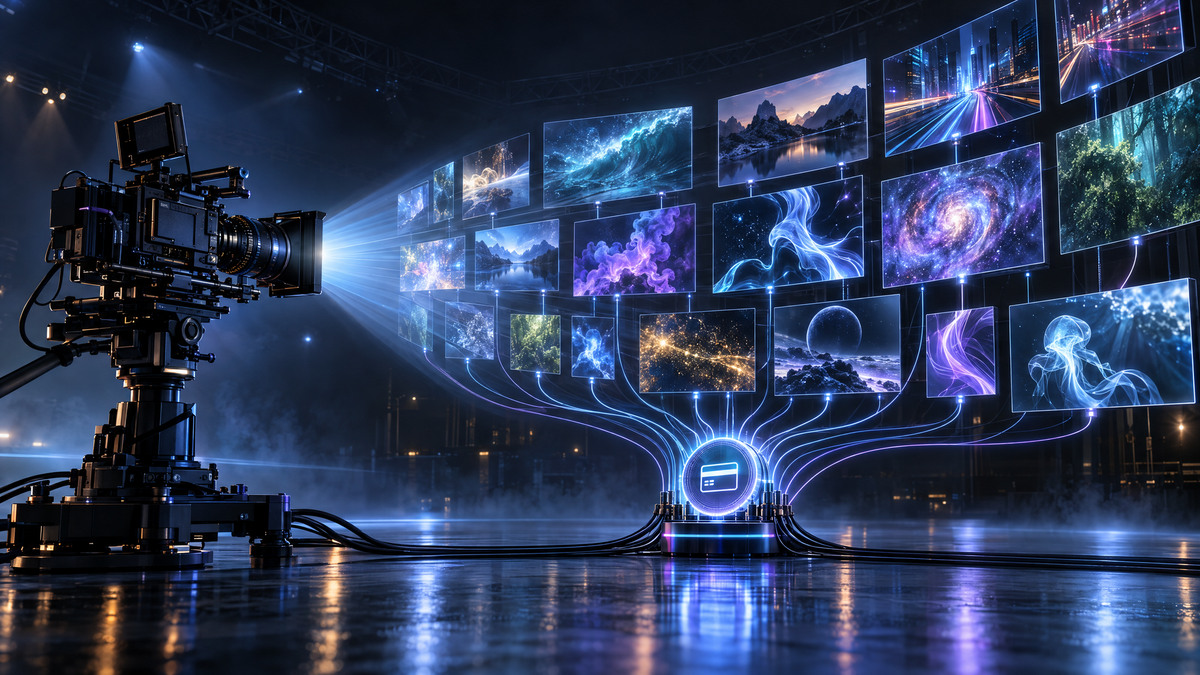
Higgsfield was valued at $5.4 billion in the August 2026 round led by DST Global, and says its annualized revenue run rate has passed $1 billion. The pricing page for its video product lists Seedance from ByteDance, Kling from Kuaishou, Veo from Google, Wan from Alibaba, MiniMax and Grok, and its own DoP video model. The company states its bet in a post about its flagship tool: Cinema Studio is "built on top of interchangeable video models."
So the short answer to "what is Higgsfield?" is a camera, not the film: a production layer, a preset library and one credit wallet over other companies' models, with a few models of its own and a lot of distribution. Everything here comes from Higgsfield's own pages (read on November 14, 2026), its blog, its docs and press coverage. Every revenue and user number is the company's own.
| 🧭 | Start here: your first 30 minutes with Higgsfield 1. Sign up free and look before you pay. The free tier has "no monthly credits, and one generation at a time." It's enough to see the interface, not to judge output. 2. Read the model list, not the logo. Open Video and check the model picker. The default was Seedance 2.5 when I looked. Pick the model on purpose; that choice decides quality and cost more than anything Higgsfield adds. 3. Read the plan footnotes before you buy. Credits expire each cycle, and "unlimited" comes with conditions (see below). 4. On Starter or above, try one image, then one short video. An image costs 0.12 to 2 credits depending on the model. Five seconds of Seedance 2.5 at 720p costs 35 credits; Kling 4.0 costs 11.25. Starter's 200 monthly credits buy about five Seedance clips. 5. Try one thing that is actually theirs. Pick a camera preset or open Cinema Studio, so you're judging Higgsfield's layer and not only the model underneath. 6. If you build, skip the subscription. Create an API key at the Higgsfield API page, then send one request: |
Who they are
Higgsfield was founded in 2023 and is headquartered in San Francisco, with what it calls "a large engineering hub in Almaty, Kazakhstan." The co-founders, per the company, are Alex Mashrabov (CEO), Yerzat Dulat (CTO) and Mahi de Silva. Mashrabov co-founded AI Factory, the computer-vision company behind Snapchat's Cameos, which Snap acquired (2019 per Higgsfield, 2020 per TechCrunch), and TechCrunch describes him as Snap's former head of generative AI. The first product, in 2024, was Diffuse, a selfie-to-video app. The current suite launched in 2025.
The money arrived fast:
That's at least $538 million disclosed.
In September 2026, Higgsfield said it passed $1 billion in annualized revenue run rate, defined as "revenue from the latest four weeks multiplied by 13." The same post claims nearly a million paying subscribers. Its about page now says "40M+ Users." The post also says subscriptions fell from over 90% of revenue to "just over 60%," so a growing share now comes from something other than subscriptions. The post doesn't say what. None of these numbers are independently verified.
What it actually sells
The navigation bar has more than twenty entries. They sort into three groups.
Other companies' models, behind one wallet. The video menu holds Seedance 2.5 and 2.0, Kling 4.0, 3.0 and its Motion Control variants, Google Veo 3.1, Wan 2.2 through 3.0, MiniMax Hailuo, and Grok Video. Images come from Nano Banana Pro, GPT Image 2.5 and 2.6, Seedream, FLUX.2 and others; upscaling partly from Topaz. The enterprise page says "35+ top models and tools in one workspace." Missing from the menu: Runway, Luma and Pika, which compete with their own models. And Sora: the Sora page now reads "Sora 2 is no longer available. Try Seedance 2.5 or Kling 4.0." OpenAI shut down the Sora API in September 2026, per The Decoder's report of OpenAI's help page; Forbes had reported in February that Higgsfield was the largest Sora 2 customer by spend.
Models it says it builds. The about page and pricing table list Soul 2.0 (an image model aimed at fashion and editorial), Soul Cinema, Soul ID (a consistent character across images), Soul HEX (color control), Higgsfield DoP (its video model, sold in Lite, Standard and Turbo tiers), Speak 2.0 (lip sync), Popcorn (storyboards: "up to 8 matching scenes with aligned characters, lighting, and tone") and Higgsfield Upscale. Soul 2.0 is cheap at 0.12 credits an image. Higgsfield doesn't say whether DoP was trained from scratch.
The layer on top. This is what Higgsfield sells as its own:
- Cinema Studio (version 4.0): cameras, lenses, focal lengths and color grading as controls instead of prompt words, "curated by a former director of photography."
- 250+ presets for camera moves and effects ("Earth Zoom Out", "Building Explosion"), and one-click apps such as face swap, relight, outfit swap and a "Virality Predictor."
- Genjutsu, which recasts a video's motion onto your characters, products or locations. Its underlying model isn't named.
- Supercomputer, an agent with connectors, skills and scheduled tasks; the homepage calls it an "Agent powered by Fable 5.2."
- Canvas, a node editor that wires prompts, images and models into one pipeline; Ads Studio ("Paste your website. Get winning static ads"); plugins for Photoshop, Premiere, After Effects and DaVinci Resolve; GPU rental by the hour.
Most of what Higgsfield built is workflow, and the flagship pixels are mostly rented. In its Cinema Studio post the company says the craft "wasn't welded to a particular model. The core model underneath changed, and the craft stayed exactly where it was."
Credits, and the fine print on "unlimited"
On November 14, 2026, a Black Friday sale was live and only yearly billing was shown:
Credits are priced per model. By my arithmetic, Plus's 1,000 credits buy about 28 five-second Seedance 2.5 clips at 720p (35 credits each) or 12 at 1080p (80 each), about 88 Kling 4.0 clips at 720p, or about 25 four-second Veo 3.1 clips at 1080p (about 40 credits each). Three rules from the pricing FAQ and plan footnotes matter more than the headline price:
- "Subscription credits do not roll over and expire at the end of each credit cycle."
- "Unlimited generations run in the standard queue, while credit-based generations always run in the priority queue," with "dynamic speed adjustments during high-traffic periods."
- Unlimited is "for personal, human use only." Automation can pause it, and it isn't available through the MCP server, CLI, Canvas or Supercomputer.
In other words, "unlimited" is a promotional bonus, not capacity. Anything you automate is billed per use. A Black Friday "unlimited" offer, the kind that drew complaints last year (below), was back on the pricing page the day I checked.
For builders
The developer surface:
- An API at
api.higgsfield.ai, keyed with an ID and secret, asynchronous: a POST returns a request ID with status and cancel URLs, then you poll or take a webhook. Docs say outputs are kept "at least seven days." - Prices in dollars per second, from the API catalog: Seedance 2.5 at $0.1177, Kling 4.0 at $0.1257, Kling 4.0 Flash at $0.063, Wan 3.0 at $0.0375. Soul 2 images cost $0.0032. The catalog gives no resolution, and API and credit prices don't rank models the same way.
- SDKs for Python (
higgsfield-client) and Node, a CLI (@higgsfield/cli), and an agent skills repo (npx skills add higgsfield-ai/skills). - An MCP server at
mcp.higgsfield.ai/mcp, with connect flows for Claude, Claude Code and ChatGPT.
For an agent that needs to make a product shot or a five-second clip, one key and one async API across Seedance, Kling, Wan and others is the actual product. You can switch models by changing a URL path instead of signing separate contracts and learning separate APIs. That's the same pitch as OpenRouter for text models, applied to video. One caveat: I didn't compare these per-second prices with each maker's own API, so whether the middleman costs extra is something to check for your top model before you commit volume.
The criticism on record
The growth came with incidents. Forbes reported in February that creators promoting the product received folders of racist and obscene videos built on famous cartoon characters, plus nonconsensual celebrity deepfakes. Co-founder de Silva confirmed that marketing staff and outside creators made the videos: "It is absolutely not representative of our values, and it was a mistake." X suspended Higgsfield's account, citing "inauthentic behavior," according to de Silva. The same report covers a Black Friday "unlimited" promotion that users said was throttled, and about 40,000 accounts the company said it shut down over "mechanized attacks," with $1.35 million it said it refunded.
In August, WION reported long waits on unlimited plans (its headline says days) and pointed to the terms that allow throttling and a seven-day refund window. TechCrunch's January funding story said it is "still an AI slop engine as well." I found no lawsuit or regulator action.
The bet: own the camera, rent the film
Higgsfield's thesis is that video models become a commodity and value moves to the application. Mashrabov told SiliconANGLE: "The next wave of value will be created by the applications that put this technology to work."
What the bet gets right:
- Model churn is real. The menu itself shows it: several Kling and Wan versions and two Seedance lines sit side by side, and Sora is already gone. A tool built around one model loses its users when that model falls behind. One built over many models is less exposed.
- Craft transfers. Lens choices, camera presets and a storyboard that keeps a character consistent help with whatever model is underneath.
- Distribution is leverage. Nearly a million paying subscribers, if the company's number holds, gives it bargaining power with suppliers that a single creator never has.
What it costs:
- The supply can vanish. OpenAI turned Sora off. For Higgsfield the hedge held: the page now points to Seedance and Kling. For anyone who had built straight on Sora, it was a forced migration. The next shutdown might be a model with no substitute, and Higgsfield's own video model, DoP, starts at about 3 credits for 3 seconds on Lite, priced like a budget option rather than a flagship replacement.
- Margins sit between two price lists. Higgsfield buys from model makers and resells in credits. A maker that cuts its own prices, or sells direct to the same creators, squeezes the middle.
- Trust is fragile. An aggregator asks you to trust it with your workflow and your spend. Throttled unlimited plans and offensive marketing draw down that trust.
Who should use it, and who should go direct
Use Higgsfield if you make a lot of short-form video, want to compare models side by side without separate accounts, and value camera presets and consistent characters more than raw model access. It's also a reasonable API if you want one async interface over several video models.
Go direct if you've already picked one model and use it at volume, need a model Higgsfield doesn't host (Runway, Luma, Pika), or need contract terms, data guarantees and uptime from the company that runs the model.
If you build on it, take webhooks instead of tight polling, and copy every output to your own storage at once, since Higgsfield promises only seven days. Keep the model name in configuration, and put your own thin interface in front of Higgsfield so you could route around it to a maker's API.