Nano Banana 2.1 vs Sunburst at Max: Cheaper, Still Behind
Google lists Nano Banana 2.1's 1K image output at $0.0336, about a sixth of what one Sunburst image at max cost me. Sunburst still leads all six independent leaderboard views I checked. Prices, Google's 4K discrepancy, features, and which jobs suit which model.
Google released Nano Banana 2.1 on October 6. The API model is gemini-nano-banana-2.1, generally available and built on Gemini 3.6 Flash. It replaces Nano Banana 2 (gemini-3.1-flash-image), which is now deprecated with no shutdown date. Its model card also lists the Gemini app, AI Mode in Search, Google Ads, Flow and Stitch.
New artwork on this site comes from GPT Image 2.5 Sunburst at quality="max", for the reasons in GPT Image 2.5: Pin Sunburst. So I read the launch with one question: is Nano Banana 2.1 better than Sunburst, and cheaper? It is much cheaper. On every independent leaderboard I checked, it ranks below Sunburst. That makes it a different tool rather than a replacement, and for several jobs it is the right one.
| ⚡ | TL;DR What shipped. The price. $0.0336 per 1K image in image-output charges, half of Nano Banana 2. One 1024×1024 Sunburst image at max cost me $0.211 in total, about 6.3 times as much. The fine print. Input tripled to $1.50 per million tokens, thinking now defaults to medium and bills at $7.50 per million, search grounding costs $14 per 1,000 queries after 5,000 free a month, and Google's own pages disagree on the 4K price. The quality. Google's evaluations put 2.1 ahead of its own older models. The independent leaderboards put Sunburst first on every list and Nano Banana 2.1 fourth to sixth. Use Nano Banana 2.1 for volume, search-grounded infographics, panoramas wider than 3:1, 4096-pixel output, and video or PDF input. Keep Sunburst for hero images, alpha-mask edits, transparent cutouts, custom sizes and several variants per call. My pipeline stays on Sunburst at max. |
What shipped
The Gemini API changelog entry for October 6 calls it "the latest high-efficiency image generation and conversational editing model" and lists improvements in "visual quality, prompt adherence, multi-turn character consistency, text rendering, and wide and panoramic aspect ratio generation". The same entry deprecates gemini-3.1-flash-image and says to migrate. There is no deadline yet.
The model page and the image-generation guide add the details:
- Output at 1K, 2K and 4K, with 1K as the default. The 512-pixel tier that Nano Banana 2 offered is gone.
- 14 aspect ratios from 8:1 to 1:8, with the tiling artifacts on the panoramic ratios fixed at 2K and 4K.
- Better text rendering and infographic layout.
- Up to 14 reference images per request, keeping up to 4 characters consistent and up to 10 objects faithful.
- Grounding with Google Web Search and Google Image Search.
- Thinking levels minimal, medium and high, with medium as the default.
The model takes text, images, video and PDF, and returns images and text. It supports search grounding, thinking and the Batch API. It does not support function calling, structured outputs, caching or URL context.
One limit needs care. Google DeepMind's model card describes "a token context window of up to 1M". The API model page lists an input limit of 131,072 tokens and an output limit of 32,768. Design against the API page.
Access is also narrower than the pricing page suggests. That page says "Google AI Studio usage is free of charge in all available regions", and the API has no free tier for this model. When I opened AI Studio on October 13, its playground said: "Nano Banana 2.1 is only available in the Playground via a Google AI Plan or an API key." The Gemini app on the same account still offered Nano Banana 2 at the same moment.
What it costs
Google's pricing page, last updated October 9, Standard tier:
The headline cut is real at 1K and 2K, where the price halves. At 4K it is 25%. Everything around the image got more expensive: input tripled, and text-and-thinking output costs 2.5 times what it did.
Thinking also starts at medium now, and the guide says it "cannot be disabled in the API". Google does not charge for the interim "thought images" the model draws while it reasons, but the thinking tokens are billed. A reference-heavy edit at high thinking will cost more than $0.0336. How much more depends on your prompts, so measure it.
Search grounding is a second meter: 5,000 free search requests a month, shared across Gemini 3 and newer models, then $14 per 1,000. One generation can trigger several billed searches, though the retrieved content is not charged as input tokens. Batch halves the rates: $0.0168, $0.0252 and $0.0567 per image at 1K, 2K and 4K.
Google's two 4K prices
The pricing page says a 4K image consumes 3,780 tokens, or $0.113. The image-generation guide lists 2,520 tokens for every Nano Banana 2.1 size at 4K, the same as Nano Banana 2. At $30 per million, that would be $0.0756, which is the figure launch coverage reported.
Both are Google pages, and the higher number is 50% above the lower one. Until Google reconciles them, budget $0.113 and check the token counts your own calls return. A 4K-heavy workload feels this difference directly.
What Sunburst costs, measured
GPT Image 2.5 also bills by the token: $5 per million text input tokens, $8 per million image input tokens and $30 per million image output tokens, or $15 with Batch. That is the same image-output rate as Nano Banana 2.1. It is not the same price per image, because Sunburst spends far more tokens on each one. OpenAI publishes no per-image token counts for 2.5 and says its GPT Image 2 calculator does not estimate them. So I measured.
I sent two prompts through the Images API on October 12, with gpt-image-2.5-sunburst, quality="max" and 1024×1024 output. One tested text and layout:
A clean modern conference poster on a deep navy background. Large bold headline at the top:
"PIXELS ARE TOKENS". Below it a smaller subtitle: "Two image models, one price per million".
Three evenly spaced flat line icons in a row with a caption under each: "Prompt", "Model",
"Picture". A thin footer line at the bottom: "October 2026". Crisp vector style, high
contrast, no other text.
The other tested materials:
Photoreal studio product photograph of a smoked-glass espresso machine on black granite.
True refraction, no text, no logos.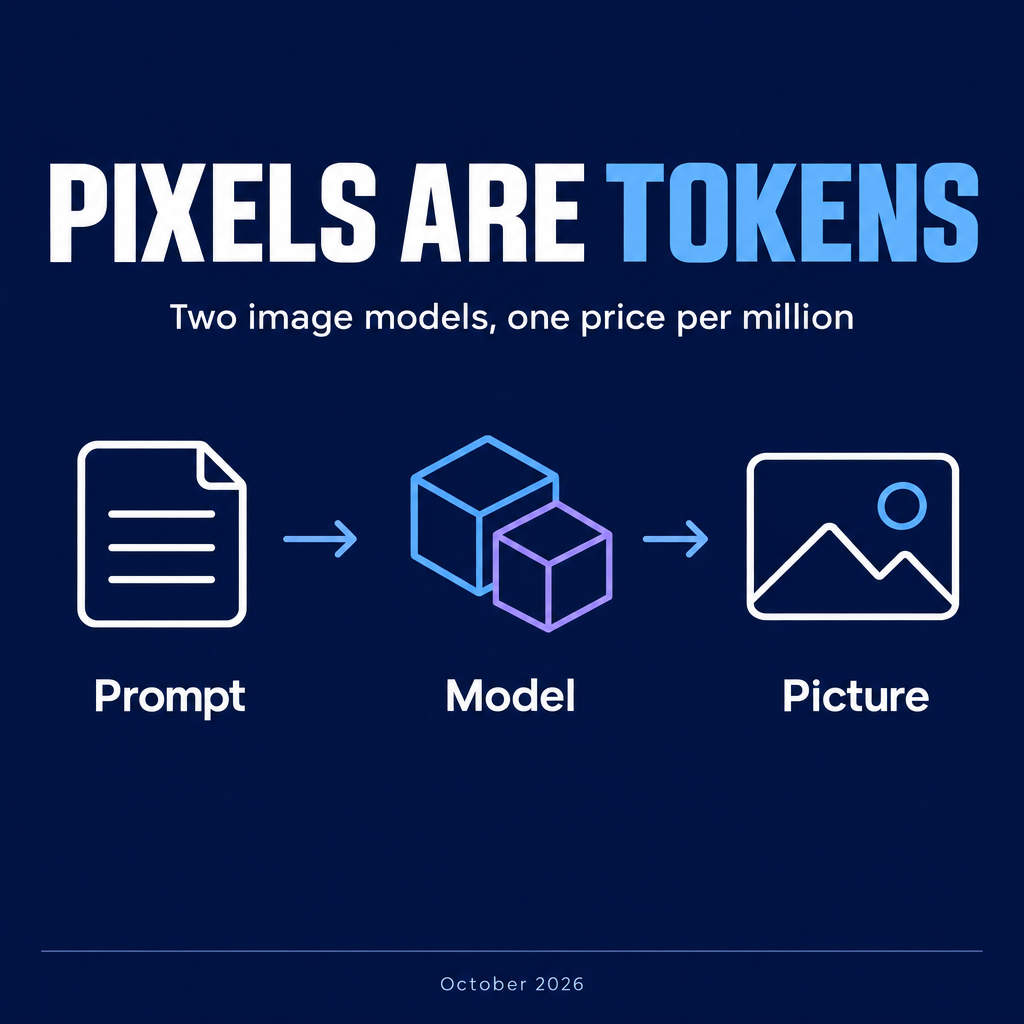
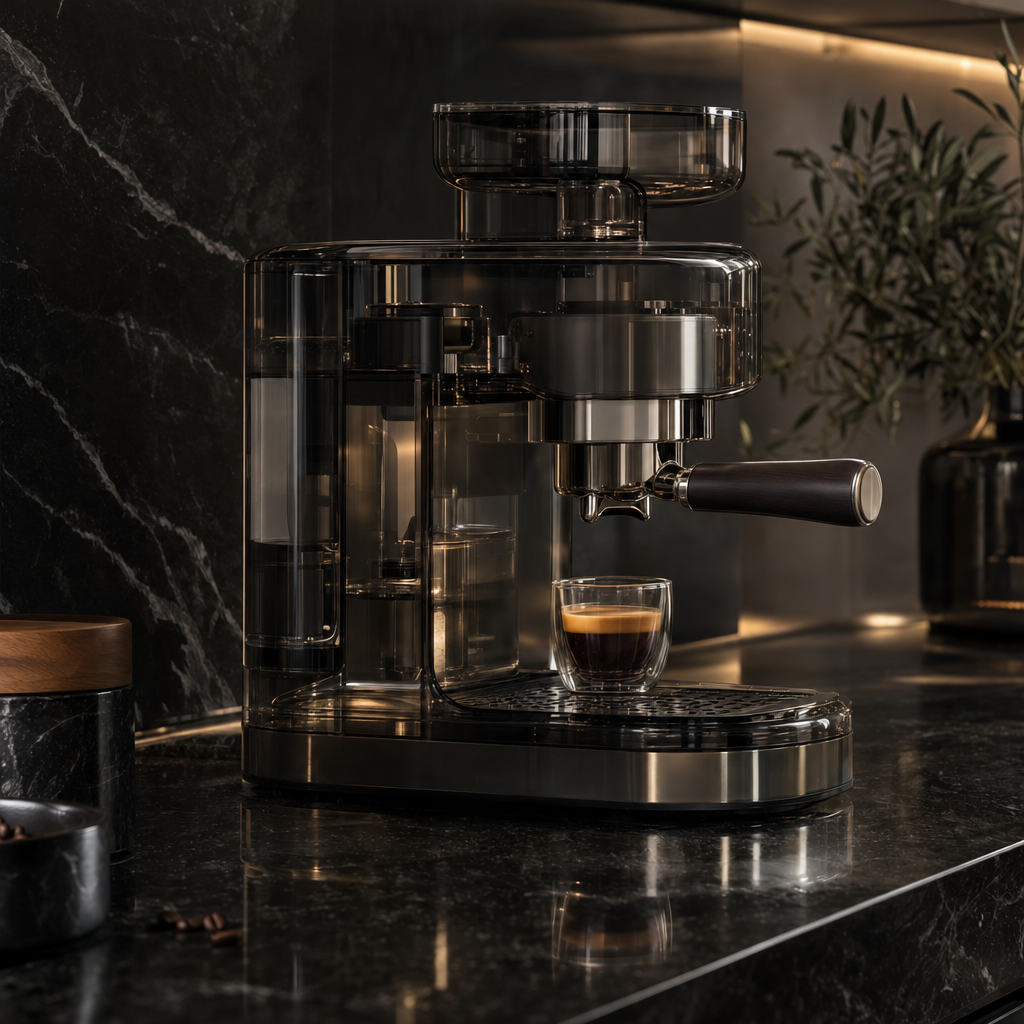
Both images returned exactly 7,024 image output tokens. With the prompt tokens, each cost about $0.211. Artificial Analysis lists $210.7 per 1,000 images for Sunburst at max, consistent with my measurement.
That makes Sunburst at max about 6.3 times Nano Banana 2.1's listed 1K price, and Batch halves both. Two caveats keep the ratio honest. Google's $0.0336 covers image output only, before thinking, input and grounding. My number is Sunburst's top setting, not its cheapest.
Wall-clock time was 95.7 and 164.0 seconds, with the two requests overlapping. OpenAI's guide says "Complex prompts may take up to 2 minutes to process", and one of mine took longer. That is not a latency benchmark, but it is a reason to set generous timeouts at max.
I did not run the same prompts on Nano Banana 2.1. The free routes I tried don't reach it.
Quality: Google's numbers, then everyone else's
Google's announcement says 2.1 "outperforms our previous models across the board", as Search Engine Roundtable quoted it. The model card backs that up inside Google's lineup. Most rows are side-by-side human ratings converted to Elo; the factuality row is an AutoRater score:
In conventional Elo terms, a 60-point gain over Nano Banana 2 is an expected score of about 59% for 2.1. The factuality score is the standout: nearly three times Nano Banana 2's on infographics.
The card's known limitations are worth reading before you rely on any of it. Small text is "often blurry in 1k model", "Character consistency is not always perfect", masked edits show "Partial instruction following and ink persistence", and the model is "Still limited in advanced capabilities with world knowledge, 3D reasoning and factuality".
The card also scores a "No Thinking" variant of 2.1. The API offers minimal, medium and high, and says thinking cannot be disabled. Treat that column as a reference point, not a setting you can select.
No OpenAI model appears in Google's tables. For that comparison there are two independent leaderboards built on blind human votes:
Sunburst is first on all six. Artificial Analysis lists it at max. Arena does not say which quality setting its GPT Image 2.5 entries use, and marks both new models as preliminary. Nano Banana 2.1 also has far fewer votes so far: 6,166 comparisons on Artificial Analysis's text-to-image board, against 14,823 for Sunburst.
Using the standard Elo formula as an illustration, Artificial Analysis's 38-point text-to-image gap corresponds to an expected score of about 55% for Sunburst, and its 47-point editing gap to about 57%. Arena's gaps are wider: about 64% for text-to-image, 65% for text rendering and 63% for single-image edits. These are not observed head-to-head vote shares. The boards agree on the order and disagree on the margin, so don't average them.
Two results from the same tables matter beyond this comparison. Against GPT Image 2 (high), OpenAI's previous generation, Nano Banana 2.1 is a coin flip on Artificial Analysis: 12 points behind on generation and 10 ahead on editing. And Google's own evaluation, Artificial Analysis and Arena all rank 2.1 above Nano Banana Pro, which costs four times as much at $0.134 per 1K image. Unless your own prompts say otherwise, Pro is hard to justify now.
One limit applies to all of this: the leaderboards don't say which thinking level Nano Banana 2.1 ran at. The gap between both models at their true maximums could differ from what they show.
Documented API differences
Going by each vendor's own documentation, Nano Banana 2.1:
- Grounds a prompt in Google Web Search and Google Image Search before drawing. The guide notes that grounding does "not support using real-world images of people from web search at this time."
- Goes beyond 3:1, all the way to 8:1 and 1:8. A 4K panorama is 12288×1536.
- Outputs 4096×4096, about 16.8 megapixels. Sunburst tops out at 8,294,400 pixels, and OpenAI calls anything above 2560×1440 experimental.
- Accepts video and PDF as input.
- Trades tokens and latency for composition through thinking levels.
Sunburst:
- Renders transparent backgrounds, with
background="transparent"and PNG or WebP output. Google's image guide documents no transparency option. - Accepts a separate mask file whose alpha channel marks the region to change. OpenAI warns that "Masking with GPT Image is entirely prompt-based" and that the model "may not follow its exact shape with complete precision". Treat the mask as guidance; you still draw the region. Google's API guide calls its inpainting "semantic masking": you describe the region in words. Its model card also scores edits guided by ink marks drawn onto the image itself.
- Accepts any size on a 16-pixel grid between 1:3 and 3:1, instead of a fixed table of sizes.
- Exposes an
nparameter to request an image count. Google's guide warns its model "won't always follow the exact number of image outputs that the user explicitly asks for." - Offers five quality levels from
lowtomax, plusauto, and amoderationsetting. - Streams partial images while it renders.
Both take several reference images, though only Google documents a budget: 14 per request, with up to 4 characters and 10 objects. Both edit across multiple turns, both offer Batch processing at half the image-output rate, and both watermark their output with SynthID. Google says "All generated images include a SynthID watermark." In May, OpenAI announced SynthID for images generated through ChatGPT, Codex or the OpenAI API, on top of C2PA Content Credentials. The watermark is shared, but verification is not: at launch, OpenAI said its public checker "is limited to content generated by OpenAI".
Which one, for which job
- Hero images, campaign stills and product shots someone will scrutinize: Sunburst. It leads every board, and at a few images per article the price difference is cents.
- Catalogs, thumbnails and ad variants generated by the thousand: Nano Banana 2.1, once it passes your acceptance test. At $33.60 per thousand 1K images against about $211 for Sunburst at max, volume changes the arithmetic.
- Infographics that need current facts: Nano Banana 2.1 with grounding. It offers integrated search grounding. Check the facts anyway.
- Banners, strips, panoramas and very large output: Nano Banana 2.1, whenever the ratio goes beyond 3:1 or the size beyond 8.3 megapixels.
- Cutouts and region edits: Sunburst, for the transparent background and the uploaded mask.
- Video and PDF input: Nano Banana 2.1, because Sunburst takes text and images only.
Whichever way you route, measure cost per accepted image, not cost per call. Run 20 prompts from your real workload through both at the settings you would ship, rate them blind, and divide each bill by the images that passed.
What my pipeline does
My rule for switching models came from the Codex seat: switch only to a model that is better at its own maximum than the incumbent at its maximum, and cheaper. GPT-6 Sol failed it: a fifth of Astra's price, behind Astra on every chart OpenAI published. Nano Banana 2.1 is much cheaper, but the rankings available today put it behind Sunburst, so they give me no reason to switch.
So the artwork here stays on gpt-image-2.5-sunburst at quality="max", called through one helper that pins the model ID and never falls back on its own. At a few images per article, the difference is well under a dollar, and the image is the first thing a reader sees.
That is a default, not a monopoly. If a piece needs a grounded infographic or an 8:1 banner, that job goes to Nano Banana 2.1. What would move the default itself: an independent leaderboard ranking a Google model above Sunburst at max, at a lower total cost.
Google has halved 1K and 2K image-output prices for a model that now outranks its own Pro tier. That is a reason to route more jobs to it, not yet a reason to move the default.
| 🔗 | Sources Google: Gemini API changelog (October 6), Nano Banana 2.1 model page, pricing (updated October 9), image-generation guide, Nano Banana 2.1 model card. OpenAI: GPT Image 2.5 Sunburst model page, image generation guide, Advancing content provenance (May 19). Leaderboards, read October 12: Artificial Analysis text-to-image and image editing; Arena text-to-image and image edit. Measurements: two |