Claude Managed Agents: Runtime and Product Responsibilities
Understand agents, environments, sessions and events in Claude Managed Agents. Evaluate managed infrastructure while keeping application permissions, correctness and operations explicit.

An agent in a software product needs more than a model request. It needs somewhere to execute tools, a way to maintain session state, observable progress and a response to interruption or failure. A managed runtime can provide part of that infrastructure.
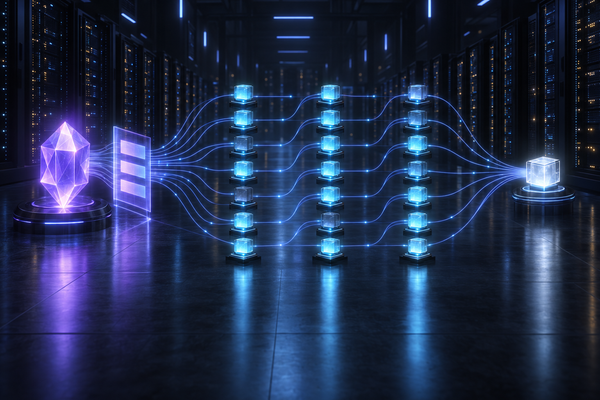
Claude Managed Agents supplies an agent runtime organized around agents, environments, sessions and events. The current documentation describes managed cloud sandboxes and self-hosted environments. This article focuses on those architectural boundaries rather than promising a fixed reduction in implementation time.
Four concepts to keep separate
An agent defines behavior and available capabilities: the selected model, system instructions, tools, MCP connections and skills. Version that configuration so that a production session can be associated with the behavior it was intended to run.
An environment describes where execution takes place. Its filesystem, network access, resource limits and credentials are deployment decisions. A sandbox can restrict an execution surface without proving that every configured tool is authorized for every user.
A session is a running instance that holds the conversation and performs a task within the chosen environment. Treat it as a lifecycle with observable state, not as an HTTP request that must remain open until all work is finished.
Events connect the application with the session. The application sends messages or tool results and consumes status and agent output. An output stream is a delivery mechanism; server-sent events alone are not a bidirectional transport.
The session guide documents creation, agent-version pinning and initial events. The event guide describes sending events and receiving session progress. Use the versioned API contract for exact request shapes.
What a managed runtime changes
Infrastructure ownership moves in specific areas. The platform can operate the agent loop and execution environment, while the application integrates events, tools and outputs. Verify the actual retry, state persistence and recovery guarantees rather than assuming the entire reliability problem has disappeared.
This can be useful when embedding asynchronous work in an application. It is also reasonable to use a direct model API or an existing agent SDK when those meet the requirements. Compare the operational responsibilities of each approach, including failure handling and portability.
Do not assume tool parity with an interactive coding client merely because names look familiar. Check supported tools, permission modes, connection types and preview status against the platform documentation for the deployment being used.
The application still owns authorization
Decide which user or service initiated a task and what that identity may access. Constrain tool permissions and data sources accordingly. An agent prompt is not a substitute for service-side authorization.
Protect secrets outside reusable instructions, restrict network access where appropriate and inspect what information tool results expose. Separate a tool’s ability to reach a service from its permission to perform a particular operation for a particular user.
For actions that change external state, design retries deliberately. A resumed session or repeated tool call should not silently duplicate a purchase, notification or other consequential operation. Use the application’s transaction and idempotency mechanisms where applicable.
Outcomes and additional agents need verification
The platform documents outcome-oriented iteration and multiagent orchestration. Their supported behavior and availability belong to the selected API version and deployment. Check those details before designing a required feature around them.
A rubric is useful only if it captures the real requirement. A model grader may miss a defect or share the producing model’s assumptions. Add deterministic checks where appropriate, validate representative outputs independently and keep an explicit limit on iteration.
Multiple agents can divide work, but they also require clear ownership and integration. Separate conversation contexts do not guarantee independent errors. Shared files and tools need coordination, and the final result needs a responsible verifier.
Observe the whole lifecycle
The session-operations guide distinguishes idle, running, rescheduling and terminated states. An idle session may have completed a turn or be waiting for action. Interpret status together with the relevant event and stop reason.
Record the configuration version, task input, relevant events and verification outcome. Keep logs useful for diagnosis while avoiding unnecessary sensitive content. Test what the application does when a tool fails, a session pauses or a stream reconnects.
Measure total workload cost using actual usage and current pricing. Include model consumption, runtime, retries and the effort needed to validate and operate the feature. A service’s published unit rate does not establish a universal infrastructure saving.
Select a bounded pilot
Start with an authorized task whose outcome can be checked and whose failures can be contained. Define the data boundary, available tools, completion criteria, recovery procedure and operational owner before expanding access.
A managed runtime can reduce the infrastructure an application team operates. The product remains responsible for what the agent is allowed to do, whether its output is correct and how the system behaves when it is not.