Why I Chose the Oura Ring 4 for Biohacking
Apple Watch tracks your steps. WHOOP tracks your strain. The Oura Ring 4 tracks the data that actually matters for biohacking — sleep architecture, HRV, temperature, and recovery. Here’s why it’s the first thing I bought.
When most people think about biohacking wearables, they picture a smartwatch. Notifications on the wrist, step counters, maybe a heart rate graph between meetings.
That's fitness tracking. It's not biohacking.
Biohacking requires data you can act on — sleep architecture, heart rate variability trends, body temperature shifts, recovery readiness. And it requires wearing something 24/7, including in bed, which is where the most important data lives.
I just ordered the Oura Ring 4. Here's why.
What the Oura Ring 4 Actually Measures
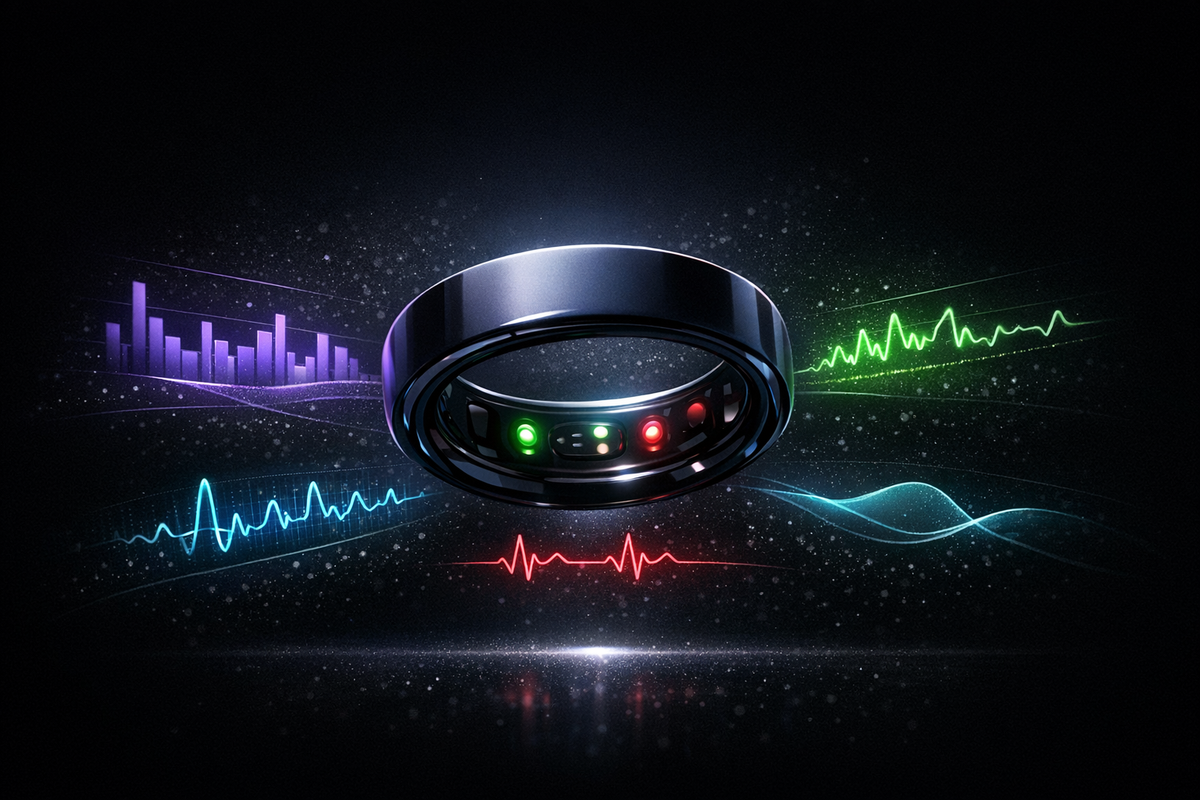
Forget step counting. The Oura Ring is a research-grade biosensor that sits on your finger and captures data most smartwatches physically can't — because the finger has stronger arterial pulse signals than the wrist.
Sleep Architecture — Not just 'hours slept.' Oura tracks deep sleep, REM sleep, light sleep, and awake time separately. This matters because growth hormone is primarily released during deep sleep. If you're getting 8 hours but only 30 minutes of deep sleep, your recovery is broken — and no smartwatch tells you that with this precision.
Heart Rate Variability (HRV) — The single best proxy for autonomic nervous system health. High HRV means your body is recovered and adaptive. Low HRV means stress, overtraining, or poor recovery. Oura measures HRV overnight (the only accurate way to do it) and trends it over weeks. This is the number that tells you whether to push hard in the gym or take a rest day.
Resting Heart Rate — Measured during sleep, not during the day when caffeine and stress contaminate the reading. Your nighttime resting HR is a true cardiovascular baseline. A gradual decline over months means your fitness is improving. A sudden spike means something is off — illness, overtraining, or poor recovery.
Body Temperature — Oura tracks skin temperature deviations from your personal baseline. A +0.5C spike can signal illness 24-48 hours before symptoms appear. It also correlates with circadian rhythm alignment — useful for dialing in sleep timing.
Blood Oxygen (SpO2) — Overnight oxygen saturation monitoring. Useful for detecting sleep apnea patterns — a common and underdiagnosed issue that destroys sleep quality and tanks testosterone.
Readiness Score — Oura's composite score combining HRV, resting HR, body temperature, sleep quality, and recent activity. A single number that answers the daily question: should I train hard today, or recover? This is the metric that turns raw data into a daily decision.
Why Not an Apple Watch?
I own an Apple Watch. It's great for notifications, calls, timers, and casual fitness tracking. But for biohacking, it loses to the Oura Ring on every metric that matters:
Sleep tracking accuracy. The Apple Watch uses wrist-based optical sensors, which are less accurate for sleep staging than finger-based sensors. The finger's palmar arteries provide a stronger, cleaner pulse signal. Multiple independent studies have shown Oura's sleep staging correlates more closely with polysomnography (the clinical gold standard) than any wrist-based device.
Comfort in bed. Wearing a watch to sleep is uncomfortable. A ring is not. If the device is annoying to wear at night, you won't wear it. And nighttime is when the most critical data is captured — HRV, deep sleep, temperature, resting HR. A device you take off at night is useless for biohacking.
Battery life. Apple Watch: 1-2 days. Oura Ring 4: up to 8 days. If your wearable dies every night because you forgot to charge it, you're missing the data that matters most. The Oura Ring charges in 20 minutes and lasts a week.
HRV measurement. Apple Watch measures HRV in spot checks or short overnight windows. Oura measures it continuously throughout the entire night and delivers a 7-day rolling average. For biohacking, the trend matters more than any single reading — and Oura's overnight continuous measurement is significantly more reliable.
No distractions. The Oura Ring has no screen, no notifications, no buzzing on your wrist. It's invisible. It captures data silently and lets you review it when you choose to. A biohacking sensor should measure your biology, not interrupt it.
What About WHOOP?
WHOOP 5.0 is the other serious contender in the recovery-focused wearable space. It's a wrist band (no screen) that tracks HRV, strain, sleep, and recovery. Subscription model: $30/month with device included.
WHOOP is excellent — especially for athletes who want strain tracking during workouts. But for my use case, the Oura wins:
Form factor. A ring is smaller, lighter, and more discreet than a wrist band. I can wear it in any social or professional context without it being 'a thing.' WHOOP on the wrist is a statement. Oura on the finger is invisible.
Sleep tracking depth. Both are strong, but Oura's finger-based sensors have an edge in sleep staging accuracy. Sleep is my priority — that's where GH release happens, where recovery happens, where the biohacking protocols either work or don't.
No subscription lock-in. WHOOP requires the $30/month subscription to access your own data. If you cancel, you lose everything. Oura's membership is $5.99/month, and the basic data is still accessible without it.
If I were primarily tracking workout strain and training load, I'd consider WHOOP. But I'm optimizing sleep, recovery, and hormonal health — and the ring is the better tool for that.
How It Fits Into the Biohacking Protocol
The Oura Ring isn't a gadget. It's the feedback loop that makes everything else work.
Before hormones: Establish a baseline. Two weeks of Oura data gives me my natural sleep architecture, HRV baseline, resting HR, and temperature pattern. When TRT or peptide therapy starts, I'll have a clear before-and-after comparison.
Training decisions: High readiness score? Push hard — heavy resistance training or VO2 max intervals. Low readiness? Zone 2 cardio or rest day. No more guessing.
Sleep optimization: Track the impact of every change — keto, fasting timing, cold showers, caffeine cutoff time, bedroom temperature. The ring quantifies what works and what doesn't for MY body, not what a podcast says should work.
Protocol monitoring: Once on a hormone protocol, HRV and resting HR become early warning systems. A sustained HRV drop or resting HR increase after starting TRT or peptides signals something needs adjustment — before the next blood panel confirms it.
Long-term trend: Monthly and quarterly HRV trends are the closest thing to a real-time health score. If the biohacking protocol is working, HRV goes up, resting HR goes down, deep sleep increases, and readiness scores improve over time. If they don't, something is wrong.
My Choice: Ceramic Midnight, Size 10
Oura Ring 4, Ceramic edition. Midnight color. The ceramic exterior is scratch-resistant with a titanium interior — the most durable option. All-ceramic exterior means no metal contact with skin, which some people prefer for comfort and aesthetics.
The Gen 4 upgrades over Gen 3:
Smart Sensing — automatically detects which finger you're wearing it on and adjusts sensor algorithms accordingly.
Research-grade sensors — improved multi-wavelength LED array for more accurate SpO2 and pulse measurements.
Thinner profile — slimmer than Gen 3, especially noticeable on larger sizes.
8-day battery — up from 7 days on Gen 3.
AI Advisor — Oura's new AI feature that interprets your data and provides personalized recommendations.
$499 for the ring, $5.99/month for the membership. Arrives in a few days. By the time my clinic responds and blood work starts, I'll already have a baseline of sleep, HRV, and recovery data ready to hand them.
This is what Day 1 of biohacking looks like. Not peptides. Not hormones. A ring on your finger that tells you the truth about how your body is actually performing — 24 hours a day, starting tonight.