
The Verification Gap
AI builds, tests, and deploys your code. But "Claude tested it" is not the same as "I verified it." The most dangerous moment in AI-assisted engineering is when you stop checking.
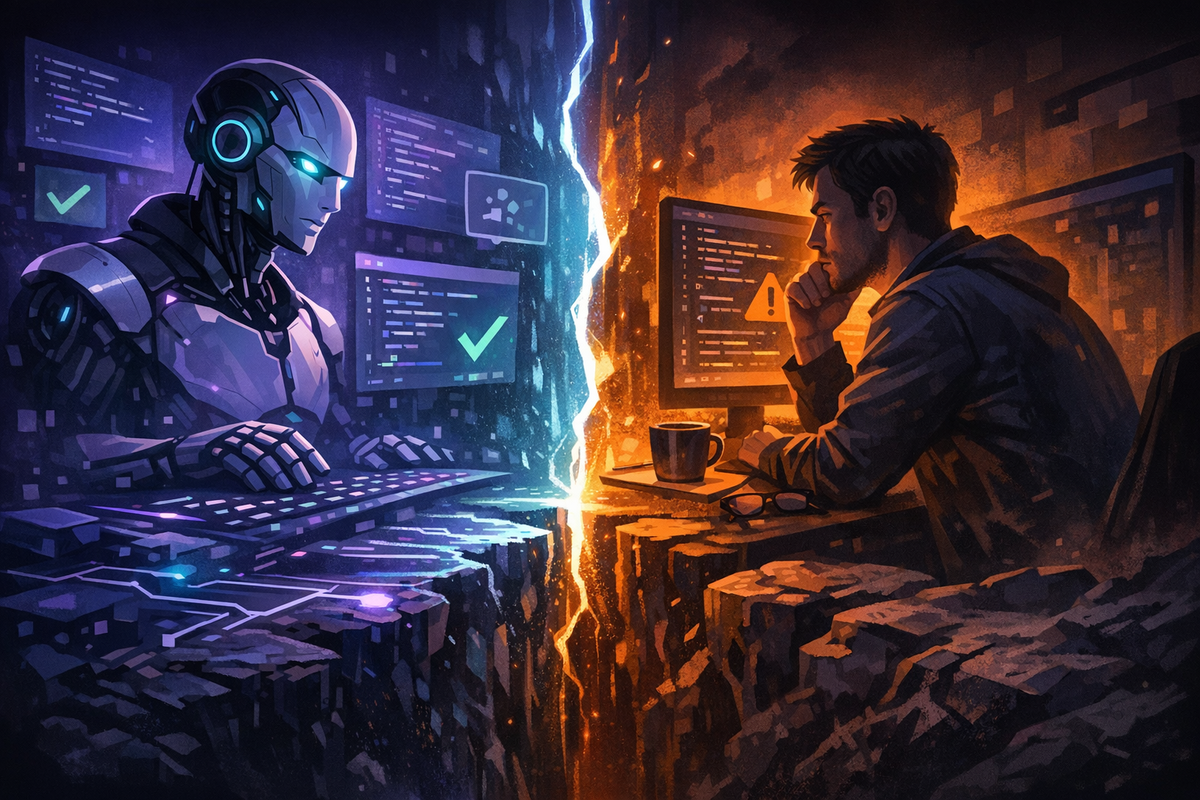
I caught myself last week. Claude Code had refactored a module, written tests, and all tests passed. I was about to merge. Then I stopped and actually read the diff.
The logic was wrong. Not dramatically — the tests passed because they tested what the AI thought the code should do, not what the code needed to do. The AI had written the implementation and the verification. Both were internally consistent. Both missed the actual requirement.
That moment should bother every engineer using AI tools.
Automation Complacency
Aviation engineers have a name for this: automation complacency. It's the well-documented tendency for human operators to reduce their vigilance when automated systems are performing well. The autopilot is flying. The instruments look normal. Attention drifts.
Automation complacency is the risk of reducing scrutiny because a system has usually appeared reliable. The engineering response is to preserve checks that can expose mistakes, rather than treating a confident output as evidence of correctness.
We're reproducing this pattern in software engineering, at scale, right now.
AI coding agents are remarkably capable. They read your codebase, write coherent implementations, generate tests, fix linting errors, and commit clean code. The output looks right. And most of the time, it is right. That's precisely the problem — intermittent correctness builds false confidence.
The Feedback Loop Collapse
There's a deeper structural issue. Traditional software development has natural verification points: you write code, you think about edge cases, you write tests that reflect your understanding, you run them, you catch mismatches between intent and implementation. The thinking is the verification.
When AI handles both implementation and testing, that loop collapses. The AI's understanding of the problem is encoded in both the code and the tests. If it misunderstands the requirement, the tests validate the misunderstanding. Everything is green. The CI pipeline passes. And the bug ships.
An important failure mode is an implementation that is internally consistent but wrong for its intended environment or requirements.
The Three Verification Layers
After working with AI coding agents daily for over a year, I've developed a framework that catches the failures automation complacency misses.
Layer 1: Intent Verification
The AI writes clean code. The tests pass. Everything looks professional. But does it actually do what you needed?
Another failure mode is solving a slightly different problem from the one intended. Code can be coherent while implementing the wrong requirement.
Read the diff. Don't ask whether the code is good. Ask whether it matches what you had in mind. You're the only person who knows the answer to that.
Layer 2: Boundary Verification
AI is excellent at the happy path. It's significantly weaker at boundaries — edge cases, error states, race conditions, integration points, data that doesn't conform to assumptions.
Specifically check:
- Null and empty states. What happens with no data? Empty strings? Zero values?
- Concurrency. If this code runs in parallel, does it still hold?
- Failure modes. What happens when the external service is down? When the database is slow? When the input is malformed?
- Scale. The AI tested with 5 records. What happens with 5 million?
Don't ask the AI to check these. Check them yourself. The point is independent verification — a second brain, not the same brain twice.
Layer 3: Integration Verification
Verification is limited by the context, access and checks available. An agent can investigate integration effects when it has the necessary evidence and tools, but a narrow successful test run does not establish correctness across the broader system.
Does this change break a downstream consumer? Does it alter an implicit contract that another service depends on? Does it change the behavior of a shared utility in a way that 14 other callers don't expect?
This requires system-level thinking. It requires knowing the architecture, the dependencies, the tribal knowledge of what's fragile and what's resilient. This is the layer where human engineering judgment is irreplaceable.
Strategies That Work
The Five-Minute Rule
Before approving any AI-generated change, spend five minutes doing nothing but reading the diff. No AI assistance. No "explain this to me." Just you, the code, and your understanding of the system.
Review depth should depend on risk, complexity and available evidence. A short check can catch obvious misunderstandings; subtle interactions may require targeted tests, deeper inspection or a separate reviewer.
Adversarial Testing
After the AI writes tests, write one more. Pick the scenario the AI is least likely to have considered — the weird edge case, the legacy data format, the thing that only happens in production on Tuesdays.
A passing test supports the behavior it actually exercises. A failing test can expose a missed case, but neither result alone establishes correctness of the whole change.
Separate the Writer and the Reviewer
Never let the AI be both the author and the sole reviewer of its own work. If Claude Code writes the implementation, you review it. If you write the specification, the AI implements it. If the AI generates tests, you verify the test assertions independently.
This is the same principle behind code review in teams — fresh eyes catch what familiar ones miss. The fact that one participant is artificial doesn't change the principle.
Track Your Override Rate
Track why AI-generated changes are accepted, modified or rejected. Those observations can reveal recurring problems, but an override rate depends on task mix and review practices.
There is no universal healthy override percentage. Aim for justified decisions and useful defect detection, not a target rate of disagreement.
The Responsibility Hasn't Moved
Here's the uncomfortable truth: AI has changed who writes the code. It hasn't changed who's responsible for it.
When that refactored module hits production and breaks the billing system, "Claude wrote it and the tests passed" is not an explanation anyone will accept. The engineer who approved the merge is responsible. That's you.
An engineer’s responsibility includes establishing that the result fits the requirements and system context. AI tools can contribute evidence and analysis; accountable judgment still requires examining the limits of that evidence.
The engineers who thrive in this era won't be the ones who delegate the most to AI. They'll be the ones who verify the best.