
Your Meeting Could Have Been a Prompt
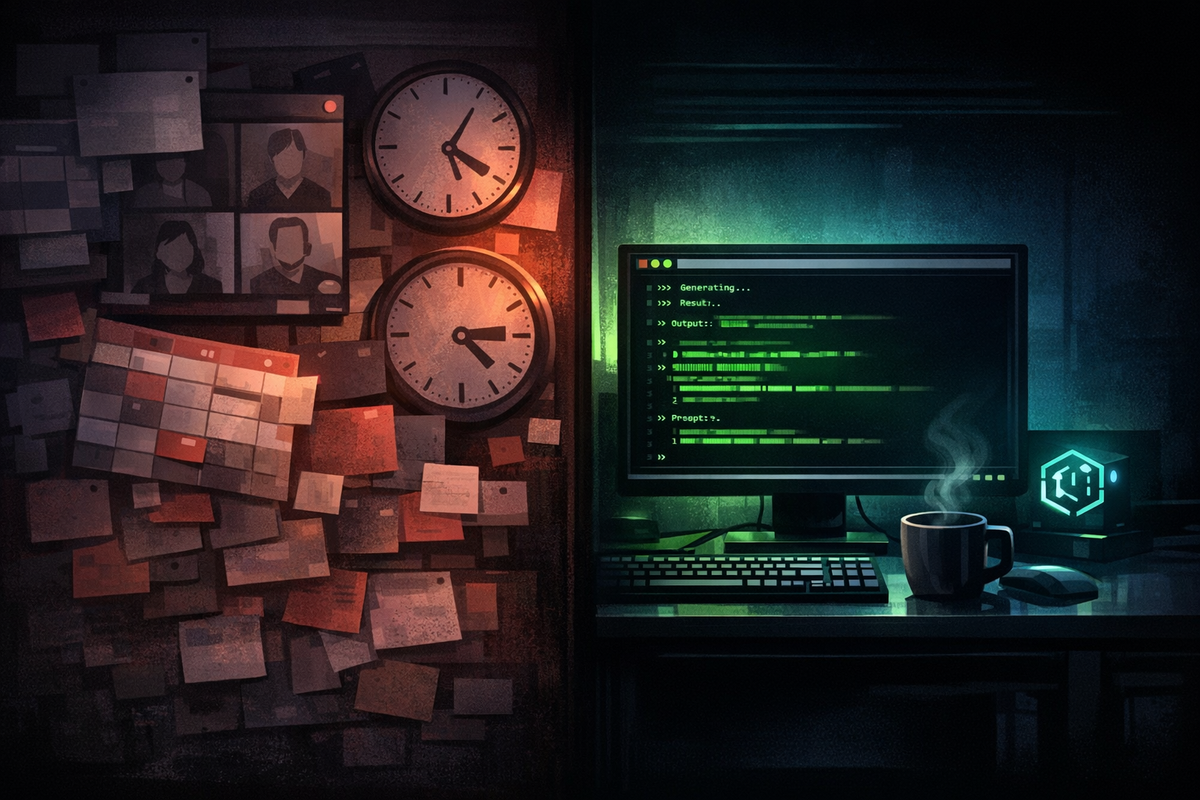
Your calendar is full. Your terminal is empty. In the AI era, every meeting that should have been text is an hour of building you'll never get back.
I've been a software engineer for 20 years. I've shipped products across fintech, healthcare, and gaming. I've debugged production outages at 3am, untangled legacy codebases that should have been buried at sea, and survived more framework migrations than I care to remember.
None of that comes close to the soul-crushing weight of a calendar full of meetings.
The Daily Standup: Theater for Adults
Let's start with the sacred ritual. Every morning, a group of engineers gathers in a virtual room to answer three questions: What did you do yesterday? What will you do today? Any blockers?
In theory, this is a lightweight coordination tool. In practice, it's performance art. Everyone takes turns reciting a carefully prepared monologue that roughly translates to I did stuff, I will do more stuff, no blockers. Nobody is listening. Everyone is mentally rehearsing their own line. The whole thing lasts 15 minutes that feel like 45.
And here's the part nobody says out loud: standups exist primarily for project managers. Engineers already know what they're working on. They talked to their teammates on Slack two hours ago. The standup is a reporting ceremony dressed up as collaboration.
The fix is obvious and already proven: async standups. A daily Slack message, written when you're ready, in your timezone, at your pace. You write what matters. Others read it when they need to. It's searchable, archivable, and — here's the kicker — an AI agent can process every standup from the entire team in seconds and give you a summary that's more useful than the meeting ever was.
But try suggesting this to a team that's been doing synchronous standups for three years. You'd think you proposed canceling oxygen.
The Meeting Spiral
The standup is just the gateway drug. Once you accept one daily meeting, the calendar fills itself.
Monday: standup + sprint planning. Tuesday: standup + deployment prep. Wednesday: standup + deployment stage 1. Thursday: standup + deployment stage 2 + retro. Friday: standup + demo + "quick sync". Every single day starts with a meeting. Most days have two or three. Some days you look at your calendar and realize you have six hours of meetings and two hours to actually write code.
This is where it gets absurd. You're hired to build software. Your entire value to the company is the code you ship, the systems you design, the problems you solve. And yet the organization structures your day so that the actual work happens in the cracks between conversations about the work.
It's like hiring a chef and then scheduling them into five hours of daily meetings about cooking.
Calendar Crimes
Meetings themselves aren't the villain. How people use them is. Your calendar says a lot about you — how you manage time, how you respect other people's time, how organized and intentional you are. And some people's calendars are crime scenes.
A short catalog of offenses:
- The ambush. Scheduling a meeting 30 minutes from now. As if everyone's day is just an empty field waiting for your calendar invite to land.
- The overtime. Booking 30 minutes, talking for 60. Your inability to manage a clock is not my problem.
- The ghost host. Calling a meeting and showing up 10 minutes late. To your own meeting. That you scheduled.
- The monologue. One person talks for the entire duration. Everyone else is a hostage with a mute button.
- The void. No agenda, no goal, no outcome. You walk out with more questions than you had walking in.
- The recurring phantom. A weekly meeting that stopped being useful six months ago but nobody has the courage to cancel.
- The chain. One meeting generates three follow-up meetings, each of which generates two more. It's meetings all the way down.
If you recognize yourself in any of these — and I say this with love — please stop.
When Meetings Actually Work
I'm not anti-meeting. I'm anti-waste. Meetings are powerful when they're used for what they're actually good at:
- Brainstorming — when you genuinely need real-time, bidirectional creative thinking
- Screen sharing — when showing is faster than describing
- Conflict resolution — when tone and nuance matter more than content
- Decision-making — when stakeholders need to align on something right now
The keyword is bidirectional. If the information only flows one way — from speaker to audience — it should be a document, a Slack message, a Loom video, anything but a meeting. The test is simple: if you could have sent it as text and nothing would be lost, you should have sent it as text.
Text Is the New Meeting
Here's where it gets interesting. Everything I said above was already true before AI. But now, in 2026, the argument isn't just philosophical — it's practical.
When information exists as text, agents can read it. Process it. Summarize it. Act on it. An AI can consume every async standup from a 40-person team and produce a coherent status report in seconds. It can scan a week of Slack threads and surface the three things that actually matter. It can turn a written brief into a product spec, a test plan, or working code.
When information exists as a meeting? It's gone. It evaporates the moment the call ends. Sure, you can record it and transcribe it — but now you've added a step to turn speech back into text, which is where it should have started.
Some people still prefer meetings because talking feels faster than writing. And it used to be — drafting a four-page document took days. But that excuse died the moment you could speak into a mic, get a transcription, and have an agent reshape it into any format you need. Documentation, requirements, specs, user stories — all generated from your voice in minutes.
Language in written form is now the most powerful input you have. It's not just communication — it's raw material. Text converts into artifacts: documentation, code, products, decisions. A meeting converts into a memory that three people remember differently.
One Hour Building vs. One Hour Listening
Think about how you feel after one hour of deep work. You shipped a feature. You solved a bug. You built something that didn't exist before. You're energized, focused, in the zone.
Now think about how you feel after one hour of a meeting where someone shared their screen and talked through 47 slides about a deployment pipeline you already understand. You're drained. You've lost momentum. The context you had before the meeting? Gone. It'll take you 20 minutes just to get back to where you were.
Time is the finite resource. You don't get that hour back. And in the AI era, the gap between what you can produce in an hour of focused work versus an hour of meetings is wider than ever. One hour with an agentic coding workflow can produce what used to take a day. One hour in a meeting produces... another meeting.
Protect Your Calendar Like Your Codebase
Your calendar is a mirror. It reflects your priorities, your discipline, and your respect for your own time and everyone else's. Treat it like you treat your codebase — with intention, with standards, and with a healthy intolerance for unnecessary complexity.
Before you schedule that meeting, ask yourself: Could this be a Slack message? Could this be a doc? Could an agent handle this? If the answer to any of those is yes — cancel the invite, write the text, and give everyone back their most valuable asset.
Their time.
Related Reading
Configure Claude Code for Maximum Power