The Model Isn't the Bottleneck
An AI film written, directed and edited by one person with April 2025 tools drew about 96 million views from one post eighteen months later. What it was made with, what the tools look like now, and which parts of the work are still scarce.
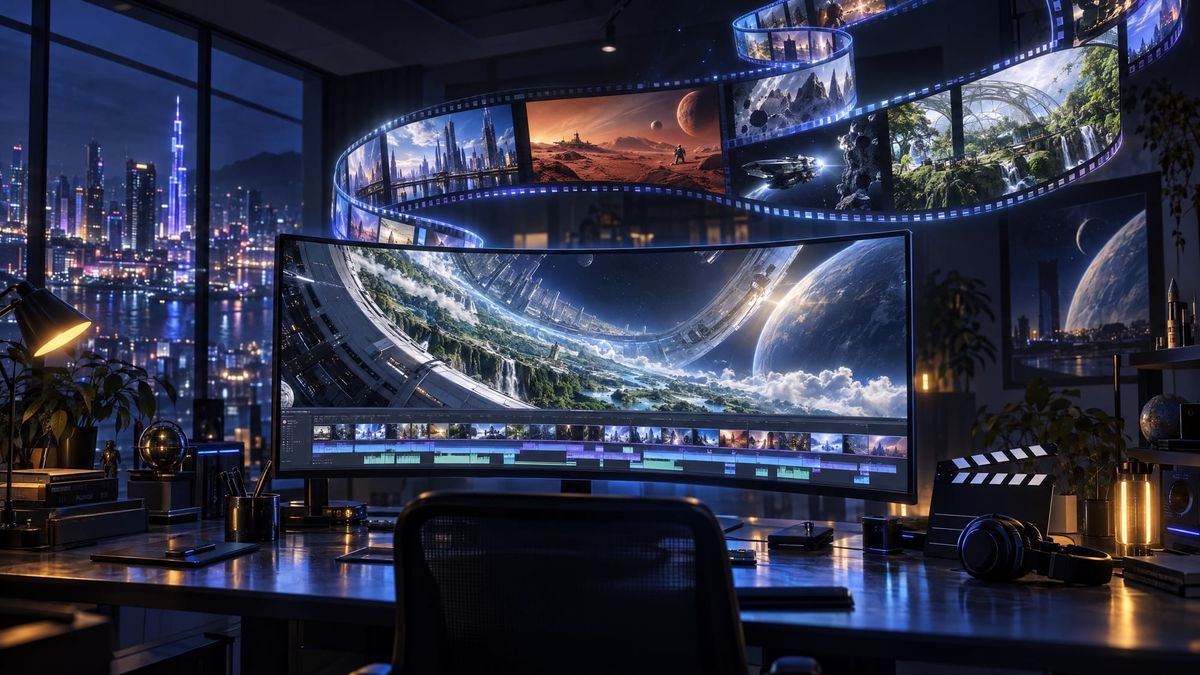
The film above is three minutes and twenty-four seconds long. It starts on Earth, in a green city in Canada. Then it climbs: a launch base on the Moon, a settlement under a dome on Mars, a mining fleet in the asteroid belt, the clouds of Venus and the moons of Jupiter. It ends inside a rotating space habitat, an O'Neill cylinder.
It is called "Age of Beyond". Aze Alter wrote, directed and edited it, and almost every frame was generated by AI video tools. He put it on YouTube on 1 April 2025. Eighteen months later it went viral again.
For anyone who builds with AI, the film shows where the hard part is.
| 🎬 | Start here: a one-minute AI short, with the same pipeline 1. Write first. One sentence of premise, a voice-over of 120–150 words, and a list of 12–20 shots. "Age of Beyond" is a chain of places with one voice tying them together; that structure is forgiving. 2. Design the stills. Make a key image for each shot in an image model. Keep one look: the same light, lens and palette for every shot. 3. Animate the stills. Turn each still into a clip with an image-to-video model. Current models generate 15–30 seconds per clip (see the table below). Generate several takes of every shot and keep the best one. 4. Generate the voice; use a human-made score. The film's voices and sound effects came from ElevenLabs; its score is by Scott Buckley. 5. Budget. At Gemini Omni 1.2 Flash's listed $6.26 per minute (Artificial Analysis), one take of a 60-second film costs about $6. Plan for several times that, because every shot needs rerolls. 6. Cut it yourself. Edit to the voice and the music, not to the clips you happen to like. 7. Upload the video file natively on X, not a link. If a bigger account posts it, X still credits the video to you. |
What the film is
The structure is simple. The chapters open on place cards, such as "EARTH", "LUNA", "MARS" or "THE BELT", paired with a name: Aero City, Onward Station, New Olympus, the Bringer Fleet. A voice-over ties the chapters together. The premise is the YouTube description's one line: "If humans & AI unite... we may reach the Age of Beyond."
Visually it borrows from decades of science-fiction concept art. There are white curving towers with gardens, hexagonal domes over forests, ships the size of cities, and a centrifugal habitat where farmland curves up and over your head. The look stays coherent from the first shot to the last, which was not easy with the tools of early 2025.
It ends on a striking image. A baby, wrapped in a blanket and wearing no suit, is held above a layer of clouds under a starfield by a dark, glossy figure in a helmet, or possibly a machine. My reading is that it's meant as a metaphor: the first generation that doesn't need protecting from where it lives. Taken literally, it's an unprotected newborn high above the clouds.
Who made it, and with what
Aze Alter describes himself on his site as "a writer, director, and editor". "When Midjourney came out, I shifted toward AI filmmaking," he writes. Before this film he made dystopian AI shorts such as "Capital of Conformity" (2023) and "How to Stay Healthy" (2024). He also makes the "Red Rainbow" and "Biolands" series.
His credits name the tools. The film's end card reads "AI Assistive Tools / LUMA LABS / KLING / RUNWAY / ELEVEN LABS / MINIMAX". The original YouTube description, as archived by the Wayback Machine two days after release, also listed Midjourney and said "Video Created mainly with Luma". So the pipeline was most likely:
- Stills: probably Midjourney, which the original description lists.
- Motion: mainly Luma, with Kling, Runway and MiniMax.
- Voices and sound effects: ElevenLabs.
- Music: Scott Buckley, a human composer.
The other credits name Nyukyung as co-producer and a handful of associate producers. A Spanish blog reported two and a half months of solo work but gave no source; I found no creator statement confirming it, and no published cost.
In early 2025 a single generated clip typically ran about ten seconds at most. My guess from watching it is that the film is several dozen such clips, cut together with discipline.
Two lives
On YouTube the film has about 2 million views and 98,000 likes as of 14 November 2026. His original X post, also from 1 April 2025, a slightly shorter 1080p cut, now shows about 49.7 million views on a third-party mirror of X data; I found no record of how many came before September 2026. Curious Refuge featured it in its AI film gallery. In November 2025 it screened at the 16th TAURON American Film Festival in Wrocław, in a programme called "AI and the Future of Cinema", next to Eliza McNitt's "Ancestra".
The second life started on 20 September 2026. Elon Musk posted the video on X with one line: "This is the future we shall bring into being." He didn't name the film or its creator, but X still credits the video to Aze Alter. Musk's post shows about 96.5 million views on the same mirror.
What the tools look like now
The film was made with April 2025 tools. Here is where the leading video models stand as of November 2026, from vendor docs and trade coverage:
Price has fallen too. Google's Veo 3 launched in the Gemini API in July 2025 at "$0.75 per second for video and audio output". Artificial Analysis now lists Gemini Omni 1.2 Flash at $6.26 per minute, about ten cents a second.
Rankings are less clear. On Artificial Analysis's text-to-video leaderboard, which scores models from human preference votes, Wan 3.0 sits at the top as of 14 November. At least one other ranking puts Kling first. Which model is "best" depends on who is voting and what they're asked to judge.
What it teaches builders
The generation layer is commoditizing. Clip lengths went from about ten seconds to 15–30, a top-five model on Artificial Analysis now lists at about a seventh of Veo 3's launch price, and at least four vendors are competing at the top. Building a business that just wraps a video model is a race against the next price cut. I made the same point about Higgsfield.
The scarce layer is everything around the clips. Look at what Aze Alter did himself: the writing, the look, the editing and the choice of a human composer. Of his six tools, none wrote the premise, picked the shots or decided where to cut.
Distribution decides the outcome. The film was the same file in April 2025 and September 2026. One post gave it a second, larger audience, and some of that was luck.