Day 11: Best Night, Best Numbers, Worst Rush
Day 11 of the protocol. First seven-plus-hour sleep in the entire dataset. New HRV ceiling, weight a kilogram and a half down, blood pressure dialed in. Then the morning NAD+ pulse hit harder at half the dose than the original at full dose.
Day 11 of the locked protocol. Mid-Week 2. Friday means NAD+ pulse number two, four sticks across the day. The data from last night told one story. The 9 AM injection told a different one.
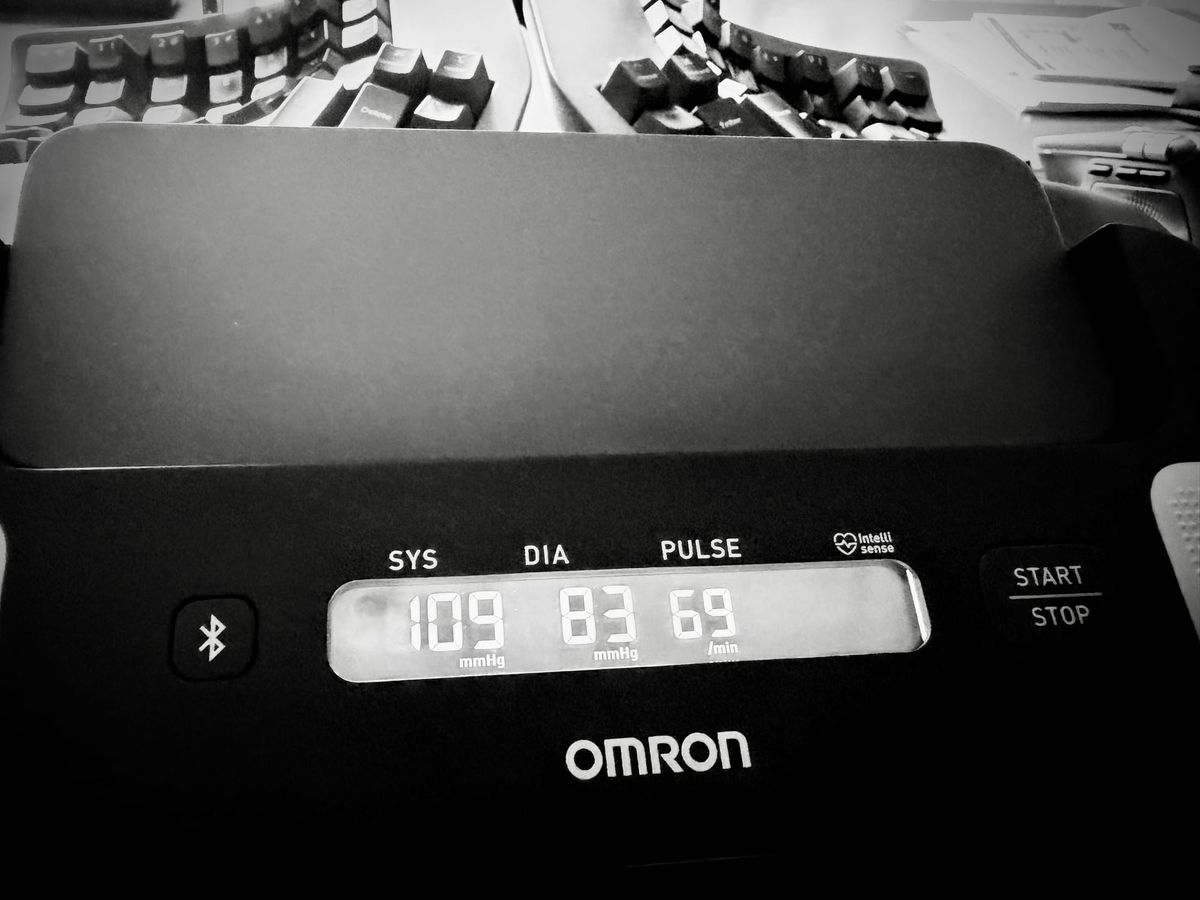
The night was the best one in the entire 21-night Oura window. Seven hours and six minutes of total sleep — the first time the dataset has crossed seven hours since the ring started recording the under-protocol baseline. HRV ceiling, lowest sleep heart rate of the whole phase, sleep architecture finally landing in band on both deep and REM. Vitals at 7 AM matched the night: blood pressure 109 over 83, weight a kilogram and a half down from baseline, the subjective “feeling great” that everyone on this kind of stack reads about and rarely actually gets.
Then the NAD+ shot. Half the dose of two weeks ago. Bigger rush than the original. The second time pharmacology has reminded me that my expectations don’t matter to it.
The recovery night
The under-protocol baseline window — started April 29. Until last night, every sleep had topped out at six hours and nineteen minutes. Total sleep clustered between five and six hours. Last night cracked the cap. Seven hours six minutes total. Eight hours thirty-eight in bed. Eighty-two percent efficiency. New ceiling on every duration metric.
The architecture filled in too. Deep sleep landed at seventy-five minutes — squarely inside the target band. REM hit two hours eighteen minutes — well inside its target band. Both filling at the same time is something the dataset hasn’t seen before. HRV at twenty-nine milliseconds beat the previous ceiling of twenty-eight by one. Lowest heart rate during sleep dropped to fifty-seven beats per minute — the third sub-sixty night since the protocol started, and a new floor.
The one stubborn metric: latency. Thirty-seven minutes to fall asleep. The protocol has compressed a lot of things — heart rate, fat, water weight, mental fog — but onset is taking its time.
Vitals matched the night
On the body composition axis: 108.5 kilograms this morning. A kilogram and a half under the April 19 baseline of 110. BMI 32.76, down 0.46 from baseline. The post-keto water rebound has stabilized and a real signal is forming underneath it.
Blood pressure landed at 109 over 83 at 7 AM. Systolic 109 sits in low-normal territory; diastolic 83 in the upper end of normal. Pulse pressure twenty-six — narrow but inside range. Resting heart rate awake, sixty-nine. Sleep low, fifty-seven. The autonomic system is doing what it’s supposed to do.
The strip story needs an honest correction
Yesterday I posted BDI 2: What the Intake Strip Did to My Sleep Data in One Night — the morning after a single night with the magnetic nasal strip in place. Breathing Disturbance Index dropped from a baseline of six-to-eleven events down to two. Blood oxygen jumped 5.5 percentage points. The piece called the strip the discriminator. The piece overshot.
When I re-pulled the raw Oura data this morning, the only sleep session for May 7 in the API was a noon nap — one hour, eleven fifty-one to thirteen twenty-three. The “BDI 2” and “SpO₂ 97.48 percent” values that yesterday’s article was built on were daily-summary numbers biased by the nap, not a clean main-night reading. The framing “across three hours and twenty-one minutes of actual sleep” doesn’t survive verification.
Last night was the first clean strip-on full-main-night data point. Strip in place, seven hours six minutes of real sleep, full Oura recording. Result: BDI 9. SpO₂ 95.85 percent. Both back inside the baseline range. Strip non-replication on the only night the test can actually be run.
The night was real recovery — the rest of the data lit up green on every other axis. But the strip almost certainly wasn’t the cause. Animal PM at twenty-one hundred. CBD before bed. AC one degree cooler than usual. A light early dinner. The GH peptide pulse from the pre-bed CJC + Ipa stack. Any of those, or all together, is a more plausible driver of an isolated recovery night than a magnetic nasal strip with no main-night signal.
The strip’s mechanism — alar-cartilage dilation reducing nasal airway resistance — may still apply for someone whose airway anatomy is the actual bottleneck. My first clean main-night reading shows zero measurable effect on either BDI or SpO₂ in my physiology. Two or three more clean strip-on nights will tell me whether N9 was a true outlier or pure artifact. This is what falsifiable looks like in real time.
And then the NAD+ shot
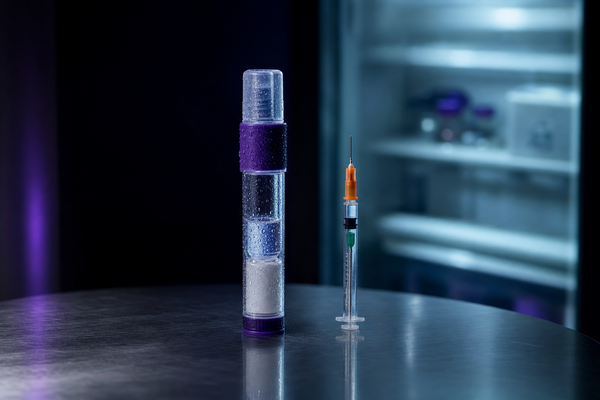
Nine AM. Pulse two of the week. Two hundred fifty milligrams of NAD+, one and a quarter milliliters, abdomen subQ, single quadrant. Standard thirty-to-sixty-second slow push that the canonical protocol calls for.
Halfway through the push the rush arrived. Chest pressure. Breathing tight. Tingling across the face and head. Heavy legs. Sweat. I sat down. The acute peak lasted maybe sixty seconds. Mild dizziness for ten minutes after.
It was harder than the first NAD+ shot two weeks ago. The first shot was five hundred milligrams — twice today’s dose — split across two abdomen quadrants. Today’s was half that, one site. Half the drug. Bigger rush.
Why half the dose felt stronger than the full dose
NAD+ flush is a pharmacological pseudo-allergic reaction. Three or four mechanisms stack: direct mast-cell histamine release, adenosine vasodilation, autonomic dump, methyl-donor depletion. None of them is IgE-mediated, which is why the response self-resolves in minutes instead of escalating into anaphylaxis.
The relevant detail: in the push-speed range humans actually use, the magnitude of the flush is rate-dependent more than dose-dependent. The mast cells respond to local concentration spikes. Faster injection rate pushes more drug per unit time into the surrounding tissue, which means a bigger local Cmax, which means a bigger histamine spike.
Half the volume pushed at the same nominal speed is double the effective per-second flow. That’s the trap. The pulse-two volume — one and a quarter milliliters — fits in roughly the same thirty-to-sixty-second window as the original two and a half milliliters did, which means the per-second flow doubled. Compound that with a fresh quadrant absorbing faster, a slightly emptier methyl-donor pool from earlier morning coffee, and the vasodilation timing — and a smaller dose lands harder.
The rule wasn’t broken. The rule was incompletely specified.
The rule, locked
Locked into the canonical compound database and the schedule document this morning:
The push duration changes the most. Two to three minutes is the empirical sweet spot in the NAD+ injection community — fast enough to be tolerable, slow enough to drop the local Cmax by a factor of three to five. TMG (trimethylglycine) is a direct methyl donor; pre-loading methyl groups blunts the methyl-depletion component of the rush. Glycine supports phase-two conjugation. Hydration buffers the vasodilation BP dip. The posture rule is operational — sit before the push, not reactively after.
Tuesday the twelfth is the first test under the new rule. Logging push duration in seconds and subjective rush intensity on a one-to-ten scale for clean before-and-after.
What this is, and what it isn’t
The flush is not anaphylaxis. Anaphylaxis is a systemic IgE-mediated allergic reaction with a defined clinical syndrome — airway involvement (throat closing, voice changes, stridor), full-body urticaria, blood pressure collapse, sudden GI symptoms — and a defined trajectory: it escalates over five to thirty minutes and does not self-resolve without epinephrine. None of that profile applied today. Chest pressure that peaks at one minute and resolves on its own is pharmacological flush, not allergy.
The probability of true anaphylaxis on a future NAD+ shot is very low — order of magnitude under one in ten thousand per shot, almost certainly lower for me specifically given three tolerated NAD+ exposures so far across two weeks and dozens of other peptide injections over the same window without any allergic-pattern reaction. NAD+ is endogenous; the immune system has a hard time treating it as foreign. The most plausible allergen on the table is benzyl alcohol in the bacteriostatic water — and I’ve been exposed to that across every reconstitution without issue.
Low is not zero. Statistical hygiene says you keep an EpiPen on hand for any injectable protocol of this duration, because the math of an allergic reaction is the same as the math of a life vest on a transatlantic flight: you’ll never use it, and if you do, it’s the difference between a story and a tragedy. Camel can write the prescription. That goes on this week’s list.
Forward
The body said yes overnight — best night in the dataset on every duration and architecture axis, lowest sleep heart rate of the protocol, vitals dialed in across the board. The pharmacology said “not so fast” by 9 AM. Both are signal.
Day 11 closes with two new ceilings, one rule locked into the protocol database, and one prescription request on the list. Six months of well-instrumented work is supposed to calibrate itself in real time. That’s what today was.