Smooth Skin & the Colombian-Arab Chef
Two updates: a Colombian-Arab chef teaching the kids to cook — with the real science on why the Levantine pantry is one of the healthiest on earth — and a follow-up to the oily-skin post. The skin turned smooth, and the honest reason is mostly metabolic, not the peptides.
Two updates — one from the kitchen, one from the skin. Both are follow-ups, and both are more interesting once you separate what actually happened from the easy story.
First the kitchen. A young Colombian-Arab chef has been running a weekly cooking-and-nutrition workshop for the kids. She studies gastronomy and lives the health side too — meditation, training, real nutrition — so the sessions aren't just recipes, they're food literacy. And the kids love it.
Teaching kids to cook is preventive medicine
The point isn't producing tiny chefs. It's that a kid who can handle real ingredients — who knows what a lentil is, how a vegetable behaves, why a whole food isn't a packaged one — builds food knowledge, confidence, and a willingness to eat outside the beige-and-sugar default while habits are still forming. Early cooking education measurably improves food knowledge and openness to unfamiliar foods. It doesn't guarantee a perfect adult diet, but it lays the wiring early, which is about as high-leverage as prevention gets.
Why the Levantine pantry is a good place to start
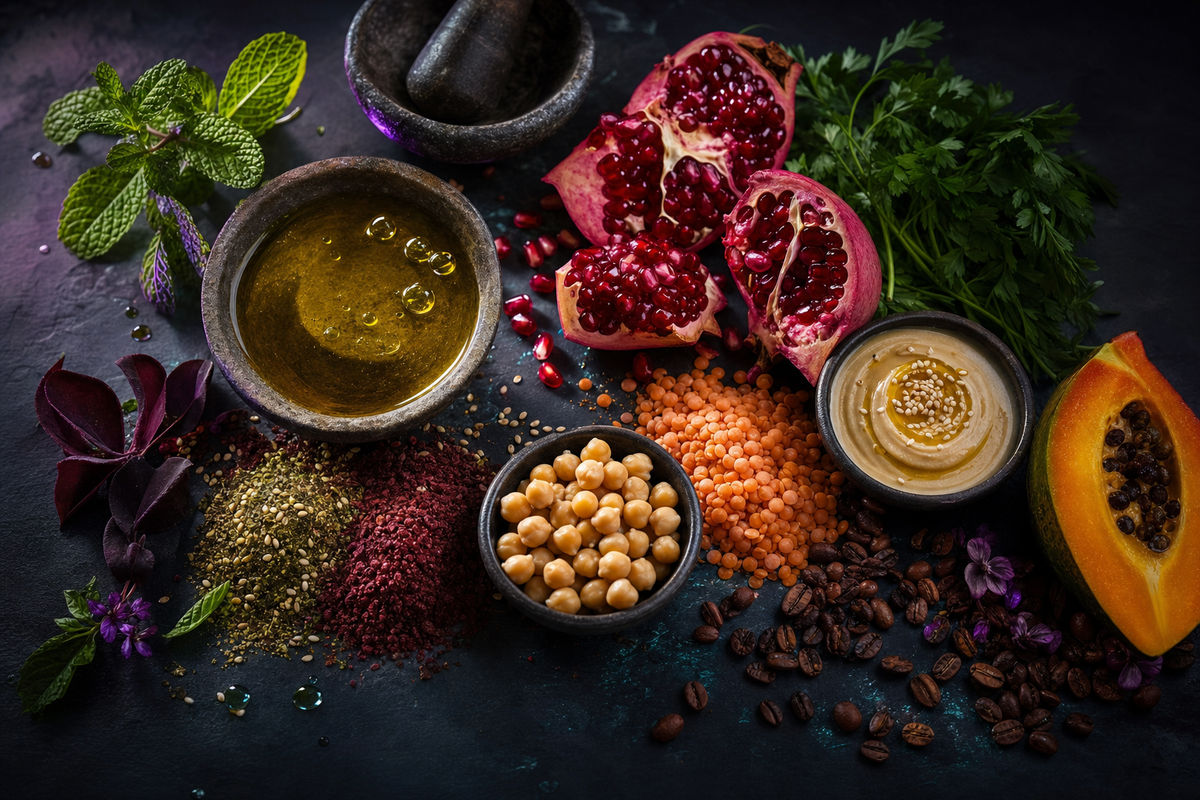
Her cooking is Colombian-Arab, and that Levantine pantry happens to overlap almost entirely with the Mediterranean diet — the eating pattern with the strongest human evidence behind it. What's actually in it:
- Extra-virgin olive oil — monounsaturated fat plus polyphenols. One of them, oleocanthal, blocks the same COX-1/COX-2 enzymes as ibuprofen in lab work; about 50 g of good oil carries roughly a tenth of an adult ibuprofen analgesic dose. The diet it anchors was tested in PREDIMED (~7,400 people, randomized): olive-oil or nut Mediterranean diets cut major cardiovascular events about 30% vs a low-fat control.
- Legumes (chickpeas, lentils, fava) — fiber, resistant starch, plant protein. They blunt post-meal glucose (viscous legume fiber ~20% lower) and raise satiety. The fermentable fiber feeds gut bacteria that make short-chain fatty acids, which trigger your gut's own GLP-1 — the same hormone the weight-loss drugs mimic, here stimulated by food.
- Tahini and sesame — sesame lignans lower LDL cholesterol and systolic blood pressure in human trials.
- Za'atar and sumac — sumac isn't just color: 3 g/day for three months lowered fasting glucose, HbA1c, and insulin resistance in type-2 diabetics. Za'atar's thyme and oregano add antioxidant and antimicrobial compounds.
- Bulgur and freekeh — low-glycemic whole grains; slower glucose, more satiety than milled flour.
- Labneh and kefir — fermented dairy; kefir lowered blood pressure and inflammatory markers in trials.
Levantine cooking reached Colombia with Lebanese, Palestinian, and Syrian immigrants who arrived from the 1880s onward and settled first on the Caribbean coast. The food stuck: kibbeh became quibbe (often beef instead of lamb), and tabbouleh and tahini folded into coastal cooking — Shakira, from Barranquilla, is the best-known descendant. Strip the labels and it's a pantry built on fiber, polyphenols, olive oil, fermented foods, and intact carbs. Teach a kid to cook from it and you've handed them the core of a "biohacking" diet without ever using the word.
Smooth skin: where the oil went
Second update — a follow-up to The Dashboard on Your Forehead. That post read the mid-morning shine as a signal: testosterone plus the GH peptides had switched the oil glands on. The new change is texture — over the last few days the skin has gone noticeably smoother, look and touch. Here's the honest mechanism, because the easy guess — the peptides are rebuilding my skin — is mostly not what the human evidence supports.
Two different things are being measured. Oily is sebum — how much the gland secretes. Smooth is texture — the dermis underneath: collagen, elastin, hyaluronic acid, hydration, barrier. Different tissue, different drivers. You can move one without touching the other.
Start with what didn't cause it. I'm on testosterone and HCG, which raise androgens, and androgens drive the oil gland. The GH peptides pull the same way: CJC-1295 + Ipamorelin raise IGF-1, and IGF-1 switches on the gland's lipid program (via PI3K/Akt → SREBP-1) — acromegaly, chronic GH excess, is famously oily-skinned. So the hormone half of my stack pushes toward more oil, not better skin. If the surface has also calmed, the only axis pointing that way is metabolic: a ketogenic diet plus the fat loss from Retatrutide lowers insulin and IGF-1 signaling at the skin — the pathway a human trial actually moved, with a low-glycemic-load diet cutting acne lesions about 51% (vs 23% on control). Net: whatever got better, the hormones didn't do it — the diet and the fat loss are the human-evidenced levers.
On the smoothness — that's a collagen-and-hydration story. GH and IGF-1 genuinely drive dermal fibroblasts to make collagen, but the clean human evidence for that is in GH-deficient patients on replacement, where skin thickness moves back toward normal; in already-healthy people the GH data is thin. For CJC-1295 + Ipamorelin specifically there's no human skin trial at all — it's mechanism, not proof. What more plausibly shifts texture in days: hydration and barrier (omega-3 improved skin hydration inside 8 weeks in a human study; water intake helps), fewer inflammatory lesions (large weight loss and GLP-1's anti-inflammatory effect both lower systemic inflammation), and a settled, evenly spread oil film. Collagen remodeling takes weeks to months — so a change over a few days is barrier and hydration far more than new scaffolding.
And the honest caveat cuts against me: the documented skin effect of fast GLP-1 weight loss isn't "smoother," it's "Ozempic face" — volume loss and laxity. I'm not seeing that, but the literature warns about it, and it would be overselling to credit the peptides for collagen no human trial has shown them build.
Read the Evidence column top to bottom and the shape is clear: the compounds with the loudest reputations for skin (the peptides) have the weakest human data, and the boring metabolic levers — keto, fat loss, hydration — have the strongest. Most of the credit belongs to the diet, not the vials.
Hot takes
- Oily and smooth aren't the same axis. One is a gland, the other is the dermis. You can move one without touching the other.
- Whatever improved, the hormones didn't do it. Testosterone, HCG, and the GH peptides all push toward more oil. Keto and fat loss are the only human-evidenced levers pointing at better skin.
- A skin change over days is hydration and barrier, not new collagen. Collagen is slow. The mirror is a fast sensor with poor specificity — don't promote a plausible pathway into proof.
- The Levantine pantry already is the stack: fiber, polyphenols, olive oil, fermented foods, intact carbs. Kids learning to cook it is preventive medicine that doesn't feel like medicine.
The point
Two updates, one rule: separate the signal from the story. The kids are learning where food comes from, from someone who treats cooking and health as the same subject. And the skin got better for reasons that are mostly metabolic and partly unprovable — saying which is which, out loud, is the whole point of tracking it.
The Dashboard on Your Forehead — the oily-skin post this follows up.
Borrowing the Pulse: CJC-1295 + Ipamorelin — the GH/IGF-1 peptides behind the texture mechanism.
Retatrutide: The Off Switch — the fat loss doing most of the metabolic work.