Retatrutide: The Off Switch
Retatrutide hits three receptors and makes semaglutide and tirzepatide look like the warm-up act. The mechanism, the trial numbers, my dose and where I'm taking it next — and the one thing nobody warns you about: it works so well you'll stop eating protein and drinking water, and burn muscle.
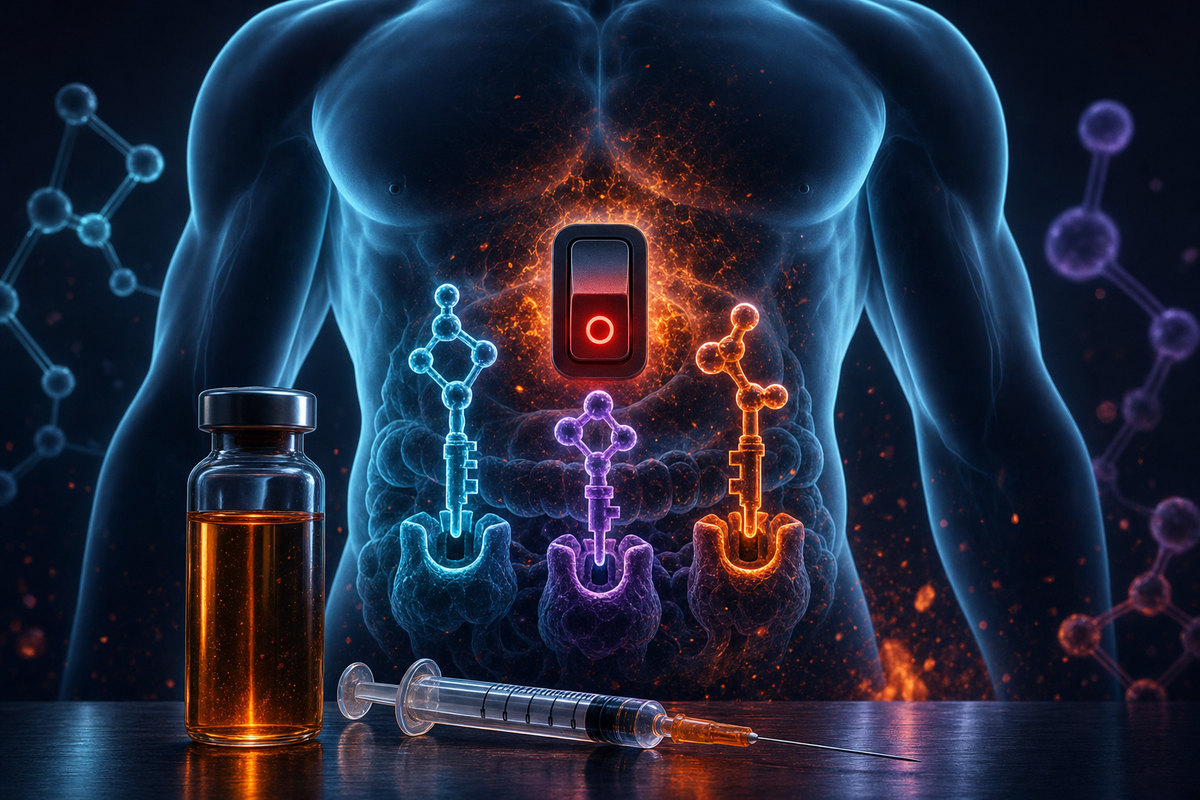
Semaglutide gave the world a satiety switch. Tirzepatide added a second receptor and pulled ahead. Retatrutide hits three at once — and in the data, it doesn't just beat them, it makes them look like the warm-up act.
I've been running it for two months. This is the mechanism, the trial numbers, my exact dose and where I'm taking it next — and the one thing nobody warns you about: this drug is so good at switching off appetite that the real danger isn't a side effect. It's that you'll quietly stop eating protein and stop drinking water, and burn muscle you never meant to.
What makes it different: the glucagon arm
Retatrutide is a once-weekly injectable — a single 39-amino-acid peptide that agonizes three receptors at the same time: GLP-1, GIP, and glucagon. That third one is the whole story.
- Semaglutide (Ozempic / Wegovy) = GLP-1 only.
- Tirzepatide (Mounjaro / Zepbound) = GLP-1 + GIP.
- Retatrutide = GLP-1 + GIP + glucagon.
GLP-1 and GIP are appetite-side levers — they make you eat less. Glucagon is the metabolic-rate lever — it mobilizes stored fat and raises energy expenditure. So where the first two fight the calories-in war, Retatrutide fights both fronts: it crushes intake AND turns up the burn. You eat far less and oxidize more. That's why it tops the leaderboard.
The numbers that raised the bar
In the Phase 2 trial (NEJM, 2023), adults with obesity on the top 12 mg weekly dose lost a mean 24.2% of body weight at 48 weeks versus placebo. For context: top-dose semaglutide lands around 15%, top-dose tirzepatide around 21%. Retatrutide cleared both. Read the distribution and it gets louder:
- 100% of the 12 mg arm lost at least 5%.
- 93% lost 10% or more; 83% lost 15% or more.
- Roughly two-thirds lost 20%+; half lost 25%+; a quarter lost more than 30%.
- Women averaged 28.5%, men 21.9%.
And the line that matters most if you're planning a cut: the weight-loss curve had not plateaued at 48 weeks. People were still dropping when the trial ended — we hadn't seen the bottom. The Phase 3 TRIUMPH program has since confirmed it: 28.3% mean loss at 80 weeks on 12 mg, climbing to about 30.3% (roughly 85 lb) at 104 weeks in the higher-BMI extension. It's still investigational — not FDA-approved as of mid-2026. That's a status, not a warning.
Mechanism, ELI5
- GLP-1 → satiety, slowed gastric emptying, glucose-dependent insulin. You feel full fast, food sits longer, blood sugar behaves.
- GIP → more insulin sensitivity and appetite modulation. Sharpens the GLP-1 effect.
- Glucagon → mobilizes fat and raises metabolic rate. This is the engine the other two drugs don't have.
GLP-1 + GIP = eat much less. Add glucagon = and burn more while you do it. Two drugs play defense. Retatrutide plays both ends of the field.
My dose — and where I'm taking it
The protocol is a slow ramp, because the gut has to adapt or it revolts. Trial titration goes 0.5 → 1 → 2 → 4 → 8 → 12 mg, roughly four weeks a rung. Skip a rung and nausea spikes hard — jumping straight to 8 mg without the lower steps ran 60% nausea versus 17% for the gradual climb. The ramp isn't caution, it's throughput: titrate clean and you actually stay on the dose.
- Month 1: 0.5 mg / week.
- Month 2 to now: 1 mg / week — 33.3 units on a U-100 insulin syringe. Smooth. No nausea, no GI drama.
Two months in, my body has fully adjusted. Appetite suppression is locked in, side effects are nil, and I'm sitting at the bottom of the dose range with a huge runway above me. I'm ready to climb. The plan: re-test bloodwork in a month, and assuming it's clean, push the dose up.
Think of it as blast and cruise for fat loss. You don't have to sit at a maintenance dose forever. When you want to accelerate the burn, you blast — temporarily move the dose up to dial fat oxidation higher on purpose — then cruise back down to hold. Fat loss becomes a throttle you control, not a setting you accept. 1 mg was the cruise. The blast is next.
The part nobody warns you about: it turns off wanting
Retatrutide doesn't just suppress hunger. It suppresses wanting.
The appetite effect is obvious and ruthless — I eat 60-70% less per meal, and fewer meals, two or three max, with no effort and no willpower. The food just stops calling. But the GLP-1 class doesn't only quiet food reward — it quiets the mesolimbic dopamine system, the brain's general-purpose wanting machine. Which means it dampens cravings across the board.
This is well documented now. GLP-1 receptor agonists blunt the reward response to alcohol, nicotine, cocaine, opioids — the whole catalog; one opioid-use pilot cut cravings about 40% in three weeks. The mechanism is shared: the same reward substrate sits underneath food, booze, and every compulsive loop you've got. The technical phrase is "reduced wanting." Lived, it feels like the volume knob on desire itself getting turned down — and not selectively.
That's a double-edged blade. The cross-craving suppression is a gift if you're trying to kill the drink or the vape — Retatrutide does that work in the background. But the same flattening hits things you don't want gone. And then there's the one that'll actually hurt you: it suppresses thirst. Same hardware — the hypothalamic GLP-1 receptors that govern hunger sit right next to the ones governing thirst, and the drug quiets both. It's called hypodipsia — reduced thirst perception. You don't feel thirsty, so you don't drink, so you walk into dehydration without a single warning signal. Eating less stacks on top. The thirst alarm is just off.
The operator's rule: force the inputs, or lose muscle
Put it together and the real risk profile is nothing like a normal drug's. The danger isn't a side effect. It's that Retatrutide works so well you forget to eat protein and drink water. Left on autopilot, the appetite suppression drives you into a deep deficit with almost no protein and barely any fluid — and now you're not running a fat-loss protocol, you're running a muscle-wasting one. GLP-1-class weight loss can run 25-40% lean mass if you let it. That's not fat-specific. That's catabolism.
So the rule flips the usual logic. On every other cut, appetite is the enemy you fight down. On Retatrutide, appetite suppression is a tool you have to manage UP. You override it. Non-negotiables:
- Eat 3 high-protein meals a day — forced. Not "when hungry." You will never be hungry. Schedule it. Hit 1.6-2 g of protein per kg of bodyweight, spread evenly. Protein is the signal that tells your body to burn fat and keep muscle. Miss it and the scale still drops — it's just eating your lean mass.
- Eat carbs. No keto on Retatrutide. You need the carbohydrate and the total calories to fuel training and protect muscle. Stacking keto's appetite suppression on top of Retatrutide's is how you crater into an accidental near-fast. Eat the carbs on purpose.
- Force water. Set a daily target and hit it on a clock, not on thirst — the thirst signal is offline. Add electrolytes; less food means less sodium. Treat hydration as a scheduled input, like the injection itself.
- Train — lift. Resistance work plus adequate protein is what makes the loss fat-specific. Two to four hard sessions a week tell the body which tissue to keep.
Do it right — forced protein, real carbs, forced hydration, hard training — and the suppression becomes pure leverage: the fat comes off and the muscle stays. Do it wrong and the same drug that's the best fat-loss tool ever trialed will strip muscle off you while you smile, never hungry, never thirsty, never warned. Appetite suppression isn't the prize. It's the variable you have to manage.
Hot takes
- Glucagon is the moat. Strip it out and you've got tirzepatide. The third receptor is the entire performance gap — burn, not just less intake.
- "It didn't plateau" is the scariest line in the data. 24% at 48 weeks with the curve still pointing down means the published ceiling isn't the real ceiling.
- The thirst suppression is more dangerous than the nausea. Nausea announces itself and self-limits. Silent dehydration just degrades you with zero alarm.
- This is the most effective accidental sobriety drug on the market. It kills the drink and the nicotine craving as a side effect. Nobody's marketing that yet. They will.
- Keto on Retatrutide is a self-own. Two appetite suppressors stacked is a recipe for muscle loss, not faster fat loss. Eat the carbs.
- The scale lies on a GLP-1. Dropping weight isn't the same as winning — without forced protein and lifting, a chunk of that number is muscle. Track body composition or you're flying blind.
- Blast-and-cruise belongs here too. Fat loss is a throttle: sit low to cruise, blast up to accelerate, drop back to hold. Manage the dose like a dial, not a prescription.
Blast & Cruise — the same dial-it-up-then-hold logic, applied to testosterone.
Carbs Are Back, and It's Fucking Awesome — why you eat the carbs and the protein, not keto, while the fat drops.
The Wolverine Stack — BPC-157 + TB-500, another piece of the same protocol.
Borrowing the Pulse: CJC-1295 + Ipamorelin — the GH peptides in the same protocol.
NAD+: The Longevity Tax — the longevity coenzyme.
Better Than Ever: Seven Protocol Changes That Compounded — seven recent changes that compounded into the best the system has felt.
The Bar Doesn't Lie: 25% Stronger in Two Weeks on Carbs — the recomp receipt: strength climbing while the fat kept coming off.
Smooth Skin & the Colombian-Arab Chef — the fat loss doing most of the metabolic work on the skin.
Three Months In — the three-month scorecard, and the blood panel that gates what comes next.
Next Level Preps — why lean-mass loss is the number that matters as the dose goes up.