NAD+: The Longevity Tax
NAD+ is the compound I can't feel and pay the most for — and I run it anyway. What it is, where the human longevity evidence is real and where it's still a promissory note, the slow-push that kills the flush, and why the most expensive line in my stack buys the slowest payoff to verify.

Most of the compounds I run, you feel. A peptide kicks in, sleep gets deeper, a joint stops talking to you, recovery tightens up. You get a signal, you adjust, you keep what works. NAD+ is not that.
NAD+ is the one I run knowing I will probably never feel it land — and it's also the most expensive thing in the entire stack. That combination should make you suspicious, and it should make me honest. So this is the post where I tell you exactly what NAD+ is, why the cell can't run without it, where the human longevity evidence is genuinely strong and where it's still a promissory note, and the protocol I actually run — which produces exactly zero side effects because of two boring tricks that turn out to be the whole game. This is not a feel-it-today stimulant. This is infrastructure. Read it that way.
What NAD+ actually is
Nicotinamide adenine dinucleotide. NAD+ for short. It's a coenzyme — a helper molecule — and it's in every single cell you have. Not a niche tissue, everywhere, all the time. Three jobs matter for the longevity story:
- It runs the power plant. Inside your mitochondria, the electron transport chain turns food and oxygen into ATP — the currency your cells spend to do anything. NAD+ is the shuttle that carries electrons into that machine, flipping between NAD+ and NADH thousands of times a second. No NAD+, no shuttle, no ATP. This is the most non-negotiable role: it's not optional to being alive.
- It pays for DNA repair. Your DNA takes thousands of hits a day. A family of enzymes called PARPs does the repair, and PARPs burn NAD+ as fuel. Every break they fix costs NAD+. More damage, more drain.
- It switches on the longevity genes. The sirtuins — seven in humans — regulate cellular maintenance: which genes are on, how mitochondria get built, how cells handle stress and inflammation. They're the most-studied characters in the aging field, and they cannot fire without NAD+. Drop NAD+ and the sirtuins go quiet, even if everything else is in place.
So one molecule sits at the intersection of energy production, genome maintenance, and the longevity-gene control panel. That's why it gets the attention. It's a hub.
The decline, and the honest longevity thesis
Here's the story that launched a thousand supplement brands: NAD+ falls as you age — one of the more reproducible molecular signatures of getting older, roughly a 50% drop between 40 and 60. And it's a double squeeze: you make less (the NAMPT enzyme that builds it declines) AND you spend more (accumulating DNA damage runs the PARPs overtime, and low-grade "inflammaging" ramps up an enzyme called CD38 that chews through NAD+ aggressively). The tank runs lower and the leaks get bigger.
The thesis is the obvious next step: if low NAD+ tracks with the breakdowns of aging, refill the tank and you should slow the breakdown. In animals it's more than a story — restoring NAD+ improves metabolism, extends healthspan, and rescues a list of age-related pathologies in mice that reads like a wishlist.
Now the honesty. In humans, the lifespan case is not proven. NAD+ precursors reliably raise blood NAD+ — that part is settled across many trials; the tank refills. But the downstream outcomes don't follow cleanly yet. A 2025 meta-analysis of 10 randomized trials found no significant benefit to muscle mass, grip strength, or gait speed in adults over 60 (gait came in at a flat p=0.79). A late-2025 Lancet trial of nicotinamide riboside found it didn't improve cognition, fatigue, sleep, or mood despite successfully raising NAD+. Where humans do show benefit it's modest and specific — small blood-pressure, lipid, and insulin-sensitivity gains. So: strong mechanism, strong animal data, consistent biomarker movement in humans, and not-yet-definitive human outcomes. Anyone selling you certainty is selling. I run it as a bet, not a settled fact. That's the deal, stated plainly.
Injectable vs precursors — why I inject
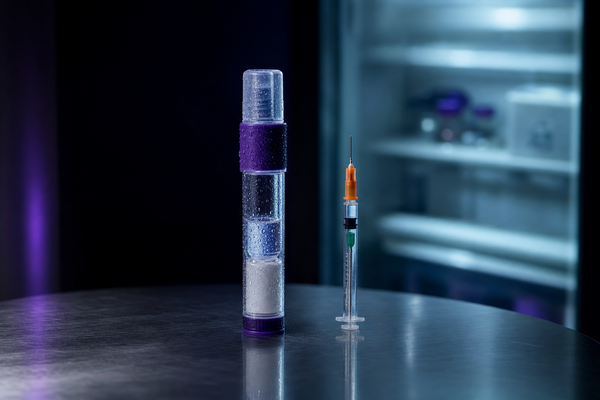
You can't realistically swallow NAD+ itself — the molecule gets torn apart in digestion. So oral products use precursors, NMN and NR: smaller building blocks that survive the gut, get absorbed, and your cells reassemble into NAD+. They work — they raise NAD+ — but they pay a tax: absorption variability, first-pass metabolism through the liver, and a ceiling on how much you can practically take. Injectable NAD+ skips all of that — the finished molecule, straight into circulation. IV gives the biggest single dose but chains you to a clinic chair for hours; subcutaneous, what I run, bypasses the gut the same way but releases NAD+ from a depot under the skin, a slow reservoir that trickles into the blood instead of a brutal bolus.
Worth noting the irony: the oral precursors have the better human-trial paper trail, while injectables have the better pharmacokinetics. I inject because I want the finished molecule in circulation without the first-pass tax — but I won't pretend the RCT literature was built on injectables. It wasn't.
The flush, and why the slow push is the whole protocol
Here's the single most practical thing about injectable NAD+, and almost nobody leads with it: push it too fast and it punishes you. The signature is a flush — chest pressure, a tightening, nausea, a head-rush, the feeling that something is wrong. It scares people off the compound entirely. And it's not random: when NAD+ hits your bloodstream too quickly, some of it converts to nicotinic acid (a niacin form of B3), which triggers prostaglandin release — the same mechanism behind the classic niacin flush — plus some direct vascular dilation. An unpleasant few minutes that feel a lot more alarming than they are.
The fix is almost insultingly simple: it's rate-dependent. Slow down and it fades. This is exactly why clinics run IV NAD+ over two to six hours — not because the dose is dangerous, but because speed is what generates the misery. So for an injection, the rule is a slow push: not jab-and-done, a deliberate 2-3 minute press. That single change is the difference between "this compound is intolerable" and "I feel nothing." The slow push isn't a comfort preference. It is the protocol.
My protocol
Here's exactly what I run, and why it produces zero side effects:
- 100 mg a day, Wednesday through Sunday. Five days — 500 mg across the week.
- Slow subcutaneous push, 2-3 minutes, every single time.
- Split, never bolus. Instead of slamming the full weekly gram in one sitting — the classic way to guarantee a flush — I break it into small daily microdoses. 100 mg on a slow push is a dose the body absorbs without complaint.
Split plus slow push equals zero flush, zero nausea, zero rush. Two boring decisions completely neutralize the only real downside of the compound. People quit NAD+ because their first experience was a big fast dose that made them feel like they were having a cardiac event — the fix was never a different compound, it was a smaller, slower delivery. What I'm actually after: cellular energy and mitochondrial function, DNA-repair capacity, sirtuin activity. None of these are things I'll feel as a buzz. They're infrastructure. I'm not dosing NAD+ to have a better Tuesday; I'm dosing it to keep the cellular machinery stocked over years.
The cost — the longevity tax
Now the part nobody likes to quantify: NAD+ is, by a wide margin, the most expensive compound in my protocol. The reason is simple — it's dosed at gram-scale weekly. A peptide is effective at micrograms, fractions of a milligram; NAD+ wants hundreds of milligrams a day, a full gram a week, and the finished molecule isn't cheap to produce or source. At clinic prices, injectable NAD+ runs roughly $95-200 per shot and weekly protocols land in the $380-800 a month range, with full IV sessions hitting four figures each. Even self-administered, gram-scale injectable NAD+ is a genuine line item, not a rounding error.
So here's the honest trade, stated cleanly: the most expensive thing in my stack buys the benefit that is hardest to verify. The compound I can least feel is the one I pay the most for. On paper that's the worst pitch imaginable. I run it anyway, for a specific reason: the mechanism is foundational, not speculative. NAD+ is non-negotiable to energy, repair, and sirtuin function; the decline with age is real; and the animal data is strong enough that I'm willing to fund the human bet while the RCTs mature. That's what a longevity tax is — paying now, in real money, for a probabilistic payoff you collect over decades and can't confirm in a mirror this quarter. If you need to feel every dollar work, NAD+ will frustrate you. If you think in infrastructure and decades, it earns its place. I've decided it earns its place — a position, not a promise, and I'll tell you the moment the human evidence forces me to revise it.
Hot takes
- NAD+ is not a stimulant, it's infrastructure. Stop trying to feel it — you don't feel your plumbing working either; you feel it when it fails. Judge it on mechanism and the long game.
- The slow push is the whole protocol. Fast push = flush, nausea, quitters. A slow 2-3 minute push = a non-event. The technique matters more than the brand.
- Split the dose; never bolus. Small daily microdoses crush the weekly gram into tolerable pieces. One big weekly slam is how you guarantee the flush you were trying to avoid.
- The flush is chemistry, not danger. Too-fast NAD+ converts to nicotinic acid and dumps prostaglandins — the niacin-flush pathway. Rate-dependent and harmless. Knowing the mechanism kills the fear.
- Oral precursors have the better human paper trail; injectables have the better pharmacokinetics. Both are legitimate — don't let anyone flatten the tradeoff.
- Blood NAD+ goes up reliably; proven human longevity outcomes do not — yet. The biomarker moves in every trial; the hard endpoints haven't followed cleanly. Run it as a bet, stay honest, not as gospel.
Borrowing the Pulse: CJC-1295 + Ipamorelin — the GH peptides on the other end of the same protocol.
The Wolverine Stack — BPC-157 + TB-500, the repair peptides.
Retatrutide: The Off Switch — the fat-loss compound that completes the stack.