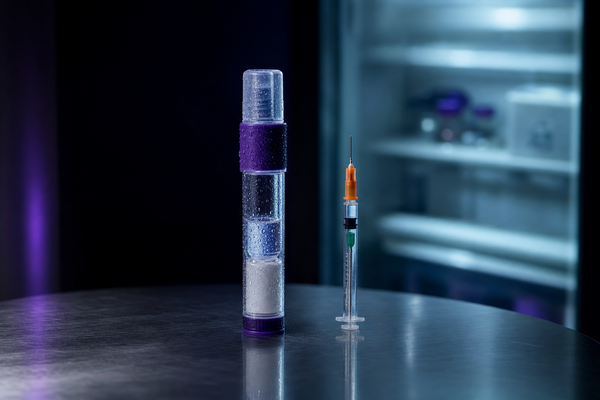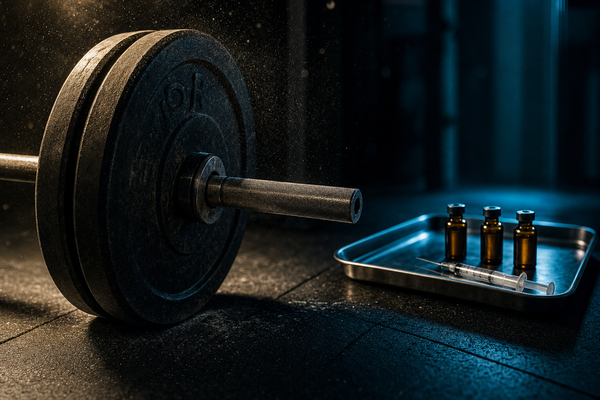
The Wolverine Stack
BPC-157 and TB-500 — the "Wolverine Stack" — get sold as a comic-book healing serum. The reality is more useful: two repair peptides that keep you training when your tendons want to quit. What they do, what the evidence actually shows, and the bodybuilding reframe most write-ups miss.

The internet calls BPC-157 plus TB-500 the "Wolverine Stack," after the mutant who heals from anything. It's a vivid nickname and a misleading one. There's no adamantium and no overnight regeneration. What there is: two peptides that drive tissue repair through different, well-characterized pathways — one builds infrastructure locally, the other mobilizes the workforce systemically. Neither makes you heal faster than your biology allows; they nudge processes that already exist. And for anyone who trains seriously, especially past 40, that's the more valuable story — not because they build muscle (they don't, not the way testosterone or growth hormone do), but because they may keep you in the game when the part that actually limits you — tendons, ligaments, joints — starts breaking down faster than it rebuilds.
I run both myself, folded into a broader protocol. Here's what they actually do — and what they don't.
BPC-157 — the local contractor
Body Protection Compound-157 is a 15-amino-acid pentadecapeptide, originally isolated from a protective protein in human gastric juice. The name overpromises; the mechanism is specific and, in animals, robust. The simple version: BPC-157 builds the roads.
The grown-up version: it works largely through the VEGFR2-Akt-eNOS pathway — it upregulates VEGF (vascular endothelial growth factor) and nitric oxide, which together drive angiogenesis, the growth of new blood vessels. It also recruits fibroblasts (the cells that lay down collagen), improves how that collagen organizes, and raises growth-hormone-receptor expression in tendon fibroblasts so those cells respond better to the growth hormone already circulating in you.
Here's the part most write-ups skip — why that matters so much for the exact tissues lifters wreck. Tendons and ligaments are hypovascular: poor blood supply by design. That's why a torn hamstring heals in weeks and a cranky patellar tendon nags for a year — the repair machinery can't reach tissue the blood doesn't service. A peptide whose headline effect is building new blood vessels into poorly-vascularized tissue is aimed squarely at the lifter's actual bottleneck. That's a structural argument, not a vibe — and it's the strongest part of the BPC-157 story.
It's also a gut peptide first — it came out of gastric-juice research with a strong preclinical record for healing GI mucosa. For anyone who's run hard training blocks alongside heavy anti-inflammatory (NSAID) use, that gut carryover is a quietly relevant benefit.
The catch, plainly: the impressive data is almost all in rodents. As of 2026 there is no published human randomized controlled trial for tendon repair. The human evidence is case series and self-report. The mechanism is real and consistent across models — but anyone selling you certainty is selling.
TB-500 — the logistics network
TB-500 is a synthetic fragment of Thymosin Beta-4 (Tβ4), a 43-amino-acid protein your body already makes in nearly every cell. Where BPC works locally, TB-500 works systemically. The simple version: TB-500 sends the construction crews.
Mechanically, it sequesters G-actin — regulating the actin cytoskeleton, the machinery that lets cells move. So its signature effect is cell migration: it mobilizes fibroblasts, endothelial cells, and progenitor/stem cells and helps them travel to the damage. You're not aiming it at one tendon; you're raising the whole repair tide.
It carries two more tricks. Its Ac-SDKP sequence is anti-inflammatory and pro-angiogenic (more VEGF — note the overlap with BPC). And it appears to reduce fibrosis by dampening TGF-β-driven collagen overdeposition. That anti-fibrotic angle is underrated: the goal of repair isn't just more tissue, it's better-organized tissue. Scar that's stiff and disorganized is how you re-injure. A peptide that biases healing toward less fibrosis is solving a different problem than one that just speeds closure.
Now an evidence distinction almost nobody makes. The impressive human-trial pedigree people cite belongs to Tβ4, the parent peptide — RegeneRx took Tβ4 through Phase I/II human trials for corneal disease, venous leg ulcers (with significant wound closure), and cardiac repair; rat wound models showed re-epithelialization up 42% at day four and 61% at day seven versus saline. But "TB-500," the research-chemical analog sold in vials, is not the exact molecule those trials used. The mechanism is shared; the provenance is not. Borrowing Tβ4's résumé to vouch for the gray-market analog is a sleight of hand — hold both facts at once.
The synergy — roads and crews
Why stack them? Because they cover different halves of the same job. BPC-157 builds the roads — the blood supply, the growth factors, the local scaffolding. TB-500 sends the construction crews — it mobilizes the repair cells and routes them to the site. One creates the conditions for healing; the other delivers the labor. A genuinely good mechanistic rationale.
And right now, only a mechanistic rationale. There is no controlled study comparing the stack against either peptide alone — nobody has run BPC + TB versus BPC-only versus TB-only versus placebo and measured who healed better. "Should work" and "demonstrated to work better together" are different epistemic tiers, and the honest move keeps them in different boxes. Anyone selling you the stack as a proven 1+1=3 is filling a gap in the data with confidence. It's a reasonable bet. It is not a fact.
The bodybuilding reframe — availability, not mass
Here's the reframe. These are not anabolics. Not steroids, not growth hormone; they will not add a meaningful kilo of muscle on their own. Evaluate them on a mass-building axis and you're using the wrong ruler.
The right ruler is availability. The dirty secret of long-term lifting — especially past 40 — is that progress is rarely capped by how hard you can train on a good day. It's capped by how consistently you can train without something breaking down. Muscle adapts fast; tendon adapts slow (that hypovascularity again); joints accumulate the cost of heavy loading. The over-40 lifter's enemy isn't a soft training max — it's the rotating cast of tendinopathies and joint flares that cost weeks at a time.
So reframe the category: the best performance enhancer is the program you can actually run. A recovery peptide that keeps a nagging elbow or patellar tendon quiet enough to train through doesn't show up as a number on the bar that day — it shows up as twelve uninterrupted weeks instead of eight-then-deload-then-rehab. Over a year, availability dwarfs any single session's intensity. The Wolverine name is silly, but it points at the right organ — not the muscle, the repair system. The uses that fit: nagging tendinopathy, joint pain from heavy loading, faster between-session recovery, off-cycle connective-tissue repair, the gut carryover. None of those is "get bigger."
What it looks like in practice
The community and literature ranges, because the numbers are already public in my prior posts: BPC-157 around 250-500 mcg/day, sometimes split, sometimes near the injury site, in cycles of a few weeks; TB-500 around 2-5 mg/week, systemic, usually split into a couple of doses, cycled over a month or two. My own run sits at the conservative end — BPC-157 at the floor, 250 mcg daily; TB-500 at 2 mg twice weekly — folded into a broader stack and judged against recovery markers (resting heart rate, heart-rate variability, sleep on the Oura ring) rather than vibes. I'm reading signal, not believing a vial did something.
Hot takes
- BPC-157 and TB-500 aren't in the steroid category — they're in the physical-therapy category. Filing them under "gains" is the single biggest misunderstanding in the space.
- The synergy is a whiteboard, not a result. No head-to-head study exists — two good mechanism stories that look complementary are a hypothesis, not a proof. Treat the stack premium accordingly.
- Tendon hypovascularity is the real thesis. The best argument for BPC-157 in a lifting context is that it builds blood supply into the exact tissue that heals slowly because it lacks blood supply. Structural fit, not testimonial.
- "TB-500" is riding Tβ4's résumé. The human trials belong to the parent peptide; the vial in your fridge is a different, unvalidated analog. Anyone who blurs that line is hoping you won't notice.
- Judge them on availability, not mass. Over a year, the lifter who never lost six weeks beats the one who PR'd in March and rehabbed through April.
- The vial is the risk, not the dose. With gray-market peptides the real variable is what's actually in it — contamination, mis-sequenced chains — not the microgram count on the label.
Bottom line
The Wolverine Stack is overhyped and under-understood at the same time. It will not give you a healing factor. What it plausibly does — and the mechanisms are real even where the human trials are thin — is help the slowest-healing, most training-limiting tissues in your body keep pace with what you ask of them. That's not a comic-book power. For anyone planning to still train hard at 60, it's something better: staying in the game.
From Panel to Protocol — where BPC-157 and TB-500 first entered the 8-compound stack, and the logic behind it.
The Abdomen Said No — the injection-site rotation problem TB-500's big volume helped create, and the thigh-primary fix.
Carbs Are Back, and It's Fucking Awesome — the nutrition half of training recovery, under the same medical supervision.
Blast & Cruise — the testosterone strategy — TRT vs blast ranges, timing, the ancillary stack, and a 250mg blast from a 100mg base.
Retatrutide: The Off Switch — the fat-loss compound.
Borrowing the Pulse: CJC-1295 + Ipamorelin — the GH peptides.
NAD+: The Longevity Tax — the longevity coenzyme.
Ancestral Massage — soft hands, the parasympathetic reset, and treating recovery as a protocol.
BPC-157: One Week, Zero Pain — injecting it straight into the injured shoulder; one week, pain gone, honestly accounted for.