BPC-157: One Week, Zero Pain
I shot BPC-157 straight into the shoulder I'd been dragging for months — fracture, surgery, heavy bar — and a week later the pain was just gone. Here's the mechanism, and every reason one pain-free week might be lying to me.
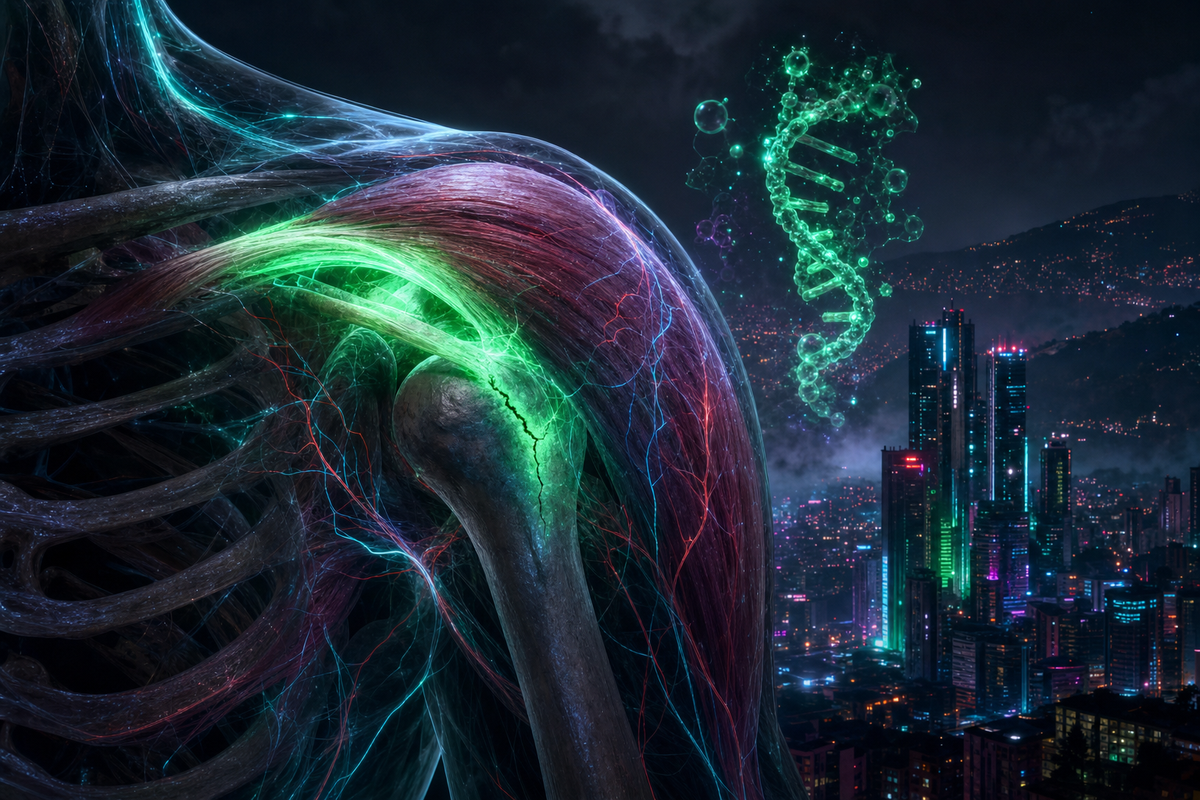
I'll say it plainly, because that's how it happened. I'd been dragging a bad shoulder for months — a fracture, a surgery, then heavy weights it wasn't ready for. Not screaming pain. The worse kind: the dull, always-there tax on every press, every reach, every time I rolled over wrong in bed. The kind you stop mentioning because complaining about it got old.
I injected BPC-157 directly into that shoulder for one week. The pain is gone. Not “better,” not “more manageable” — gone. I keep poking the joint waiting for it to answer back and it just doesn't. After months. After one week. Bruh, what.
That's exactly the kind of result that should make you suspicious — including of yourself. So this post is two things at once: a real “holy shit,” and the honest accounting of what one pain-free week actually proves. (Spoiler: less than it feels like.) If you want the 90-second version of how the peptide works first, the short up top covers it.
Where this fits — the three posts before this one
This didn't come out of nowhere. I've been walking up to it:
- The Wolverine Stack was the theory — BPC-157 and TB-500 as two repair peptides on different jobs, and the line that matters here: BPC builds the roads, TB-500 sends the crews.
- Protocol Adjustments was me re-aiming the technique — stop dosing BPC systemically and put it local, straight into the wreck. A stack that never gets adjusted is just a habit wearing a lab coat.
- Ancestral Massage was the first solo shot into my own shoulder, and the realization that recovery is a protocol, not a luxury.
This is the payoff post. The theory met the joint.
Why I Put the Needle Into the Shoulder
BPC-157 is a synthetic 15-amino-acid peptide derived from a protein in human gastric juice. Not a hormone, not anabolic — it won't put mass on you and isn't trying to. What it does, in the literature, is drive angiogenesis: it grows new blood vessels through the VEGFR2 → nitric-oxide pathway, and nudges fibroblasts (the cells that lay down new tendon) to migrate and rebuild.
Here's why that decides where you inject it. Tendons and ligaments are hypovascular — they barely have a blood supply. That's the whole reason they heal like wet cement: no roads in, nothing to deliver repair to the site. The logic, then, is to put the angiogenic signal directly into the starved tissue rather than hope a belly shot finds its way there. You build the roads in the neighborhood that has none. That's the Wolverine Stack line made literal.
Full honesty: there is no head-to-head study proving a local shot beats a systemic one — BPC spreads through the body either way, and its plasma half-life is under 30 minutes. The hypovascular-tendon rationale is real and peer-reviewed; “put it right in the wreck” is the reasoned bet I made on top of it, not a proven protocol.
The technique is the same one from the last post, and it stays boring on purpose: a couple centimeters below the bony tip of the shoulder, pinch a fold of skin and fat off the muscle, go in at 45° with a short insulin needle, stay subcutaneous, dodge the surgical scar, rotate sites. Piece of cake — which still surprises me, given how much I dreaded the first one.
Now the part that keeps me honest
Here's where most peptide write-ups go quiet and turn into a sales page. I'm going to do the opposite, because the caveats are what make the rest of this worth reading.
Almost all of BPC-157's spectacular healing data is in rats. Not “mostly” — as of 2026 there is essentially no published human randomized trial for tendon or musculoskeletal healing. What exists is a stack of rodent mechanism studies — disproportionately from one Croatian group — a few tiny pilots, a pile of anecdote, and a thick layer of clinic marketing that quietly borrows the rats' résumé and lets you assume it's yours. (Its one real brush with a human trial — a Phase II study for ulcerative colitis years ago — was never even published.) Here's the honest scoreboard:
And my one week is the definition of a confounded experiment. Every other suspect in the room, because if I don't name them I'm just a guy worshipping a vial:
- Natural post-surgical recovery. Shoulders heal on a timeline. Maybe this was just the week mine turned the corner.
- I changed my training load. Back off the weight that's been aggravating a joint and it feels better. That's not a peptide, that's arithmetic.
- I added bodywork. The massage from the last post is in the mix; soft-tissue work moves the needle on its own.
- Regression to the mean. Pain that's been bad drifts back toward baseline on its own. You credit the intervention; you don't credit the statistics.
- Placebo. I wanted this to work — I wrote three posts building to it. Belief is a variable, and not a small one.
So I can't prove BPC-157 did this. Not close. One pain-free week — even a dramatic one — is a compelling anecdote, not evidence. What I can tell you is the shape of it, with my name on it: months of ache, one week of local peptide, ache gone. That's the data point. I'm weighting it as “interesting enough to keep going and watch carefully,” not “cured.”
The stuff in the vial, and the stuff on paper
Two honest flags before anyone runs to copy this. BPC-157 is not an FDA-approved drug. The US picture is in active motion right now: the FDA put it on the 503A “do-not-compound” list in late 2023 (citing possible immune response, impurities, and missing safety data), then removed it from that list in April 2026 — which is not approval, just un-banning it for compounding pending review. An FDA advisory committee takes it up on July 23–24, 2026. In other words, its status is literally being decided next month. And if you compete in anything tested: it's WADA-prohibited under S0 (non-approved substances), banned at all times, no therapeutic-use exemption — the NFL and UFC ban it too.
My read on the real risk: it's in the vial, not the molecule. Independent testing of the gray-market peptide supply is grim — audits have found roughly half of sampled peptides failing their stated purity, and an anti-doping scientist put it bluntly: what's in an unregulated vial “could be a steroid… could be something just like water.” A “99% pure” certificate doesn't even tell you it's the right molecule. There's also a theoretical flag worth saying out loud: the same angiogenesis that rebuilds a tendon could, in principle, feed a tumor — though the actual animal data points the other way (BPC tends to suppress VEGF-driven tumor growth in models). No human data either way, so it's genuinely unresolved — not a known danger, not a clean bill of health. Test your source or don't run it. That's the part that can actually hurt you, and it has nothing to do with biochemistry.
Why this is the whole game
Here's why I'm not shrugging this off as “probably just recovery,” even while I admit it might be. Past 40, the entire game is availability — not what you lift on your best day, but how many days you show up at all. Every month is a negotiation between training stimulus and the injuries that take you out of the gym, and the guy who stays in the room beats the guy with the better peak who's iced half the year. The best performance enhancer is the program you can actually run.
A pain-free shoulder isn't a vanity number. It's me back under the bar — the difference between a training block and a rehab block. Whether BPC built the roads or my body finally paved them itself, the ROI is the same, and it's the only one that's ever mattered: I'm training again, full, no tax.
So that's the receipt. One shoulder, one week, pain gone, amazement fully intact — and every reason to stay skeptical laid out right next to it. I'll keep injecting, keep watching, and if the pain comes back I'll tell you that too. Signal, not worship. The shoulder works. I'll take it.
Sources worth your time: the peer-reviewed “Regeneration or Risk?” review (robust preclinical support, but “should be considered investigational”); the STAT / Undark investigation on the science-vs-hype gap and the FDA timeline; and USADA on the WADA ban. None of this is medical advice — it's one person's logged n=1.
The Wolverine Stack — the theory: BPC-157 + TB-500, and why BPC “builds the roads.”
Protocol Adjustments — re-aiming the technique: BPC local, into the injury, not systemic.
Ancestral Massage — the first solo shoulder shot, and recovery as a protocol.