One Hour, Door to Door
In Colombia you wait for everything. Today my son needed a doctor and the whole thing — transport, consultation, medicine, home again — took sixty minutes.
The day started the way most of them start here — outside, early, catching the sun before it gets serious. We have written about why that matters more than once, so I will not repeat it.
The second half of that clip is the part I actually want to write about. My son had said something felt strange in his ear. A few hours later he was taking the medicine for it. In between is the whole story, and it lasted one hour.
In Colombia, you wait
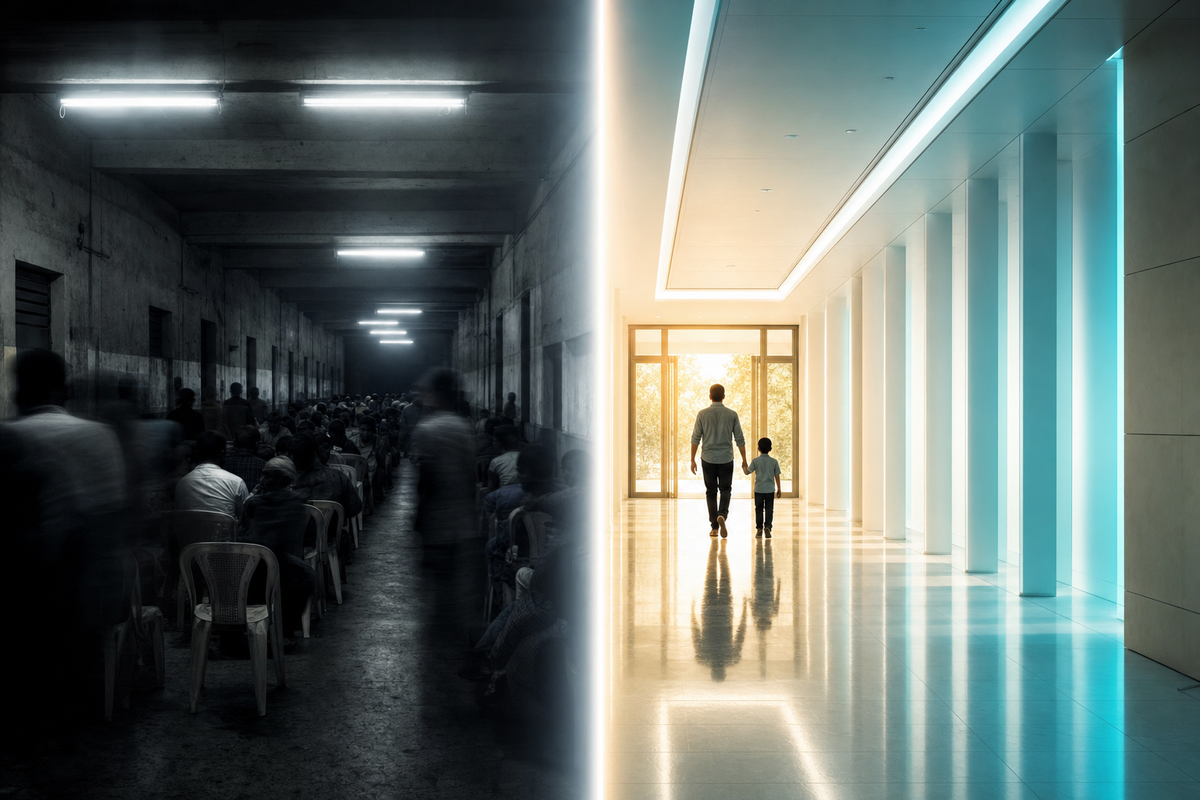
If you live here you already know this and no amount of politeness changes it. The public system covers a great deal and it covers it slowly. A non-urgent specialist appointment through EPS is commonly quoted at one to three months. Private prepaid plans are usually quoted at one to two weeks. That gap is the product. That is genuinely what you are buying.
For a family that treats health as something you actively manage rather than something you react to, a three-month queue is not an inconvenience. It is a structural failure of the thing you are trying to do.
So when I set this up I took the top plan Sura offers rather than the one that looked sensible on a spreadsheet. Today was the first time we actually used it.
What sixty minutes looks like
SaludSura sites attend only policy holders. The reason there is no queue is that the population allowed through the door is a fraction of the one a public clinic serves. You are not getting faster doctors. You are getting a smaller denominator, and you are paying for exactly that.
Worth saying plainly, because the honest version of this is more useful than the advertisement.
What the plan actually is
Sura's Plan Salud Global is a voluntary private health policy — the top tier of two, the other being the Clásica. The structural thing most people miss:
What the Global tier covers, in the parts that matter:
What it costs, honestly
Market rates for 2026 run from roughly $392,000 COP a month for the Clásica up to about $1,641,000 for the Global with international cover. Mine is a family policy — me and two kids — at $1,800,083 COP a month, after a 10.5% family-group discount. Call it $450 USD for three people.
The Clásica would have been about $261,000 COP a month cheaper. Here is what that saving costs you:
I travel, and the children travel with me. A plan that stops working at the border was not a saving, it was a gap. That single line is what decided it.
What this is not
Worth it
Everything in this project — the training, the bloodwork, the protocol, the sleep stack — runs on the same assumption: that you can measure a thing, act on it, and not lose weeks to friction in between. Health insurance is not usually filed under biohacking. It should be. Access speed is an input like any other.
A three-month queue does not just delay treatment. It changes what you bother to investigate at all — and the small strange symptom that goes unchecked is exactly the one worth checking.
This morning my son said something felt odd. He had the medicine in his hand before lunch. That is what I am paying for, and today it did exactly what it said it would.
Early Risers — why the day starts outside.
Ten Minutes of Morning Sun — the mechanism behind the first half of that clip.
Twenty-One Markers and an ECG — the other half of taking health seriously: measuring it.