
HGH Delivered: How to Mix, Dose and Store Genotropin
The prescription is written in IU. The syringe is printed in U-100 units. They are not the same ruler, and the dose lands between two lines. The arithmetic, the mixing procedure, and the 28-day clock.
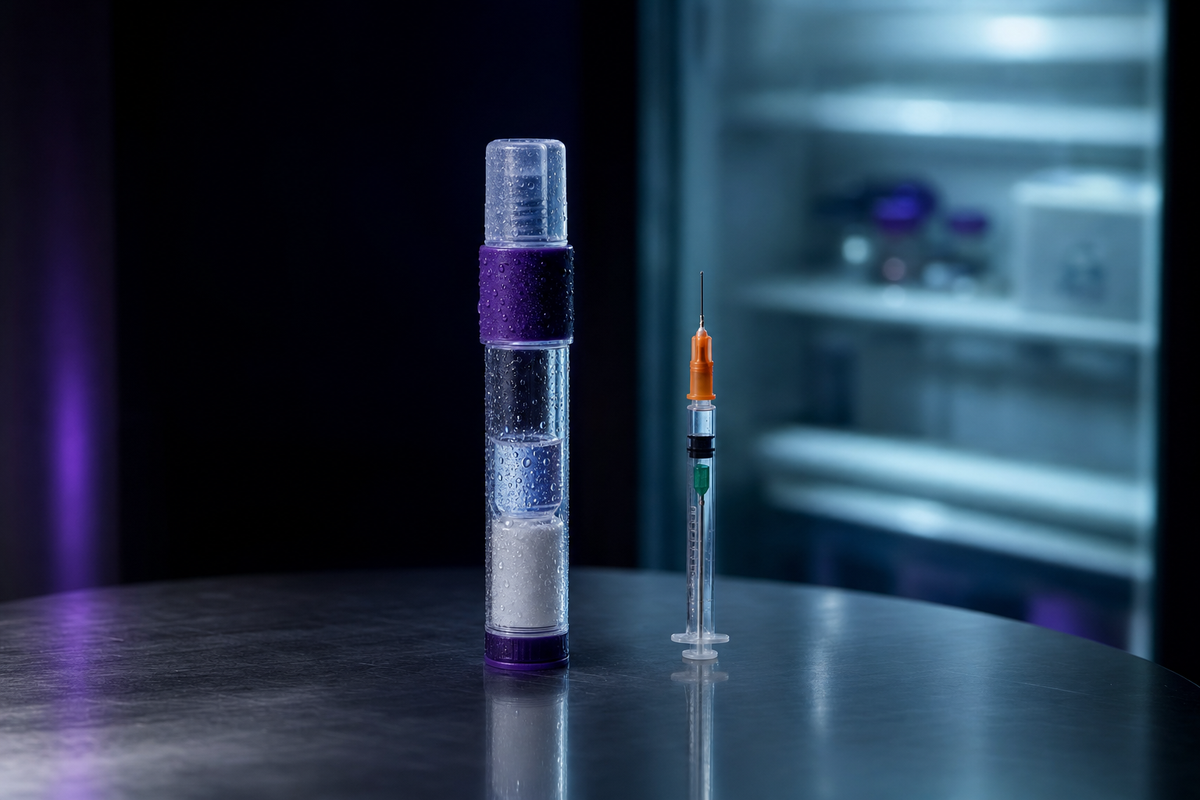
A growth-hormone cartridge is a small object with an unusually large blast radius for sloppy thinking. The powder is fragile. The prescription is written in one unit and the syringe is printed in another. And the dose I need lands between two lines.
That combination rewards procedure and punishes improvisation, which is why this post exists. It is the operating record for the box in that video: what arrived, how the concentration actually works, how the two-chamber cartridge is mixed, where the dose sits on the syringe, and which lab result changes the plan.
TL;DR
- Pfizer Genotropin, two-chamber cartridge, 16 IU / 5.3 mg somatropin.
- Reconstituted, the concentration is 16 IU per mL. That number drives everything else.
- Prescribed: 0.6 IU subcutaneous, once daily, evening, 30–60 minutes before sleep and at least 2 hours after the last meal.
- 0.6 IU works out to 3.75 units on a U-100 insulin syringe — which is not a line on any syringe made.
- So the physician picked the marked line below it: 3.5 units = 0.035 mL = 0.56 IU.
- Hardware: 0.3 mL U-100 syringe with half-unit graduations. Not the pen. Not a 1 mL syringe. No estimating between lines. Fresh syringe every night.
- 2–8 °C before and after mixing, never frozen, out of the light. Discard 28 days after reconstitution and write that date on the cartridge.
- IGF-1 in December decides whether the dose stays, drops, or stops. Not me.
What Landed
The Genotropin is the new thing, but the same box closed three gaps that had been open for a while. BPC-157 and TB-500 had been out of stock for months. HCG had been paused since mid-August, and that one had a clock on it.
One thing worth saying out loud before anything gets drawn: a delivery manifest is not a dosing instruction. Several compounds arriving in the same box does not mean they all restart on the same evening. Changing four variables at once is how you end up unable to attribute anything to anything.
Two Rulers, One Tiny Dose
This is the part that trips people, and it is worth being slow about.
The medicine and the syringe use different rulers. The cartridge measures growth hormone in international units — IU. The syringe measures liquid on a U-100 scale, where 100 units is one millilitre. They are both called "units" in casual speech and they are not the same quantity at all.
Pfizer's own carton settles the concentration. Read off the box in the video: “reconstituido cada mL contiene 16 UI (5,3 mg)”. Sixteen IU in every millilitre.
From there it is arithmetic anyone can check:
concentration      16 IU / 1 mL          = 16 IU per mL
prescribed dose    0.6 IU ÷ 16 IU/mL     = 0.0375 mL
on a U-100 barrel  0.0375 mL × 100 u/mL  = 3.75 units
                   ↑ not a line on any syringe

chosen mark        3.5 units ÷ 100       = 0.035 mL
                   0.035 mL × 16 IU/mL   = 0.56 IU
So the nightly number is 3.5 units on the syringe, and what that delivers is 0.56 IU of somatropin. Same dose, two rulers.
“Units” is an offensively overloaded word in injectable medicine. Any protocol handed to a patient should show the whole conversion chain, not just a syringe number and a hope that the context survives the trip home.
Mixing the Cartridge
The cartridge is bicameral: somatropin powder in the front chamber, its own solvent in the back. It is not reconstituted with bacteriostatic water — the water in the delivery is for the peptides. This one arrives with everything it needs and simply has to be joined.
- Hold it upright and stable. Do not strike it, bend it, or push on it sideways.
- The cap stays on. Nothing is unwrapped to do this.
- Push the rear plunger slowly and evenly. The solvent moves forward into the powder. There is no thumb-friendly plunger rod on this cartridge, so the nurse used the barrel of a second syringe — needle off, just the plastic — as a pusher against it. That is the trick: a clean tool to apply slow, straight, even pressure, not fingers improvising.
- Watch it go all the way across — the two chambers have to end up together, with no solvent left behind.
- Then tilt it slowly, side to side, until the powder is fully dissolved.
- Do not shake it.
- Inspect it in good light: clear, colourless, no particles.
Shaking is not extra mixing. Somatropin is a protein, not instant coffee, and agitation damages it. If slow tilting feels tedious, that is the correct feeling.
Then write the date on the cartridge, immediately. Memory is not a storage-control system.
Drawing It
The required syringe is a 0.3 mL U-100 with half-unit graduations, and the specificity is the point: on a half-unit barrel, 3.5 is a printed line you can put a plunger on. The intended draw is 0.035 mL. Using a 1 mL syringe for that is not a capacity problem, it is a resolution problem — the barrel can obviously hold it, but nobody can resolve it consistently.
- Confirm the mark before you start. It is the same mark every night.
- Alcohol on the cartridge access point and on the site. Let both dry.
- New sterile syringe, held vertical, read at eye level.
- Align the top edge of the plunger stopper with the mark — not the middle, not the tip.
- Needle up, tap, expel the air, then re-check the mark. Removing a bubble moves the volume.
- Pinch a fold of skin and inject slowly into the subcutaneous tissue.
- Straight into the sharps container. Never reuse a needle or a syringe.
Sites are abdomen, thighs, or the back of the upper arms, avoiding the navel, the waistline and any irritated skin, rotating every dose. Rotation is not fussiness — hitting the same patch repeatedly introduces a local variable into a protocol whose entire purpose is to be measurable.
Timing is part of the prescription, not a preference: evening, 30 to 60 minutes before sleep, at least two hours after the last meal. “Evening” is a window, not “some point after dark”.
Miss one? Do not double the next. Resume the schedule and tell the clinic. Catch-up dosing turns an adherence error into a dosing error.
The Fridge and the 28-Day Clock
Cold chain applies before mixing and after it. It also lives in its own container inside the fridge, so it is not sharing a shelf, unwrapped, with food.
That last row is the elegant part and the trap at the same time. At 3.5 units a cartridge yields 28 doses and expires at 28 days, so dose count and stability window line up almost perfectly. But the clock starts at mixing, not at the first injection. Mix it three days before you start and you have quietly thrown away three doses.
It is also a useful sanity check on the dose itself. If someone tells you the nightly draw is a tenth of what you think it is, ask how a 1 mL cartridge is supposed to be finished in 28 days. Arithmetic catches unit errors that eyeballing does not.
IGF-1 Decides, Not Me
Baseline IGF-1 was 214.70 ng/mL. That is not a low starting point, and it is the reason the lower of the two candidate marks was chosen. CJC-1295 and ipamorelin already act on the same growth-hormone axis, so beginning slightly under the target and titrating up against a lab is preferable to beginning over it in an axis that is already being pushed.
The next reading is in December, and the decision has already been written down in advance — which is the part I actually like:
Note what is missing from that table: any rule that lets me increase the dose on my own. Below 300 the standing instruction is to stay, not to climb. Any change comes from the physician, in writing, or it does not happen.
But the direction of travel is worth being clear about, because 3.5 units is deliberately under the prescribed 0.6 IU, not at it. The whole reason for starting on the low mark is to titrate up against the labs rather than down — begin slightly below target in an axis that CJC-1295 and ipamorelin are already working, then let IGF-1 say whether there is room. If December comes back comfortably low and everything else looks clean, the realistic next step is 3.75 or 4.0 units, closing the gap to the nominal dose or going slightly past it. That is the plan working as designed, not a deviation from it.
If several compounds touch the same biological axis and you change them independently without synchronised labs, that is not biohacking. That is unversioned production code.
What This Dose Is, And What It Isn't
Worth being honest about the scale here, because “growth hormone” carries a lot of freight it has not earned in this context.
0.56 IU a night is a replacement-tier dose. The performance-and-physique world talks in numbers several times this, and the side-effect profile people associate with growth hormone — the water retention, the carpal-tunnel tingling, the joint pain, the glucose drift — largely belongs to those numbers, not to this one. What a dose like this is aimed at is sleep quality, recovery, connective tissue and body composition at the margins, with IGF-1 kept inside a normal range rather than pushed past it.
Which also means the honest expectation is undramatic. This is not a compound where you wake up transformed in three weeks. It is a slow input, judged against a blood test in December, in a protocol where several other things are already running. If it does something, it will show up in the numbers before it shows up in the mirror.
And the procedural caveat is real rather than decorative: preparing this cartridge without the Pfizer pen is not the manufacturer's standard procedure. It has to be demonstrated by a professional before anyone does it alone, which is exactly how this one was handled.
Related Reading
The full protocol this sits inside — the compounds, the schedule, the site rotation and why it is built the way it is — is in MONSTER 2.0 — The Needle.
Confirmed, and one thing still open
The clinic put the mark in writing on 4 September: the dose and the 3.5-unit mark in the administration guide were correct and had already been confirmed with the prescribing physician when the instructions were prepared. A 0.5-unit figure that came up during the in-person training was, in their words, a misunderstanding, reviewed and corrected the same day. So Pfizer’s carton, the guide, the dosing card and the clinic all agree: 3.5 units = 0.035 mL ≈ 0.56 IU.
The open item is hardware, not arithmetic. The syringes that arrived are the correct 0.3 mL size but carry 1-unit graduations — the half-unit version is out of stock at the pharmacies, and the clinic is sourcing it. That matters because on a 1-unit barrel 3.5 sits between two printed marks, and estimating between graduations is precisely what the guide forbids. If you are running this protocol, the half-unit 0.3 mL syringe is not an accessory: it is the only instrument that can resolve the dose.
The Week, Day by Day
The cartridge is one line of a larger protocol. This is the whole week as it actually runs from 7 September — every compound, which days it lands on, and how far up the syringe each one goes.
The numbers are syringe marks on a 1 mL U-100, not milligrams — somatropin is the exception and uses a 0.3 mL half-unit syringe. CJC-1295 and ipamorelin are drawn into one syringe: to 8 with CJC, then on to 16 with ipamorelin.