
MONSTER 2.0 — The Needle
The signed MONSTER 2 packet now closes the Genotropin mark, no-DAC CJC, corrected dosing card, supplies, COP 2.24M NAD+ credit, delivery plan and monitoring calendar.

The plan for Sunday was Netflix and chill. Sofi, the cats, the kids, nothing on the calendar. That is the video above and I stand by it as a plan.
It lasted until about two in the afternoon.
Leg day. On a Sunday. In the middle of a rest week, because the productive-biohacking-family problem is that it genuinely cannot help itself.
Meanwhile Sofi and the kids were doing the other half of the job—first live experiments with fruit for Maxi, and a certain amount of officially sanctioned cheating, because the new phase was about to start and this was the last day of the old regime. Miranda negotiated for both of them. She usually does.
And then, in the evening, the thing I had been waiting three days for landed.
Adriana Martinez — Co-Founder and Executive Client Services at TRT Colombia — first sent the physician response, then returned on 26 August with the corrected operational package: two signed prescriptions, the revised quotation, a patient-specific Genotropin guide and a complete dose card. Every operating dose now has a written answer, including the points where the clinic corrected its own documents. What remains is execution, not another round of questions.
That is the standard I wanted: arithmetic that survives checking, contradictions corrected instead of defended, and exact syringe marks before a first dose. Thank you Adriana, and thank you TRT Colombia.
So this is the current record, in one place: the source documents, the arithmetic, the pharmacology, the exact schedule and the final logistics before Day One.
The 60-second version
The order arrived Friday 4 September, not Saturday the 5th, and the supervised first preparation happened the same day rather than on the 5th or 6th. Everything below this line was written before any of that and is kept as the record of the plan.
What actually changed: the Genotropin cartridge was reconstituted on 4 September, and the 28-day clock runs from mixing rather than from the first injection — so it is discarded on 2 October, not the 4th. The dose is unchanged and confirmed: 3.5 units on the 0.3 mL half-unit syringe, 0.035 mL, ≈0.56 IU. The full protocol still starts Monday 7 September.
The same delivery closed three stock gaps — HCG, BPC-157 and TB-500 are all back.
The delivery itself, the concentration arithmetic, the mixing procedure and the storage rules are documented in full in The Dose Between Two Lines.
Confirmed in writing, 4 September. The clinic confirmed the 3.5-unit mark was correct and had already been agreed with the prescribing physician; a 0.5-unit figure raised during the in-person training was a misunderstanding and was corrected the same day. Still open: the syringes delivered are the right 0.3 mL size but with 1-unit graduations — the half-unit version is out of stock and is being sourced.
FINAL OPERATIONAL PACKAGE · 26 AUGUST 2026. Eight active compounds, 30.5 subcutaneous administrations a week at steady state, one deferred and one discontinued. The corrected dose card, hardware, training path, cartridge cadence, September supplies and price are now recorded. Execution starts with payment, delivery and supervised first use.
1 · Where this started — fifteen weeks of evidence
None of this is a fresh start. It is the second phase of something that has been running since late April, and the escalation rests on the full set of available results plus a current ECG. The final delivery added Lp(a) 3.6 mg/dL and soluble transferrin receptor 1.62 mg/L. Ret-He/CHr was requested but not performed, and a reticulocyte count does not substitute for it.
Estradiol 43.84 pg/mL — 99.6% of the upper limit of the CMIA reference interval (11–44). Chemiluminescent immunoassays carry known bias and limited specificity at male estradiol concentrations, so that figure is approximate. A sensitive method (LC-MS/MS) is preferred for confirmation.
Haematocrit 47.5% with haemoglobin 17.0 g/dL — this, not testosterone concentration, is what governs how far the dose can go. Reticulocytes 0.9%, within range, read alongside ferritin and transferrin saturation.
HDL 39 mg/dL — the single marker that did not respond to fifteen weeks. ApoB at 81.28 and hs-CRP at 0.10 add useful context but do not determine overall cardiovascular risk. HDL is precisely why you do not suppress estrogen casually.
The rest of the panel, for completeness: free testosterone 12.27 pg/mL · LH <0.09 · FSH 0.07 · TSH 1.825 · free T4 1.10 · free T3 2.52 · DHEA-S 233.30 · morning cortisol 11.20 · PSA 0.89 · creatinine 1.24 with eGFR 74 and cystatin C 0.68 · ALT 21 · AST 28 · albumin 5.22 · total cholesterol 158 · LDL 102 · VLDL 17 · ApoB 81.28 · Castelli index 4.1 · glucose 81 · vitamin D 44 · homocysteine 10.25 · platelets 211 · RDW 14.2 · transferrin saturation 20.87% · serum iron 67.2 · TIBC 322. ECG on 3 August: normal, sinus rhythm, PR 152 ms, QRS 104 ms, QTc 379 ms.
The last two landed on 18 August. Lipoprotein(a): 3.6 mg/dL against a ceiling of 30—very low, which indicates very low Lp(a)-mediated cardiovascular risk but does not exclude other inherited risks. Soluble transferrin receptor: 1.62 mg/L on a range of 0.76–1.76—within range, near its upper end, so it supports monitoring increased iron use but does not prove established tissue iron deficiency. ApoB is 81.28 mg/dL. Reticulocytes are 0.9%; reticulocyte count does not substitute for the missing Ret-He/CHr result.
2 · What changed, and why — the V2 to V3 reversals
I submitted MONSTER 2.0 as a proposal. The physician reviewed it and issued a first set of decisions on 13 August. Then he reviewed it again on 16 August and reversed four of his own decisions. That second pass is the reason this protocol is better than either my proposal or his first answer.
My point 4 argued for washing out CJC-1295 and ipamorelin before starting somatropin. The mechanism was sound: exogenous growth hormone raises IGF-1, which feeds back against the pulsatile release the secretagogues stimulate. Running all three can therefore be sub-additive.
TRT Colombia confirmed that the physician understood that mechanism and still chose concurrent treatment. Mechanism and clinical decision are not the same thing. The secretagogues also act through GHRH-receptor and ghrelin-receptor signalling, with effects that are not reducible to one IGF-1 number. The signed action bands, symptom triggers and 7 December control are the monitoring plan; this article does not pretend the schedule is tighter than it is.
3 · The protocol
Eight active agents, all subcutaneous. This is the signed 13-week protocol starting Monday 7 September. The final package now includes the exact Genotropin mark and the correct first-use training path.
Deferred: anastrozole — not to be initiated, not to be purchased, not to be self-started. Discontinued: NAD+ — existing stock not to be used unless re-authorised, no reorder scheduled.
The safety thresholds — the numbers that stop things
The 300 and 350 ng/mL figures are physician-selected treatment action thresholds, not normal ranges or proof of safety. The laboratory reference interval remains 76–230 ng/mL; a result above 230 is still above that printed interval and requires clinical interpretation even though the protocol's first dose action begins above 300.
4 · The injection plan — reconstitution, volumes, units
This is the section I actually use. Every compound, what goes in the vial, what concentration that produces, and the exact syringe mark. Every line uses a 1 mL U-100 syringe except Genotropin, which uses its own 0.3 mL half-unit syringe. Throughout this article, “u” means a U-100 syringe-unit mark; “IU” means International Units of drug activity. They are not interchangeable.
HCG changes completely. It was 2,500 IU = 100 units once a week. It is now 250 IU = 10 units every other day.
Genotropin has its own hardware. It is 3.5 units on a 0.3 mL half-unit syringe, never the 1 mL syringe used for the other compounds and never the pen.
CJC-1295 and ipamorelin share one syringe. Draw CJC to 8, then ipamorelin until the plunger reaches 16 units total. TRT Colombia's corrected card now matches the graphic, prescription, email and weekly schedule. There is one dose and no competing instruction.
Pfizer Genotropin 16 IU / 5.3 mg reconstitutes in its built-in 1 mL diluent. The nominal 0.6 IU calculation lands between printed graduations at 3.75 units. The physician chose the lower physical mark: 3.5u = 0.035 mL ≈ 0.56 IU.
Both 3.5 and 4.0 sit 6.7% from nominal. Starting low was the deliberate choice because somatropin, CJC-1295 and ipamorelin all act on the growth-hormone/IGF-1 axis and my starting IGF-1 is 214.70. Titration comes later from the laboratory result, symptoms and tolerance. Do not alternate, estimate 3.75, use the pen or substitute a 1 mL syringe.
Somatropin — what it actually is, and why it is not what I am already taking
This is the only genuinely new class in the protocol, and it is worth being precise about, because on paper it looks like more of something I already do.
Growth hormone is made in the pituitary and released in pulses, mostly during deep sleep. CJC-1295 and ipamorelin — both of which I have been running for months — contain no growth hormone at all. They are secretagogues: messengers that tell my own pituitary to release more of my own hormone, in my own pulse pattern. Their ceiling is whatever that gland can produce.
Somatropin is the hormone itself — a laboratory-made copy of the identical 191-amino-acid human molecule. Injecting it skips the pituitary entirely.
That last row is why insulin-like growth factor 1 (IGF-1) is on the December panel. It is the stable proxy for how much growth-hormone signalling is landing; my pre-somatropin value is 214.70. Below 300, the dose stays at 3.5u. Above 300 but below 350, it falls to 3.0u—about 0.48 IU—and IGF-1 is repeated around four weeks later. At 350 or above, somatropin stops pending physician review, with CJC-1295 and ipamorelin reviewed too.
Why the cartridge size mattered — the counterintuitive bit
Somatropin ships in a dual-chamber cartridge—powder in one half, diluent in the other—designed for a Pfizer pen. The final order is the 16 IU / 5.3 mg presentation with 1 mL of built-in diluent. The protocol deliberately does not use the pen.
The nominal calculation is 0.6 IU ÷ 16 IU/mL = 0.0375 mL = 3.75 U-100 units. That point does not exist on the supplied syringe. The signed operational mark is 3.5 units, delivering 0.035 mL or approximately 0.56 IU.
The second reason for the smaller cartridge is shelf life. It is discarded 28 days after mixing. At 0.56 IU per night, it supplies 28 daily doses inside that window, with a small residual. The published 7 September–4 October and 5 October–1 November windows assume the first cartridge is mixed on 7 September. If supervised training on 5 or 6 September includes actual mixing, label that date and move every discard and refill date earlier.
Half-unit syringes — one barrel, one unambiguous line
A U-100 insulin syringe is calibrated so 100 units = 1 mL. The Genotropin barrel is a 0.3 mL U-100 syringe with a printed line every 0.5 units, making 3.5 a visible physical mark instead of an estimate.
The current line is 3.5. The 3.0-unit line is reserved for the written IGF-1 reduction rule. The 4.0-unit line is explicitly marked not used. There is no alternating and no manufactured average.
Consistency makes the result interpretable. The same syringe, same mark and same nightly timing turn the December result into something the physician can actually titrate.
Thirty-five half-unit syringes are included for the first 35 Genotropin doses, through 11 October on a 7 September start. The 13-week course needs 91 in total, so later orders must add 56. They are separate from the standard 1 mL syringe supply.
The Genotropin guide — the final mark and the nurse training
TRT Colombia has prioritised supervised first preparation at home on 5 September after delivery, with 6 September as backup. Mixing this dual-chamber cartridge without the pen is not the manufacturer's standard procedure, so preparation and first use stay under the clinic's patient-specific guide and live supervision. The 28-day clock begins when the cartridge is actually mixed, not when the first dose is injected.
The supplied images are orientation aids, not a substitute for the live session. TRT Colombia will supervise the actual 16 IU cartridge with the exact supplies delivered. The mixing date must be written on the cartridge because that date—not Day One—starts the 28-day discard clock.
Keep the cartridge at 2–8°C before and after mixing, protected from light. Never freeze; discard if frozen. Label the mixing date and discard after 28 days. Do not double a missed dose.
Do not wait for the December panel if there is significant oedema, persistent joint pain, tingling or numbness in the hands, severe headache, visual symptoms or any unexpected effect. Those trigger earlier clinical assessment.
Pfizer’s current product information independently confirms use of the supplied solvent, gentle swirling, inspection for a clear particle-free solution, refrigeration at 2–8°C after mixing, light protection and the 28-day in-use limit. It describes the 5.3 mg / 16 IU cartridge for the matching Genotropin pen or reconstitution device—not the clinic’s external-syringe method. That is why professional first-use preparation is non-negotiable. Read Pfizer’s product information.
The earlier recording showed a 36 IU / 12 mg cartridge, generic 10/20-unit examples and was mislabeled as sermorelin. It is not part of the current instructions. The final reference is the patient-specific 16 IU guide below plus live training with a TRT Colombia nurse.
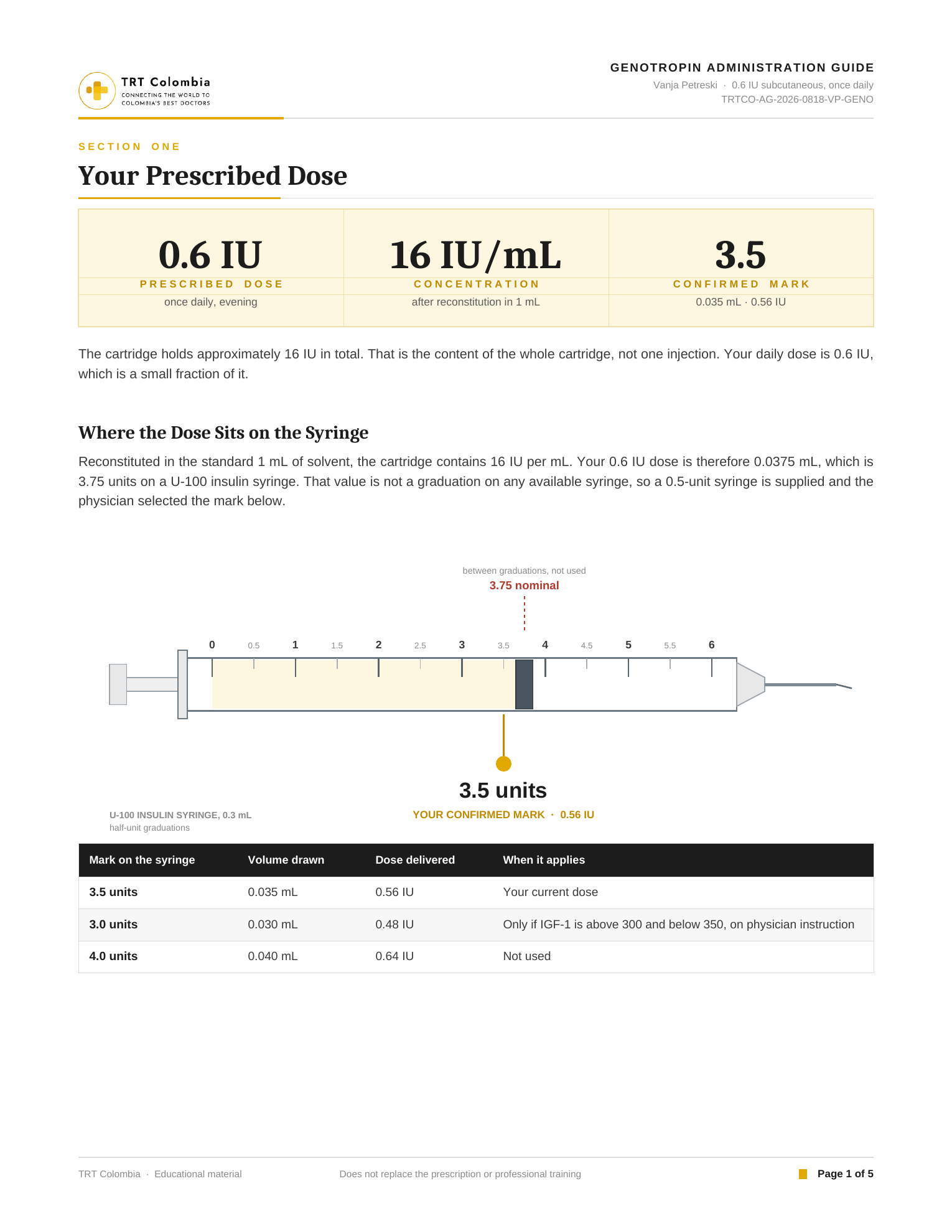
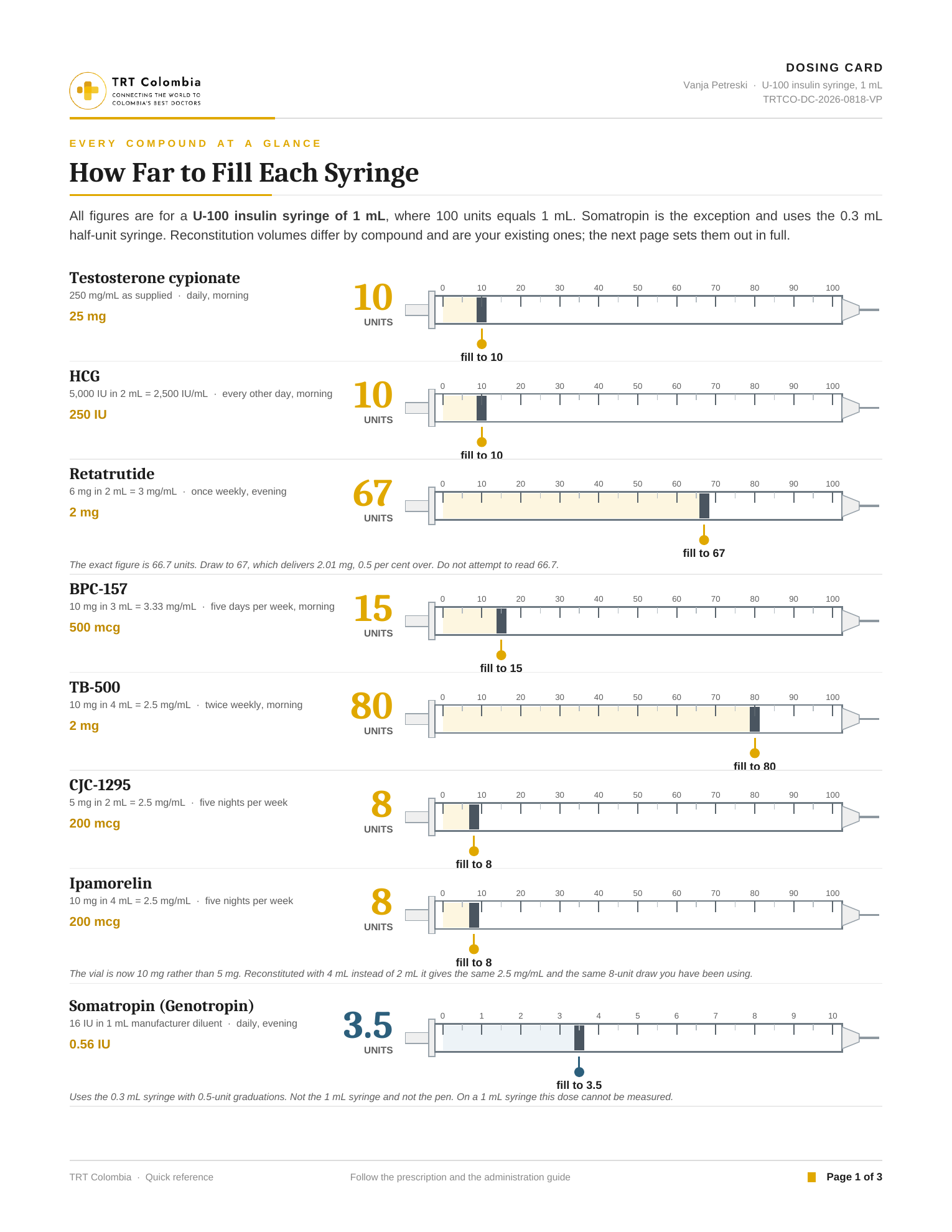
That dose-card page is the useful one: all eight physical marks, all in one place. The corrected prose now agrees with the graphic and schedule. The combined CJC-1295 plus ipamorelin draw ends at 16 units.
The testosterone transfer — why there is a filter needle in the box
Testosterone comes as single-use glass ampoules, and the regimen is daily, so one ampoule cannot be opened and used ten times. The answer is a transfer kit: ten sterile vials and ten 5-micron filter needles, one of each per ampoule, included at no charge.
Opening a glass ampoule can introduce microscopic particles into the solution. The supplied five-micron filter needle reduces the risk of transferring those particles. It is used for the ampoule draw only, then replaced with clean transfer equipment.
Procedure: transfer one ampoule at a time through the supplied five-micron filter needle into a new sterile vial. The clinic calculates ten nominal 25 mg draws per ampoule before filter, transfer dead-space and residual-volume losses. Store the transferred vial at room temperature, 20–25°C, away from direct sunlight. Do not refrigerate. The article does not add an invented discard rule beyond the signed prescription and supplied handling labels.
The storage contradiction is now closed in writing. Testosterone cypionate is oil-based; cold thickens it and can cause crystallisation. The newer refrigerator instruction was wrong, the earlier room-temperature instruction was right, and both final documents now say 20–25°C away from direct sun.
The frequency changes the handling burden. On twice-weekly dosing an ampoule was accessed about five times; daily dosing plans ten withdrawals over ten days. Moving each ampoule once through a filter into a sterile vial reduces repeated manipulation of opened glass and makes the workflow explicit. It does not remove contamination risk: aseptic technique and the complete transfer supplies still matter every time.
The procedure, written out
Transfer day—nominally every ten doses, with filter/transfer loss checked rather than assuming every ampoule yields a perfect 1.00 mL:
Wipe the ampoule neck and snap it away from you. Fit the filter needle to a 3 mL syringe and draw the full 1 mL. Tip the ampoule rather than chasing the last drops against the glass. Swap to a clean transfer needle, push the oil through the septum of a fresh sterile vial and label it with the date. The filter needle goes in the sharps container—it is single-use. Store the transferred vial only under the single written rule the clinic issues after reconciling its fridge-versus-room-temperature conflict.
Every morning — the actual dose:
Wipe the septum. Draw 10 units (0.10 mL = 25 mg at 250 mg/mL) into a U-100 insulin syringe straight from the storage vial. No filter needed at this stage — the glass was removed on transfer day. Subcutaneous, rotating through the site grid, hold five seconds, withdraw, sharps container.
Two things are easy to get wrong. Never inject through the filter needle—it is a drawing tool, and pushing oil back through a used filter defeats its purpose. And never put the transferred testosterone vial in the refrigerator: the final instruction is 20–25°C, away from direct sun.
5 · The week — what actually happens on which day
Testosterone is daily in the morning. Somatropin is daily at night at the confirmed 3.5-unit mark. Everything else hangs off that spine.
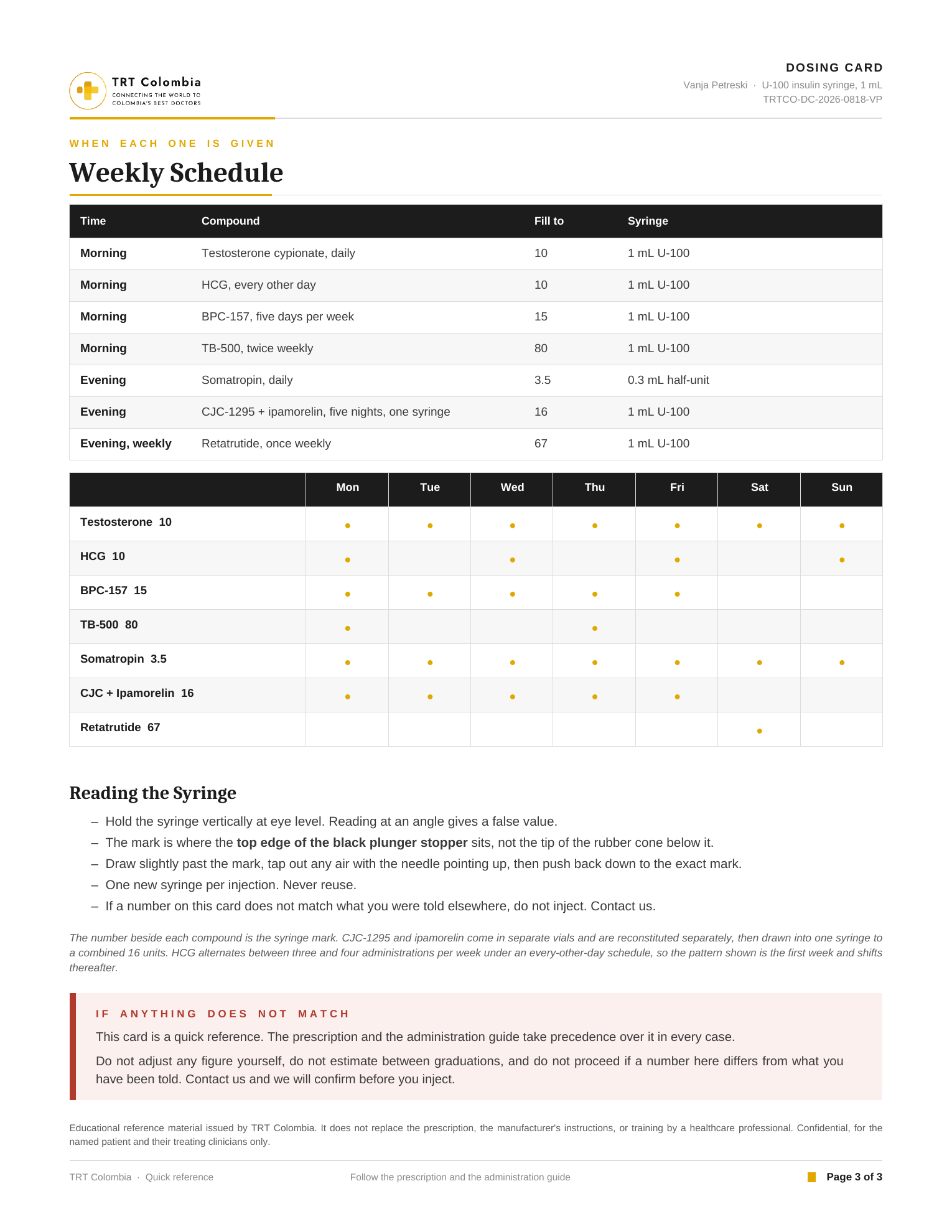
That totals 30.5 administrations a week—27 fixed plus 3.5 for HCG, which alternates between three and four. The table shows the first week; the every-other-day HCG pattern shifts across weekdays after Sunday. CJC-1295 and ipamorelin share one syringe as prescribed. Genotropin always uses its separate 0.3 mL half-unit syringe.
6 · The audit — I checked their math, line by line
Not because I distrust them. Because a supply calculation that is off by four days is invisible until the morning there is nothing in the fridge, and because verifying arithmetic is free. I rebuilt every coverage figure independently from the prescription.
What checks out
The medication lines sum to COP 9,050,000. The 5% discount removes COP 452,500. The two unopened NAD+ vials are credited at 70% of original value, removing another COP 2,240,000. Final bank-transfer total: COP 6,357,500. A payment link is COP 6,802,525; PayPal is COP 7,311,125. All coverage figures are nominal: each reconstituted product still follows its own supplied storage and beyond-use label, and bacteriostatic water alone does not define usable life.
What the final packet closed
At 3.5 U-100 syringe units ≈ 0.56 IU, one 16 IU cartridge supplies 28 daily doses inside its 28-day in-use window, with a small residual. If cartridge one is mixed on 7 September, its window runs through 4 October and cartridge two through 1 November. If supervised training mixes it on 5 or 6 September, every discard and refill date shifts earlier. The written mixing date controls.
The September box includes 150 standard 1 mL U-100 syringes plus 35 special 0.3 mL half-unit syringes for Genotropin. The 13-week calendar needs about 306 standard and 91 half-unit syringes, so later orders must add about 156 standard and 56 half-unit. The 300 swabs are also an initial supply, not whole-course coverage. One fresh syringe per injection; the two sizes are not interchangeable.
The current 500 mg of testosterone is exactly 20 nominal daily doses from Tuesday 18 August through Sunday 6 September. The complete order arrives Saturday 5 September; the full protocol starts Monday 7 September.
The first package includes 300 swabs, 10 three-millilitre Luer-lock transfer syringes, ten transfer vials, ten five-micron filter needles, 150 standard syringes, 35 half-unit syringes, bacteriostatic water, labels, cold-chain packaging and delivery.
The corrected dose card is also closed: CJC goes to 8, then ipamorelin to 16 units total. The signed prescription and supplied labels remain the operating authority; this article does not invent handling limits that are not printed there. Later monthly orders must replenish syringes and swabs.
7 · The pharmacology — what the numbers actually predict
Why daily testosterone beats twice-weekly
Cypionate has a roughly eight-day half-life. The simplified half-life model below illustrates why shortening the interval should reduce peak-to-trough fluctuation. It does not establish my individual bioavailability, aromatisation or gynecomastia risk, and it is not a pharmacokinetic simulation.
Within that simplified model, daily dosing compresses the peak-to-trough swing substantially. The physician’s smoothing rationale is plausible. Whether it changes estradiol, symptoms or adverse effects for me is an empirical question, not something the ratio proves.
Daily dosing flattens the testosterone curve; it does not reduce mean exposure. The weekly dose rises from 100 to 175 mg—a 75% escalation—and estradiol production plus red-cell drive track average exposure over weeks.
The September and October controls are now cancelled. The next scheduled complete blood count is 7 December. The protection between now and then is not a mythical “daily is safer” assumption: it is symptom and blood-pressure surveillance, the signed stop thresholds and earlier assessment if clinically triggered.
Three inputs on one axis — the real issue
Somatropin supplies growth hormone directly. CJC-1295 drives pituitary release through the GHRH receptor. Ipamorelin drives it through the ghrelin receptor. All three raise IGF-1, and IGF-1 feeds back through hypothalamic somatostatin to suppress the very pulses the secretagogues stimulate. The combination is sub-additive, not additive — but sub-additive is not zero.
Scale first. One milligram of somatropin is about 3 IU, so the confirmed 0.56 IU daily mark is approximately 0.187 mg/day—about 1.83 mcg/kg at 101.8 kg. Pfizer’s label uses 0.15–0.3 mg/day as a low starting range for adults with confirmed adult-onset growth-hormone deficiency. Falling inside that numeric range does not establish the labelled diagnosis or make this multi-agent protocol predictable. My pre-somatropin IGF-1 is 214.70 after months of CJC-1295 and ipamorelin, so the achieved IGF-1—not the nominal dose—has to decide the exposure.
The formulation is now identified: CJC-1295 without DAC, also called modified GRF 1-29, with an approximate thirty-minute half-life. That is the short-acting product the five-nights-per-week schedule was written for; a six-to-eight-day DAC product would have been a different protocol.
Below 300, Genotropin stays at 3.5u. Above 300 but below 350, it falls to 3.0u and IGF-1 is repeated around four weeks later. At 350 or above, somatropin is withheld and the combined axis is reassessed before restart.
Significant oedema, persistent joint pain, hand tingling or numbness, severe headache, visual symptoms or any unexpected effect also moves the assessment forward. A calendar never overrules a symptom.
Estradiol — why deferring is right
The reported estradiol is 43.84 pg/mL, asymptomatic, on a direct CMIA immunoassay. At male concentrations, immunoassay specificity and bias are imperfect. The direction and magnitude cannot be corrected by subtracting a fixed number, and the result cannot be converted into an LC-MS/MS equivalent.
Deferring anastrozole is correct for four independent reasons: the value remains inside the laboratory interval; there are no estrogen-related symptoms; the assay is approximate at this concentration; and HDL is already 39, so unnecessary estrogen suppression has real downside. This is a reason to monitor, not to manufacture a more flattering number.
The laboratory’s mass-spectrometry option is Total Estrogens (estradiol + estrone), not isolated E2: COP 860,000, fasting, with a 21–24 day turnaround. It would not provide the specific estradiol result I wanted in time for a treatment decision.
The December panel therefore keeps the standard immunoassay. Its result is an approximate method-dependent value—not a floor, not an LC-MS/MS equivalent, and not something to “correct” by subtracting 5–15 pg/mL. If symptoms or the trend make anastrozole a real question, then a fit-for-purpose sensitive assay becomes worth sourcing.
A floor matters as much as a ceiling. Sustained estradiol below about 15 pg/mL by LC-MS/MS warrants concern for bone, sexual function and body composition; below about 10, the evidence for harm becomes stronger. I asked for a defined floor before any aromatase inhibitor starts. Adriana recorded the request so it does not get lost before the December result. The date moved; the reason not to suppress blindly did not.
HCG 250 IU every other day — the dose is well chosen
Under full suppression — LH below 0.09, FSH at 0.07 — HCG substitutes for the LH signal at the Leydig cell. The dose-ranging evidence in men on 200 mg/week of testosterone enanthate is unusually clean:
A short-term dose-ranging study found that 250 IU every other day kept intratesticular testosterone near baseline during testosterone suppression. That supports the mechanism, not a guarantee of preserved fertility, testicular volume or a predictable response in me. HCG can also add testicular testosterone and aromatisation, so estradiol remains part of the December read unless symptoms trigger earlier assessment.
What it does not do: HCG replaces LH signalling, not FSH. Short-term dose-ranging data suggest 250 IU every other day can keep intratesticular testosterone near baseline during testosterone suppression. That does not guarantee preserved testicular volume or fertility. Seminiferous-tubule function and spermatogenesis can still decline; only semen analysis answers that question directly.
Haematocrit and iron — the constraint that will bind first
Haemoglobin 17.0 and climbing, ferritin down 39% from 129 to 78.38, transferrin saturation 20.87% — 0.87 points above the usual iron-restriction boundary. With hs-CRP at 0.10, substantial systemic inflammation is less likely, though not every influence on ferritin is excluded. The mechanism is textbook androgen-driven erythropoiesis:
Reticulocytes at 0.9% do not contradict this. They rise during an acute production change and settle back into range once the larger red-cell mass reaches a new steady state.
Margins: haemoglobin 17.0 → 18.5 is 1.5 g/dL; haematocrit 47.5% → 54% is 6.5 points. At the current relationship, haemoglobin could hit its stop line first, and either threshold alone suspends testosterone.
sTfR 1.62 remains within range, ferritin is 78.38 and transferrin saturation 20.87%. That supports surveillance, not blind iron and not blood donation. There is no scheduled interim CBC. The 7 December control remains the plan; earlier assessment happens only if symptoms or a clinician-directed reassessment changes it.
Retatrutide against growth hormone — opposite directions on the same dial
Growth hormone reduces insulin sensitivity: more lipolysis, more free fatty acid delivery, more hepatic glucose output, less peripheral uptake. Retatrutide pushes the other way through GLP-1 and GIP signalling, reduced intake and weight loss — though its glucagon component can raise hepatic glucose output acutely. There is no trial of this combination. What there is, is arithmetic:
Somatropin can reduce insulin sensitivity, while retatrutide-driven weight loss may push the other way. The net effect in this exact combination is unknown until measured. HOMA-IR at 0.90 leaves little room to improve and plenty to lose; metabolic preservation is the red line, and the next formal read is the consolidated December panel.
The protocol was designed around 105 kg, making its 5% target 99.75 kg. The scale now reads 101.8 kg: 3.2 kg down from the 18 August dose increase, 8.2 kg down from the roughly 110 kg April baseline, and 2.05 kg above that protocol target.
The recent drop is not pure fat—water, glycogen and gut contents move much faster than adipose tissue. December body composition, waist and gym performance will help interpret what the scale loss actually was.
8 · Two start dates — the bridge, then the real thing
The protocol does not switch on in one move, because two of the changes did not need anything delivered and the rest do. So there is a bridge.
Nothing is being taken early that has not been prescribed, and nothing is being started before it arrives. The bridge exists because the calendar and the pharmacy do not run on the same clock.
9 · The calendar — every date I cannot forget
This is the calendar I will come back to: payment 3–4 September, delivery on the 5th, full protocol on the 7th, and one complete control on 7 December. Genotropin discard and refill dates follow the actual cartridge-mixing date recorded during supervised first use.
The original plan had three draws: a one-month hormonal panel in mid-September, a two-month panel with body composition in mid-October, and a three-month IGF-1 in December. That was built around two different clocks — the prescription date for everything already running, and the somatropin start date for the growth-hormone axis.
TRT Colombia approved collapsing it to one. Every compound now starts or changes inside a three-week window, so a single control point three months after the full protocol begins measures all of it at once, under one set of conditions, on one fasted morning.
The dates align cleanly. From Monday 7 December: that is 91 days of somatropin — the prescription's own three-month monitoring interval, to the day — and 111 days, just under sixteen weeks, since the testosterone went from 100 to 175 mg per week. Both clocks land on the same Monday.
What I am accepting by doing this: no haematocrit reading between the dose increase and December. Testosterone raises red cell mass, my ferritin is already falling and soluble transferrin receptor is in the upper third of range — so that is the one number with a real cost attached to waiting. That is a conscious monitoring choice, not a forgotten test: 7 December remains the control, and earlier assessment happens only if symptoms or a clinician-directed reassessment changes it.
The body-composition measurement — Monday 7 December
Home service, same visit as the December panel. It is the only appointment in this whole plan that is not a blood test, and it is the one that answers the question the scale cannot: did the weight that came off come off the right tissue.
Growth hormone can expand extracellular water. One extra litre may register as roughly one kilogram of “lean mass” without representing new contractile tissue.
Bioimpedance is hydration-sensitive. It infers body composition from electrical conductivity, so changes in fluid can distort the exact measurement used to estimate lean mass.
The useful response is standardisation: same morning timing, fasted, similar previous-day hydration and no training in the previous 24 hours. Repeated readings under matched conditions matter more than one isolated result.
That is why the December assessment reads body composition alongside waist circumference and gym performance. None proves tissue change alone; together, under standardised conditions, they make the interpretation harder to fool.
A convincing result on 7 December is fat mass and waist trending down while strength and lean mass are maintained or improved. If inferred lean mass rises without support from the other measures, fluid and measurement variation stay on the list of explanations instead of being declared muscle by default.
The dosing plan is executable. Training with a TRT Colombia nurse is the only step between the delivered cartridge and the first Genotropin dose. Monday 7 December remains 111 days past the testosterone increase and 91 possible nightly doses after a 7 September start.
The standing rhythm is monthly ordering based on what is actually missing, not copying the previous cart. On a 7 September mix, refill gates are: CJC-1295, TB-500 and 56 more half-unit syringes before 12 October; HCG before 17 October; retatrutide before 24 October; the BPC-157 balance and Genotropin cartridge three before 2 November; cartridge four before 30 November. Standard syringes and swabs also need topping up in later orders. If the first cartridge is mixed during 5–6 September training, move every Genotropin date earlier from that actual mixing date.
10 · What I expect to happen, and when
Not hopes. Predictions with timeframes, so that in three months I can check which ones were wrong.
What is now locked
The clinical doses, syringe marks, price, calendar, supply counts and corrected card are written. What remains is ordinary logistics: the exact training time, payment, the delivery and NAD+ handoff, and travel-certificate details only when a trip exists.
Payment: 3 or 4 September.
Delivery: Saturday 5 September.
Full protocol: Monday 7 September.
Genotropin: 16 IU / 5.3 mg; 3.5u on the 0.3 mL half-unit syringe ≈ 0.56 IU; 28 daily doses inside each 28-day in-use window.
CJC-1295: without DAC / modified GRF 1-29.
Order total: COP 6,357,500 by bank transfer after the NAD+ return credit.
Scheduled control: Monday 7 December—full fasting panel, IGF-1 and body composition. Earlier clinical assessment remains symptom-driven, as written in the prescription.
NAD+: discontinued. Anastrozole: deferred; do not initiate.
Closed in this round: the corrected card confirms CJC to 8 and then ipamorelin to 16 units total; the return of both sealed NAD+ vials with the 5 September delivery is confirmed and its COP 2,240,000 credit is already inside the final total.
1. First-use training: Saturday 5 September after delivery is the priority, with Sunday 6 as backup. The exact time is still being locked.
2. Payment: complete COP 6,357,500 by bank transfer on 3–4 September.
3. Delivery handoff: receive the order and return both sealed NAD+ vials on 5 September.
4. Travel certificates: no current action. When a trip exists, provide the destination and the quantity of each medication travelling—vials, cartridges or units—so the English and Spanish versions can be prepared correctly.
The correction log now has a cleaner ending. Delivery is 5 September, not the 6th. Testosterone stays at 20–25°C, not in the refrigerator. CJC-1295 is the short-acting no-DAC product. Genotropin is 3.5 units, not a blank choice, and the obsolete 36 IU video is retired. The stray 12 is now corrected to 16, and the NAD+ return is assigned to the delivery handoff. The correspondence is closed; what remains is execution. The correction log now distinguishes resolved changes from future logistics.
11 · One deliberate no
The semen analysis — where Adriana pushed back on me
I said skip it. She made the case for doing it anyway, and it is a good case, so it belongs here in full rather than quietly dropped.
Her argument: the baseline is already gone — that would have been April, before fifteen weeks of suppression, and with LH under 0.09 and FSH at 0.07 a sample today cannot tell me what I had before I started. What it does capture is the pre-HCG reference, and that window closes the day the first dose goes in. HCG is going in specifically to preserve testicular function; if I want to know in six months whether it worked, I need a number from before it started.
It would not change the protocol. The HCG is approved and the result does not move the dose. It is information, not a decision. Her actual reason for pushing is simpler and harder to argue with: if it comes back azoospermic, that is worth knowing now rather than in two years. Recovery after prolonged testosterone exposure can take many months and may be incomplete; neither timing nor completeness can be predicted from one sample. Knowing early preserves options that knowing late does not. She notes, fairly, that I have been consistent that fertility is not the objective, and takes that at face value.
My answer is still to skip it, and I want to be honest that this is a preference and not a refutation. She is right that the information is cheap and the window is closing. Fertility is not an objective for me, the result does not change a dose, and I would rather not add a test whose only function is to tell me something I am not going to act on. If that turns out to be a mistake it will be an informed one. Protocol, for the record: 2–5 days abstinence, and an abnormal result gets repeated at 2–3 weeks before anything is concluded, because a single sample varies enormously.
The final status table
12 · What it costs
Included free: 10 sterile transfer vials, 10 five-micron filter needles, 10 three-millilitre Luer-lock transfer syringes, 150 standard U-100 insulin syringes, 35 special 0.3 mL half-unit syringes, 2 × 30 mL bacteriostatic water, 300 alcohol swabs, printed labels, the preparation guide, cold-chain packaging and local delivery. Transfer has no surcharge; a payment link totals COP 6,802,525 and PayPal COP 7,311,125.
The September medication line rose because it now contains two Genotropin cartridges and the available ipamorelin vial doubled from 5 to 10 mg. The NAD+ return changed the number that matters: COP 2,240,000 credited, bringing the bank transfer to COP 6,357,500. The larger ipamorelin vial is cheaper per milligram but exceeds the likely four-to-eight-week life after reconstitution, so some product may still be discarded.
What I actually think of this
I proposed 250 mg of testosterone a week. I got 175, fractionated daily, with a condition attached that the weekly total does not move. That is the right answer and it is not the answer I asked for.
I proposed washing out the secretagogues. I got told to keep them, with an acknowledgement that my pharmacology was correct and the decision went the other way anyway. Also probably right, and it is the reason the monitoring gap is now the thing I care about most.
I asked whether anastrozole could run at a lower dose. I got told not to start it until estradiol and symptoms justify an intervention. That is the single best decision in the document—I was arguing about the size of something that should not happen yet.
And the thing I was most attached to, NAD+, got removed entirely. Injection burden goes down. The clinic's earlier pricing put its recurring line at roughly COP 3.44 million per month; separately, this order receives a one-time COP 2.24 million credit for the two unopened vials. Nothing in the evidence base justified keeping it.
Four of my positions revised, and the protocol is stronger for all four. That is what paying for expertise is supposed to look like and it is rarer than it should be. A clinic that tells you what you want to hear is not a clinic, it is a shop.
Eight compounds, thirty and a half administrations a week and thirteen weeks of calendar. The final packet closes the largest operational gaps: mark, hardware, cartridge cadence, CJC formulation, testosterone storage and the September supply. The corrected card closes the one-number contradiction, and the NAD+ handoff is fixed. There are no more correspondence items. Training time, payment and future travel certificates are ordinary logistics.
Payment: 3–4 September. Delivery and NAD+ handoff: Saturday 5 September. First-use training: Saturday after delivery if the time is locked, Sunday 6 as backup. Full protocol: Monday 7 September. Complete control: Monday 7 December. The article now reflects the corrected card, the reconciled arithmetic and every resolved operating instruction. This record is closed; next comes execution.
MONSTER 2.0 — The Response — the first round of physician decisions, the 13 August dossier this one supersedes.
MONSTER 2.0 — The Kitchen — the solver-checked meal plan underneath all of this. 2,455 calories, 225 g of protein, 25 recipes.
Seven Foods and a Signed Deal — the same discipline applied to family nutrition.
Three Pillars, All Live — how the training, kitchen and protocol run together, and the one date that reads all three
The Week, Day by Day
This is the protocol as it actually runs from 7 September, after the delivery landed and the schedule was fixed to a repeating week.
The numbers are syringe marks on a 1 mL U-100, not milligrams — somatropin is the exception and uses a 0.3 mL half-unit syringe. CJC-1295 and ipamorelin are drawn into one syringe: to 8 with CJC, then on to 16 with ipamorelin.
Status the week before this protocol starts: Everything Else Is Washed Out.