
No Capsule Adds Hours
Four products landed from the hibernation protocol. Here is what each one actually does, the exact form to buy, and the honest limit: none of them can manufacture time in bed.

The hibernation protocol stopped being theoretical last night. Four products ordered, all arriving this week. This is the breakdown of what each one is, why that exact form and not a cheaper-looking alternative, how to sequence all four in one evening, and how I will know in 28 nights whether any of it worked.
The target is specific and unflattering: my sleep has averaged 5.5 hours on both the 7-day and the 30-day window, and it has not moved in a month. The question is not whether the stack buys me one unusually calm Tuesday. It is whether it moves that line.
1. Ashwagandha — an extract, not a plant
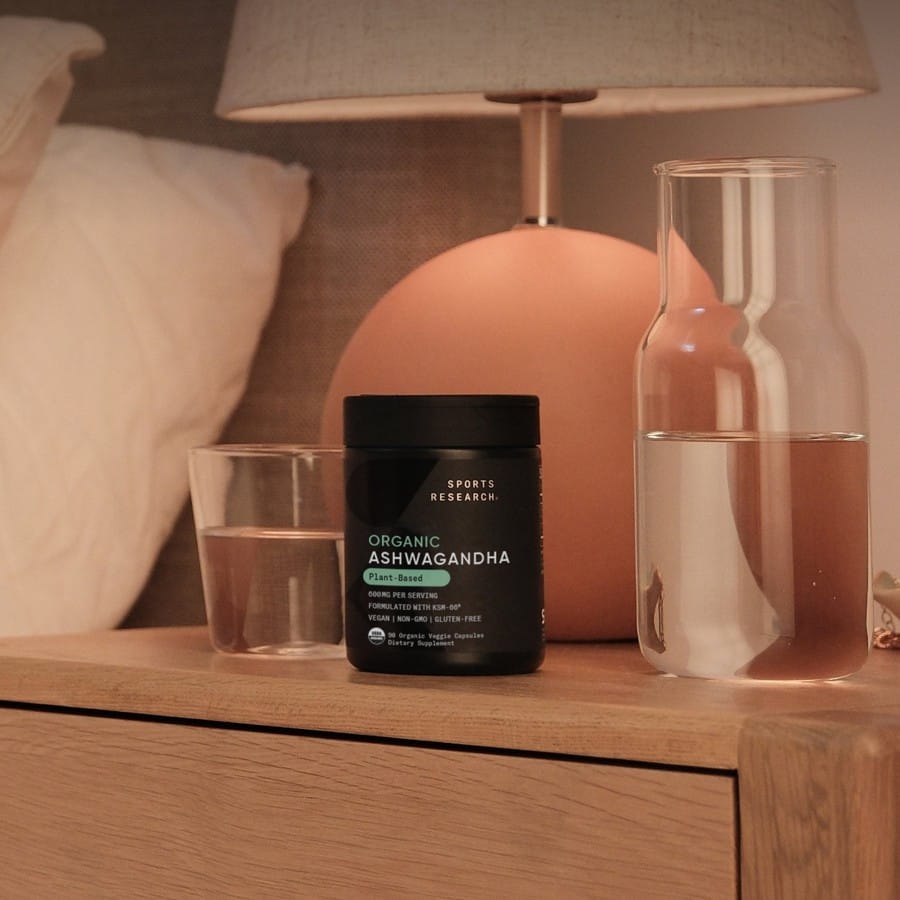
One capsule delivers 600 mg of KSM-66 standardised to 5% withanolides, which means the labelled total withanolide content by the extract's own assay is 30 mg. Two caveats worth stating: withanolides are a measured family of constituents rather than one proven active, and a labelled amount is not an absorbed dose. The arithmetic still explains why the extract matters more than the bottle — "600 mg of ashwagandha" alone is close to meaningless.
Withanolides are a family of steroidal lactones, and the mechanism is not sedation. Ashwagandha modifies the stress response — hypothalamic-pituitary-adrenal signalling and cortisol dynamics — alongside effects on neurotransmitter systems involved in arousal. When it works, what you get is lower background activation, not pharmacological unconsciousness. It does not knock you out. It lowers the floor you are trying to fall asleep from.
Why you cannot swap extracts
These are not three strengths of the same product. Different extraction, different constituent ratios, different chemical fingerprint, different clinical dosing protocols. Even matching total withanolide arithmetic would not make them equivalent. The evidence attaches to the named extract at its studied dose, not to the word "ashwagandha."
Sports Research sells two ashwagandhas in near-identical black bottles. The veggie capsules are KSM-66 at 600 mg. The softgels with coconut MCT oil are Shoden at ~120 mg — a different extract entirely.
Worse: both products share a size selector on Amazon at identical prices (60/$21.95 · 90/$32.95 · 120/$34.95). Clicking the 120-count option from the correct page flips you to the Shoden product. I did exactly that.
Buy the 90 count as displayed and do not touch the size options.
Take it with dinner. Food reduces the chance of nausea and the evening slot suits a compound that lowers arousal. Do not expect a first-night effect — one to two weeks before anything is noticeable, four to eight before it deserves a verdict.
2. Magnesium bisglycinate — an absorption decision

Magnesium is a cofactor in hundreds of enzymatic processes — ATP metabolism, muscle function, neuronal excitability, electrolyte regulation. In the nervous system it helps regulate NMDA receptor activity and the balance between excitation and inhibition. The sleep benefit is most plausible when intake, absorption or losses have left status suboptimal.
Which is worth being explicit about rather than assumed: six training days a week, heavy sweating, tropical climate. Sweat carries electrolytes including magnesium. That is one risk factor, not evidence of marginal status — diet, symptoms and history matter more, and magnesium is notoriously hard to test well.
Why bisglycinate and not the cheaper forms
And no, being 105 kg is not permission to double the scoop. Start at one serving; half a serving for the first three nights if gut tolerance is unknown.
One scoop (3.77 g, giving the 200 mg elemental) in water, 60 to 90 minutes before bed. Thorne's is lightly sweetened with monk fruit and dissolves cleanly, which is why the glycine goes in the same glass rather than a second one. 200 mg also sits under the 350 mg/day upper limit for supplemental magnesium — count anything else you take toward that. The honest position: the sleep evidence for magnesium is mixed and strongest when intake or status is genuinely low. Judge it over several weeks, not several nights.
3. Vitamin D3 + K2 — two halves of calcium physiology
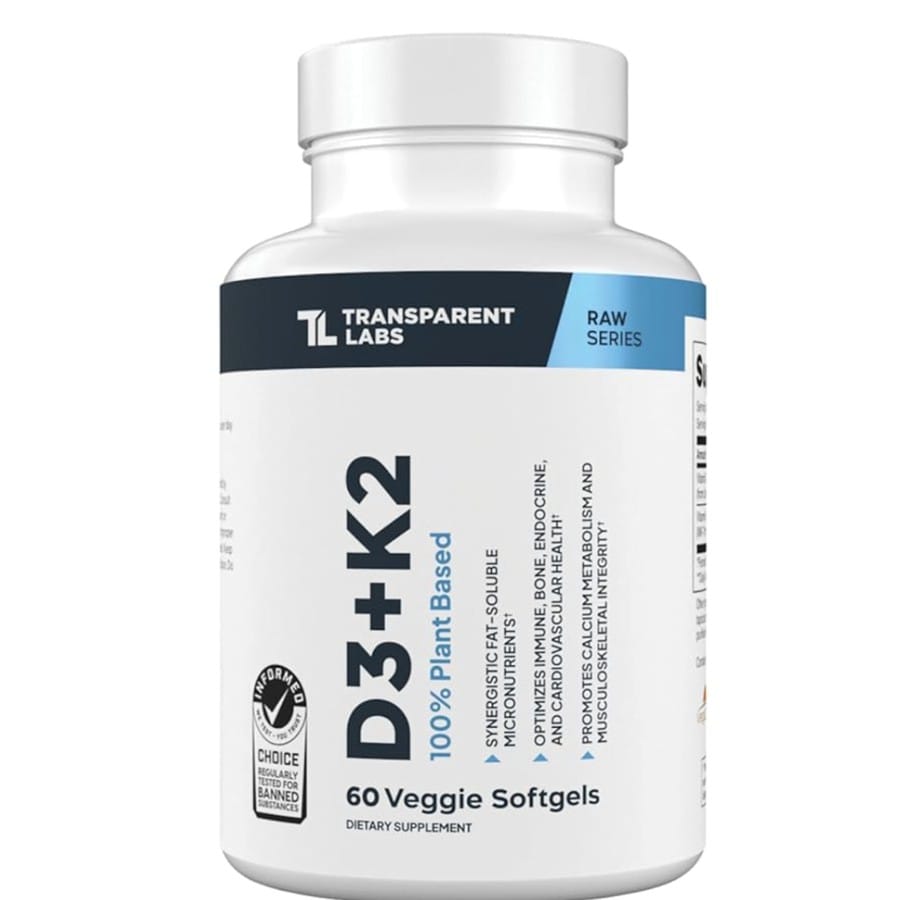
This one is in the stack because of a measured number rather than a hunch: my vitamin D came back at 35 ng/mL. That is sufficient by most standard reference ranges — the 40-60 target is a clinician-specific preference, not a consensus. A fresh result is pending, and that number, not the old one, decides the dose. Worth being explicit here because the article gives a number: 5,000 IU sits above the commonly cited adult tolerable upper intake level of 4,000 IU/day. That is not a toxicity threshold, but it does make this a supervised, time-limited dose rather than a default one — and a vitamin D result alone never decides it. Calcium status, kidney function, total intake from everything else and sun exposure all belong in that call.
D3 is converted in the liver to 25-hydroxyvitamin D — the form measured in blood — then into active metabolites that bind the vitamin D receptor and change gene transcription. One major effect is increased intestinal absorption of calcium and phosphate. Note what that is not: this is not a sleep mechanism. Vitamin D is not a sedative and 5,000 IU at dinner will not deepen tonight's sleep. It is a weeks-long correction of a hormonal micronutrient, and it earns its place in an evening stack purely by convenience.
Why the K2 is not filler
Vitamin K activates proteins through gamma-carboxylation: activated osteocalcin helps bind calcium into bone, and activated matrix Gla protein inhibits calcium depositing where it should not, including vascular tissue. That biochemistry is solid. The clinical leap is not: evidence that routine K2 supplementation changes hard outcomes remains uncertain, and excess vitamin D can cause hypercalcaemia with or without K2 in the capsule. So the pairing is mechanistically sensible and reasonably priced, not a proven requirement.
1. K2 does not "escort calcium to your bones." It activates the proteins that regulate where calcium goes. Useful shorthand, incomplete mechanism.
2. MK-7 and MK-4 are not interchangeable. MK-7 stays in circulation far longer and suits once-daily microgram dosing; MK-4 has a short half-life and is normally used in much larger or divided doses. "Contains K2" on a label tells you less than you think.
3. K2 is not an antidote to too much D3. It does not prevent hypercalcaemia if the dose is wrong for you. Which is why the pending lab result matters more than the bottle.
Take it with dinner, with fat in the meal — both vitamins are fat-soluble and absorption is meaningfully better that way. If evening D3 seems to make you alert, move it to breakfast and change nothing else. Retest 25-hydroxyvitamin D at eight to twelve weeks. The correct response to hitting target is a lower maintenance dose, not 5,000 IU forever.
4. Glycine — a thermoregulation tool
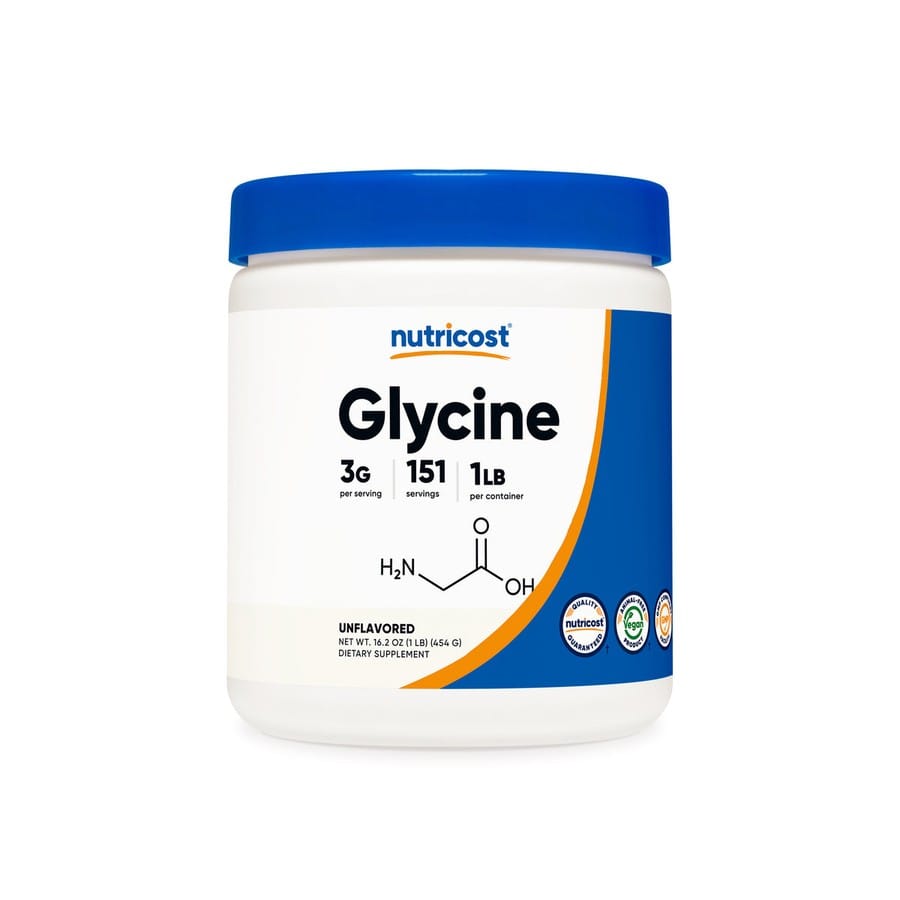
3 g per serving, 151 servings in the bag — which is the practical argument for powder over capsules. Reaching the studied dose in capsule form means swallowing six to ten of them nightly.
Glycine is an amino acid, a collagen building block, and a neurotransmitter. It activates inhibitory glycine receptors — chloride channels concentrated in the spinal cord and brainstem — and it is also a required co-agonist at NMDA receptors. That second role is modulatory rather than inhibitory, which is why calling glycine a general neuronal suppressant is wrong.
The proposed sleep mechanism is thermoregulation. Sleep onset normally coincides with a fall in core body temperature, and glycine appears to support peripheral heat loss so core temperature drops more efficiently. Keep the confidence proportionate: the human trials at 3 g are small, and what they report is modest — improvements in subjective sleep quality and some latency measures, not a transformation.
Glycine increases peripheral blood flow, moving heat from the core out to the skin. Your extremities feel warmer while your core temperature falls. That outward transfer — not becoming uniformly colder — is the transition into sleep. So if you take glycine and your feet get warm, that is not the opposite of what you wanted — it is consistent with the proposed mechanism. It is not proof the compound is working for you; only the 28 nights can say that.
3 g in water, 30 to 60 minutes before lights out, with or without food. It tastes faintly sweet and dissolves into the magnesium drink if one glass is more repeatable than two. This is the one compound here that may do something on the first night — but the honest expectation is modest: an easier transition, fewer tired-but-awake minutes. Not two extra hours. And the 3 g is not scaled to bodyweight; 105 kg does not make it 6 g.
The whole evening, in order
Anchored to a 22:30 lights-out, that is: 18:30-19:30 dinner with some fat, D3+K2 and ashwagandha with it. 21:00 magnesium in water. 21:45 3 g glycine. 22:30 lights out — and that last step is not decorative. It sets the ceiling on how much sleep the other four can possibly produce.
Two reasons. If something upsets your gut you know exactly what. And the staged introduction plus the later ashwagandha off-cycle is the only attribution you get — starting four compounds simultaneously tests the stack and can never tell you which one did the work.
Interactions, honestly
No direct interaction between the four is established — but nor has the combination been properly studied, which is a different statement from "it is fine." The plausible one is additive relaxation from ashwagandha, magnesium and glycine. Test that at home, not before driving. And if you are on anything prescribed, the complete list belongs in front of your prescriber or pharmacist, not inferred from an article.
Only one of the four gets cycled. Ashwagandha runs 12 weeks on, three to four off — not because it turns hostile on day 85, but because it has the most systemic endocrine and stress-axis activity of the group, most clinical data runs shorter than indefinite use, and the off-period is the cleanest causal test I will get. Magnesium, glycine and D3 need no arbitrary cycling — they get adjusted from tolerance, diet and bloodwork.
How I will know if it worked
Continuous data is only an advantage if the verdict is defined before you look at the results. So, stated in advance:
Baseline is the flat 30-day period already on record. Exclude the staggered introduction nights. Then run the complete stack for at least 28 consecutive nights under roughly stable training and cutting conditions.
If sleep goes 5.5 → 6.2 hours but the sleep opportunity also grew by 45 minutes, the behaviour deserves the credit, not the stack. The stack only has a real claim if time in bed stays fixed while onset latency and wakefulness fall. Both numbers get read together or neither means anything.
Sleep stages stay secondary throughout. Consumer wearables estimate them; they do not measure brain activity. Duration, timing and trend are the useful outputs — not a celebrated spike in "deep sleep."
What this will not fix
Supplements do not create hours. Moving my average materially above 5.5 requires a scheduled sleep opportunity closer to 7.5-8.5 hours. The stack can convert more of that window into actual sleep. The window has to exist first.
It also will not fix late caffeine, alcohol-fragmented sleep, a hot bedroom, uncontrolled light or noise, or training so late and hard that sympathetic activation is still elevated at bedtime. A cutting phase adds hunger and recovery pressure on top. Those get logged as variables, not blamed on a capsule.
The pass-or-fail rule
Three separate clocks, because one pass/fail date cannot fairly judge compounds that work on different timescales. The fast-acting part of the stack gets 28 full nights after the introduction period. Ashwagandha is explicitly exempt from that verdict — it gets its 12-week block and the withdrawal check after. D3 is judged only by the lab, at eight to twelve weeks.
Everything else is secondary to the number this is all aimed at, which has not moved in a month and is currently identical on both windows: 5.5 hours.
The Hibernation Protocol — the original stack this is the shopping list for.
Thirteen Tonnes and a Clean Heart — the clean ECG and the training block these sit alongside.
Twenty-One Markers and an ECG — the panel that produced the vitamin D number driving product three.
MONSTER 2.0 — The Blueprint — the six-day block whose recovery demand is half the reason this stack exists.
The Best Thing in Animal Pak Is the 100 mg They Took Out — a label-by-label read of the Animal line, and what the supplement facts actually show.
Three Pillars, All Live — how the training, kitchen and protocol run together, and the one date that reads all three