
MONSTER 2.0 — The Blueprint
Six days, built from an AI scan of every machine on my gym floor. Ten kilos of fat out, no muscle back. Every term defined, every set and rep, and an illustration of the start and finish of every exercise.

The program I've been running for months was written before I ever set foot in this gym. It assumed equipment that isn't here and ignored equipment that is. So I scanned the entire floor with two AI vision models and got a complete inventory — every machine, rack, bar, plate and cable attachment, reconciled and verified.
This is what that inventory was for.
Monster 2.0. Six days, built around the equipment that is actually on this floor, and around one objective: strip ten kilos of fat while keeping — and where possible adding — the muscle underneath it.
Everything you need to run it is below, in the order you need it. What the old program was and why it's changing. Every term defined, because a plan you can't read is a plan you won't follow. How a session actually runs. Then the six days, exercise by exercise — each one with an illustration of its start and finish position, the exact machine, and the exact attachment to put on the cable.
Now: 105 kg, training six days a week, lifts moving. The areas with the most room to grow are the upper chest, back width, shoulders, arms and traps.
Target: 95 kg with the same or more lean mass. Sharper definition, a wider back, fuller delts and arms, and every lift heavier at the end of the block than the start.
Timeline: 14 to 22 weeks at half to three-quarters of a percent of bodyweight per week. Slower than the internet promises, because faster is how you lose muscle instead of fat.
What I Was Running: the Original Monster Plan
The Monster Bodybuilding Workout Plan was a six-day, high-volume, old-school split. Three muscle pairings, each hit twice a week — but never the same workout twice. The second session of each pairing used different exercises and different angles from the first:
| Pairing | Trained | First session | Second session |
|---|---|---|---|
| A | Chest & Back + abs | Day 1 | Day 4 — different exercises and angles |
| B | Shoulders & Arms + abs | Day 2 | Day 5 — different exercises and angles |
| C | Legs & Calves + abs | Day 3 | Day 6 — different exercises and angles |
The defining method was the antagonist superset. Two opposing muscles paired back to back with no rest between them — a set of bench press straight into a set of barbell rows, then roughly 90 seconds of rest, then repeat that pair three or four times. Chest with back. Biceps with triceps. Then move to the next pair.
Alongside that: short rest periods, a 2-1-2 tempo, abs every single session, and 40 minutes of fasted low-intensity cardio every morning.
It's a good program. It's dense, it's brutal, and pairing opposing muscles keeps the heart rate high enough that the session doubles as conditioning. Nothing below is a correction of it. It did its job — it just isn't the right tool for the next 14 weeks, in this gym, for this goal.
What Changes, and Why
| Monster 1.0 | Monster 2.0 | |
|---|---|---|
| Structure | 3 muscle pairings, each hit twice a week with different exercises | 6 distinct sessions, each with its own focus |
| Method | Antagonist supersets — paired, no rest between | Straight sets — all sets of one exercise, then move on |
| Priority | Everything trained roughly equally | Chest, back, shoulders and abs go first, while fresh |
| Volume | Maximum volume, short rest | Fewer sets, heavier load, longer rest |
| Rest | 30–90 s | 2–3 min on compounds, 60–90 s on isolation |
| Cardio | 40 min fasted every morning, before lifting | After lifting. Stair climber, 2–3× a week |
| Abs | Every session, unloaded high reps | 4 sessions a week, loaded and progressive |
| Equipment | Generic — a gym in the abstract | Mapped to specific machines on this floor |
Why straight sets instead of supersets
Supersets are a density tool. They let you do more work in less time, and they raise the heart rate — which is exactly what you want when calories are high and you're chasing size.
In a fat-loss phase the priority inverts. The thing that tells your body to keep muscle while you're eating less is heavy load moved well. Superset the bench into a row and the row is compromised — you're still out of breath from pressing. You end up moving lighter weight on both exercises and calling the extra fatigue "intensity."
Straight sets with real rest let you keep the load high. The weight on the bar is the signal that protects your muscle. Everything else is negotiable.
Why the priorities go first
Whatever you do first in a session gets your best effort — freshest, strongest, most focused. Whatever's last gets whatever is left over.
The priorities here are chest, back, shoulders and abs. Arms are already the strongest thing I've got, so they don't need to lead a session — they need to keep being trained properly while the rest catches up.
So the week is built around giving each priority a session where it goes first, and a second session that hits it from a different angle rather than repeating the first:
| Priority | Leads on | Second exposure | How the two differ |
|---|---|---|---|
| Chest | Day 1 — incline press | Day 4 | Day 1 is heavy and incline-led for the upper chest; Day 4 is flat and fly-led. |
| Back | Day 1 — pull-ups | Day 4 | Day 1 is vertical pulling for width; Day 4 is horizontal rowing for thickness. Two different jobs. |
| Shoulders | Day 3 — overhead press | Day 6 | Day 3 is heavy pressing; Day 6 is high-rep lateral and rear-delt volume. |
| Abs | Day 1 | Days 3, 5 and 6 | Four sessions, three different functions — loaded flexion, pelvic curl, anti-extension. |
Arms still get a full day and a second session — they're on Days 3 and 6, same as the shoulders they share those days with. The difference is that they're trained to keep developing, not to catch up.
Why abs get four sessions a week
Every other muscle here gets two. Abs get four, and that isn't an oversight.
Abs are a small muscle group worked through a short range with light loads. They generate far less systemic fatigue than a squat or a row, and they recover in about a day — which is why they tolerate a frequency that would wreck your chest. The old Monster plan trained them every single session for exactly this reason.
What's different now is that they're loaded and progressive. Endless bodyweight crunches stop working the moment you can do fifty of them. Abs are a muscle: to grow, they need resistance that goes up over time. So the cable crunch is weighted and the weight climbs, the hanging leg raise progresses from bent knees to straight legs to holding a dumbbell between the feet, and the rollout progresses by extending further.
| Day | Function | Exercise | Sets × Reps | How it progresses |
|---|---|---|---|---|
| 1 | Loaded spinal flexion | Cable crunch | 3 × 8–12 | When all three sets hit 12 clean reps, add 2.5–5 kg to the stack. |
| 1 | Pelvic curl | Hanging leg raise | 3 × 8–12 | Bent knees → straight legs → a light dumbbell held between the feet. Never just more reps. |
| 3 | Anti-extension | Ab rollout | 3 × 6–10 | Roll further out. Once you reach full range for 10, add load with a weighted vest. |
| 5 | Loaded spinal flexion | Cable crunch | 3 × 8–12 | Same progression as Day 1. |
| 5 | Pelvic curl | Hanging leg raise | 3 × 8–12 | Same progression as Day 1. |
| 6 | Anti-extension | Ab rollout | 3 × 6–10 | Same progression as Day 3. |
Eighteen hard sets a week across three distinct functions. That's priority-level volume, and it's why abs appear on four of the six training days.
Why abs still come last inside each session: loading the trunk before heavy presses, rows, squats or deadlifts weakens every one of those movements. Abs are a priority in *frequency and progression*, not in running order.
And one thing to be straight about: training abs builds the muscle, it does not uncover it. Thickness comes from this work. Visibility comes from the ten kilos. Two separate jobs, and you need both.
Why fewer sets, not more
More sets do build more muscle — but with sharply diminishing returns, and the point where it stops paying comes down when you're eating less. Recovery is a budget, and a calorie deficit shrinks it.
A destroyed muscle means excess damage, not superior stimulus. Ten to sixteen hard sets per week for a priority muscle, six to ten for everything else. Sets you can't recover from are just fatigue you're paying for twice.
Why cardio moved to after lifting
Cardio before lifting measurably reduces the weight you can move — and that weight is the muscle-retention signal. Doing 40 minutes first thing and then lifting later still leaves you starting the session with a deficit in the tank.
It goes after the weights now, and never on a day that would compromise the leg sessions.
The Language
Every term used anywhere in this plan, defined once. Skip it if you already know it — but the day tables use this vocabulary and assume nothing.
Structure
| Term | What it means |
|---|---|
| Set | One continuous run of repetitions, then you stop and rest. |
| Rep | One complete repetition of the movement, start to finish and back. |
| Straight set | You do all sets of one exercise, resting between each, before moving to the next exercise. This is what this whole program uses. |
| Superset | Two exercises done back to back with no rest between them. |
| Antagonist superset | A superset pairing opposing muscles — chest with back, biceps with triceps. The method the old Monster plan was built on. |
| Compound | An exercise moving more than one joint and training several muscles at once — a press, a row, a squat. |
| Isolation | An exercise moving one joint and targeting one muscle — a curl, a lateral raise, a leg extension. |
| Warm-up set | A light set done to prepare the movement. Doesn't count toward your prescribed sets. |
| Working set | A hard set at your real weight. These are the sets the plan counts. |
| PPL | "Push / pull / legs" — a common split where pressing muscles train one day, pulling muscles the next, legs the third. This program is deliberately not a PPL, for the reason given above. |
| Volume | How many hard sets a muscle gets per week. |
| Frequency | How many separate sessions a week a muscle gets. |
| Intensity | How heavy the weight is relative to your maximum. |
Effort and execution
| Term | What it means |
|---|---|
| RIR | "Reps in reserve." How many more reps you could have done. RIR 2 means you stopped with two clean reps left in the tank. RIR 0 means you stopped because you physically could not do another. |
| Failure | The point where you cannot complete another rep with good form. Same as RIR 0. |
| Rep range | The window of reps to aim for, e.g. 8–12. Pick a weight that puts you at the target effort inside that window. |
| Tempo | The speed of the rep. Here: control the lowering over 1–3 seconds, no bouncing. |
| Eccentric | The lowering half of a rep — the bar coming down. The muscle lengthens under load. |
| Concentric | The lifting half — the bar going up. The muscle shortens. |
| Range of motion | How far the weight travels. Full range means all the way to the stretch and all the way back. |
| Stretched position | The point in a rep where the working muscle is longest — the bottom of a squat, the bottom of a curl. Disproportionately important for growth. |
| Progressive overload | Adding weight or reps over time. Without it, nothing changes. This is the entire mechanism. |
Body and goal
| Term | What it means |
|---|---|
| Hypertrophy | Muscle growth — the muscle fibres getting physically bigger. |
| Lean mass | Everything that isn't fat — muscle, organs, bone, water. |
| Deficit | Eating fewer calories than you burn. Required to lose fat. |
| Refeed | A single planned higher-carbohydrate day inside a deficit. |
| Posterior chain | The muscles down the back of the body — hamstrings, glutes, lower back. |
| Lat width | How far the back flares out to the sides. Comes from the latissimus dorsi, trained with overhead pulling. |
| Back thickness | How deep the back looks from the side. Comes from traps and mid-back, trained with rowing. |
| V-taper | The silhouette created by wide lats above a narrower waist. |
| LISS | "Low-intensity steady state" — easy continuous cardio at a conversational pace. |
| HIIT | "High-intensity interval training" — short hard bursts with recovery between. |
| Zone 2 | A steady, moderate effort you could hold for an hour and still speak in short sentences. |
How a Session Actually Runs
This is the biggest practical change from the old plan, so it gets stated as plainly as possible.
You do every set of exercise 1, resting between each set, before you touch exercise 2. Then every set of exercise 2. And so on down the list.
Example — exercise 1 is 4 × 6–8: set of 6–8, rest 3 min, set, rest 3 min, set, rest 3 min, set. That exercise is now finished. Move to exercise 2.
No jumping between two machines. No pairing. Nothing is superset unless the plan explicitly says so — and in this program, nothing does.
Warming up
The walk to the gym raises your body temperature, but it does not warm up a movement. Before the first heavy compound of the day, ramp up in four quick sets — none of them hard, none of them counting toward the prescription:
| Warm-up set | Load | Reps |
|---|---|---|
| 1 | ~40% of your working weight | 8 |
| 2 | ~60% | 5 |
| 3 | ~75% | 3 |
| 4 | ~85% | 1–2 |
For the next major exercise that hits a new area, one or two light sets. For isolation work later in the session, one is plenty — or none if the muscle is already warm.
Picking the weight — and how the reps work
The rep numbers in every table are a RANGE, not a target.
When Day 1 says 4 × 6–8, it does not mean "do 8 reps". It means: four sets, and each set should land somewhere between 6 and 8.
The reps are not fixed. They climb. You start at the bottom of the range and work up to the top over several sessions at the same weight. Only once you hit the top of the range on every set do you add weight — and adding weight knocks you back down to the bottom of the range again.
That is why it is called double progression. Two things progress: first the reps, then the load.
Starting weight: pick something you can hit the *bottom* of the range with, cleanly, on every set — at roughly RIR 2. For 4 × 6–8, that means a weight you get 6 solid reps with on all four sets, with about two left in the tank.
If the weight forces fewer than six good reps, it's too heavy — drop it 5–10%. If you blow straight past 8 on the first session, it's too light.
What that looks like over six weeks
One exercise, real numbers. Incline barbell press, 4 × 6–8:
| Session | Weight | Reps per set | What you do next time |
|---|---|---|---|
| 1 | 60 kg | 6, 6, 6, 6 | Same weight. Try for 7 on the first set. |
| 2 | 60 kg | 7, 6, 6, 6 | Same weight. Push the second set. |
| 3 | 60 kg | 7, 7, 6, 6 | Same weight. Keep grinding reps. |
| 4 | 60 kg | 8, 7, 7, 6 | Same weight. Nearly there. |
| 5 | 60 kg | 8, 8, 8, 8 | Top of the range on every set — ADD WEIGHT. |
| 6 | 62.5 kg | 6, 6, 6, 5 | Back to the bottom of the range. Start climbing again. |
Open the log. Look at what you did last time on this exercise. Beat it by one rep on one set.
That is the entire instruction. Not "add weight every session" — nobody can do that for long. Not "do exactly 8 reps" — that is a fixed target with nowhere to go.
One more rep than last time, somewhere. When all sets are full, the weight goes up.
Week one you have no log to beat. Just find your starting weights, stop at RIR 2, and write everything down. That is the whole job today.
Why not just add weight and keep the reps fixed? Because you would run out of progress in about a month. There is no weight increment small enough to add every single session forever. Reps are the fine adjustment; load is the coarse one. Double progression gives you five or six sessions of measurable progress between each jump instead of one.
In a deficit this matters even more. Holding the same weight and adding one rep is genuine progress, and it is often all you will get in a hard cut. Don't read that as failure.
Two counting rules while we're here: all listed sets are working sets — warm-ups never count. And for single-side exercises, *3 x 10-12 each* means three sets of 10-12 reps per side. Three sets, not six.
Between sets, and how long it all takes
| Rest | Why | |
|---|---|---|
| Heavy barbell work, hack squat, leg press, RDL | 2.5–3 min | Long enough to genuinely recover, so the next set is as heavy as the last. Cutting this to save time costs load — and load is the point. |
| Machine compounds | 90–120 s | Supported movements, less systemic cost. |
| Isolation and abs | 60–90 s | Smaller muscles recover faster. |
| Session length | 65–90 min | Excluding the walk and the cardio. Day 6 runs shorter, about 60–70. |
During rest: log the set, breathe, set up the next one. Don't slot in another exercise, and don't aggressively stretch the muscle you're about to load again.
Log every set — weight, reps and effort, every session. Progressive overload is the entire mechanism, and you cannot progress against a number you didn't write down.
Fuel and Recovery
The training is half of it. These are rules, not suggestions — in a deficit, they're what decides whether the ten kilos comes off fat or off muscle.
| Lever | Target | Why |
|---|---|---|
| Rate of loss | 0.5–0.75% of bodyweight/week ≈ 0.5–0.8 kg | Faster than this and an increasing share of what you lose is muscle. Ten kilos lands in 14–22 weeks. |
| Protein | 175–195 g/day | Scaled to lean mass, not total bodyweight — at 105 kg that's roughly 72–78 kg of fat-free mass to work from. Split across 4–5 meals of 35–50 g. This is the single most important number on the page, and it matters most on the days you aren't hungry. |
| Deficit | ~500 kcal/day below maintenance | Enough to move the needle, small enough to still train hard. |
| Creatine | 3–5 g daily, no breaks | Preserves strength and training output while calories are low. |
| Steps | 8,000–12,000 | Dieting quietly reduces how much you move all day — enough to cancel out planned cardio. The commute already covers most of this. |
| Refeed | One higher-carb day per week | Placed on a heavy leg day. For adherence, energy and sanity. |
| Sleep | 7+ hours | Dieting on short sleep shifts more of the loss onto muscle. This is not a soft recommendation — it changes what you lose. |
| Weigh-in | Daily, act on the 7-day average | Single days are water. Only the trend means anything. |
Adjusting the deficit
Check the two-week average, not the scale this morning. Then:
| If the average is... | Do this |
|---|---|
| Falling less than 0.4 kg/week | Cut 150–200 calories a day, or add one climber session. One change, not both. |
| Falling 0.4–0.9 kg/week | Nothing. This is the target. Leave it alone. |
| Falling more than 0.9 kg/week and strength is dropping | Add 150–250 calories a day. You're losing it too fast and some of it is muscle. |
Change one variable at a time or you learn nothing from the result.
1. No cold plunge or cold shower within 4–6 hours of lifting. Cold immersion straight after training blunts the growth signal you just spent an hour creating. Cold is fine — put it on rest days or in the morning.
2. Finish training at least 3 hours before bed. Late heavy work keeps the nervous system switched on and pushes bedtime back. Since sleep is what decides whether you lose fat or muscle, this costs more than it looks like it does.
Cardio
The stair climber is the machine. Not because it burns the most — a treadmill burns more — but because it's *concentric-only*. You push up, and the stair drops away beneath you. There's no impact and no lowering phase, which is what makes running so expensive: running damages the legs eccentrically and competes directly with your leg days.
The climber gives you the work without the recovery debt, at 105 kg, with nothing to absorb through the joints.
| When | How long | Effort |
|---|---|---|
| After Day 1 | 20 min | Steady. Able to speak in short sentences. |
| After Day 3 | 20–25 min | Same steady pace. |
| After Day 6 | 25 min — optional | Add this third session only once the first five days are consistently strong and joints and sleep are holding. |
| Every day | ~60 min walking | 30 min downhill to the gym, 30 min uphill home. |
The ClimbMill
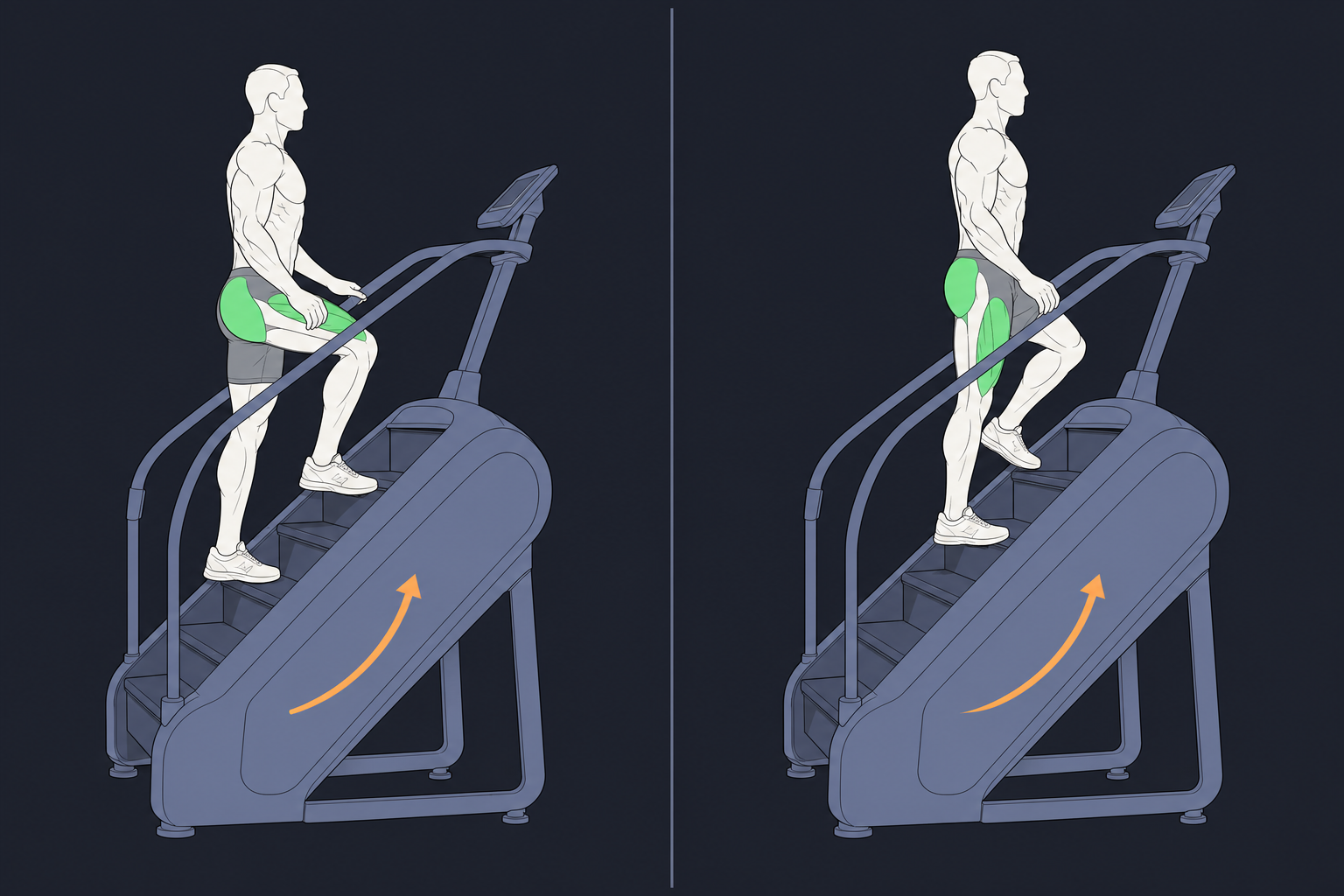
| EQUIPMENT | Matrix ClimbMill — rotating staircase, not the pedal stepper |
| SETS × REPS | 20–25 min |
| REST | — between sets |
| SET UP | Stand tall. Hands resting lightly on the rails for balance only. |
| EXECUTE | Full steps, driving through the heel. Steady pace where you could speak in short sentences. |
| COMMON MISTAKE | Leaning your bodyweight onto the handrails, which can cut the actual work by a third while the machine still reports the same numbers. |
| NOTE | Concentric-only — you push up, the stair drops away. That is why it does not wreck your legs the way running does. |
Setting the machine up
The ClimbMill is rated in steps per minute — that's the number that actually controls how hard it is. The level dial changes the step rate; it is not a resistance setting like a bike. Use Manual mode, not a preset program: presets vary the intensity for you, which is the opposite of what steady-state work needs.
| Phase | Duration | Level | Steps / min | Heart rate and feel |
|---|---|---|---|---|
| Warm-up | 4 min | 2–4 | 30–40 | Heart rate drifting up toward 100–110. Breathing still completely easy. |
| Working pace | 15–20 min | 5–7 | 45–58 | 110–130 bpm. Effort 3–4 out of 10. You can still speak in full sentences and could keep going past the clock. |
| Cool-down | 3–4 min | 2–3 | 25–35 | Breathing settles, heart rate back under 110 before you start the walk home. |
| Too hard | — | 8+ | 60–65+ | Above 130 bpm, breathing forced, full sentences break down. Drop a level immediately. |
The heart rate target beats the level number. Warm up at level 3, move to level 5, then check your pulse after three minutes and climb one level at a time until you're inside 110–130. Hold it there. If fatigue from the weights pushes you over the top of the range later in the session, drop back down — that's the machine reading your recovery, not you being lazy.
| Setting | Use this |
|---|---|
| Program | Manual. Not Intervals, not Rolling Hills, not Fat Burn, not Random. Presets vary the intensity for you, which is exactly what steady work does not want. |
| Posture | Stand tall. Chest up, eyes forward, don't hunch over the console. |
| Foot strike | Full step, drive through the heel. No tiptoe half-steps. |
| Handrails | Fingertips only, for balance. Do not lock your elbows, lean forward, or carry any bodyweight through the rails. Doing so cuts the real work substantially while the console reports the same numbers. If you can't stay upright without hanging on, the level is too high. |
| Progression | Add 5 steps/min, or 2–3 minutes of duration, every couple of weeks. Never both at once. |
| Don't compensate | The uphill walk home is already doing work. Don't make the ClimbMill harder to "make up for" an easy walk. |
Never before lifting. Never on a leg day. Days 2 and 5 get no machine cardio at all — the legs have done enough, and the uphill walk home is real work at this bodyweight.
Steady pace, not intervals. Intervals aren't better for fat loss and they cost leg recovery you need for six lifting sessions. And do not lean on the handrails — resting your bodyweight on the rails can cut the actual work by a third while the machine happily reports the same numbers.
30 minutes downhill to the gym and 30 minutes uphill home, six days a week, is six hours of walking — and the uphill return is genuine steady-state cardio at 105 kg, at the moment your fuel is lowest.
It is already in the plan. It is the reason cardio starts at two machine sessions instead of five. Do not drive.
Intensity Techniques
These are the named methods for pushing a set past normal failure. None of them is magic — they mostly save time rather than build extra muscle, and stacking them on top of an already-hard program just costs recovery. Used on the right exercise, at the right moment, they're worth having.
Where the plan wants one, the day's exercise detail says so explicitly.
| Technique | What it is | Verdict |
|---|---|---|
| Lengthened partials | After your last full rep, keep doing half reps in the stretched bottom half of the range until you can't. | USE — last set of leg extension, preacher curl, lat pulldown. Safe isolation only, never on a barbell compound. |
| Drop set | Hit failure, immediately strip 25–35% of the weight, keep going with no rest. Usually one or two drops. | USE — last set of a machine or cable exercise where changing the load takes two seconds. |
| Rest-pause / myo-reps | Go to failure, rack it, rest 15–20 seconds, do a few more reps. Repeat once or twice. | USE — machine pressing and isolation. Delivers the same growth for meaningfully less total work. |
| Cluster sets | Break a set into mini-sets with 10–20 second pauses to keep the bar speed high. | OPTIONAL — good for keeping power on heavy work. Doesn't add growth. |
| Blood flow restriction | Light weight with properly measured cuffs restricting blood flow from the limb. | OPTIONAL — genuinely useful if a joint is complaining and you need to train around it. Needs real measured cuffs, not a wrapped band. |
| Pre-exhaustion | Doing an isolation exercise first to fatigue a muscle before the compound. | SKIP — it doesn't add growth and it reduces what you can lift on the exercise that follows. |
| Slow eccentrics | Deliberately lowering over 5–10 seconds. | SKIP — a controlled 1–3 second lowering does the same job. Slower is just more soreness. |
1. None at all in weeks 1 and 2. Establish your weights and your technique first. You cannot intensify a set you have not yet calibrated.
2. From week 3: a maximum of ONE technique per session, on the final set of one safe isolation exercise. Not one per exercise. One per workout.
3. Never on the first exercise of the day. That lift is your heaviest and most valuable — take it to a hard, clean stopping point and leave it there. Intensity techniques belong at the end of a session, on machines and cables, on the last set only.
How Long to Run This
Eight weeks, then a deload week, then eight more. The exercises do not change inside a block. The weights do.
A deload is one planned easy week. You keep the same exercises in the same order, but cut the sets roughly in half, drop the weight 10–15%, and stop every set well short of failure.
It is not time off and it is not lost progress. Training creates fatigue faster than it creates adaptation, and a deload lets the fatigue drain away so the adaptation underneath it can show up. You almost always come back stronger than you left. Full protocol further down.
This matters more than it sounds. Rewriting the program every three weeks is the single most popular way to never get stronger at anything — you can only measure progress against a movement you keep repeating.
| Week | What you do |
|---|---|
| 1 | Calibration. Establish working weights on everything at RIR 2. No intensity techniques. Log every set. |
| 2–7 | Add reps, then load. When every set hits the top of its rep range at the target effort, add 2–5%. Intensity techniques become available from week 3. |
| 8 | Confirm the block. Compare your log against week 1 — this is the number that tells you whether it worked. |
| 9 | Deload week. See below. |
| 10–17 | Second block, same program, heavier numbers. |
| After two blocks | Full review. 16 hard weeks plus two deloads. Reassess bodyweight, measurements and bloodwork, then decide what changes. |
Change an individual exercise only if it causes persistent joint discomfort, or if it fails to progress across three exposures despite your food, sleep and technique being right. Not because it got boring.
When to deload
Week 9 is scheduled. But deload earlier if any *two* of these show up together:
| Signal | What it looks like |
|---|---|
| Performance dropping | Down 2+ reps, or roughly 5%, on several major lifts for two sessions running. |
| Soreness lingering | Repeatedly still sore more than 72 hours after a session. |
| Joints, not muscles | Joint discomfort that increases week over week. |
| Warm-ups feel heavy | Normal warm-up weights feeling unusually hard for four or more days. |
| Sleep and drive | Three or more bad nights, plus motivation, coordination or focus dropping off. |
| Unexpected failure | Weights you handled comfortably last week suddenly hitting failure. |
One bad session is not a signal. Two of the above, together, is.
What a deload actually is
| How | |
|---|---|
| Exercises | Identical. Same order. Change nothing. |
| Sets | About half — a 4-set exercise becomes 2, a 3-set becomes 2, a 2-set becomes 1. |
| Weight | 10–15% lighter than your normal working load. |
| Effort | Stop at RIR 4. No drop sets, no partials, no rest-pause. Nothing. |
| Cardio | Suspend the ClimbMill sessions. Keep the walks. |
| Food | Eat at maintenance for the week. |
In a deficit, expect strength to stall before it falls. A plateau is normal and is not a reason to change anything. Three sessions moving genuinely *backwards* is — and the fix is almost always food or sleep, not programming.
If recovery starts slipping, cut in this order
Don't guess at what to remove. There's a correct order, and it protects the priorities to the last possible moment:
| Order | Cut this | Why it goes first |
|---|---|---|
| 1 | The optional Day 6 ClimbMill session | Pure add-on. Costs recovery, contributes least. |
| 2 | All intensity techniques | They add fatigue faster than they add stimulus. Nothing in the plan depends on them. |
| 3 | Day 6 arm work — 4 sets down to 2 | Arms are already strong and get substantial indirect work from every press and every row. This is the cheapest real volume in the program. |
| 4 | One set from each non-priority exercise | Legs and arms before anything else. |
| Never | The first exercise of any day | That heavy first movement is the muscle-retention signal. It's the last thing to go, not the first. |
If you're still going backwards after all four, the problem isn't the program. It's food, sleep, or life stress — and no amount of set-shuffling fixes those.
The Six Days
Six distinct sessions. Nothing repeats. Every muscle gets trained twice a week, and every area that needs the most work gets a session where it goes first, while you're fresh.
| Day | Focus | Opens with | Cardio after |
|---|---|---|---|
| Day 1 | Chest + back width + abs | Incline barbell press | 20 min climber |
| Day 2 | Quads + glutes + calves | Hack squat | — |
| Day 3 | Shoulders + arms + abs — heavy | Seated dumbbell press | 20–25 min climber |
| Day 4 | Back thickness + traps + chest | Barbell row | — |
| Day 5 | Hamstrings + glutes + abs | Romanian deadlift | — |
| Day 6 | Shoulders + arms + traps + calves + abs — volume | Cable lateral raise | 25 min optional |
Numbered rather than named, because the week starts when it starts. Run them in order, six on and one off, or five-on-one-off-one-on if life interferes. The order matters; the calendar doesn't.
The seventh day is a full lifting rest. Walking and normal movement, nothing else. And if you miss a session, do not try to make it up — pick the sequence back up where you left off and carry on. A six-day program absorbs a missed day fine; what it doesn't absorb is two days crammed into one.
The Diet, in One Section
Full nutrition breakdown gets its own article. This is the orientation — enough that you know the shape of the diet before Day 1, without recipes or gram-by-gram tracking.
I have run strict ketogenic phases this year. For this block, keto is the wrong tool and I am not going back to it.
Ketosis does not stop you building muscle, but it is a handicap on a six-day programme built on heavy compounds and repeated hard sets — that work runs on muscle glycogen. Keto tends to cut repeated-set performance and recovery, which are the exact things a deficit is already attacking.
And it offers no fat-loss advantage over a non-keto diet when calories and protein are matched. The fast initial scale drop is glycogen and water. The fat still comes off the deficit.
On a GLP-class drug it is actively counterproductive: keto's main practical benefit is appetite control, and my appetite is already suppressed pharmacologically. Stacking a restrictive high-fat diet on top of that makes it easier to undereat protein, and large fatty meals make the nausea worse.
The answer is high protein, moderate fat, and enough carbohydrate to train hard.
The numbers
| Daily target | Its job | |
|---|---|---|
| Protein | 175–195 g | Non-negotiable. Scaled to fat-free mass (~78 kg), not to the 105 kg on the scale. This is the main defence against losing muscle. |
| Carbohydrate | 240–300 g | Training fuel — and the lever you actually adjust. Move it in 25–40 g steps, never protein. |
| Fat | 65–80 g | A floor for hormones, then a bounded calorie filler. Not a lever. Saturated fat under ~20 g. |
| Fibre | 25–35 g | Digestion and satiety. Increase gradually — a sudden bran assault on a GLP-1 drug is a bad afternoon. |
| Calories | ~2,450–2,600 | A starting point, not a calculation to defend. Adjust from the scale, not the spreadsheet. |
A representative day: 175 g protein, 270 g carbs, 75 g fat. Protein stays fixed. Fat stays in its band. Carbs move.
Meals and sources
| The rule | |
|---|---|
| How many meals | Four protein feedings, 3–5 hours apart — three meals plus a shake is fine. Four moderate feedings beat two enormous ones on this drug, and give four chances to hit protein instead of two. |
| Per meal | 35–50 g protein each. One feeding within ~3 h before training, one within ~3 h after. Beyond that, timing is a rounding error next to the daily total. |
| Protein sources | Lean red meat 3–4×/week and shellfish 1–2×/week — both are also heme iron, which given my iron finding makes them double-duty. Then whey isolate, Greek yoghurt, cottage cheese, salmon, sardines, chicken, eggs. |
| Carb sources | Rice, potatoes, oats, pasta, sourdough or wholegrain bread, beans, lentils, fruit. 40–80 g in the meal 1–3 h before lifting — something that digests predictably, low fat, not a fibre bomb. Another 50–100 g in the hours after. |
| Fat sources | Olive oil, avocado, nuts, chia, flax. Fatty fish 2–3×/week. Limit butter, cream, coconut oil, fried food, heavy cheese — high-fat meals sit in the stomach and make the nausea worse. |
| Fruit & veg | 2 servings of fruit and 400–600 g of vegetables daily. Fruit is not a problem in a deficit — it is carbohydrate with fibre attached. Cooked veg when appetite is poor; less bulk than a giant salad. |
| The iron trick | Put vitamin C next to the iron — peppers, tomatoes, broccoli, citrus alongside the beef or shellfish. And keep coffee and tea 1–2 hours away from those meals. Free absorption, costs nothing. |
Appetite suppression turning into protein suppression.
The drug makes eating optional in a way it has never been before. The scale drops fast and it feels like winning — while the missing protein is being taken out of muscle. Fast weight loss is not automatically successful fat loss.
On days when appetite is simply gone: whey isolate in water, 35–45 g. Then Greek yoghurt, cottage cheese, egg whites, lean mince, white fish. Drop the fat and the bulky fibre on those days — both make fullness worse.
Do not fast all day and try to rescue it with one enormous evening meal. That is how you end up nauseous and short on protein.
Ranked by what actually matters
| Do this | Why it ranks here | |
|---|---|---|
| 1 | Hold the deficit that produces 0.5–0.75 kg/week | This and only this determines the rate of fat loss |
| 2 | Hit the protein. Every day. | The main dietary defence against losing muscle |
| 3 | Eat enough carbs to keep the lifts moving | Protects the training stimulus that protein is defending |
| 4 | Mostly minimally processed food, unsaturated fats, real produce | Nutrient density and adherence over months |
| 5 | Spread protein across four feedings | A real optimisation — but only after 1–4 are secure |
| Noise | Nutrient timing to the minute, fasted cardio, insulin spikes from fruit, "clean" vs "dirty" carbs, carb cycling, metabolic confusion | People spend more energy on these than on the four things above. They are decoration |
Why Day 6 is what it is
Day 6 is fixed. Same session every week. It exists to close the week's coverage, not to rotate through a menu of specialisations.
Look at what Days 1 to 5 deliver on their own: chest twice, back twice, glutes twice — but shoulders, traps, calves and arms would each land only once. Shoulders are a priority and can't be left at one session. Day 6 is the second exposure for all of them, built around volume and isolation rather than heavy load, so it complements Day 3 instead of repeating it.
The result is a closed, complete week:
| Muscle | Sessions | Where | Weekly hard sets |
|---|---|---|---|
| Chest — priority | 2 | Day 1, Day 4 | ~13 |
| Back width (lats) — priority | 2 | Day 1, Day 4 | ~13 |
| Back thickness / traps — priority | 2 | Day 4, Day 6 | ~14 |
| Shoulders — priority | 2 | Day 3, Day 6 | ~18 |
| Abs — priority | 4 | Days 1, 3, 5, 6 | ~18 |
| Biceps & triceps | 2 | Day 3, Day 6 | ~13 each |
| Quads | 2 | Day 2, plus the climber and the uphill walk | ~10 |
| Hamstrings / glutes | 2 | Day 2, Day 5 | ~14 |
| Calves | 2 | Day 2, Day 6 | ~8 |
The four priorities carry the most volume and the most frequency. Arms sit deliberately below them — they get real, progressive work twice a week, which is plenty for a body part that's already ahead.
DAY 1 — CHEST + BACK WIDTH + ABS
Three of the four priorities in one session. Upper chest leads while you're freshest, then vertical pulling for the lats — the muscle that creates width — then loaded ab work.
| # | Exercise | Sets × Reps | Rest | Effort |
|---|---|---|---|---|
| 1 | Incline Barbell Press | 4 × 6–8 | 3 min | RIR 1–2 |
| 2 | Plate-Loaded Chest Press | 3 × 8–10 | 2 min | RIR 1–2 · drop set on the last |
| 3 | Cable Crossover | 3 × 12–15 | 90 s | RIR 0–1 |
| 4 | Pull-Up | 4 × 6–10 | 3 min | RIR 1–2 |
| 5 | Lat Pulldown | 3 × 10–12 | 2 min | RIR 1 |
| 6 | Straight-Arm Pulldown | 3 × 12–15 | 90 s | RIR 0–1 |
| 7 | Cable Crunch | 3 × 8–12 | 60 s | RIR 0–1 · weighted |
| 8 | Hanging Leg Raise | 3 × 8–12 | 60 s | RIR 0–1 |
Finish with 20 minutes on the ClimbMill, then walk home uphill.
Day 1 — exercise by exercise
1. Incline Barbell Press
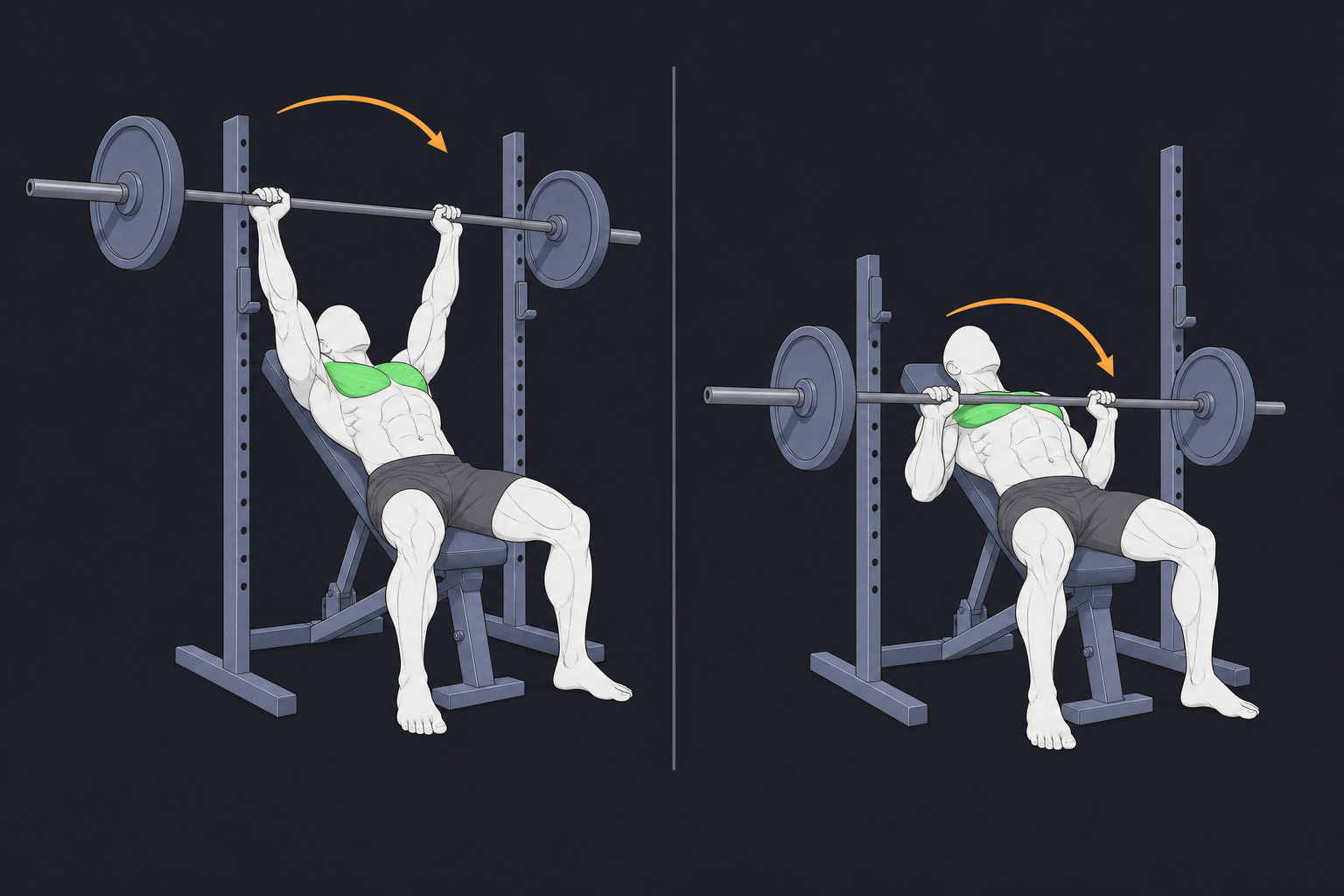
| EQUIPMENT | Olympic incline bench + straight barbell |
| SETS × REPS | 4 × 6–8 |
| REST | 3 min between sets |
| EFFORT | RIR 1–2 |
| SET UP | Set the bench to 30 degrees. Higher than that and the front shoulder takes over the work you are trying to give the chest. Lie back, feet flat, shoulder blades pulled down and together. |
| EXECUTE | Grip just outside shoulder width. Lower the bar under control to your upper chest, elbows about 45 degrees from your torso. Press back up without locking out hard at the top. |
| COMMON MISTAKE | Flaring the elbows straight out to the sides. It puts the shoulder joint in its weakest position and takes the chest out of the movement. |
2. Plate-Loaded Chest Press
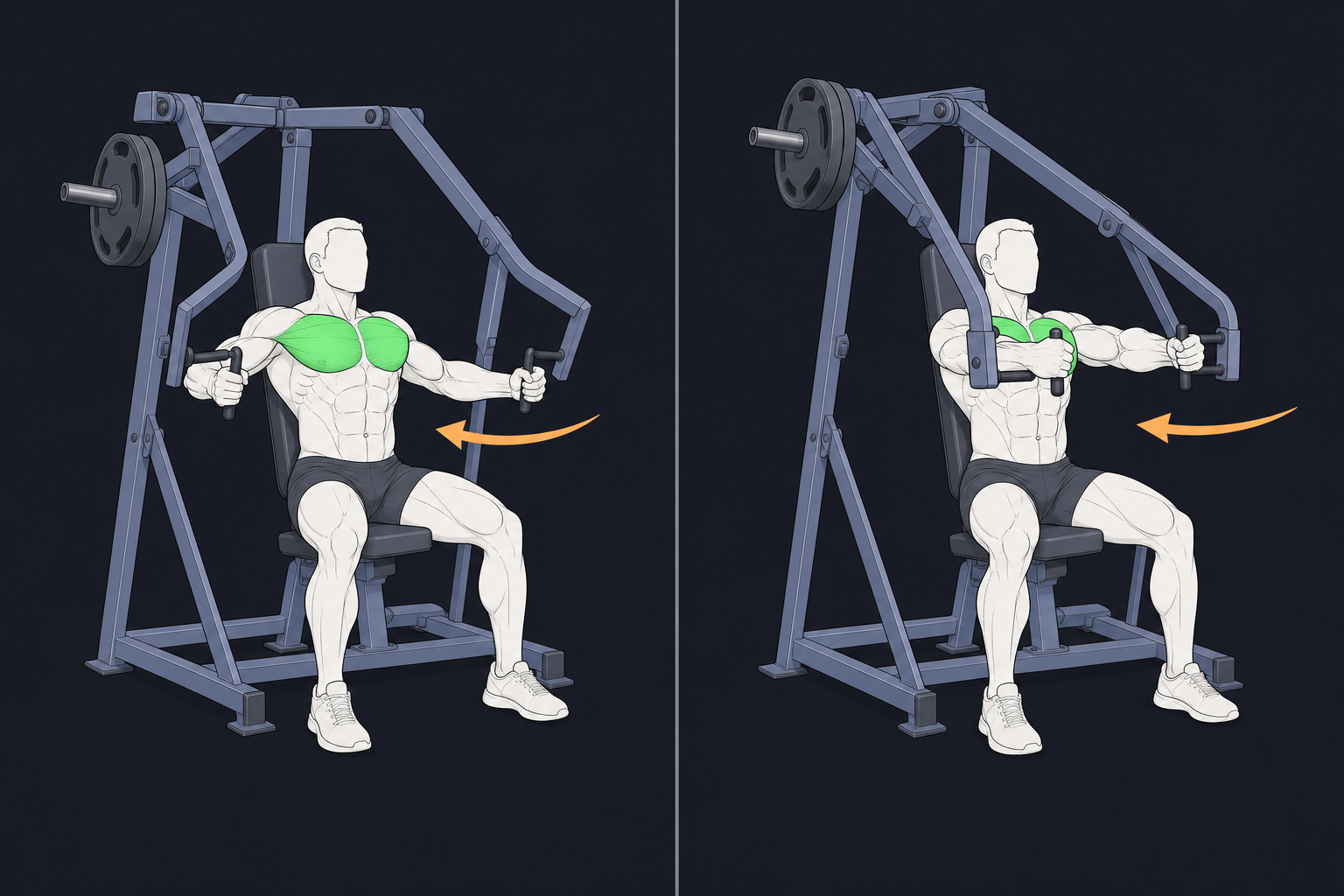
| EQUIPMENT | Plate-loaded converging chest press |
| SETS × REPS | 3 × 8–10 |
| REST | 2 min between sets |
| EFFORT | RIR 1–2 · drop set on the last |
| SET UP | Set the seat height so the handles sit level with your nipple line when you sit back. This one adjustment decides whether the exercise hits your chest or your shoulders. |
| EXECUTE | Press the handles forward and slightly inward — the arms converge, which is the point of this machine. Let the handles come back until you feel a real stretch across the chest before the next rep. |
| COMMON MISTAKE | Setting the seat too high, which turns it into an incline press you are already doing as the first exercise. |
| TECHNIQUE | DROP SET — last set only. Take the final set until you cannot complete another clean rep. Immediately strip 25–35% of the weight — no rest, do not walk away, do not sit down — and keep repping until you fail again. One drop, then stop. |
| NOTE | Converging machines let you press slightly inward at the top, which a barbell cannot do. Squeeze there. |
3. Cable Crossover
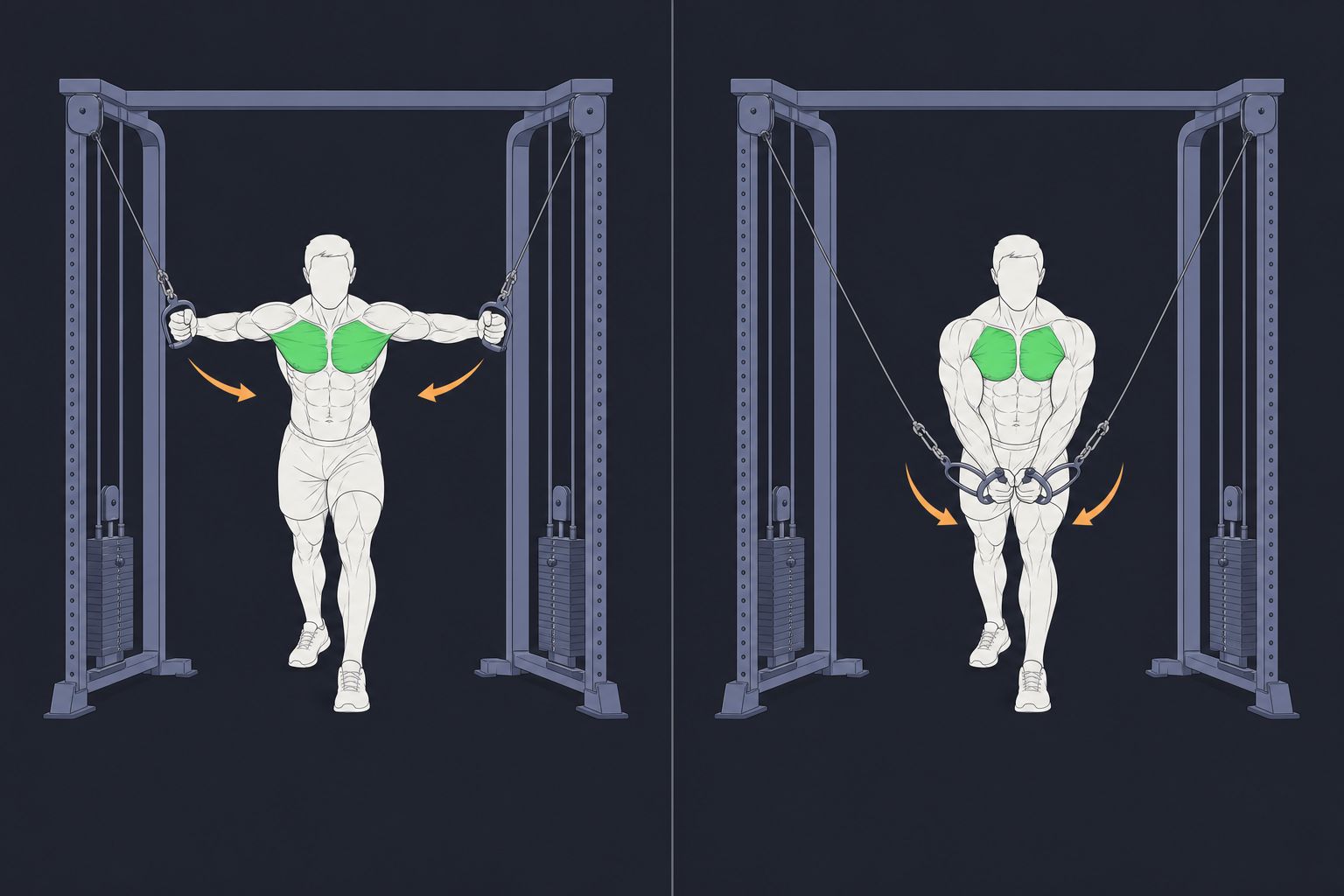
| EQUIPMENT | Cable crossover, both pulleys HIGH — D-handles |
| SETS × REPS | 3 × 12–15 |
| REST | 90 s between sets |
| EFFORT | RIR 0–1 |
| SET UP | Attach a single D-handle to each high pulley. Take one in each hand, step forward into a split stance, lean your torso slightly forward. |
| EXECUTE | With a fixed soft bend in the elbows, bring both hands down and together so they cross below your sternum. Squeeze for a count, then let the arms travel back and wide until the chest is fully stretched. |
| COMMON MISTAKE | Bending and straightening the elbows, which turns a chest fly into a triceps pressdown. |
4. Pull-Up
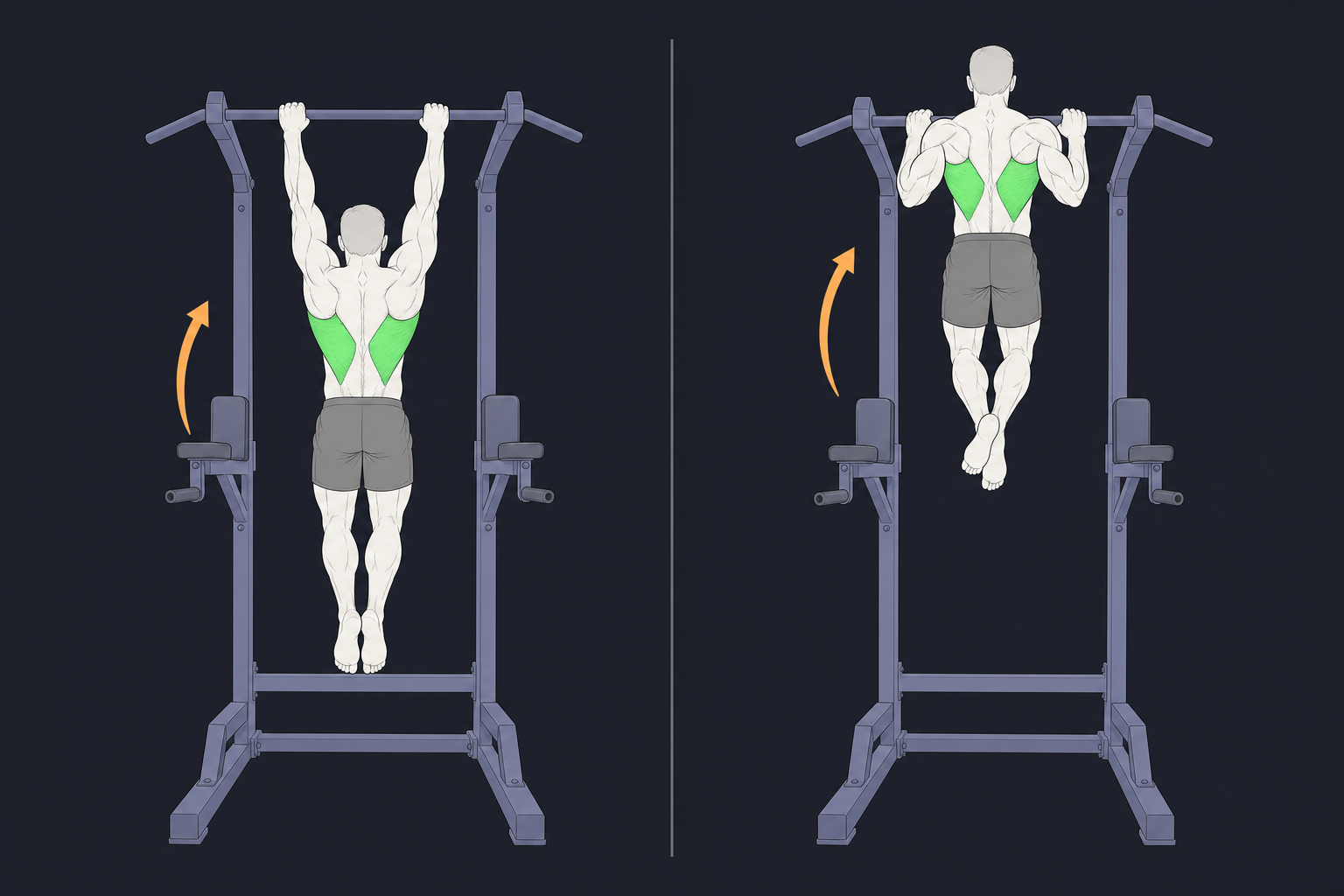
| EQUIPMENT | Multi-grip pull-up tower — or the assisted pull-up machine |
| SETS × REPS | 4 × 6–10 |
| REST | 3 min between sets |
| EFFORT | RIR 1–2 |
| SET UP | Take a grip slightly wider than your shoulders. Hang completely straight — arms locked out, shoulders stretched up toward your ears. |
| EXECUTE | Pull your elbows down and back until your chest is close to the bar. Lower all the way back to a dead hang each rep. |
| COMMON MISTAKE | Cutting the bottom short. The stretched position at the bottom is where most of the growth comes from, and it is the first thing people skip when they get tired. |
| NOTE | If you cannot get 6 clean reps, use the assisted machine. When you can do 10, start adding weight. |
5. Lat Pulldown
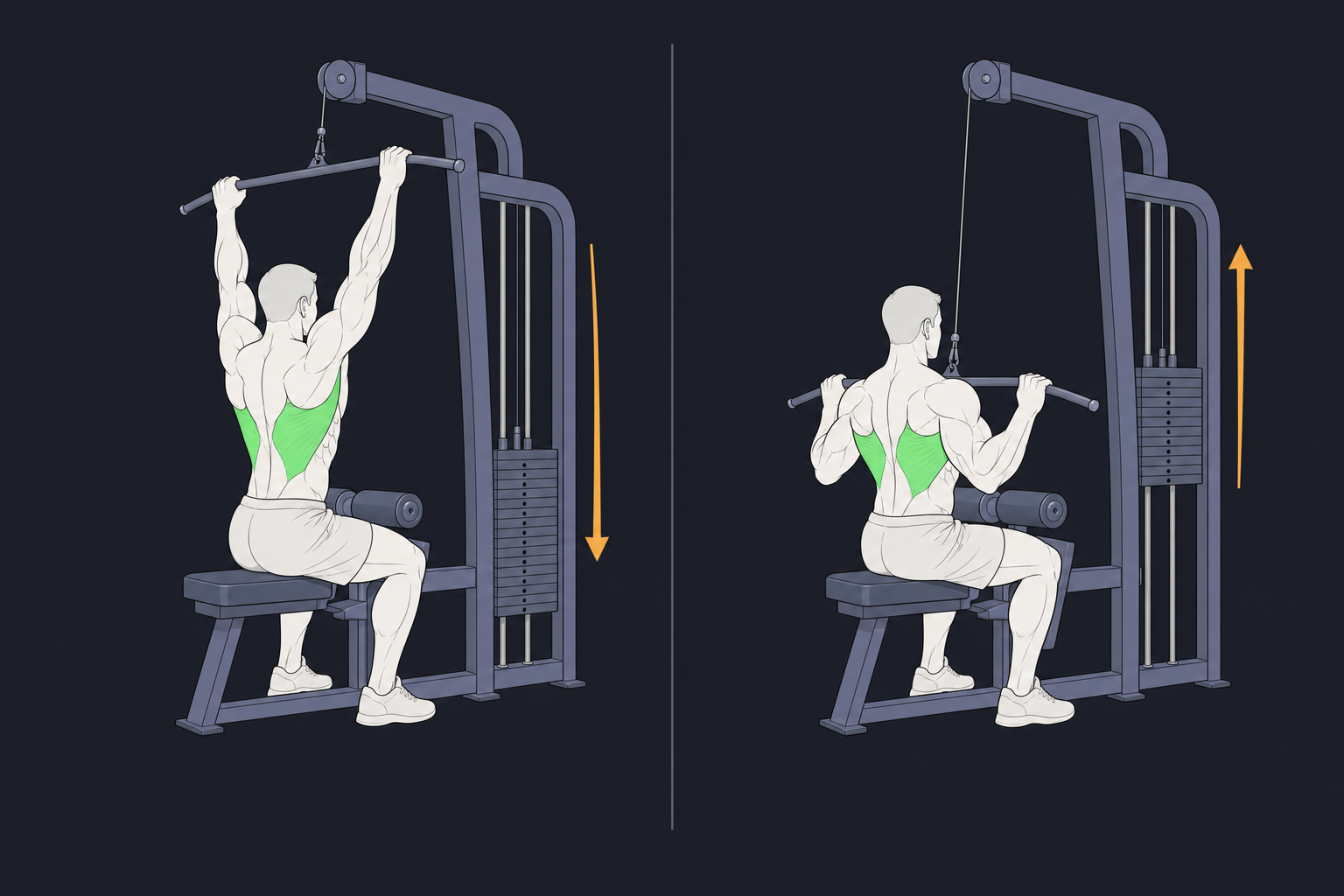
| EQUIPMENT | Lat pulldown — long angled lat bar |
| SETS × REPS | 3 × 10–12 |
| REST | 2 min between sets |
| EFFORT | RIR 1 |
| SET UP | Attach the long angled lat bar. Set the thigh pads tight enough that you cannot lift off the seat. Take a grip around one and a half times shoulder width, where the bar starts to angle down. |
| EXECUTE | Let the bar rise until your shoulders are pulled up and your lats are fully stretched. Pull down to your collarbone, driving the elbows toward your hips, chest up. |
| COMMON MISTAKE | Leaning far back and heaving. If your torso is swinging, the weight is too heavy and your lats are doing less, not more. |
| NOTE | Grip width barely changes which muscles work. Use the width you can control. |
6. Straight-Arm Pulldown
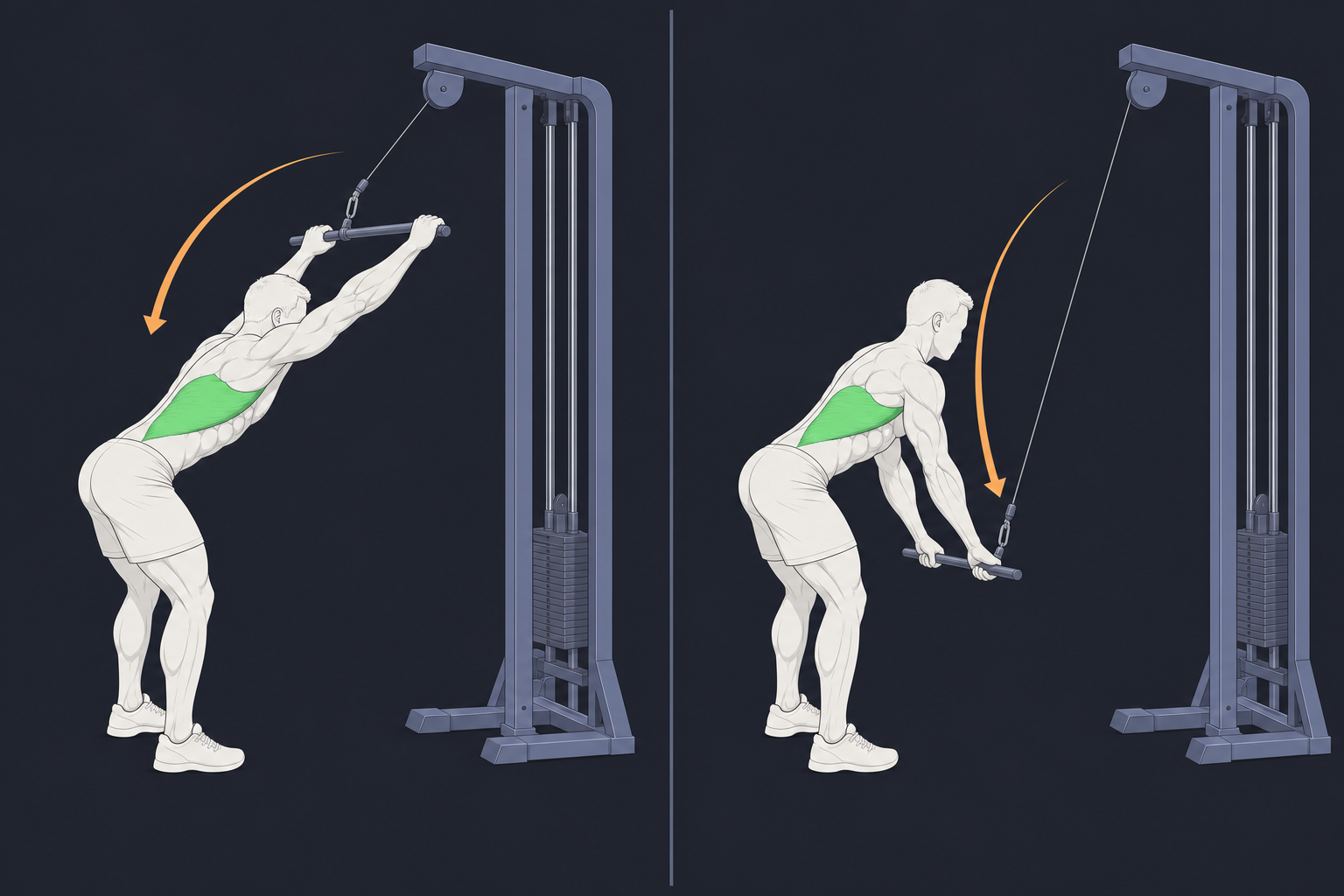
| EQUIPMENT | Cable station, pulley HIGH — straight rotating bar |
| SETS × REPS | 3 × 12–15 |
| REST | 90 s between sets |
| EFFORT | RIR 0–1 |
| SET UP | Attach the straight rotating bar to the high pulley. Stand a step back, hinge slightly forward at the hips, arms straight out in front of you. |
| EXECUTE | Keeping your arms completely straight, sweep the bar down in an arc to your thighs. Squeeze, then let it travel back up to the stretch. |
| COMMON MISTAKE | Letting the elbows bend. The whole value of this exercise is that it trains the lat with zero biceps involvement. |
7. Cable Crunch
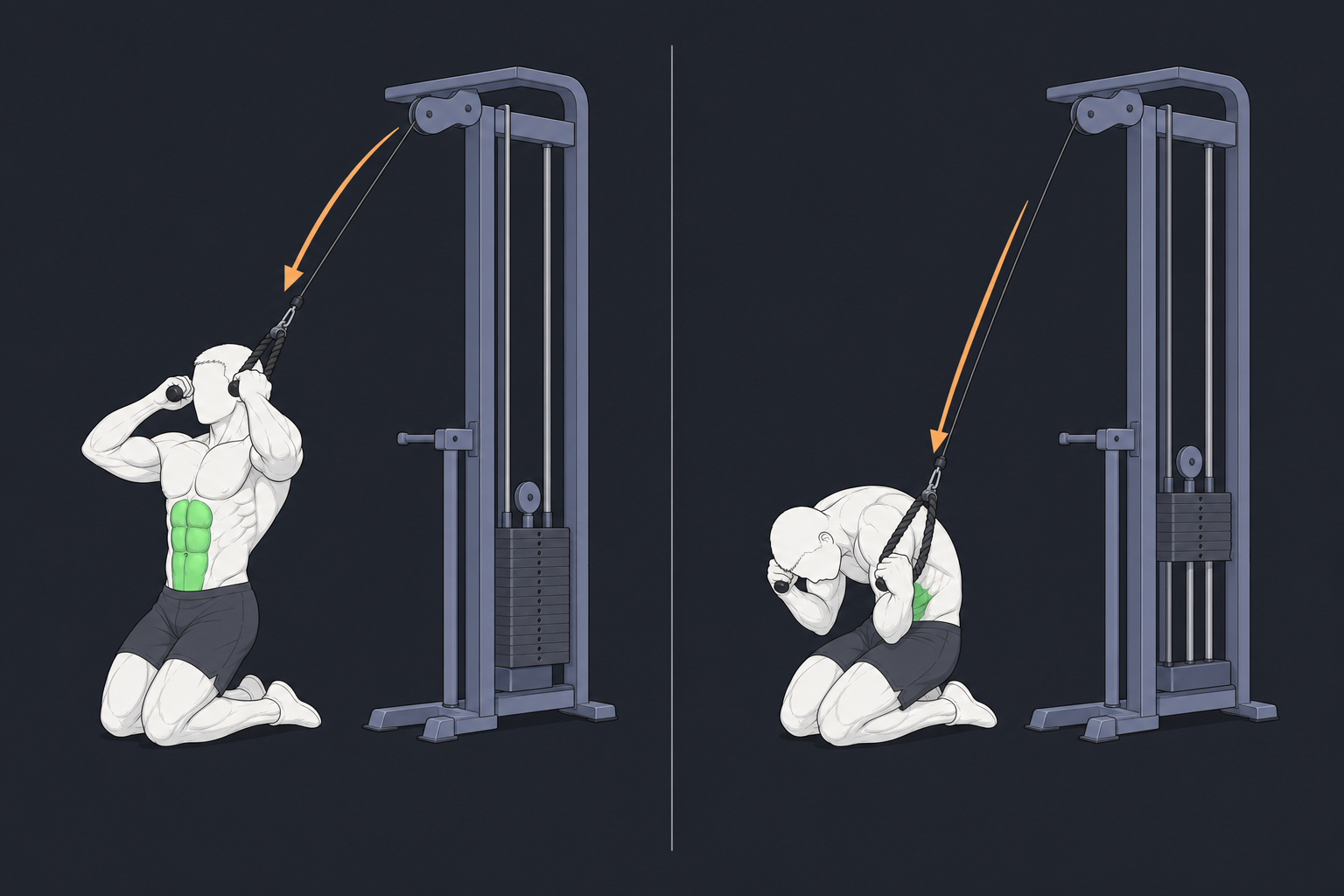
| EQUIPMENT | Cable station, pulley HIGH — rope |
| SETS × REPS | 3 × 8–12 |
| REST | 60 s between sets |
| EFFORT | RIR 0–1 · weighted |
| SET UP | Attach a rope to the high pulley. Kneel facing away, hold the rope beside your head, hips directly under your shoulders. |
| EXECUTE | Curl your spine down — think of pulling your ribs toward your pelvis, not bowing at the hips. Round your back deliberately. Return under control. |
| COMMON MISTAKE | Hinging at the hips instead of flexing the spine, which turns it into a hip exercise with your abs just holding on. |
| NOTE | Abs are a priority in this program and they progress like any other muscle: ADD WEIGHT. When all three sets reach 12 clean reps, put 2.5-5 kg more on the stack. Do not drift into sets of forty. |
8. Hanging Leg Raise
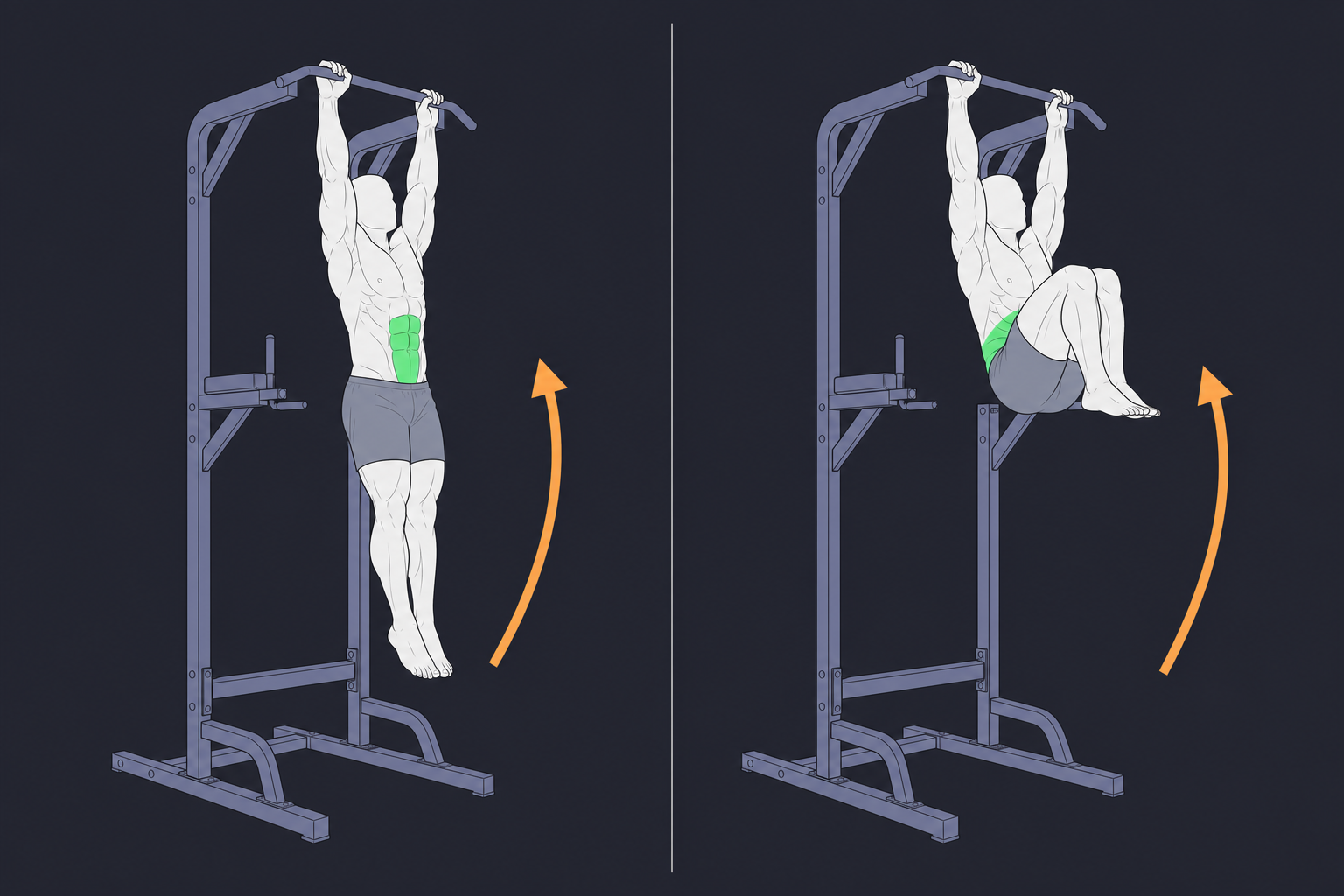
| EQUIPMENT | Pull-up tower |
| SETS × REPS | 3 × 8–12 |
| REST | 60 s between sets |
| EFFORT | RIR 0–1 |
| SET UP | Hang from the bar, arms straight, body still. |
| EXECUTE | Raise your legs and curl your pelvis up toward your ribs so your lower back rounds at the top. Lower slowly with no swing. |
| COMMON MISTAKE | Swinging into the next rep. If your body is moving like a pendulum, your hip flexors are doing the work and your abs are along for the ride. |
| NOTE | Progress by making it harder, not longer: bent knees first, then straight legs, then a light dumbbell squeezed between the feet. Reps stay in the 8-12 window throughout. |
Day 1 — cardio
20 minutes after the weights, then walk home uphill.
| Phase | Duration | Level | Steps / min | Target |
|---|---|---|---|---|
| Warm-up | 4 min | 2–4 | 30–40 | HR drifting to 100–110 |
| Working | 20 min | 5–7 | 45–58 | 110–130 bpm — full sentences still possible |
| Cool-down | 3–4 min | 2–3 | 25–35 | HR back under 110 |
| Too hard | — | 8+ | 60+ | Above 130 — drop a level |
Manual mode, never a preset. Fingertips on the rails for balance only — leaning on them cuts the real work while the console reports the same numbers. The heart-rate target beats the level number: if fatigue from the weights pushes you over 130, drop a level.
DAY 2 — QUADS + GLUTES + CALVES
The heavy leg day. Depth is the theme — full range is where the quads and glutes actually get loaded, and a heavier half-rep is worth less than a lighter full one.
| # | Exercise | Sets × Reps | Rest | Effort |
|---|---|---|---|---|
| 1 | Hack Squat / V-Squat | 4 × 8–10 | 3 min | RIR 1–2 |
| 2 | 45° Leg Press | 3 × 10–12 | 2–3 min | RIR 1–2 |
| 3 | Bulgarian Split Squat | 3 × 10–12 each leg | 2 min | RIR 1–2 |
| 4 | Hip Thrust | 4 × 10–12 | 2 min | RIR 1 |
| 5 | Leg Extension | 3 × 15–20 | 60 s | RIR 0 · lengthened partials on the last |
| 6 | Sled Calf Press | 4 × 12–15 | 60 s | RIR 0–1 |
No machine cardio today. The legs have done enough — the uphill walk home is the rest of it. This is also the best day for the weekly refeed.
Day 2 — exercise by exercise
1. Hack Squat / V-Squat
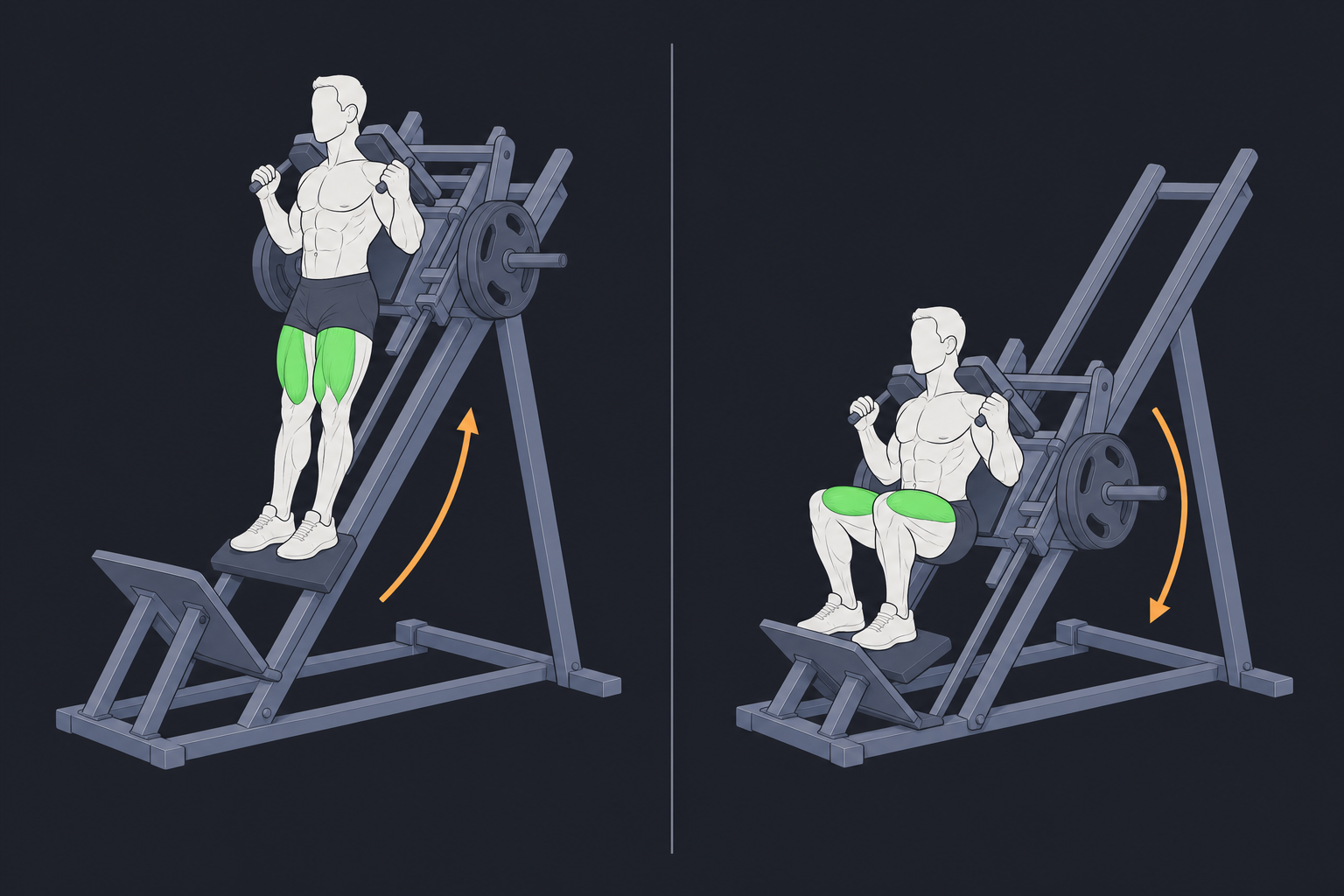
| EQUIPMENT | Plate-loaded V-squat / hack squat sled |
| SETS × REPS | 4 × 8–10 |
| REST | 3 min between sets |
| EFFORT | RIR 1–2 |
| SET UP | Feet mid-platform, roughly shoulder width, toes slightly out. Back and hips flat against the pad throughout. |
| EXECUTE | Descend under control until your thighs are clearly below parallel. Drive back up through the whole foot without locking the knees hard at the top. |
| COMMON MISTAKE | Stopping at parallel. Depth is where the quads and glutes actually get loaded — a heavier half rep is worth less than a lighter full one. |
2. 45° Leg Press
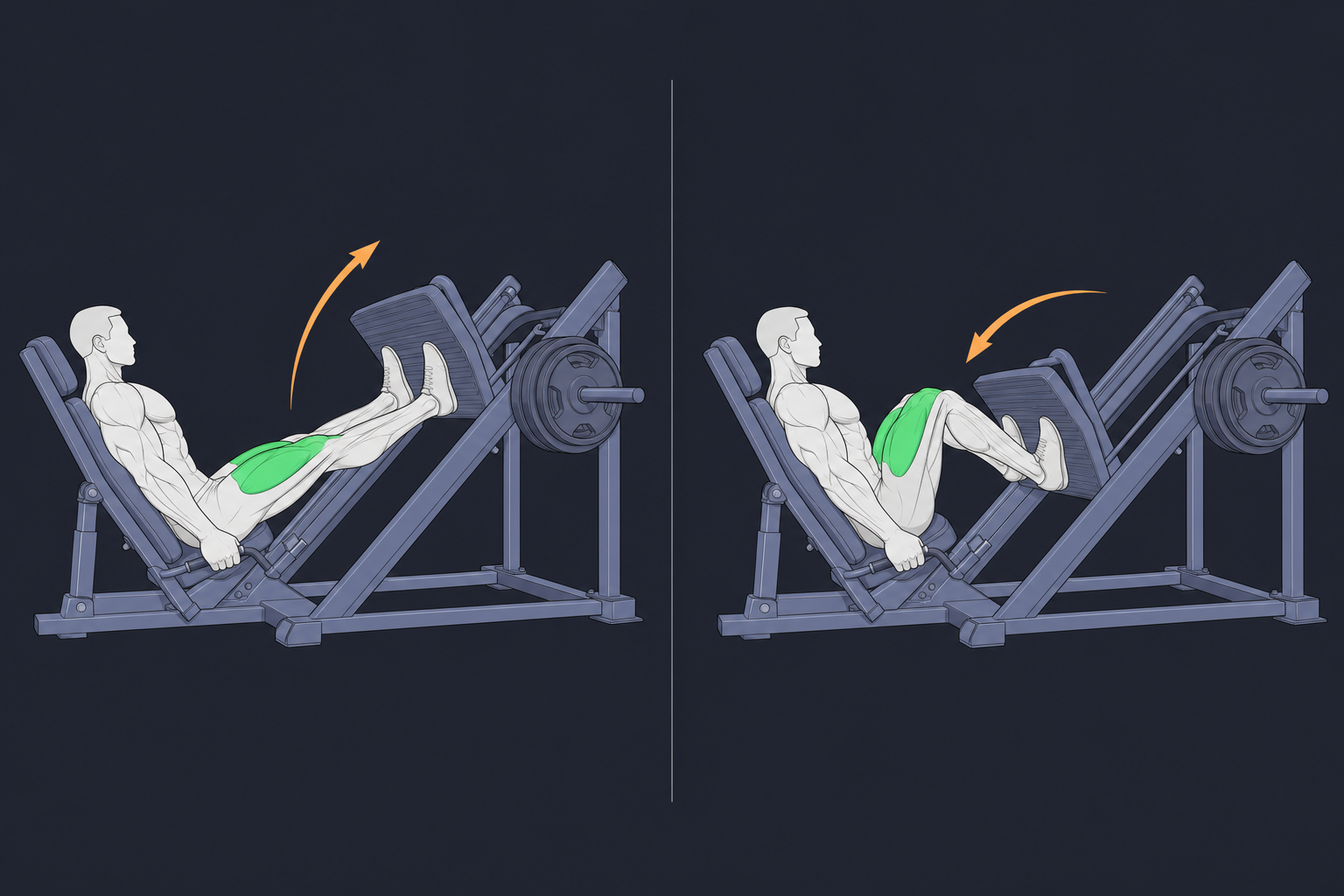
| EQUIPMENT | 45 degree sled leg press |
| SETS × REPS | 3 × 10–12 |
| REST | 2–3 min between sets |
| EFFORT | RIR 1–2 |
| SET UP | Feet low on the platform and about shoulder width — this position biases the quads. Lower back stays glued to the pad. |
| EXECUTE | Bring your knees down toward your chest as far as your hips allow without the pelvis tucking under. Press back out to almost straight. |
| COMMON MISTAKE | Letting the lower back round off the pad at the bottom. Reduce the range before you reduce the spine's safety. |
3. Bulgarian Split Squat
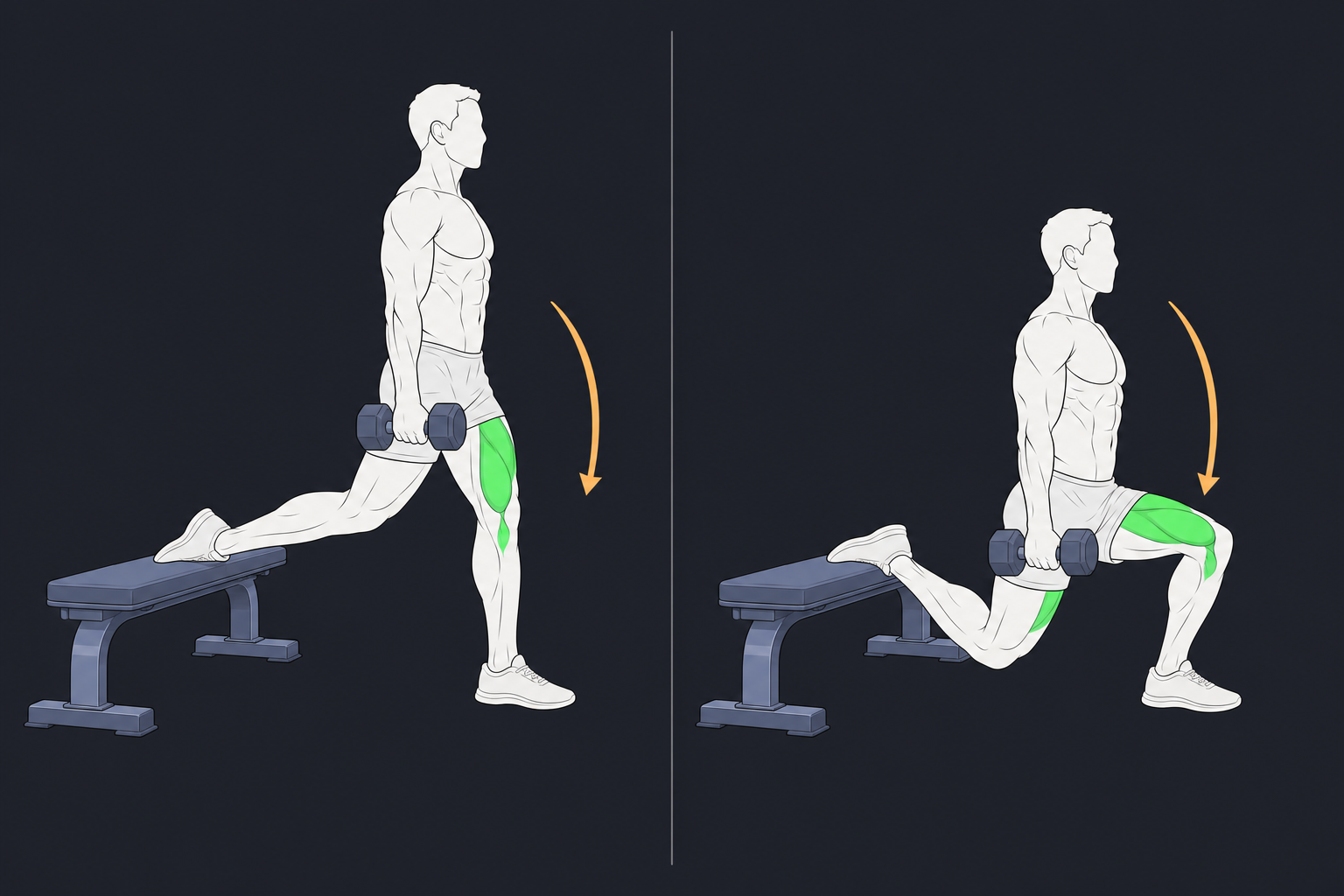
| EQUIPMENT | Flat bench + dumbbells |
| SETS × REPS | 3 × 10–12 each |
| REST | 2 min between sets |
| EFFORT | RIR 1–2 |
| SET UP | Rest the top of your rear foot on the bench. Hop the front foot far enough forward that the shin stays vertical at the bottom. |
| EXECUTE | Drop straight down, front thigh to parallel or lower, rear knee travelling toward the floor. Drive up through the front heel. |
| COMMON MISTAKE | Standing too close to the bench, which forces the front knee far past the toes and turns it into a knee-joint exercise. |
4. Hip Thrust
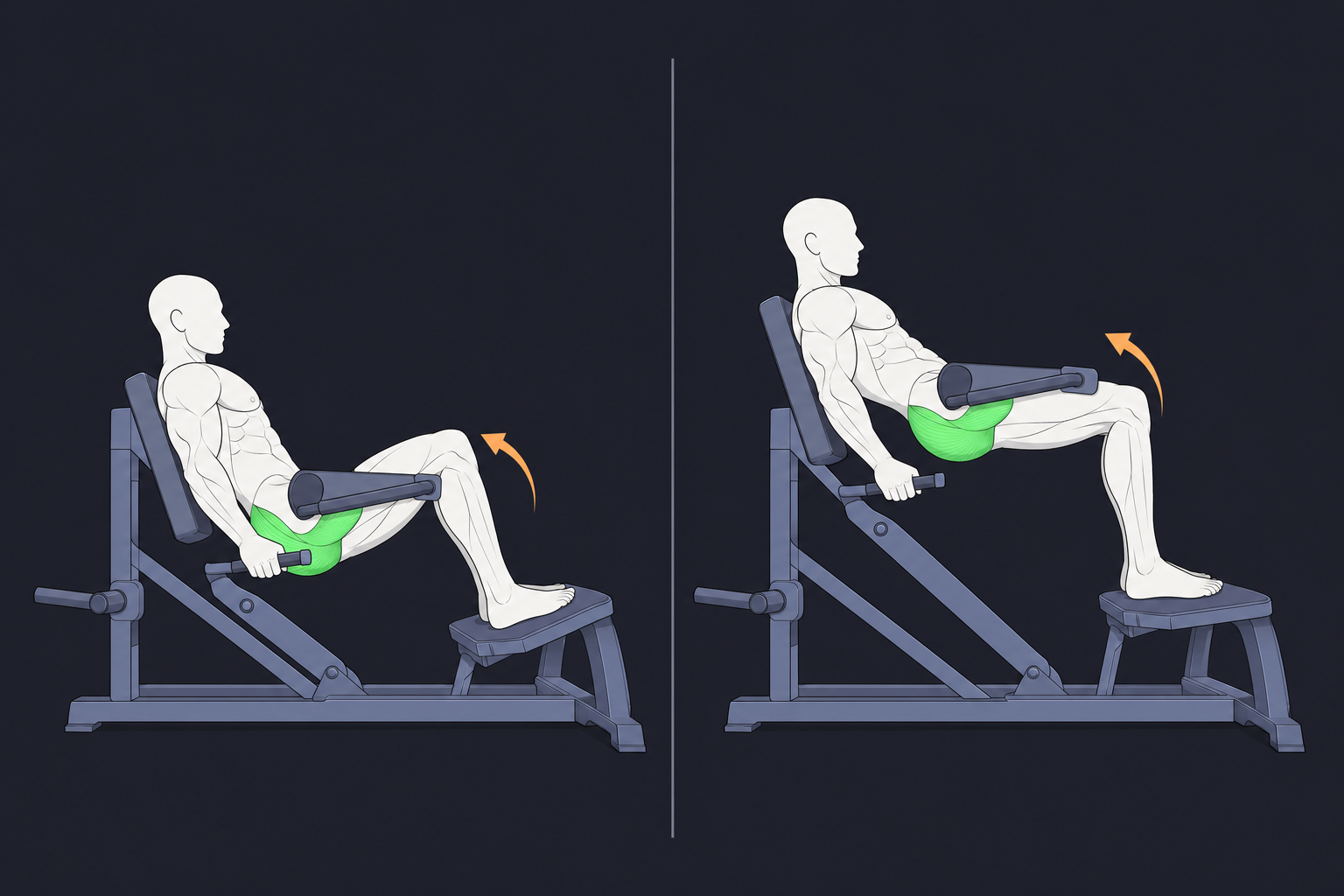
| EQUIPMENT | Hip thrust / glute drive machine |
| SETS × REPS | 4 × 10–12 |
| REST | 2 min between sets |
| EFFORT | RIR 1 |
| SET UP | Upper back against the pad, lap pad low across the hips, feet flat and roughly shoulder width. |
| EXECUTE | Drive the hips up until your torso and thighs make one straight line. Tuck the chin, keep the ribs down, hold the top for a full second. |
| COMMON MISTAKE | Arching the lower back to get higher. The extra range comes from the spine, not the glutes. |
5. Leg Extension
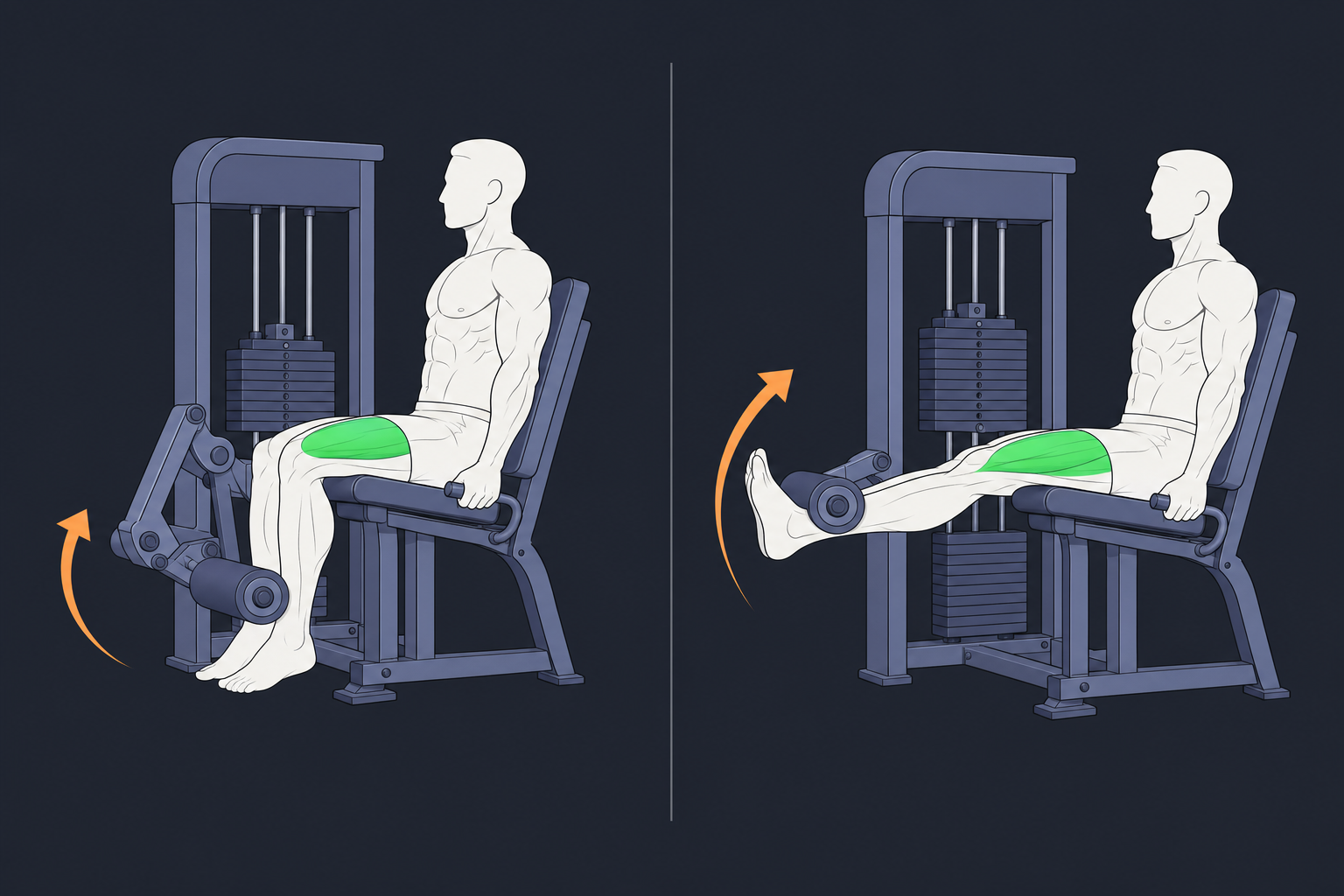
| EQUIPMENT | Leg extension |
| SETS × REPS | 3 × 15–20 |
| REST | 60 s between sets |
| EFFORT | RIR 0 · lengthened partials on the last |
| SET UP | Line the knee joint up with the machine's pivot. Roller sits on the lower shin, just above the ankle. |
| EXECUTE | Extend to full lockout and squeeze hard for a count. Lower slowly — the last part of the descent is the stretch that grows the quad. |
| COMMON MISTAKE | Swinging the weight up with momentum and dropping it back down. |
| TECHNIQUE | LENGTHENED PARTIALS — last set only. When you can no longer complete a full rep, don't rack it. Keep going with half reps in the bottom, stretched half of the range only — the part where the muscle is longest and under most tension. Continue until you cannot move it at all. Expect 5–10 partials. |
| NOTE | This is the safest place in the whole program to push past failure - the load is light, the path is fixed, and nothing can fall on you. |
6. Sled Calf Press
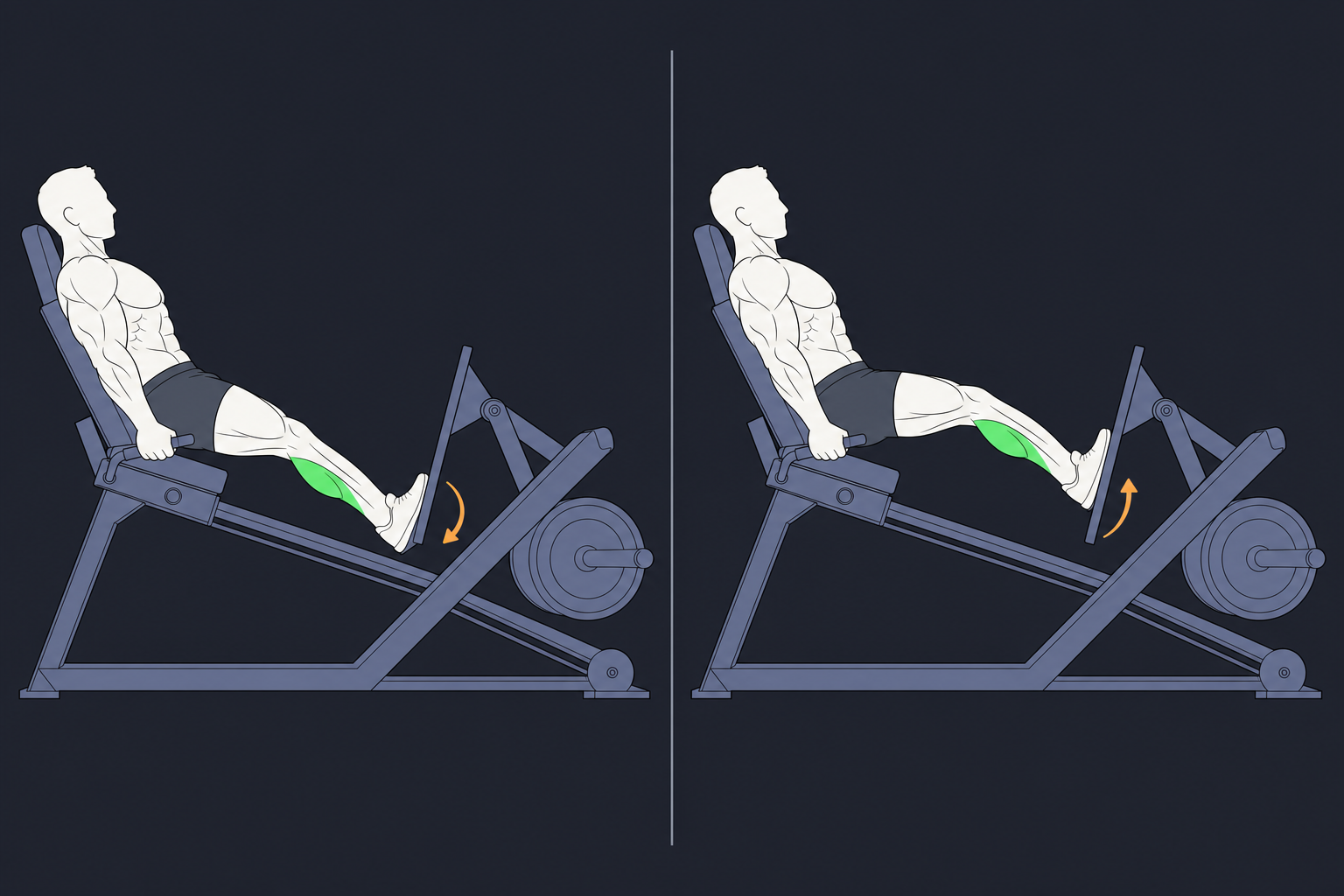
| EQUIPMENT | 45 degree leg press — balls of the feet on the bottom edge |
| SETS × REPS | 4 × 12–15 |
| REST | 60 s between sets |
| EFFORT | RIR 0–1 |
| SET UP | Put only the balls of your feet on the very bottom edge of the platform so your heels hang off into space. Legs stay straight. |
| EXECUTE | Let the heels sink as far below the platform as they will go and pause one second in that stretch. Then push all the way up onto the toes. |
| COMMON MISTAKE | Short bouncy reps. Calves are almost entirely built by the stretched bottom position. |
DAY 3 — SHOULDERS + ARMS + ABS — HEAVY
Shoulders lead this one — heavy overhead pressing first, then the lateral and rear-delt work that builds width across the top. Arms follow: they aren't a weak point, but they get a full, serious block here rather than scraps at the end of a chest day. Abs close it out.
| # | Exercise | Sets × Reps | Rest | Effort |
|---|---|---|---|---|
| 1 | Seated Dumbbell Shoulder Press | 4 × 6–8 | 3 min | RIR 1–2 |
| 2 | Cable Lateral Raise | 4 × 12–15 | 75 s | RIR 0–1 |
| 3 | Machine Shoulder Press | 3 × 10–12 | 2 min | RIR 1 · rest-pause on the last |
| 4 | Rear Delt Fly | 3 × 15–20 | 60 s | RIR 0–1 |
| 5 | Overhead Cable Triceps Extension | 4 × 10–12 | 90 s | RIR 1 |
| 6 | Rope Pressdown | 3 × 12–15 | 60 s | RIR 0–1 |
| 7 | EZ-Bar Curl | 4 × 8–10 | 90 s | RIR 1 |
| 8 | Hammer Curl | 3 × 12–15 | 60 s | RIR 0–1 |
| 9 | Ab Rollout | 3 × 6–10 | 60 s | RIR 0–1 |
Finish with 20 to 25 minutes on the ClimbMill. Safe here — no leg session competing with it.
Day 3 — exercise by exercise
1. Seated Dumbbell Shoulder Press
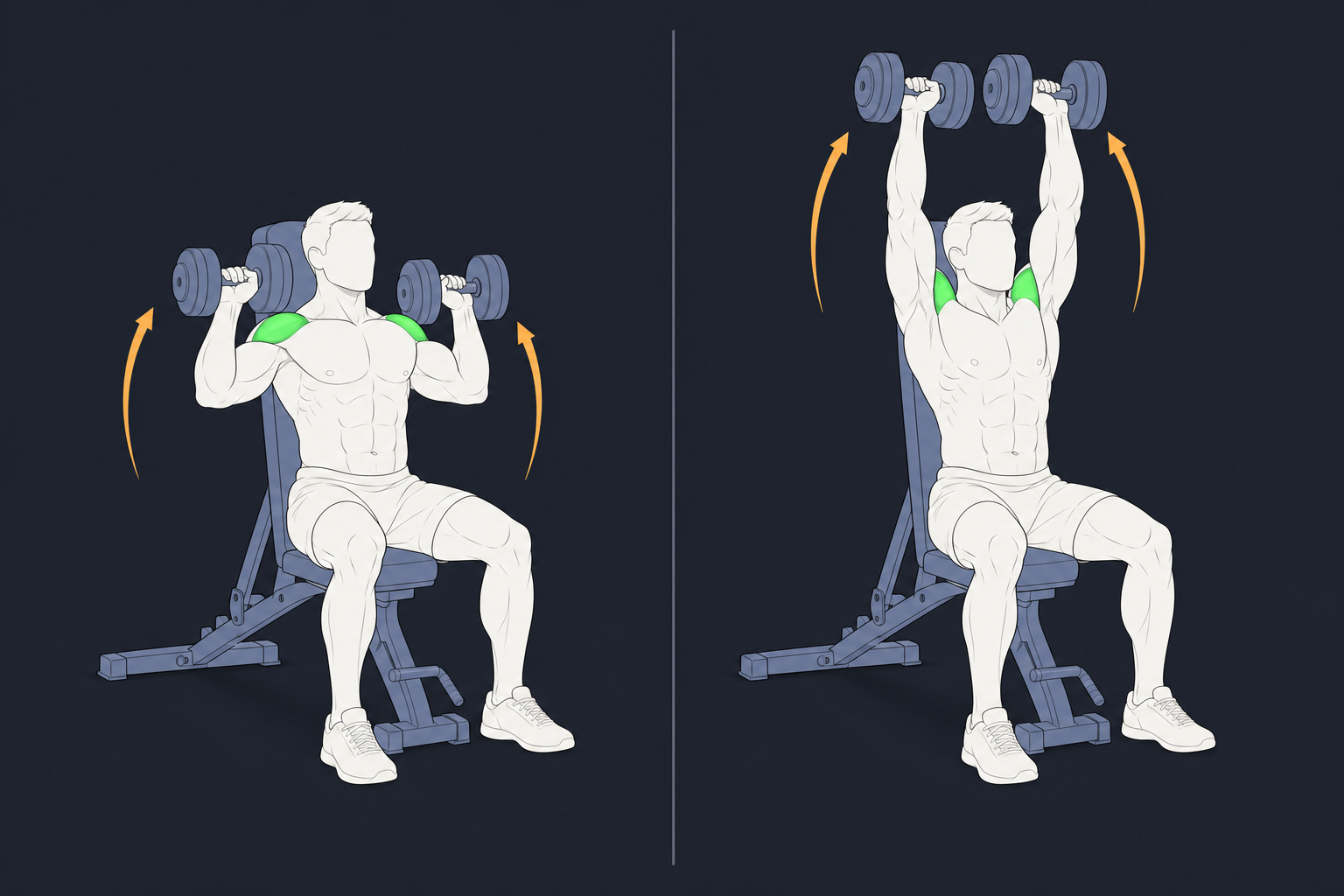
| EQUIPMENT | Adjustable bench (85 degrees) + hex dumbbells |
| SETS × REPS | 4 × 6–8 |
| REST | 3 min between sets |
| EFFORT | RIR 1–2 |
| SET UP | Set the backrest one notch off vertical. Dumbbells start at ear height, elbows slightly in front of your torso rather than flared straight out. |
| EXECUTE | Press up and slightly in until the dumbbells nearly touch overhead. Lower under control to ear height. |
| COMMON MISTAKE | Setting the bench fully vertical and flaring the elbows back — that grinds the shoulder joint for no extra muscle. |
2. Cable Lateral Raise
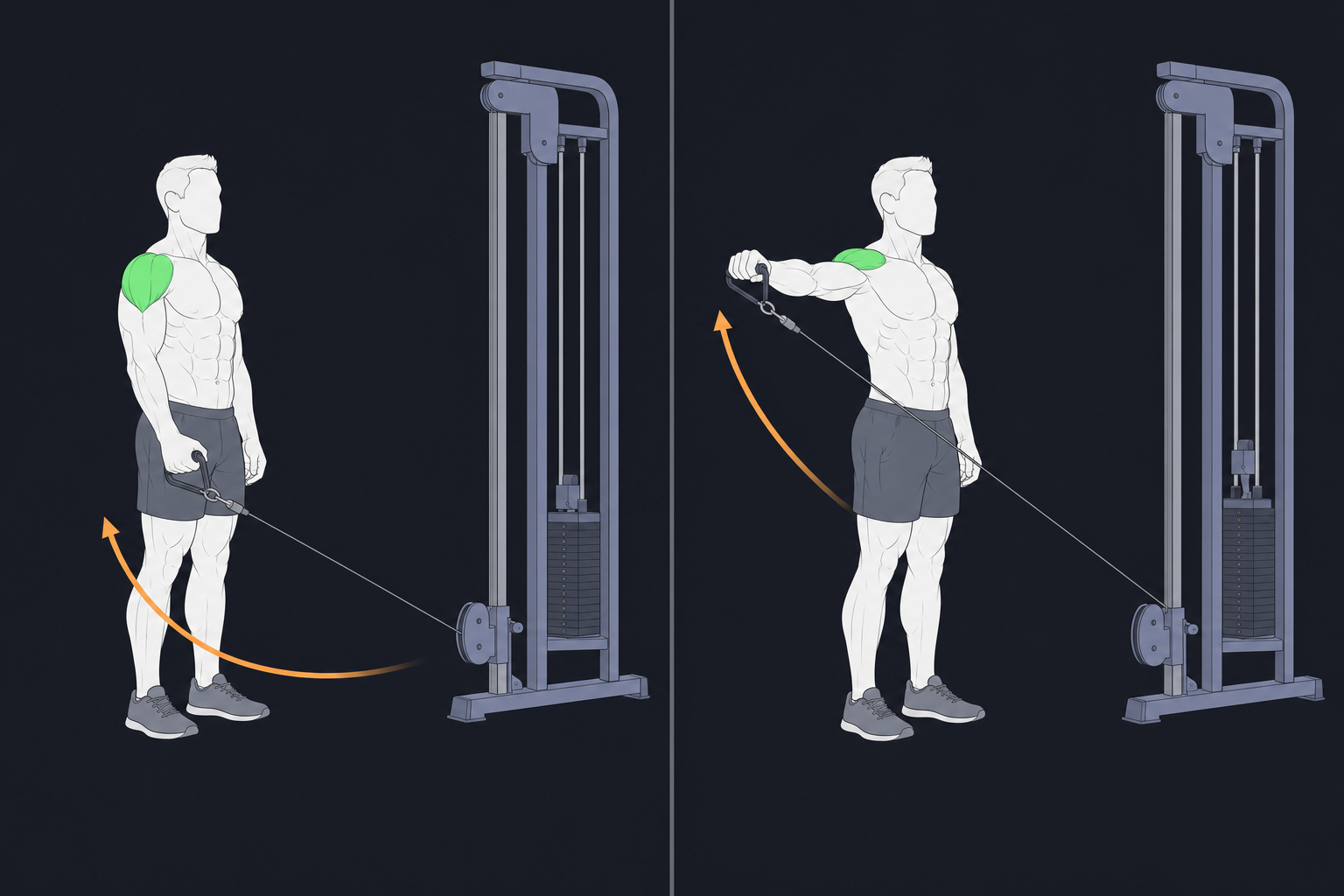
| EQUIPMENT | Functional trainer, pulley LOW — single D-handle |
| SETS × REPS | 4 × 12–15 |
| REST | 75 s between sets |
| EFFORT | RIR 0–1 |
| SET UP | Attach a D-handle at the lowest setting. Stand side-on so the cable runs across the front of your body, handle in the outside hand. |
| EXECUTE | Raise your arm out to the side to shoulder height with a soft fixed elbow. Lower slowly and let the cable pull the arm across your body at the bottom. |
| COMMON MISTAKE | Going too heavy and shrugging the weight up. If the traps take over, the side delt gets nothing. |
| NOTE | Cable and dumbbell versions work equally well. Use whichever you can control. |
3. Machine Shoulder Press
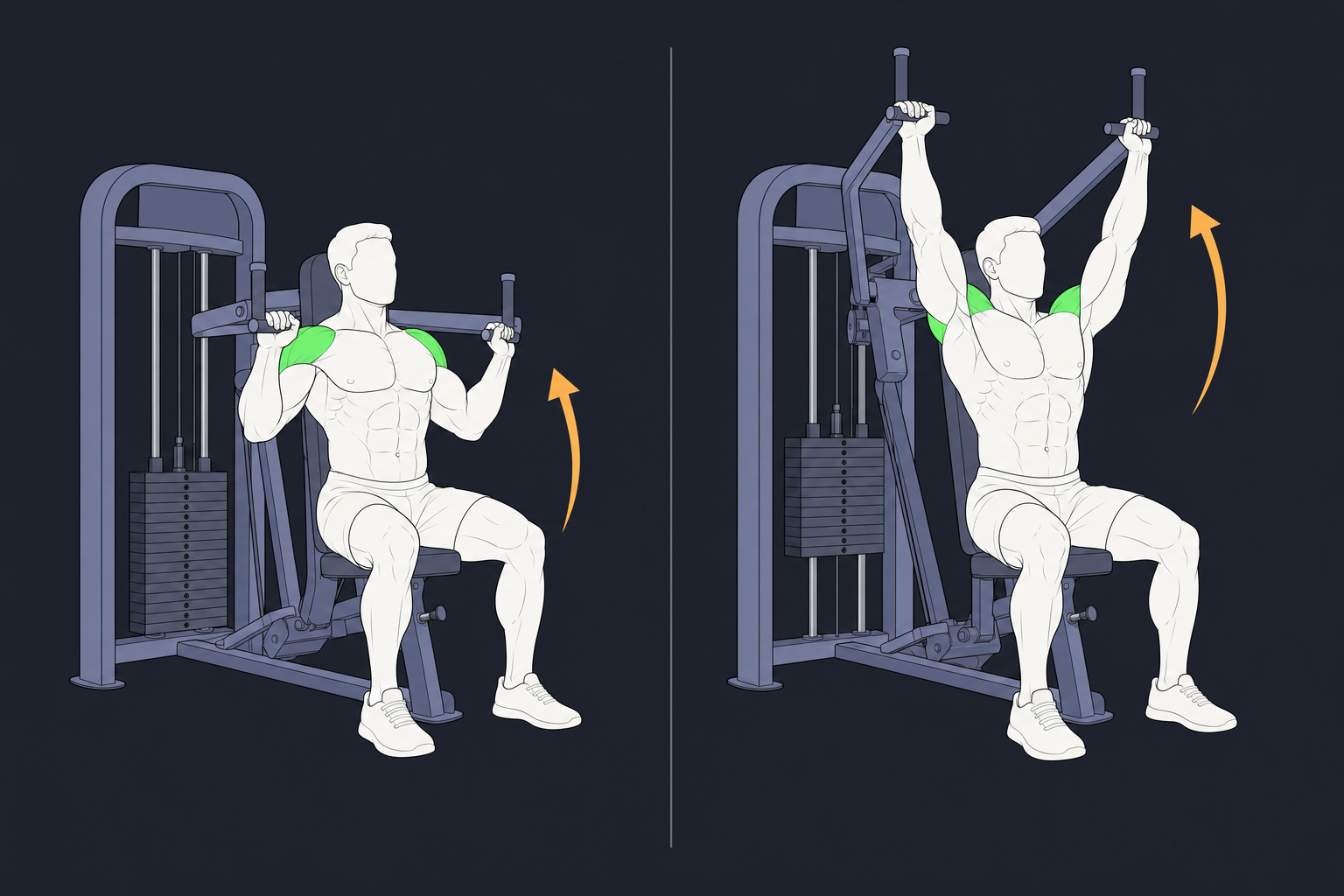
| EQUIPMENT | Selectorized shoulder press |
| SETS × REPS | 3 × 10–12 |
| REST | 2 min between sets |
| EFFORT | RIR 1 · rest-pause on the last |
| SET UP | Seat height so the handles start at shoulder level. Back flat against the pad. |
| EXECUTE | Press up, stopping just short of locking out so the delts stay under tension. Come back down to a full stretch at the bottom. |
| COMMON MISTAKE | Locking out hard at the top and resting there between reps. |
| TECHNIQUE | REST-PAUSE — last set only. Take the final set to failure, then rack it and rest 15–20 seconds while staying in position. Pick it back up and grind out as many more reps as you can — it will be 3 to 5. Rest 15–20 seconds again, do one more mini-set, then stop. |
| NOTE | Machine pressing is where you can safely chase the last few reps - the path is fixed and there is nothing to drop. |
4. Rear Delt Fly
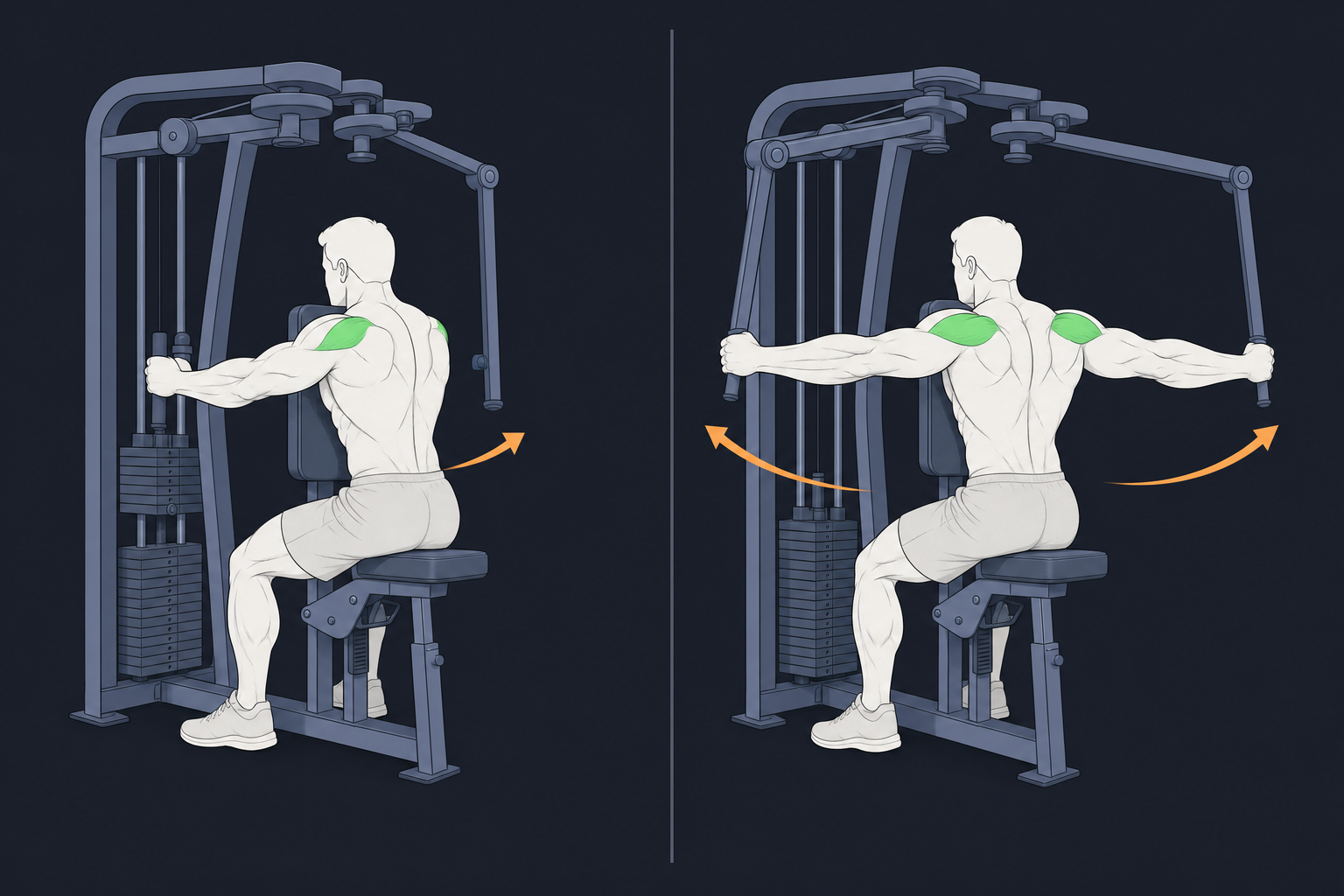
| EQUIPMENT | Rear delt / pec fly combo — seated FACING the chest pad |
| SETS × REPS | 3 × 15–20 |
| REST | 60 s between sets |
| EFFORT | RIR 0–1 |
| SET UP | Sit facing into the machine with your chest against the pad. Set the handles so your arms start straight out in front at shoulder height. |
| EXECUTE | Sweep both arms out wide and back in an arc, leading with the elbows. Squeeze the shoulder blades at the end. |
| COMMON MISTAKE | Thinking about pulling the hands back. Think about driving the elbows apart — the rear delt opens the arm, it does not row it. |
5. Overhead Cable Triceps Extension
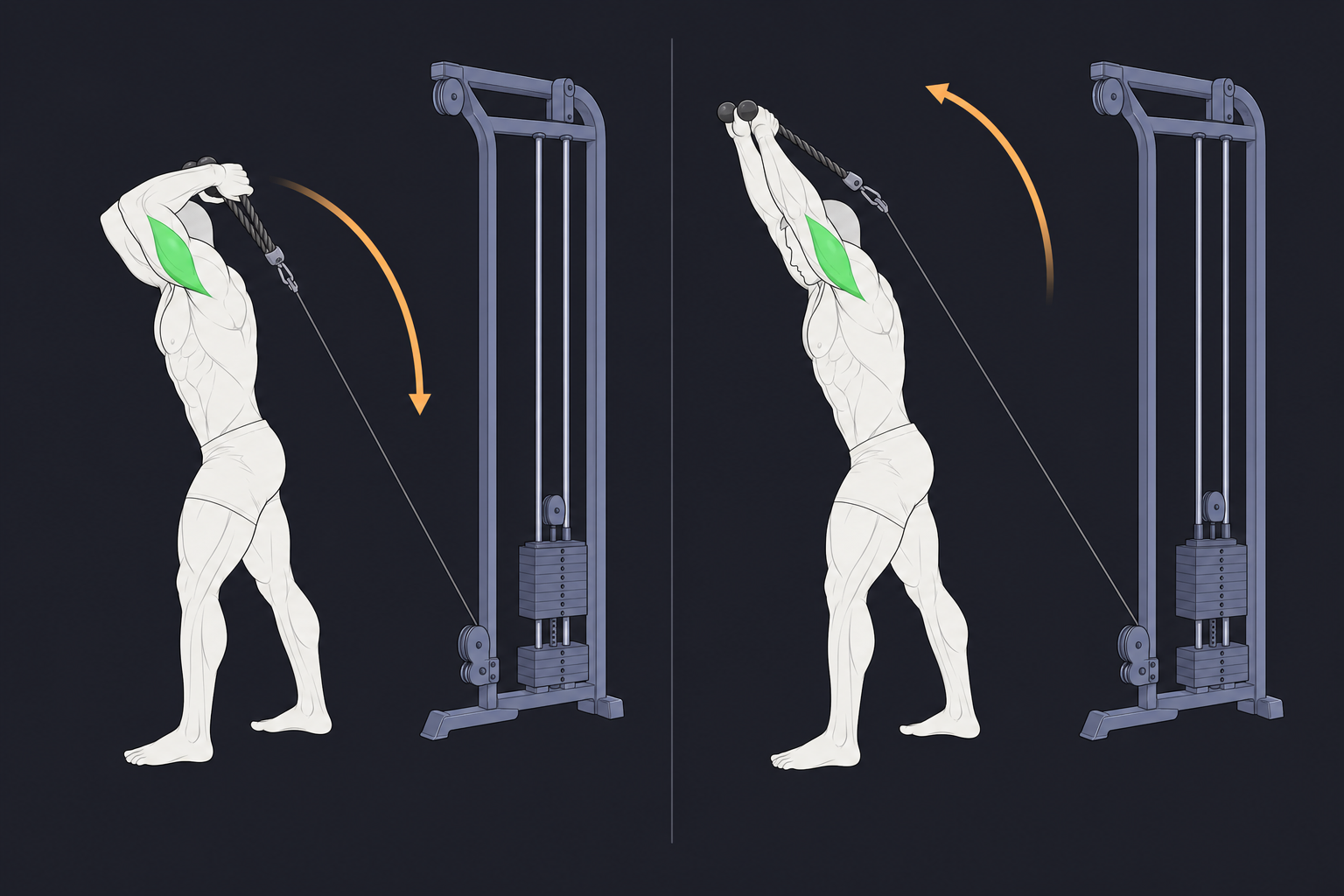
| EQUIPMENT | Functional trainer, pulley LOW — rope |
| SETS × REPS | 4 × 10–12 |
| REST | 90 s between sets |
| EFFORT | RIR 1 |
| SET UP | Attach a rope to the low pulley. Face away from the machine, rope behind your head, step forward and lean your torso slightly ahead of your hips. |
| EXECUTE | Keeping your elbows high and completely still, extend your arms up and forward until straight. Let the elbows bend back to a deep stretch behind your head. |
| COMMON MISTAKE | Letting the elbows drift down and forward, which turns it back into a pressdown. |
| NOTE | This is the single most productive triceps exercise in the program. It goes first, and it gets the most sets. |
6. Rope Pressdown
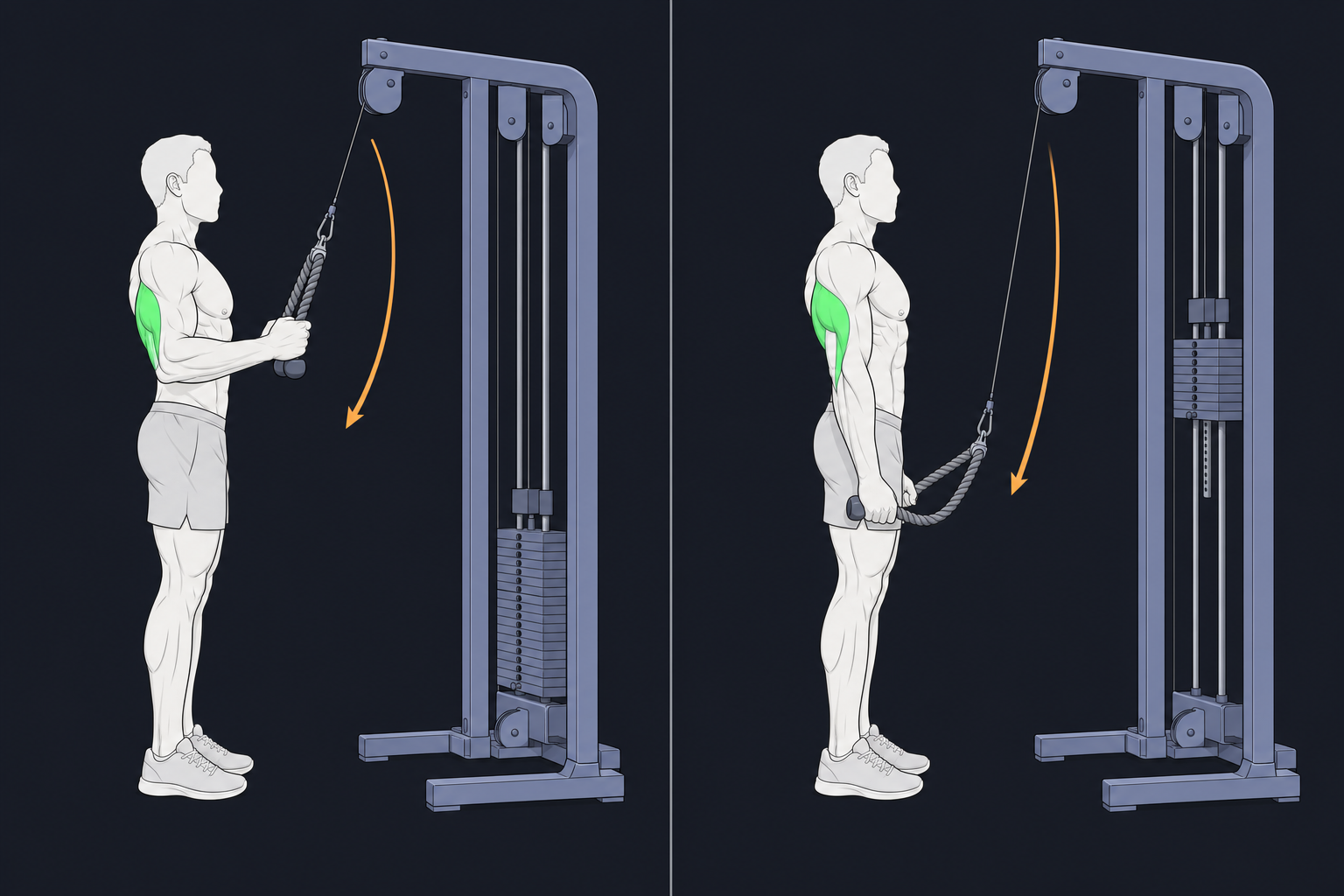
| EQUIPMENT | Cable station, pulley HIGH — rope |
| SETS × REPS | 3 × 12–15 |
| REST | 60 s between sets |
| EFFORT | RIR 0–1 |
| SET UP | Rope on the high pulley. Stand close, elbows pinned to your sides and bent to about 90 degrees. |
| EXECUTE | Push down and spread the rope apart at the bottom, holding the lockout for a count. Return only until the elbows reach 90 degrees. |
| COMMON MISTAKE | Letting the elbows drift forward and away from the ribs, which recruits the chest and shoulders. |
7. EZ-Bar Curl
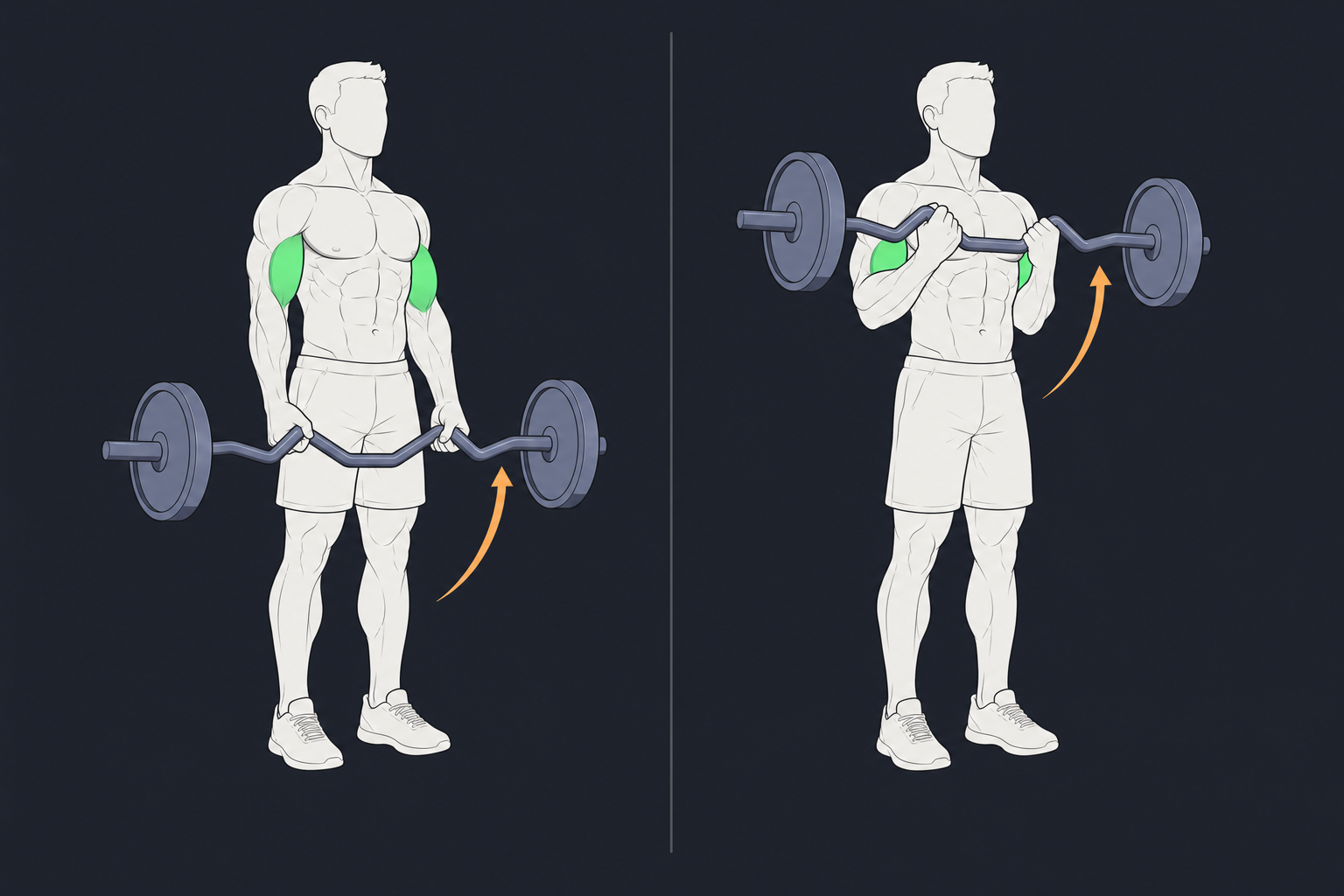
| EQUIPMENT | EZ-curl bar |
| SETS × REPS | 4 × 8–10 |
| REST | 90 s between sets |
| EFFORT | RIR 1 |
| SET UP | Take the angled inner grips. Stand tall, elbows at your sides, bar resting at thigh level. |
| EXECUTE | Curl by bending only the elbow — upper arms stay pinned. Lower all the way to straight arms every rep. |
| COMMON MISTAKE | Swinging the torso to start the rep. Momentum moves the bar; it does not build the biceps. |
| NOTE | This is your heaviest curl of the week. Strict beats heavy if you have to choose. |
8. Hammer Curl
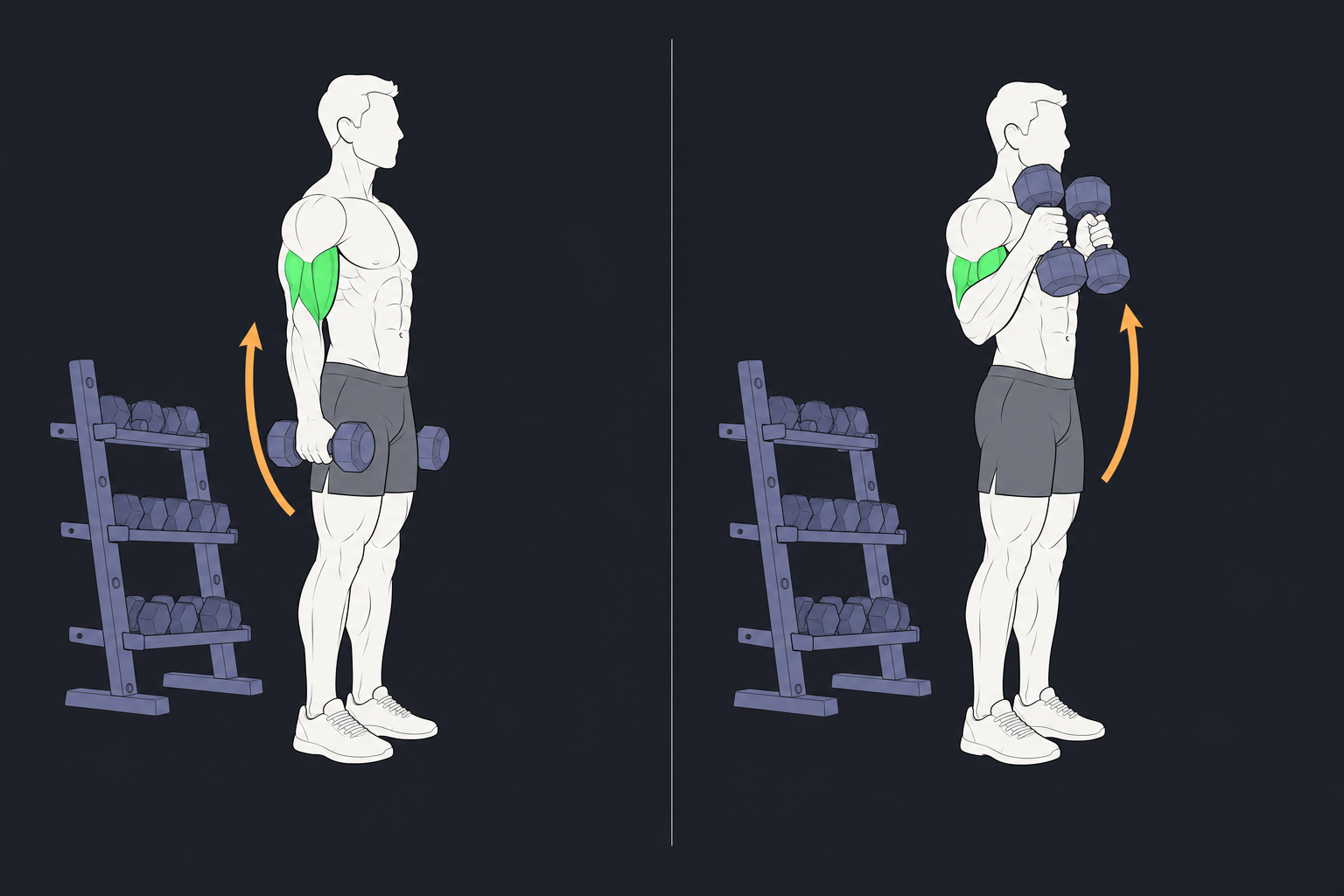
| EQUIPMENT | Hex dumbbells, neutral grip |
| SETS × REPS | 3 × 12–15 |
| REST | 60 s between sets |
| EFFORT | RIR 0–1 |
| SET UP | Stand tall, dumbbells at your sides, palms facing in toward your body. |
| EXECUTE | Curl straight up keeping the palms facing inward the whole way. Lower under control. |
| COMMON MISTAKE | Rotating the wrist on the way up, which turns it into a regular curl and skips the muscle you are targeting. |
| NOTE | This trains the brachialis — the muscle underneath the biceps. Building it pushes the biceps up and makes the arm look thicker from the side. |
9. Ab Rollout
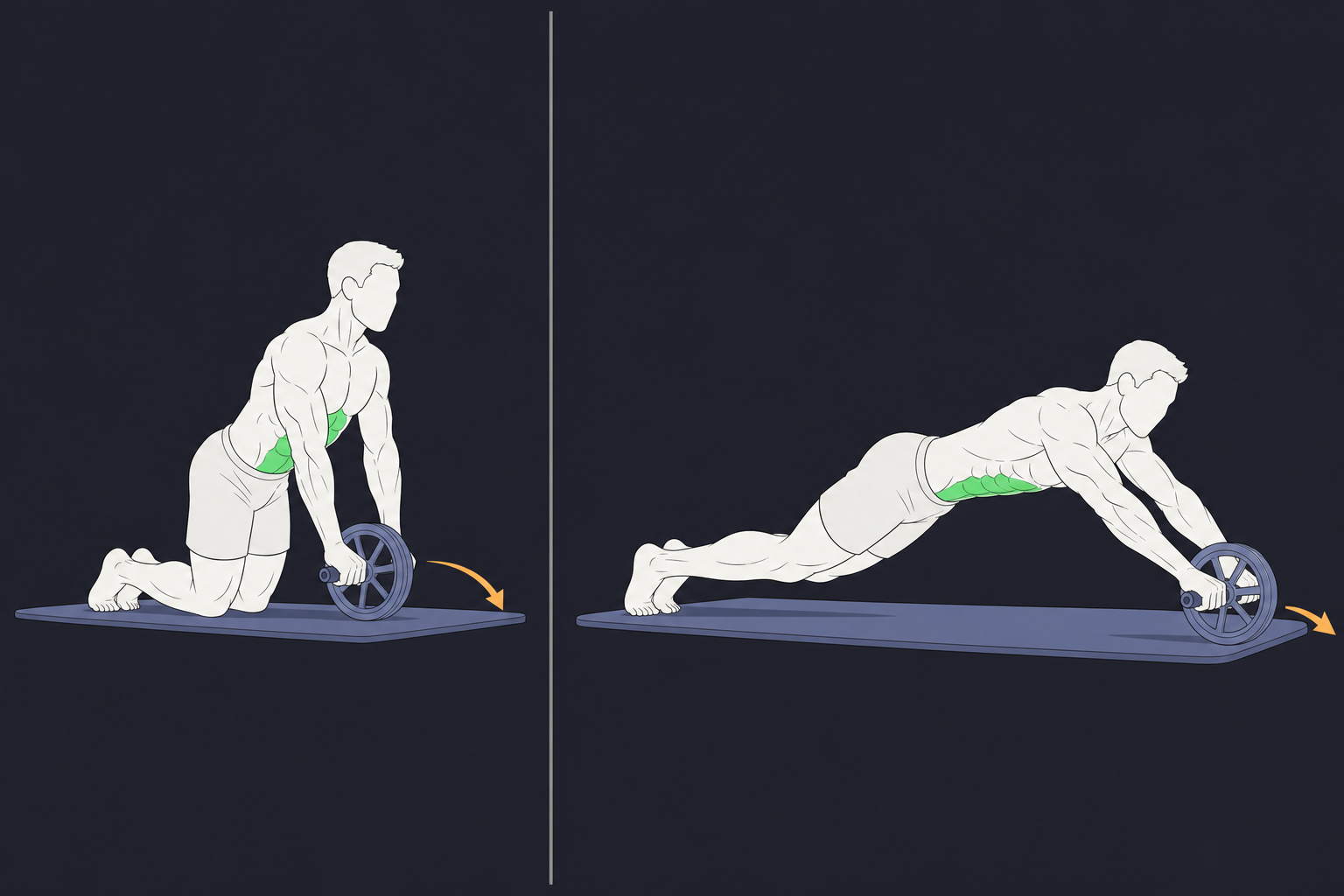
| EQUIPMENT | Ab wheel on a mat (or the FORMA rig) |
| SETS × REPS | 3 × 6–10 |
| REST | 60 s between sets |
| EFFORT | RIR 0–1 |
| SET UP | Kneel with the wheel under your shoulders, core braced, ribs pulled down. |
| EXECUTE | Roll forward as far as you can while keeping your lower back from sagging. Pull yourself back with the abs, not the hip flexors. |
| COMMON MISTAKE | Letting the hips sag so the lower back arches - that is the exact position this exercise is meant to train you to resist. |
| NOTE | Progress by rolling further out until you reach full extension for 10 reps, then add load with a weighted vest. This is the anti-extension half of the ab work - the other two exercises train flexion, this one trains resisting it. |
Day 3 — cardio
20 to 25 minutes after the weights. Safe here — no leg session competing with it.
| Phase | Duration | Level | Steps / min | Target |
|---|---|---|---|---|
| Warm-up | 4 min | 2–4 | 30–40 | HR drifting to 100–110 |
| Working | 20–25 min | 5–7 | 45–58 | 110–130 bpm — full sentences still possible |
| Cool-down | 3–4 min | 2–3 | 25–35 | HR back under 110 |
| Too hard | — | 8+ | 60+ | Above 130 — drop a level |
Manual mode, never a preset. Fingertips on the rails for balance only — leaning on them cuts the real work while the console reports the same numbers. The heart-rate target beats the level number: if fatigue from the weights pushes you over 130, drop a level.
DAY 4 — BACK THICKNESS + TRAPS + CHEST
Day 1 built width with overhead pulling. This day builds depth with horizontal rowing, adds the trap work that makes a back look like armour from behind, and gives the chest its second exposure.
| # | Exercise | Sets × Reps | Rest | Effort |
|---|---|---|---|---|
| 1 | Barbell Row | 4 × 6–8 | 3 min | RIR 1–2 |
| 2 | Plate-Loaded High Row | 3 × 8–10 each arm | 2 min | RIR 1–2 |
| 3 | Seated Cable Row | 3 × 10–12 | 2 min | RIR 1 |
| 4 | Dumbbell Shrug | 4 × 10–15 | 90 s | RIR 1 |
| 5 | Chest-Supported Rear Delt Row | 3 × 12–15 | 75 s | RIR 0–1 |
| 6 | Flat Dumbbell Press | 3 × 8–10 | 2 min | RIR 1–2 |
| 7 | Pec Fly | 3 × 12–15 | 75 s | RIR 0 · drop set on the last |
No machine cardio. Walk home.
Day 4 — exercise by exercise
1. Barbell Row
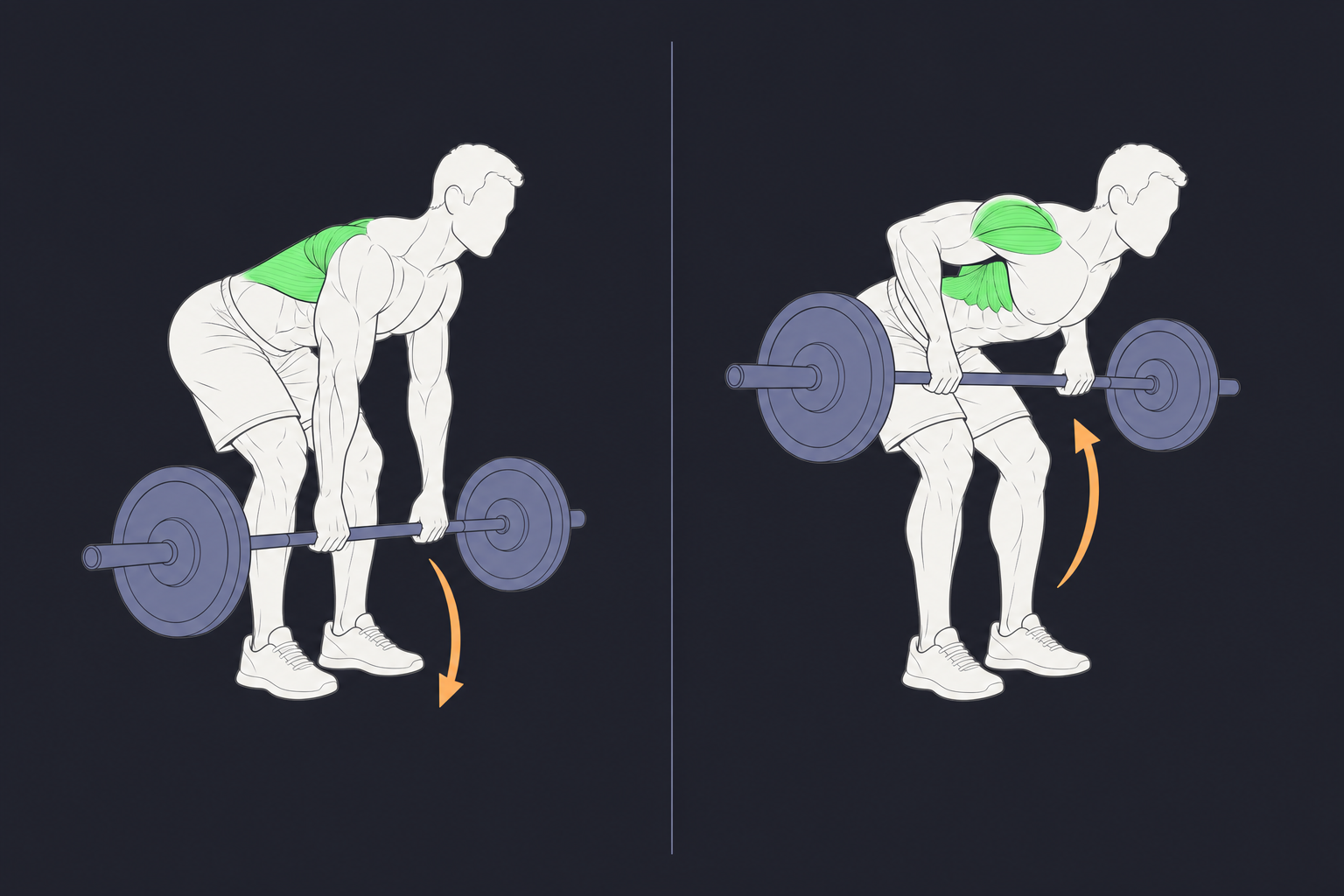
| EQUIPMENT | Olympic barbell |
| SETS × REPS | 4 × 6–8 |
| REST | 3 min between sets |
| EFFORT | RIR 1–2 |
| SET UP | Hinge at the hips until your torso is roughly 45 degrees, knees soft, back flat. Overhand grip at shoulder width. |
| EXECUTE | Pull the bar to your lower ribs, driving the elbows back past your torso. Lower under control and let the lats stretch at the bottom. |
| COMMON MISTAKE | Standing up more with every rep. As the set gets hard the torso rises and the exercise quietly turns into a shrug. |
2. Plate-Loaded High Row
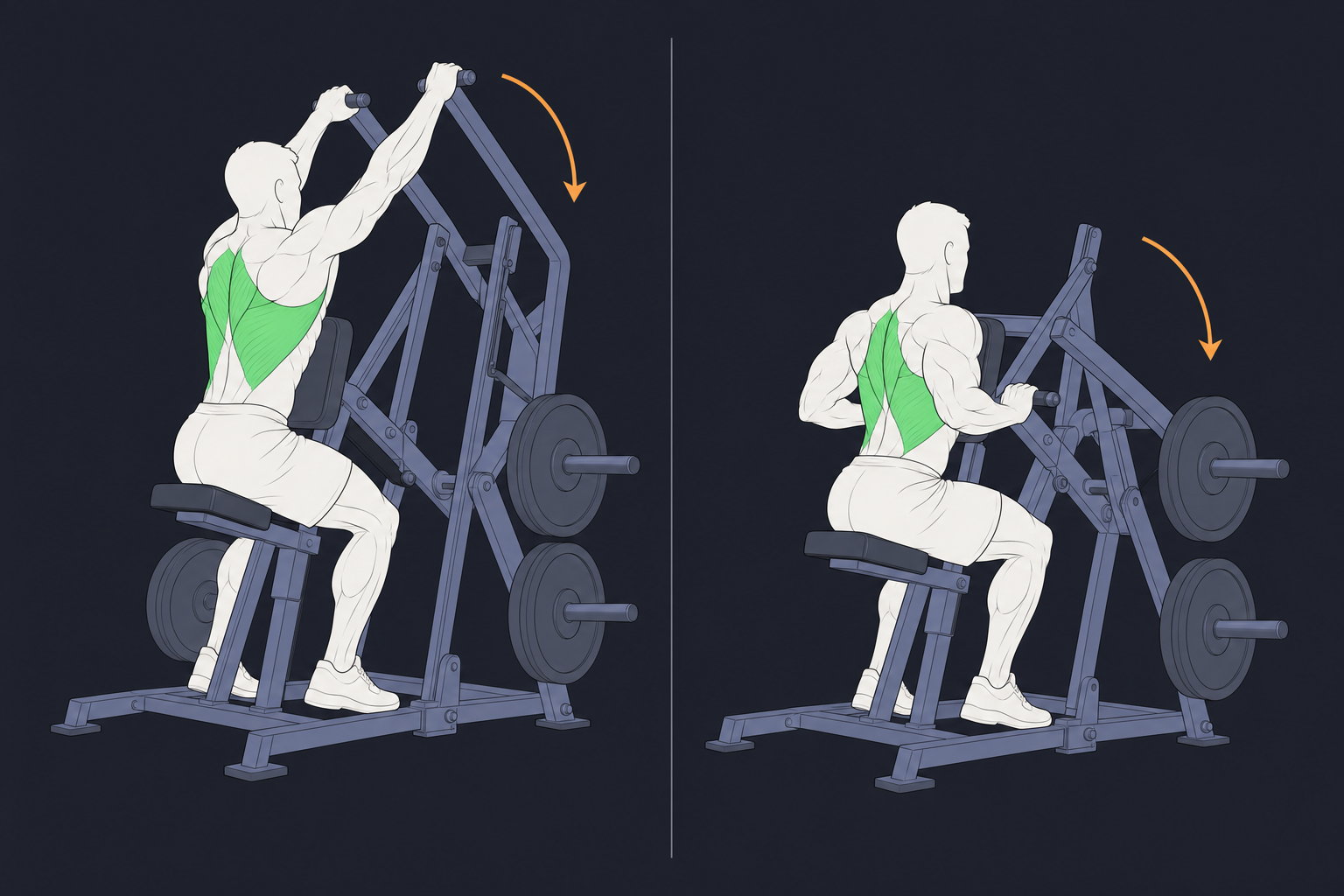
| EQUIPMENT | Plate-loaded high row — independent lever arms |
| SETS × REPS | 3 × 8–10 each |
| REST | 2 min between sets |
| EFFORT | RIR 1–2 |
| SET UP | Chest firmly into the pad, seat set so the handles start above shoulder height. Work one arm at a time. |
| EXECUTE | Reach up and forward to a full stretch, then pull the handle down and back toward your ribs with the elbow low. |
| COMMON MISTAKE | Using both arms and letting the stronger side take over. Independent arms exist specifically to stop that. |
3. Seated Cable Row
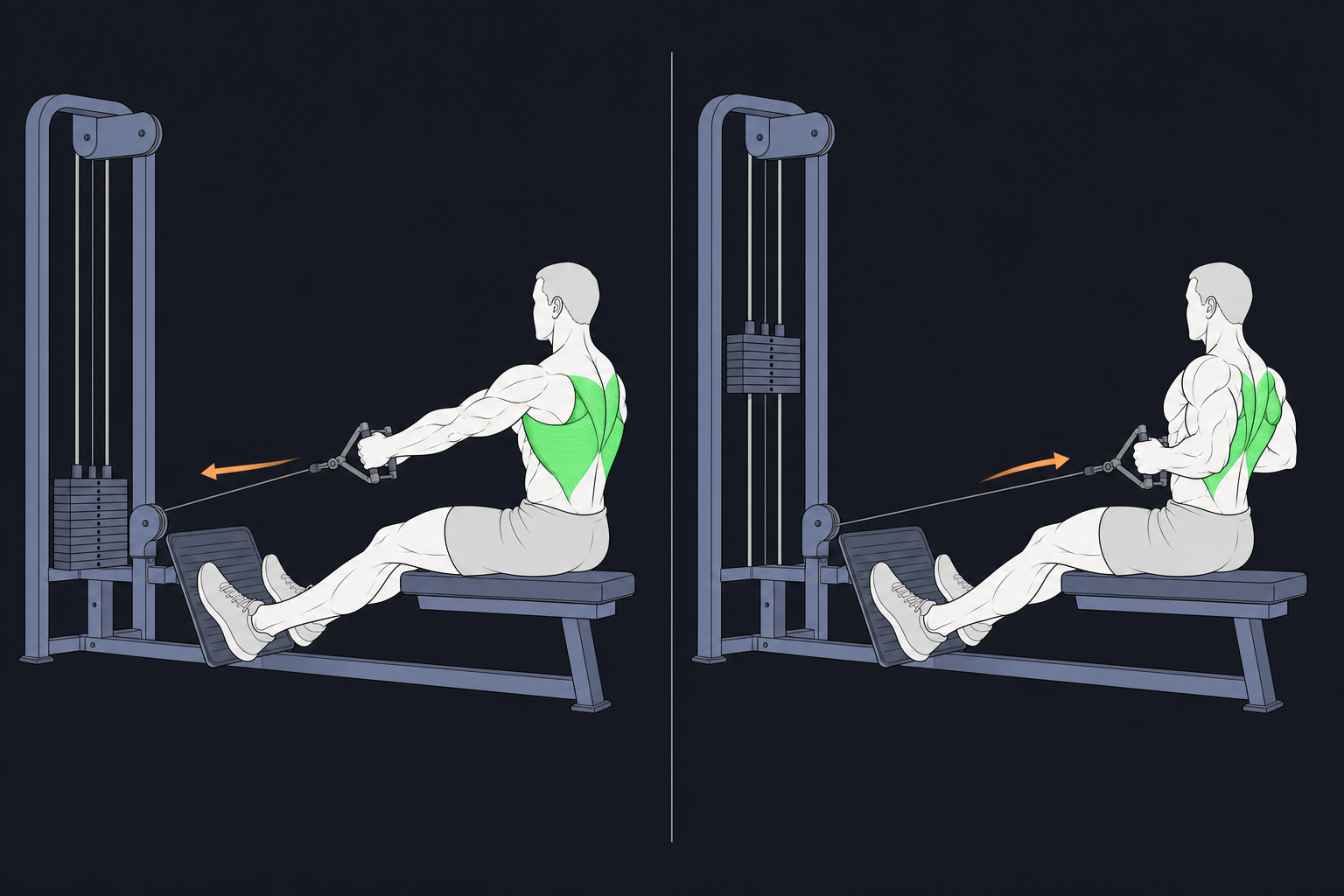
| EQUIPMENT | Seated row — close-grip V handle |
| SETS × REPS | 3 × 10–12 |
| REST | 2 min between sets |
| EFFORT | RIR 1 |
| SET UP | Attach the close-grip V handle. Feet on the plate, knees slightly bent, torso vertical. |
| EXECUTE | Let the arms reach fully forward and the shoulder blades spread apart. Pull the handle to your navel, elbows tucked, and squeeze for a count. |
| COMMON MISTAKE | Rowing with the lower back — leaning far forward and then throwing the torso backward. |
4. Dumbbell Shrug
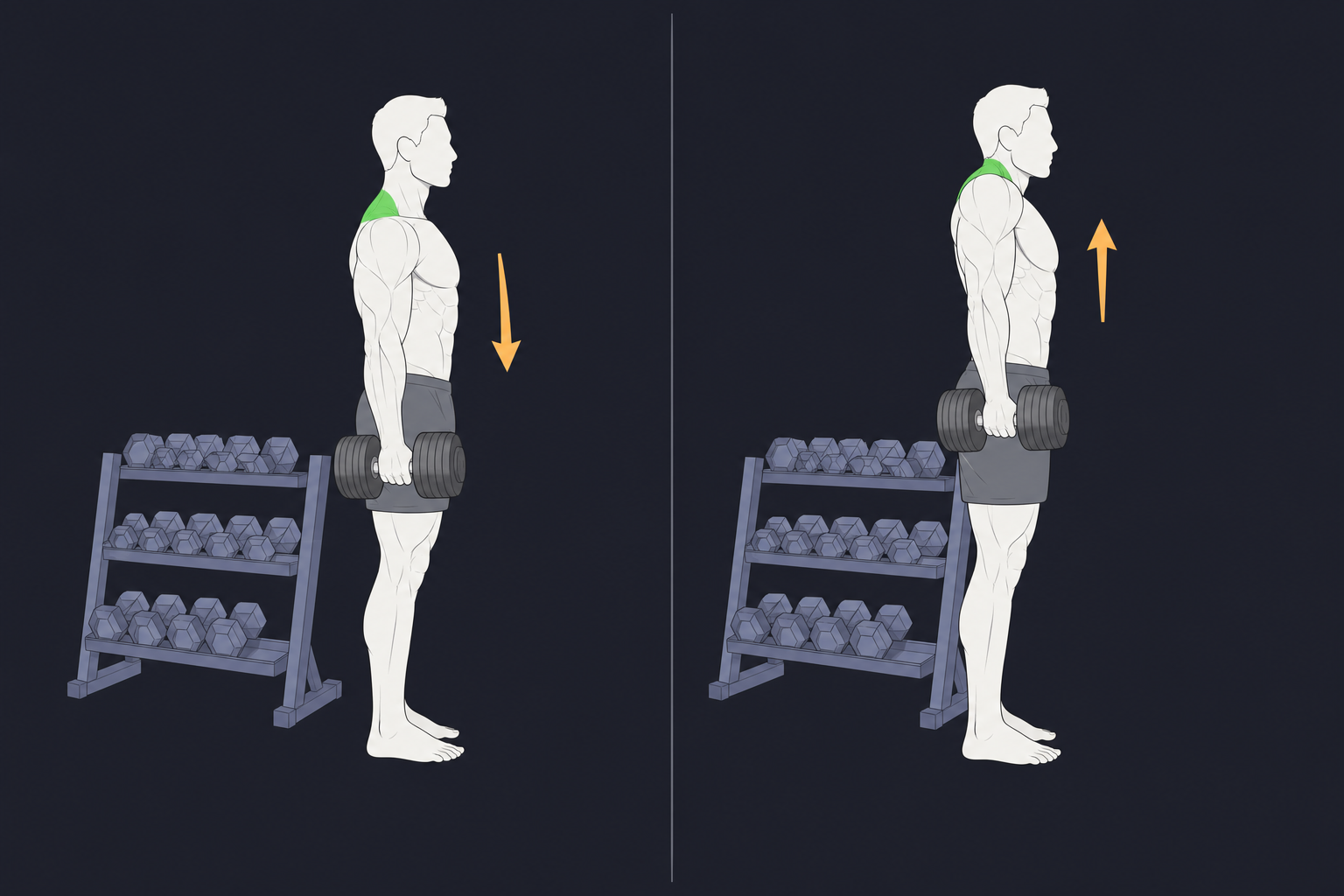
| EQUIPMENT | Heaviest hex dumbbells (or the Smith machine) |
| SETS × REPS | 4 × 10–15 |
| REST | 90 s between sets |
| EFFORT | RIR 1 |
| SET UP | Stand tall, arms straight down at your sides, shoulders relaxed and pulled low. |
| EXECUTE | Elevate the shoulders straight up toward your ears as high as they will go. Hold one second at the top, then lower all the way down. |
| COMMON MISTAKE | Rolling the shoulders backward. It adds nothing and grinds the joint. |
| NOTE | Full range, not heavy partials. Let the shoulders drop completely at the bottom of every rep. |
5. Chest-Supported Rear Delt Row
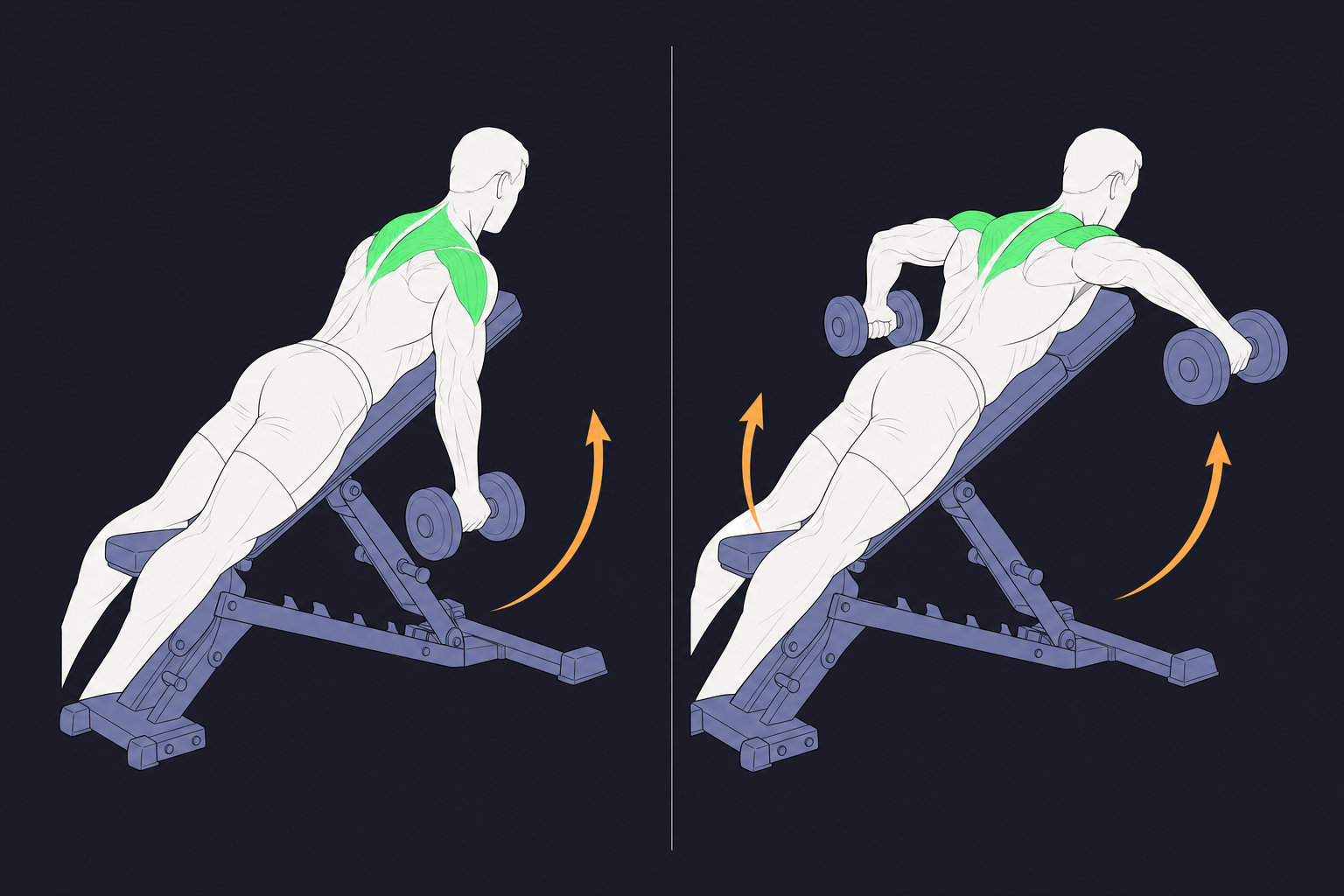
| EQUIPMENT | Adjustable bench (45 degrees) + dumbbells |
| SETS × REPS | 3 × 12–15 |
| REST | 75 s between sets |
| EFFORT | RIR 0–1 |
| SET UP | Lie face down on the incline bench so your chest is supported and your arms hang straight down. |
| EXECUTE | Row both dumbbells up and out with the elbows flared wide, to shoulder level. Squeeze the shoulder blades together at the top. |
| COMMON MISTAKE | Tucking the elbows in. Flared elbows are what shift this from lats onto the rear delts and mid-traps. |
6. Flat Dumbbell Press
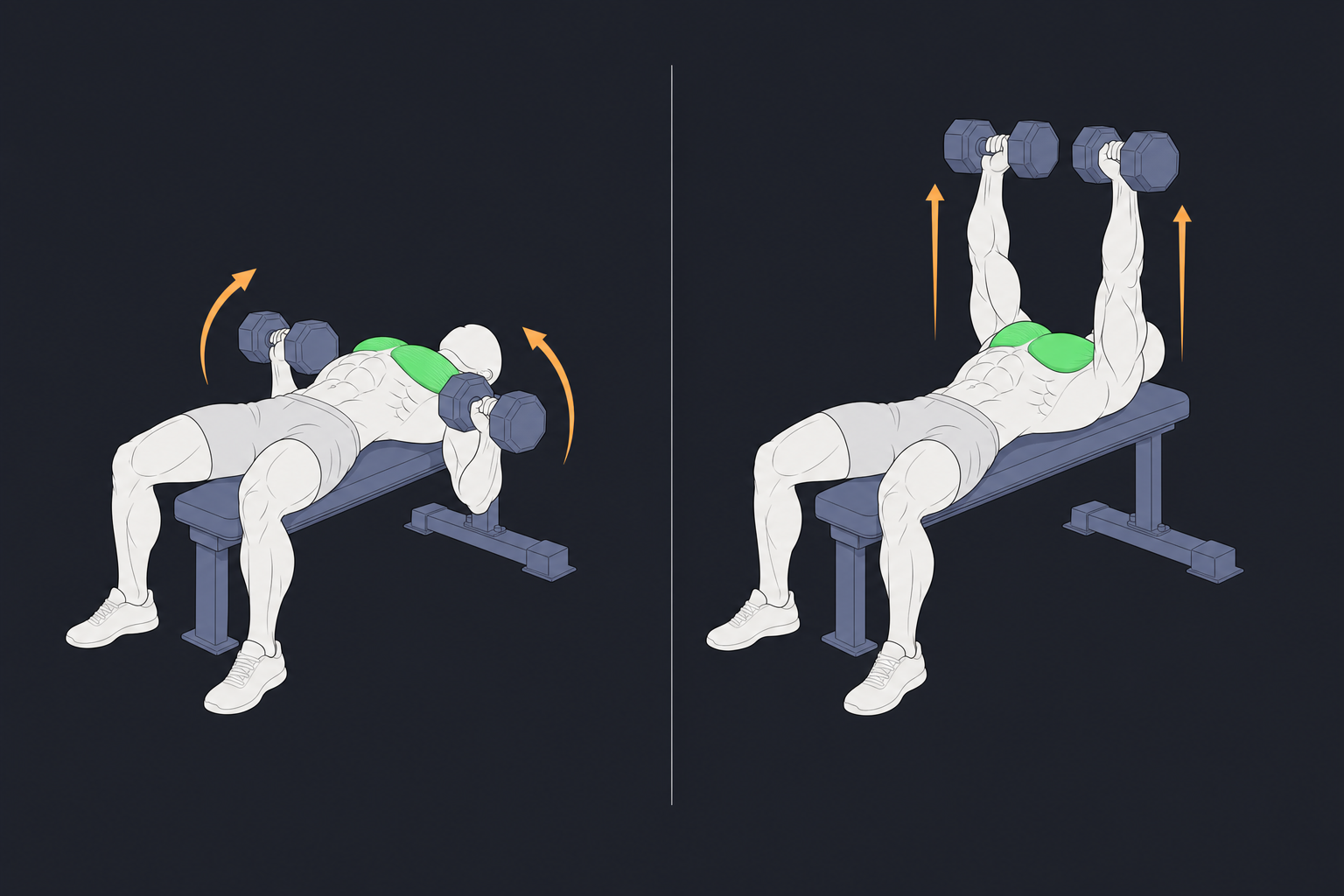
| EQUIPMENT | Flat bench + dumbbells |
| SETS × REPS | 3 × 8–10 |
| REST | 2 min between sets |
| EFFORT | RIR 1–2 |
| SET UP | Lie flat, feet planted, shoulder blades pulled together and down. |
| EXECUTE | Lower the dumbbells wide and deep until you feel the chest stretch below the line of the torso. Press up and slightly together. |
| COMMON MISTAKE | Going as heavy as an ego demands and cutting the depth. Dumbbells earn their place here precisely because they allow more range than a bar. |
7. Pec Fly
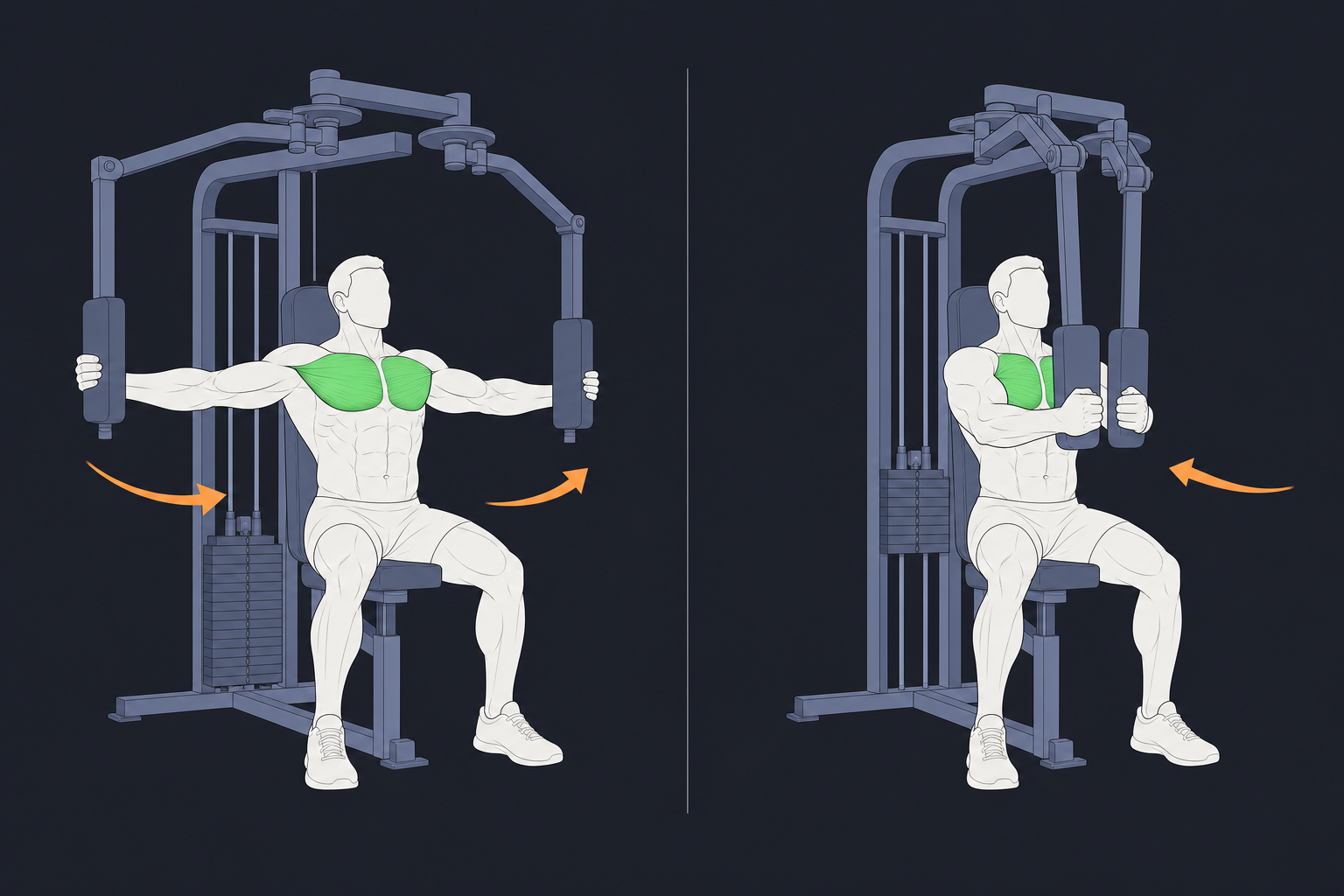
| EQUIPMENT | Rear delt / pec fly combo — fly side |
| SETS × REPS | 3 × 12–15 |
| REST | 75 s between sets |
| EFFORT | RIR 0 · drop set on the last |
| SET UP | Sit with your back flat on the pad, arms out to the sides gripping the pads, elbows softly bent. |
| EXECUTE | Bring the arms together in front of your chest and squeeze. Open back up until the chest is fully stretched. |
| COMMON MISTAKE | Reducing the range to add plates. The stretch at the outside of the movement is the whole exercise. |
| TECHNIQUE | DROP SET — last set only. Take the final set until you cannot complete another clean rep. Immediately strip 25–35% of the weight — no rest, do not walk away, do not sit down — and keep repping until you fail again. One drop, then stop. |
DAY 5 — HAMSTRINGS + GLUTES + ABS
The back of the body. Hamstrings cross two joints, so they get trained both ways — from the hip with the Romanian deadlift and from the knee with the seated curl. Squats barely train them at all.
| # | Exercise | Sets × Reps | Rest | Effort |
|---|---|---|---|---|
| 1 | Romanian Deadlift | 4 × 8–10 | 3 min | RIR 1–2 |
| 2 | Seated Leg Curl | 4 × 10–12 | 2 min | RIR 1 · lengthened partials on the last |
| 3 | Hip Thrust | 3 × 12–15 | 2 min | RIR 1 |
| 4 | Walking Lunge | 3 × 12 each leg | 2 min | RIR 1–2 |
| 5 | Hip Abduction | 3 × 15–20 | 60 s | RIR 0–1 |
| 6 | 45° Back Extension | 3 × 12–15 | 60 s | RIR 1 |
| 7 | Cable Crunch | 3 × 8–12 | 60 s | RIR 0–1 · weighted |
| 8 | Hanging Leg Raise | 3 × 8–12 | 60 s | RIR 0–1 |
No machine cardio. Walk home. Second option for the weekly refeed.
Day 5 — exercise by exercise
1. Romanian Deadlift
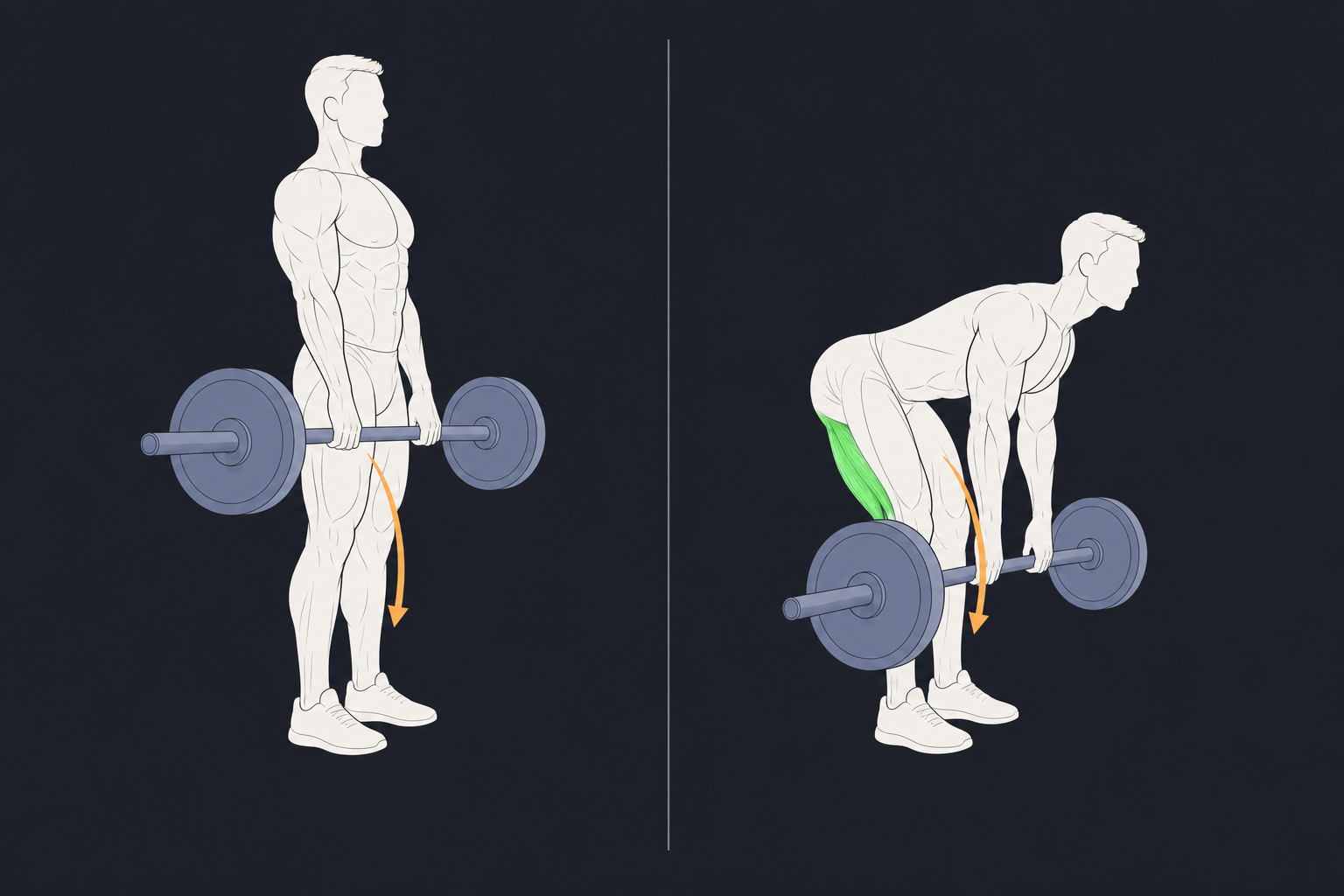
| EQUIPMENT | Olympic barbell |
| SETS × REPS | 4 × 8–10 |
| REST | 3 min between sets |
| EFFORT | RIR 1–2 |
| SET UP | Stand tall holding the bar at your thighs, knees slightly soft, shoulders back. |
| EXECUTE | Push your hips backward — not down — letting the bar slide down the front of your legs. Stop when the hamstrings reach their stretch, then drive the hips forward to stand up. |
| COMMON MISTAKE | Trying to reach the floor. The bar goes as far as your hamstrings allow and no further; past that the lower back takes over. |
2. Seated Leg Curl
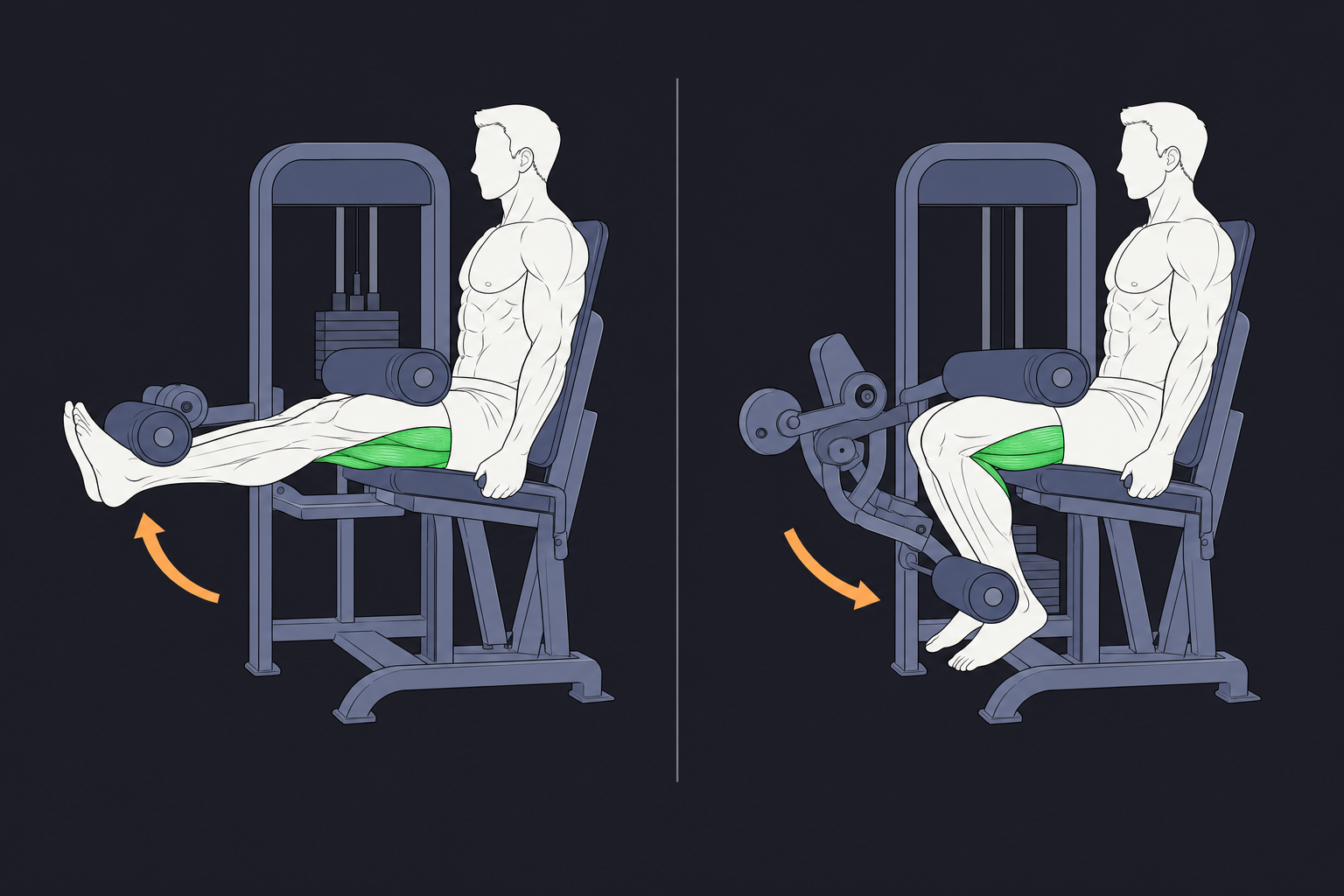
| EQUIPMENT | SEATED leg curl — not the lying one |
| SETS × REPS | 4 × 10–12 |
| REST | 2 min between sets |
| EFFORT | RIR 1 · lengthened partials on the last |
| SET UP | Sit fully upright with the lap pad tight across your thighs and the roller behind your lower calves. |
| EXECUTE | Curl your heels down and back underneath the seat as far as they go. Squeeze, then return slowly to straight legs. |
| COMMON MISTAKE | Sliding the hips forward to help. The whole advantage of the seated version is the hip angle — losing it wastes the exercise. |
| TECHNIQUE | LENGTHENED PARTIALS — last set only. When you can no longer complete a full rep, don't rack it. Keep going with half reps in the bottom, stretched half of the range only — the part where the muscle is longest and under most tension. Continue until you cannot move it at all. Expect 5–10 partials. |
| NOTE | The seated version beats the lying version. Use this machine even if the lying one is free. |
3. Hip Thrust
| EQUIPMENT | Hip thrust / glute drive machine |
| SETS × REPS | 3 × 12–15 |
| REST | 2 min between sets |
| EFFORT | RIR 1 |
| SET UP | Upper back against the pad, lap pad low across the hips, feet flat and roughly shoulder width. |
| EXECUTE | Drive the hips up until your torso and thighs make one straight line. Tuck the chin, keep the ribs down, hold the top for a full second. |
| COMMON MISTAKE | Arching the lower back to get higher. The extra range comes from the spine, not the glutes. |
4. Walking Lunge
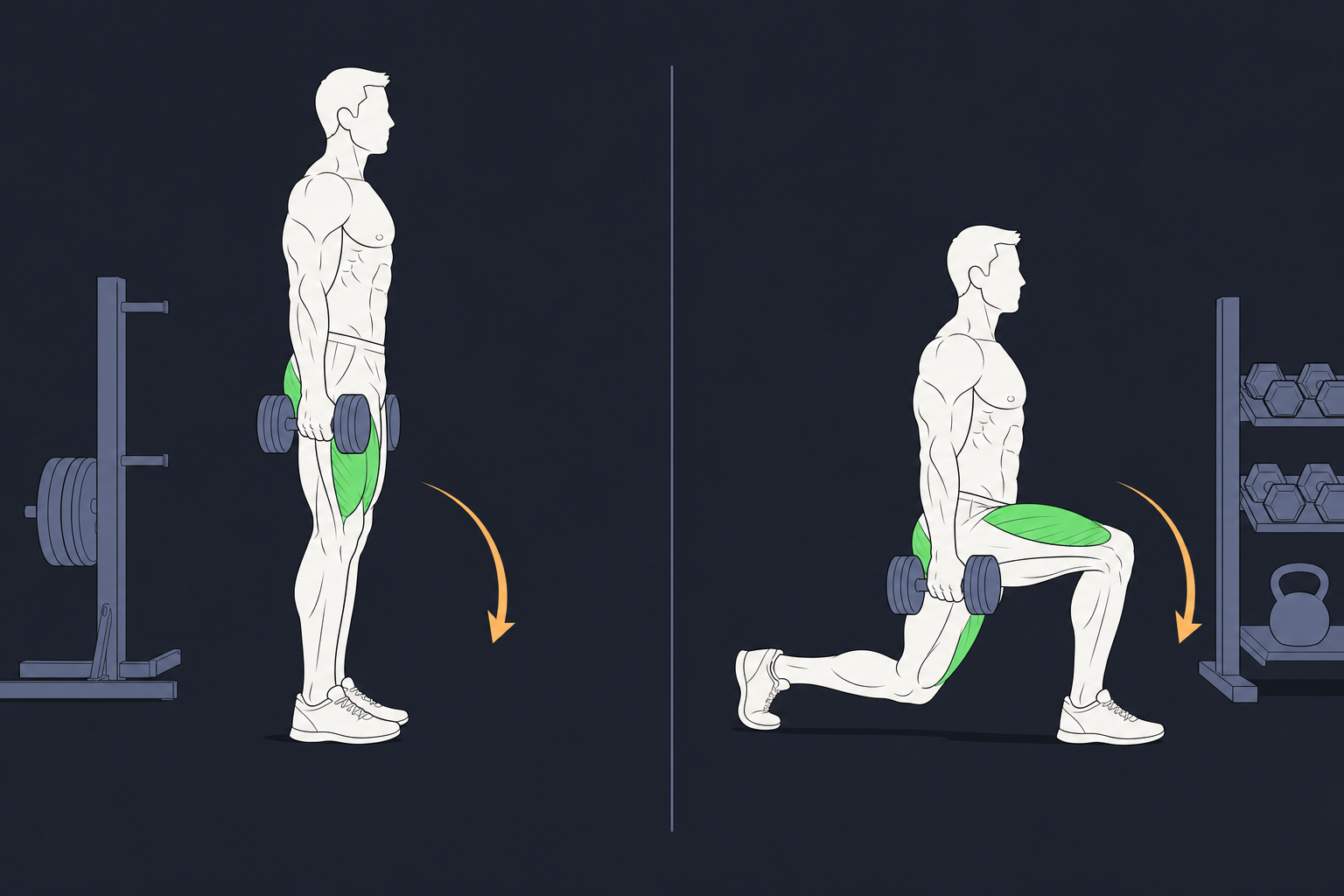
| EQUIPMENT | Dumbbells + open floor |
| SETS × REPS | 3 × 12 each |
| REST | 2 min between sets |
| EFFORT | RIR 1–2 |
| SET UP | Stand tall with a dumbbell in each hand. |
| EXECUTE | Step forward into a long stride, dropping the rear knee toward the floor, front shin vertical. Push through the front heel to bring the rear leg through into the next rep. |
| COMMON MISTAKE | Short choppy steps, which shift the work to the quads and the knee. |
| NOTE | Long stride biases the glutes. Short stride biases the quads. Here you want long. |
5. Hip Abduction
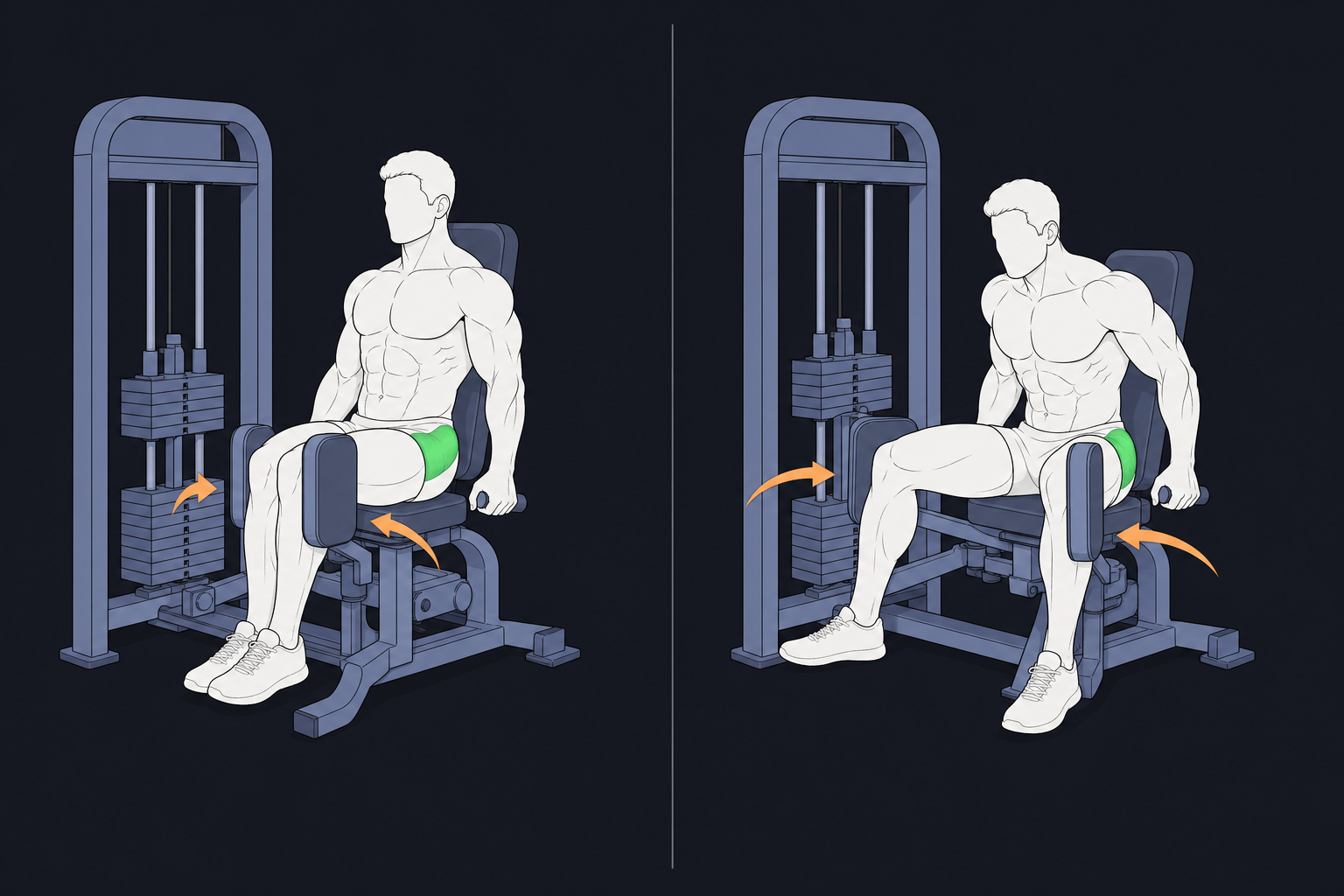
| EQUIPMENT | Hip abductor machine |
| SETS × REPS | 3 × 15–20 |
| REST | 60 s between sets |
| EFFORT | RIR 0–1 |
| SET UP | Sit with the pads against the outside of your thighs — and lean your torso forward. |
| EXECUTE | Push your knees apart against the pads as far as they go. Hold, then return slowly under control. |
| COMMON MISTAKE | Sitting bolt upright, which shifts the work off the glutes and onto a smaller hip muscle. |
| NOTE | That forward lean is the entire trick. It moves the work onto the glute medius — the muscle that builds the shelf at the side of the hip. |
6. 45° Back Extension
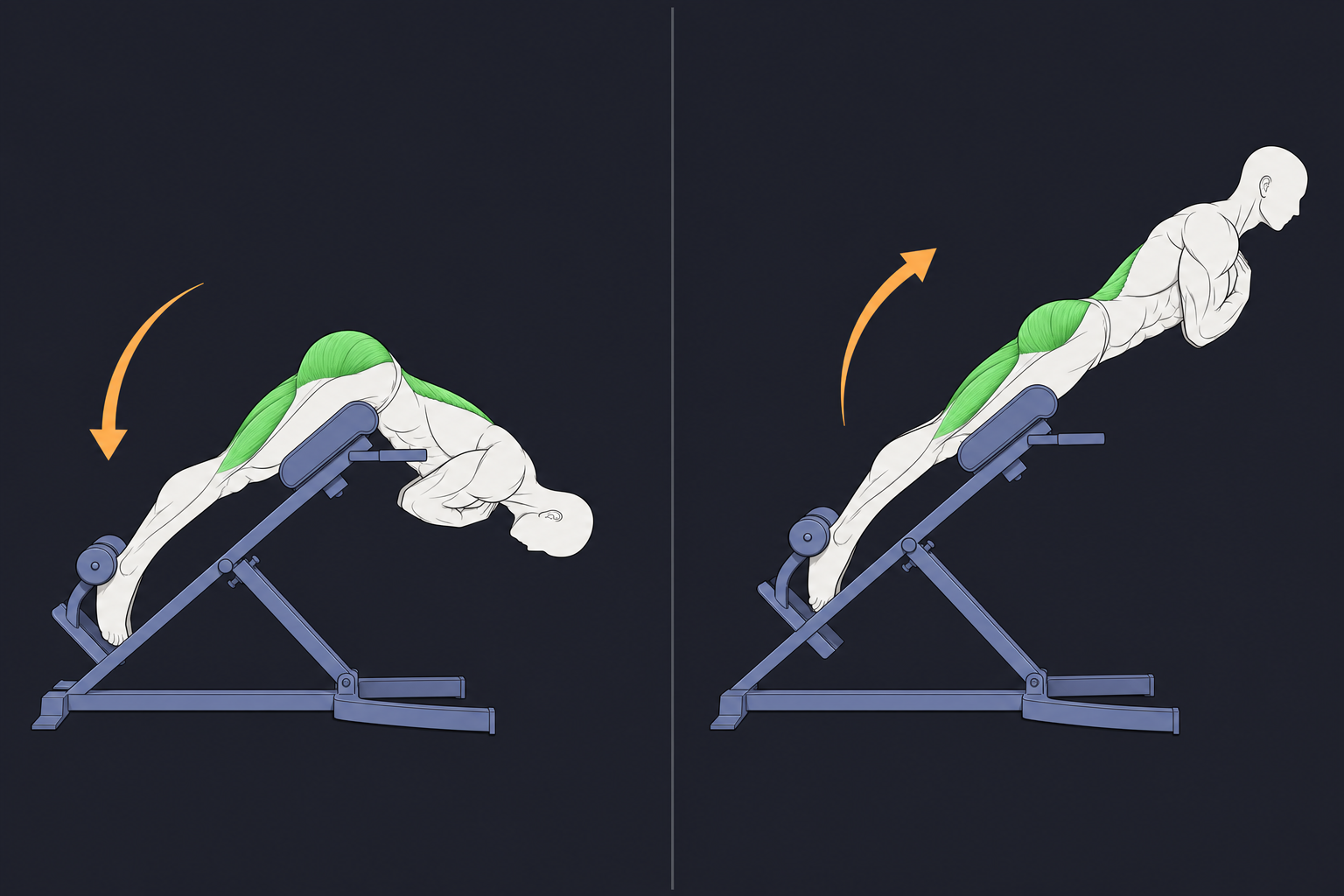
| EQUIPMENT | 45 degree back extension bench |
| SETS × REPS | 3 × 12–15 |
| REST | 60 s between sets |
| EFFORT | RIR 1 |
| SET UP | Hip pad just below the pelvis, ankles secure. Keep your spine rigid and neutral. |
| EXECUTE | Hinge down at the hip until you feel the hamstrings stretch, then extend back up until your body is one straight line. Do not go past straight. |
| COMMON MISTAKE | Hyperextending at the top and arching hard. Stop at straight. |
| NOTE | Hold a plate against your chest once bodyweight gets easy. |
7. Cable Crunch
| EQUIPMENT | Cable station, pulley HIGH — rope |
| SETS × REPS | 3 × 8–12 |
| REST | 60 s between sets |
| EFFORT | RIR 0–1 · weighted |
| SET UP | Attach a rope to the high pulley. Kneel facing away, hold the rope beside your head, hips directly under your shoulders. |
| EXECUTE | Curl your spine down — think of pulling your ribs toward your pelvis, not bowing at the hips. Round your back deliberately. Return under control. |
| COMMON MISTAKE | Hinging at the hips instead of flexing the spine, which turns it into a hip exercise with your abs just holding on. |
| NOTE | Abs are a priority in this program and they progress like any other muscle: ADD WEIGHT. When all three sets reach 12 clean reps, put 2.5-5 kg more on the stack. Do not drift into sets of forty. |
8. Hanging Leg Raise
| EQUIPMENT | Pull-up tower |
| SETS × REPS | 3 × 8–12 |
| REST | 60 s between sets |
| EFFORT | RIR 0–1 |
| SET UP | Hang from the bar, arms straight, body still. |
| EXECUTE | Raise your legs and curl your pelvis up toward your ribs so your lower back rounds at the top. Lower slowly with no swing. |
| COMMON MISTAKE | Swinging into the next rep. If your body is moving like a pendulum, your hip flexors are doing the work and your abs are along for the ride. |
| NOTE | Progress by making it harder, not longer: bent knees first, then straight legs, then a light dumbbell squeezed between the feet. Reps stay in the 8-12 window throughout. |
DAY 6 — SHOULDERS + ARMS + TRAPS + CALVES + ABS — VOLUME
The completion day, and it is identical every week. Everything that would otherwise get only one session across Days 1 to 5 gets its second here. Day 3 was heavy and press-led; this one is lighter, higher-rep and isolation-led, so it adds useful work without adding much recovery cost.
| # | Exercise | Sets × Reps | Rest | Effort |
|---|---|---|---|---|
| 1 | Cable Lateral Raise | 4 × 15–20 | 60 s | RIR 0 · drop set on the last |
| 2 | Machine Shoulder Press | 3 × 12–15 | 90 s | RIR 1 |
| 3 | Rear Delt Fly | 4 × 15–20 | 60 s | RIR 0–1 |
| 4 | Dumbbell Shrug | 4 × 12–15 | 75 s | RIR 1 |
| 5 | Overhead Cable Triceps Extension | 3 × 12–15 | 75 s | RIR 0–1 |
| 6 | Rope Pressdown | 3 × 15–20 | 60 s | RIR 0–1 |
| 7 | Preacher Curl | 4 × 10–12 | 75 s | RIR 0–1 |
| 8 | Hammer Curl | 3 × 12–15 | 60 s | RIR 0–1 |
| 9 | Sled Calf Press | 4 × 12–15 | 60 s | RIR 0–1 |
| 10 | Ab Rollout | 3 × 6–10 | 60 s | RIR 0–1 |
Optional 25 minutes on the ClimbMill to finish — add this third cardio session only once Days 1 to 5 are consistently strong and joints and sleep are holding.
Day 6 — exercise by exercise
1. Cable Lateral Raise
| EQUIPMENT | Functional trainer, pulley LOW — single D-handle |
| SETS × REPS | 4 × 15–20 |
| REST | 60 s between sets |
| EFFORT | RIR 0 · drop set on the last |
| SET UP | Attach a D-handle at the lowest setting. Stand side-on so the cable runs across the front of your body, handle in the outside hand. |
| EXECUTE | Raise your arm out to the side to shoulder height with a soft fixed elbow. Lower slowly and let the cable pull the arm across your body at the bottom. |
| COMMON MISTAKE | Going too heavy and shrugging the weight up. If the traps take over, the side delt gets nothing. |
| TECHNIQUE | DROP SET — last set only. Take the final set until you cannot complete another clean rep. Immediately strip 25–35% of the weight — no rest, do not walk away, do not sit down — and keep repping until you fail again. One drop, then stop. |
| NOTE | Cable and dumbbell versions work equally well. Use whichever you can control. |
2. Machine Shoulder Press
| EQUIPMENT | Selectorized shoulder press |
| SETS × REPS | 3 × 12–15 |
| REST | 90 s between sets |
| EFFORT | RIR 1 |
| SET UP | Seat height so the handles start at shoulder level. Back flat against the pad. |
| EXECUTE | Press up, stopping just short of locking out so the delts stay under tension. Come back down to a full stretch at the bottom. |
| COMMON MISTAKE | Locking out hard at the top and resting there between reps. |
| NOTE | Machine pressing is where you can safely chase the last few reps - the path is fixed and there is nothing to drop. |
3. Rear Delt Fly
| EQUIPMENT | Rear delt / pec fly combo — seated FACING the chest pad |
| SETS × REPS | 4 × 15–20 |
| REST | 60 s between sets |
| EFFORT | RIR 0–1 |
| SET UP | Sit facing into the machine with your chest against the pad. Set the handles so your arms start straight out in front at shoulder height. |
| EXECUTE | Sweep both arms out wide and back in an arc, leading with the elbows. Squeeze the shoulder blades at the end. |
| COMMON MISTAKE | Thinking about pulling the hands back. Think about driving the elbows apart — the rear delt opens the arm, it does not row it. |
4. Dumbbell Shrug
| EQUIPMENT | Heaviest hex dumbbells (or the Smith machine) |
| SETS × REPS | 4 × 12–15 |
| REST | 75 s between sets |
| EFFORT | RIR 1 |
| SET UP | Stand tall, arms straight down at your sides, shoulders relaxed and pulled low. |
| EXECUTE | Elevate the shoulders straight up toward your ears as high as they will go. Hold one second at the top, then lower all the way down. |
| COMMON MISTAKE | Rolling the shoulders backward. It adds nothing and grinds the joint. |
| NOTE | Full range, not heavy partials. Let the shoulders drop completely at the bottom of every rep. |
5. Overhead Cable Triceps Extension
| EQUIPMENT | Functional trainer, pulley LOW — rope |
| SETS × REPS | 3 × 12–15 |
| REST | 75 s between sets |
| EFFORT | RIR 0–1 |
| SET UP | Attach a rope to the low pulley. Face away from the machine, rope behind your head, step forward and lean your torso slightly ahead of your hips. |
| EXECUTE | Keeping your elbows high and completely still, extend your arms up and forward until straight. Let the elbows bend back to a deep stretch behind your head. |
| COMMON MISTAKE | Letting the elbows drift down and forward, which turns it back into a pressdown. |
| NOTE | This is the single most productive triceps exercise in the program. It goes first, and it gets the most sets. |
6. Rope Pressdown
| EQUIPMENT | Cable station, pulley HIGH — rope |
| SETS × REPS | 3 × 15–20 |
| REST | 60 s between sets |
| EFFORT | RIR 0–1 |
| SET UP | Rope on the high pulley. Stand close, elbows pinned to your sides and bent to about 90 degrees. |
| EXECUTE | Push down and spread the rope apart at the bottom, holding the lockout for a count. Return only until the elbows reach 90 degrees. |
| COMMON MISTAKE | Letting the elbows drift forward and away from the ribs, which recruits the chest and shoulders. |
7. Preacher Curl
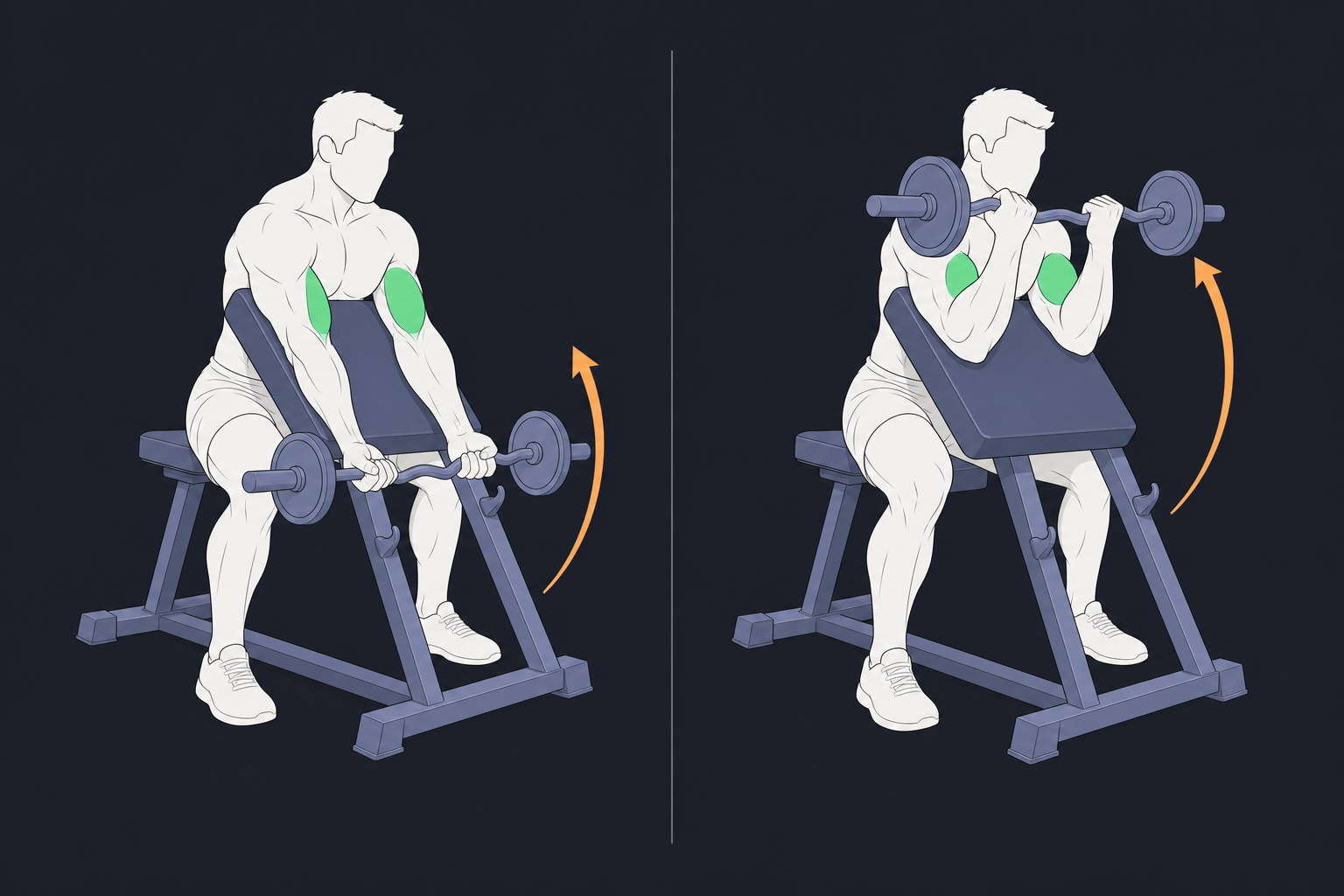
| EQUIPMENT | Preacher bench (or the machine preacher) — EZ bar |
| SETS × REPS | 4 × 10–12 |
| REST | 75 s between sets |
| EFFORT | RIR 0–1 |
| SET UP | Armpits at the very top of the angled pad, upper arms flat against it, chest into the pad. |
| EXECUTE | Lower to full arm extension at the bottom, then curl up toward your chin. Do not let the elbows slide up the pad. |
| COMMON MISTAKE | Bouncing out of the bottom. The stretched bottom position is the reason this exercise exists — and it is also where the biceps is most vulnerable, so control it. |
| NOTE | The bottom of a preacher curl is where the biceps is longest and weakest. Control it - do not drop into it. |
8. Hammer Curl
| EQUIPMENT | Hex dumbbells, neutral grip |
| SETS × REPS | 3 × 12–15 |
| REST | 60 s between sets |
| EFFORT | RIR 0–1 |
| SET UP | Stand tall, dumbbells at your sides, palms facing in toward your body. |
| EXECUTE | Curl straight up keeping the palms facing inward the whole way. Lower under control. |
| COMMON MISTAKE | Rotating the wrist on the way up, which turns it into a regular curl and skips the muscle you are targeting. |
| NOTE | This trains the brachialis — the muscle underneath the biceps. Building it pushes the biceps up and makes the arm look thicker from the side. |
9. Sled Calf Press
| EQUIPMENT | 45 degree leg press — balls of the feet on the bottom edge |
| SETS × REPS | 4 × 12–15 |
| REST | 60 s between sets |
| EFFORT | RIR 0–1 |
| SET UP | Put only the balls of your feet on the very bottom edge of the platform so your heels hang off into space. Legs stay straight. |
| EXECUTE | Let the heels sink as far below the platform as they will go and pause one second in that stretch. Then push all the way up onto the toes. |
| COMMON MISTAKE | Short bouncy reps. Calves are almost entirely built by the stretched bottom position. |
10. Ab Rollout
| EQUIPMENT | Ab wheel on a mat (or the FORMA rig) |
| SETS × REPS | 3 × 6–10 |
| REST | 60 s between sets |
| EFFORT | RIR 0–1 |
| SET UP | Kneel with the wheel under your shoulders, core braced, ribs pulled down. |
| EXECUTE | Roll forward as far as you can while keeping your lower back from sagging. Pull yourself back with the abs, not the hip flexors. |
| COMMON MISTAKE | Letting the hips sag so the lower back arches - that is the exact position this exercise is meant to train you to resist. |
| NOTE | Progress by rolling further out until you reach full extension for 10 reps, then add load with a weighted vest. This is the anti-extension half of the ab work - the other two exercises train flexion, this one trains resisting it. |
Day 6 — cardio
Optional. Add this third session only once Days 1 to 5 are consistently strong and joints and sleep are holding.
| Phase | Duration | Level | Steps / min | Target |
|---|---|---|---|---|
| Warm-up | 4 min | 2–4 | 30–40 | HR drifting to 100–110 |
| Working | 25 min — optional | 5–7 | 45–58 | 110–130 bpm — full sentences still possible |
| Cool-down | 3–4 min | 2–3 | 25–35 | HR back under 110 |
| Too hard | — | 8+ | 60+ | Above 130 — drop a level |
Manual mode, never a preset. Fingertips on the rails for balance only — leaning on them cuts the real work while the console reports the same numbers. The heart-rate target beats the level number: if fatigue from the weights pushes you over 130, drop a level.
Running It
Print it, screenshot it, or open this page at the gym. Find your day, work down the table, and use the detail below it when you're not sure how a machine is meant to be set up.
Three things decide whether this works, and none of them is the program:
Log every set. Weight and reps, every session. You cannot progressively overload against a number you didn't write down, and progressive overload is the entire mechanism.
Hit the protein. 175 to 195 grams, every day, especially on the days you aren't hungry. In a deficit this is the difference between losing fat and losing muscle.
Don't change the plan for 12 weeks. The exercises stay. The weights climb. Rewriting the program every three weeks is the most popular way to never get stronger at anything.
Ten kilograms. Every lift heavier at the end than the start.
Day 1 is tomorrow.
Related Reading
- Mapping SmartFit Inventory with AI — the machine inventory this program is built on.
- Monster Bodybuilding Workout Plan — version 1.0 — the program this replaces.
- The Numbers Came Back — the bloodwork that set the target.
- Even If You Are Tired, Keep Moving Forward — for the days the plan is the last thing you want.
- The Sword Goes Back in the Sheath — why the recovery weeks are part of the program.
- Thirteen Tonnes and a Clean Heart — a clean serial ECG at day 98, and day one of the new training block.
- The Best Thing in Animal Pak Is the 100 mg They Took Out — a label-by-label read of the Animal line, and what the supplement facts actually show.
- Three of Six — MONSTER 2.0 Day 3, and what three near-identical tonnage totals across different muscle groups actually prove.
- MONSTER 2.0 — The Ask
- Day One. Logged. — first session of the 7 September block.
MONSTER 2.0 — The Kitchen — the nutrition companion: 2,455 kcal, 225 g of protein, 25 interchangeable recipes.
Three Pillars, All Live — how the training, kitchen and protocol run together, and the one date that reads all three
Day One. Logged. — first session of the 7 September block.
Day Four. One Side Effect. — Tuesday and Wednesday logged, plus the first side effect under watch.