Wagyu: The Best Fat on Earth
Most “Wagyu” you’ve eaten was a markup, not a marbling grade. What the real thing actually is — the genetics, the A5 grading nobody explains properly, the fat science a biohacker should care about — and where I finally found it in Colombia.
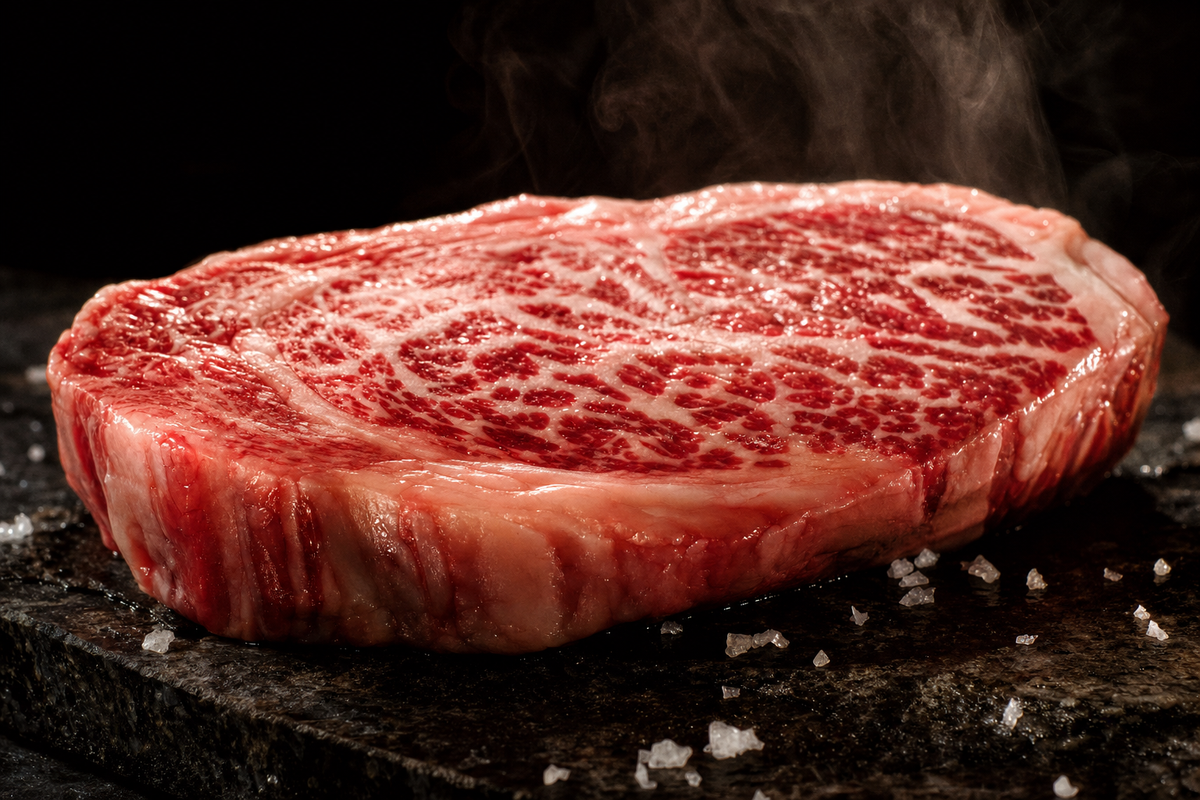
There’s a moment with real Wagyu where the fat doesn’t chew — it vanishes. You lay a thin, barely-seared slice on your tongue and it dissolves at body temperature, buttery and faintly sweet, leaving behind something ordinary steak has never once delivered. That’s not the chef. That’s not the seasoning. That’s physics, written into the animal at the genetic level.
I went deep on Wagyu recently — partly because I eat for performance and wanted to know exactly what I was buying, partly because most of what gets sold under the name is marketing with a price tag stapled to it. Here’s the real thing, grading and fat science included, with the honest parts the steak blogs leave out.
What Wagyu actually is
“Wagyu” just means “Japanese cattle” — wa (Japanese) + gyu (cattle). It isn’t one breed; it’s four. And one does nearly all the work: Japanese Black (Kuroge Washu) is north of 90% of all Wagyu — often cited around 97%. The others (Japanese Brown, Shorthorn, Polled) are rare by comparison.
What makes these animals singular is genetic: a freakish predisposition to deposit fat inside the muscle, not just around it. That intramuscular fat is the marbling — the Japanese call it sashi, the fine white lacework threading through the red. There’s even a known genetic lever behind it: the SCD (stearoyl-CoA desaturase) gene, which converts hard saturated fat into softer monounsaturated fat. That’s why Wagyu fat has a lower melting point than normal beef fat — credible measurements put it somewhere in the 25–33°C range, versus roughly 40°C+ for commodity beef fat. Translation: Wagyu fat starts liquefying at or below the temperature of your mouth. The “melts in your mouth” line isn’t poetry. It’s a slip point.
The grading nobody explains properly
This is where people get fleeced, so let’s be precise. Japan grades beef on two axes:
- Yield grade — A, B, C: how much usable meat comes off the carcass (A = 72%+, top).
- Quality grade — 1 to 5: where 5 is best.
“A5” is the top of both. But the quality number is stricter than people think: it’s the lowest of four separate scores — marbling, meat color and brightness, firmness and texture, and fat color and quality. You don’t average your way to a 5. One weak axis caps the whole grade. A5 doesn’t mean one dazzling number — it means the absence of a single unimpressive one.
Marbling has its own sub-scale, the BMS (Beef Marbling Standard), 1 to 12 — and grade 5 demands BMS 8 through 12. Here’s the part that recalibrates people:
USDA Prime — the top American grade — tops out somewhere around BMS 4–6. It’s genuinely excellent beef, and it still sits below the entry point for Japanese A5. Put it bluntly: A5 carries roughly double the marbling of top Prime, and the USDA scale simply has no rung above Prime — it runs out of numbers before it gets to A5. A real A5 dropped into the American system would only score “Prime,” which dramatically undersells it. Australia runs its own marble score (0–9+), and the best Australian Wagyu lives at the top of it.
Then there’s terroir. Kobe is the famous name — but Kobe is a certification, not a synonym for Wagyu. To wear it, the animal has to be Tajima bloodline, a heifer or steer, hit BMS 6 or higher, land yield grade A or B, and come in at 499.9 kg carcass weight or less. Only a few thousand head qualify a year — which is precisely why most “Kobe” on menus outside Japan is fiction. Miyazaki (a serial champion at Japan’s national Wagyu competition), Matsusaka, and Omi are the other heavyweight regional brands.
The honest reality check
Most “Wagyu” sold on Earth is crossbred — Wagyu bred onto Angus and sold by percentage: F1 (50%), F2 (75%), F3 (87.5%), with “fullblood” reserved for 100% Japanese genetics. American “Wagyu” is overwhelmingly the crossbred kind. It can be very good meat. It is not Japanese fullblood A5, and the gap is enormous: a typical F1 crossbreed carries around 12% intramuscular fat; authentic Kobe pushes ~60%. That “Wagyu burger” on a chain menu? Usually F1 or less — sometimes a token smear of Wagyu genetics in an otherwise ordinary patty, sold at a premium for the syllables.
How to tell you’re getting the real thing: the seller names the origin (country, often prefecture), the grade (A5/A4 + BMS), and ideally breed and traceability (real Kobe ships with a certificate and an ID number). Vague “100% Wagyu” with no country and no grade? Assume premium crossbred at best.
There’s also a hard scarcity floor under the whole thing: Japan declared Wagyu a national treasure in 1997 and banned the export of live animals and their genetics. Every non-Japanese Wagyu alive today descends from a few hundred animals that got out before that gate closed. That’s not a marketing story — it’s the structural reason the real thing stays rare.
Price tracks all this — but precisely, not luridly. Genuine Japanese A5 retail cuts run roughly USD $330–550/kg; it’s only at the very top — certified Kobe, BMS 12 — that you clear $1,000+/kg (one retailer lists a BMS-12 Kobe filet around $1,650/kg). The luxury is earned: these cattle are raised far longer than commodity beef, individually fed and monitored, only the top grades qualify, and outside Japan you’re also paying for air freight, cold chain, and tariffs.
And the legends — beer-fed, massaged, classical-music cattle? Mostly folklore, amplified for Western tourists. Where beer or brushing ever happened, it was small-scale and functional: a little beer to spark appetite in summer heat, brushing to relieve stiffness in penned animals. Marbling comes from genetics, a long careful grain finish, and time — not a saxophone.
Why a biohacker should actually care
Here’s the part that matters if you optimize your body. Wagyu’s fat isn’t just more fat — it’s a different fat. It’s unusually high in monounsaturated fat, dominated by oleic acid (the same fat that makes olive oil “heart-healthy”): roughly 50–55% MUFA in well-marbled Wagyu versus ~35–42% in commodity beef. The cleanest head-to-head in the literature puts the monounsaturated-to-saturated ratio at about 1.50 for Wagyu versus 1.17 for Angus. It carries some conjugated linoleic acid (CLA) too.
Now the honest part, because I’m not here to sell you a fairy tale:
- “Better fat profile” is fair. “Proven heart benefit” is not. The human evidence is a handful of small, short studies in healthy men showing high-oleic beef nudges HDL up by a few mg/dL — modest, inconsistent, and a long way from demonstrated cardiovascular protection. Take the better fat composition as a real edge; don’t inflate it into medicine.
- The “favorable omega ratio” line is a bait-and-switch. That belongs to grass-fed beef. Most A5 is grain-finished — grain is literally what builds the marbling — so its omega-6:omega-3 runs the less favorable way. You can have world-class marbling or a great omega ratio; you mostly can’t have both in the same steak.
- Marbling means more total fat, full stop. A5 is the most calorie-dense beef on the planet by design — 50%+ of the cut can be fat. “Healthier fat per gram” is not a license to eat 400 grams of it.
So the frame is quality over quantity: a small portion of the best-marbled beef on earth, eaten deliberately. And that’s the real biohacking point. You can run every training block, every recovery protocol, every optimization you can name — but if your daily inputs are industrial feedlot garbage, you’ve quietly capped the ceiling on the whole system. Input quality is a lever, not a luxury. Most days that means clean, simple, high-quality protein. Once in a while it means eating the single best thing money can buy — which is pleasure and signal: a reminder of what food can actually be.
How to eat the real thing
Cook A5 like it’s expensive, because it is. Thin slices — a quarter to half an inch, against the grain. A screaming-hot pan, 500°F+, thirty to forty-five seconds a side. No oil — the fat renders instantly and any added fat just dilutes it. Salt, and nothing else. Bring it to room temperature first, take it to medium-rare (~54°C) and never past medium, rest it a couple of minutes.
And small portions — 60 to 115 grams of true A5 is plenty; the richness taps you out faster than you’d believe. This is the inversion of cooking a lean steak: with a sirloin you’re fighting to keep what little moisture it has, so you go gentle and eat a big piece. With A5 you’re there to render the fat and stop. Treat it like a 12-ounce ribeye and you’ll waste it and feel sick.
Where I finally found it (Colombia)
I tried a few places in Colombia before landing on one that actually delivered on both quality and service: SUTO (sutowagyu.com). Genuinely impressive operation — fast, responsive, no friction. I ordered on a Saturday and the meat was at my door in about two hours. In a country where “same-day” usually means “maybe Tuesday,” that is not normal, and I noticed.
I got the Wagyu Burger, the Wagyu Burger Brisket (even juicier, even more premium — the brisket fat does exactly what you’d hope), Wagyu sausages, and a Wagyu Ribeye. Expensive? Yes. Worth it? Also yes. Some things you buy on price. This isn’t one of them.
You can order through their site or WhatsApp (+57 305 230 2602). If your only reference point for “Wagyu” is a chain burger, the real thing will reset the whole scale for you — and now you know exactly what to ask for: origin, grade, BMS. Make them tell you.
The word “Wagyu” will keep getting cheaper as more chains staple it to more burgers. The real thing — the SCD gene, the fat that turns liquid below body temperature, the A5 the USDA scale doesn’t even have a word for — only gets rarer. Learn to tell them apart, eat the real one on purpose, and cook it like you respect what it cost.
Sources worth your time: the Frontiers in Animal Science 2024 review on Wagyu fat composition and the oleic-acid genetics; the Gilmore et al. 2011 HDL study for the honest version of the health claims; and Robb Report on how little “Kobe” outside Japan is real.
Carbs Are Back, and It's Fucking Awesome — the other side of the nutrition coin.
Veins, Dreams, Half-Meals — what eating on protocol actually looks like.
What Is Biohacking? — the foundation: optimizing the inputs you actually control.
678 Korean BBQ — grill-your-own protein, banchan, and fermented sides — the day the gift arrived.