Bruh, AI News Is Cinema Now 🍿
Claude just got a hardware standard for microscopes, robot arms and autonomous labs. In the same news cycle, Nvidia reportedly moved to buy Hugging Face. The cyberpunk trailer is becoming infrastructure.
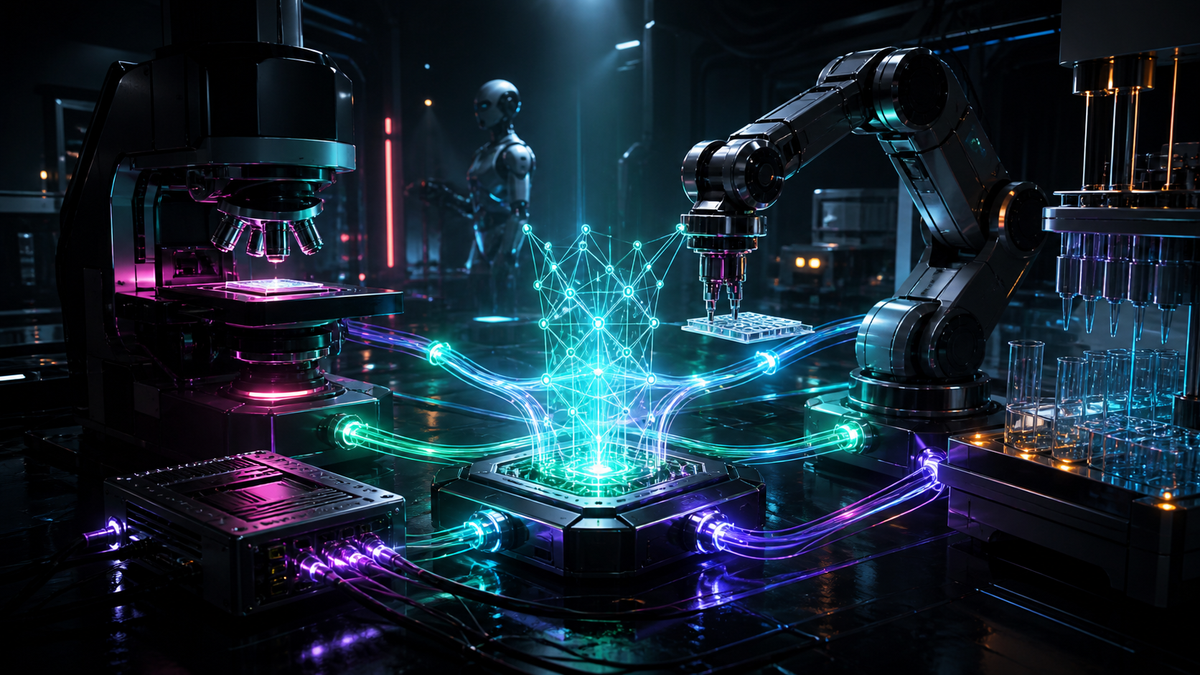
I opened the AI news and got an 11-minute cyberpunk trailer with footnotes.
Claude aligns lasers, moves robotic arms, steers microscopes, tracks live specimens and tunes an assay. In the same news cycle, Nvidia reportedly agreed to pay $12.9 billion for Hugging Face—the open-model hub Anthropic names in the rollout of its new hardware standard.
Bruh. At this point you do not read AI news. You dim the lights and bring popcorn.
The Anthropic video is not merely another robot demo. And the reported Nvidia deal is not merely another obscene AI valuation.
Together, they point to a broader convergence across the AI stack: model reasoning, agent harnesses, device interfaces, robotics libraries, model distribution, compute and chips are becoming more tightly connected.
The Model Just Got Hands
Until recently, most AI agents lived inside clean digital boxes. They could browse, call APIs, edit code and rearrange information. Even when they screwed up, the blast radius was usually another file, a malformed database record or a deeply confident email nobody should have sent.
Physical systems are less forgiving.
A microscope has calibration. A robot arm has momentum. A liquid handler can introduce bubbles. A laser can drift. A badly chosen action does not return a neat JSON error explaining that reality rejected your request.
Anthropic's answer is the Model Hardware Standard, or MHS: a shared, model-agnostic specification through which agents can operate programmable physical devices. It is currently a limited research preview, not an open-source release, and the more complex workflows remain proofs of concept.
Still, the direction is obvious.
MHS gives agents access through MCP, command-line tools and code APIs. If you followed MCP from pidgin into a real protocol layer, this is the next logical step. Once an instrument has an MHS driver, the agent does not need another model-specific integration. It can discover what the device is, inspect its state, understand its capabilities and issue constrained commands through a standard interface.
In Anthropic's examples, Claude is not simply chatting about laboratory work. It helps connect instruments, sequences operations across them, observes results, adjusts parameters and turns successful procedures into deterministic scripts.
That last part matters enormously.
The valuable outcome is not necessarily a frontier model improvising forever beside a laser. It is an agent exploring the problem, discovering a reliable procedure and compiling that knowledge into boring software that can run predictably.
The model crosses unknown territory. The script paves the road behind it.
The Boring Standard That Changes Everything
The flashy part is the robot arm. The strategically important part is the driver.
MHS drivers expose common read and write primitives, machine characteristics, discoverable state and capabilities, plus enforced safety limits. They can also include natural-language tags describing physical knowledge normally buried in manuals or living inside an experienced operator's head.
That combination gives an agent two distinct things: a vocabulary for acting and context for deciding.
This is the abstraction trick that repeatedly wins in computing. Operating systems made developers stop caring about the exact geometry of a hard drive. Web protocols separated applications from network plumbing. CUDA made Nvidia GPUs programmable enough to become an ecosystem rather than a box of expensive silicon.
A hardware standard for agents attacks the ugliest part of physical AI: integration.
Anthropic and its partners say some integrations that previously took weeks or months were completed in hours or minutes. That is pilot and vendor evidence, not a universal benchmark. Laboratories are wonderfully diverse collections of old instruments, proprietary software, improvised cables and machines controlled by a Windows PC nobody has rebooted since 2009.
But even a partial reduction in integration cost changes what becomes economically viable.
Once instruments share a common agent-facing layer, models can move across machines and workflows. A new capability can propagate through software instead of requiring another custom robotics project. Procedures can become more portable across compatible, driver-equipped systems. Failures can become reusable lessons when experts encode them. Hardware vendors gain access to agent ecosystems, while model developers gain access to the physical world.
Standards look dull because their power is invisible. They remove the friction that made everything else impossible.
Hands Before Common Sense
The experiments also show exactly why “the AI can use the machine” is not the same as “the AI understands the machine.”
In an Anthropic-reported Carnegie Mellon partner pilot, researchers integrated a three-instrument serial-dilution workflow in about eight hours, compared with the multiple weeks they said it would normally require. The system blocked six deliberately induced unsafe conditions before anything moved. It also rejected a poor first curve and reran the experiment with a better range.
That is a compelling result: fast integration, closed-loop evaluation and hard constraints working together.
In Anthropic's QuEra partner case study, an agent-development loop produced a deterministic laser-relock controller that later succeeded in 695 of 700 blind trials—99.3%. But the production artifact was deterministic code. They did not leave a frontier model continuously improvising in direct control of the laser.
That is not a footnote. It is probably the architecture.
Use models where ambiguity and adaptation matter. Use verified code where repeatability matters. Put safety enforcement underneath both.
In Anthropic's Genentech partner case study, bubbles supplied the reality check. They caused runtime errors in an experiment. Claude retried the same well, worsening the physical problem because it did not understand the underlying physics. Human experts had to explain what was happening, after which the lesson could be encoded into reusable skills.
AI has hands before it has common sense about foam.
A safe interface can prevent a robot arm from crossing a boundary or reject a prohibited command. It cannot manufacture an accurate mental model of every fluid, surface, vibration, obstruction and weird little physical failure.
Interface safety and model reasoning are separate layers. We need both.
Anthropic explicitly says MHS still requires expert oversight, only works with hardware that exposes a programmable interface and needs more safety evaluation. That caution is not legal garnish. In physical systems, “the model tried again” can be a debugging strategy, a ruined sample or an emergency stop.
Then Nvidia Reportedly Moved to Buy the Distribution Layer
While Anthropic was showing Claude reaching into laboratories, TechCrunch reported that The Information said Nvidia had agreed to acquire Hugging Face for $12.9 billion.
Business Insider, also cited by TechCrunch, reported that no agreement had been signed and that the talks could still collapse. Neither Nvidia nor Hugging Face has confirmed the acquisition.
So this is a reported, unconfirmed deal—not a completed one.
The reported numbers are wild enough to deserve careful wording. Hugging Face reportedly generates around $150 million in annualized revenue. A $12.9 billion price would therefore be roughly 86 times that figure. Its last public funding valuation was $4.5 billion in 2023, in a round Nvidia already joined.
Paying approximately 86 times reported annualized revenue for a model-sharing website would sound deranged.
But Hugging Face is not merely a website, and it stopped being merely a model repository years ago. It is a distribution and coordination layer spanning models, datasets, libraries, applications, inference, storage, compute and—now very explicitly—robotics.
Nvidia already dominates the scarce compute underneath modern AI. Hugging Face sits near the point where developers discover, compare, download, fine-tune, evaluate and deploy what runs on that compute.
That is why the strategic object is not just revenue. It is defaults.
If Nvidia eventually owns Hugging Face, that would not automatically mean it abuses the platform's neutrality. It would, however, change the incentives. Model rankings, hardware optimizations, hosted-compute defaults, telemetry and roadmap governance would all deserve more scrutiny.
Critical infrastructure becomes politically interesting the moment one powerful actor may own it. I made a similar argument when a Hugging Face agent breach turned the test environment itself into the target. The hub is not passive plumbing. It is part of the AI supply chain.
Hugging Face Is Already a Physical-AI Company
The factual overlap between these stories is concrete; what it means strategically remains interpretation.
Anthropic's MHS announcement names Hugging Face as an early adopter adding MHS support to LeRobot, its open robotics framework. Meanwhile, Nvidia and Hugging Face already collaborate across physical-AI models, datasets, simulation, evaluation and robotics workflows.
Their Isaac, GR00T and LeRobot work links Nvidia's simulation and robotics stack with Hugging Face's model and dataset ecosystem. The companies describe a combined reach spanning Nvidia's two million robotics developers and Hugging Face's more than 13 million AI builders.
Nvidia also launched Cosmos 3 on Hugging Face, positioning the open omni-model around physical-AI reasoning and action.
And Hugging Face's own 2026 open-model report makes the hardware strategy unusually explicit. AMD and Nvidia each published more than 200 new model repositories between January and July 2026. Open models help hardware vendors drive hardware adoption.
Of course they do.
A chip is more valuable when the popular model runs beautifully on it. A robotics platform is more valuable when developers can find compatible policies, datasets and evaluation tools in one place. A model hub is more valuable when it connects directly to the libraries, simulators and physical devices where models become useful.
MHS adds another bridge. LeRobot can become an agent-compatible robotics layer. Hugging Face can distribute the models and workflows. Nvidia can supply the simulation, runtime and silicon.
No coordination between Anthropic's announcement and the reported acquisition needs to be implied. The convergence is strategic, not conspiratorial. Different companies are independently discovering the same shape of the future.
The Cyberpunk Part
The cyberpunk turn is not one humanoid walking awkwardly across a stage.
It is the collapse of boundaries between layers that used to be separate.
Models reason. Harnesses give them tools. MHS gives those tools a common physical interface. LeRobot supplies robotics workflows. Hugging Face distributes models, data and software. Nvidia supplies simulation, compute and chips. Laboratories provide the instruments and the consequences.
This is roughly the direction I described in Decade Zero: AI escaping the chat window and becoming entangled with physical production, science and infrastructure. But the mechanism is arriving in a more mundane form than science fiction promised.
Not a chrome android kicking down the door.
A driver specification. A capability manifest. A safety boundary. A model repository. A deterministic script generated after an agent figures out the procedure. Possibly, if the reports become reality, a $12.9 billion acquisition of the distribution layer connecting much of it.
This does not mean every demo deserves belief. Vendor pilots are not deployment statistics. A successful assay does not solve general robotics. A constrained interface does not eliminate reasoning failures. A model that can move a pipette can still lose an argument with a bubble.
But that is precisely why the current news feels cinematic. Plot lines that looked separate—models, robots, laboratories, open source, chips and distribution—have suddenly entered the same scene.
The future arrives as a driver, a manifest and a safety limit. Then reports of a $12.9 billion acquisition put the hub in play. Only after that does the shiny robot walk onstage.