Decade Zero: A Realistic Blueprint for 2026–2035
A speculative scenario essay about AI, work and institutions over the next decade. Dates and future outcomes are assumptions, not calibrated predictions.
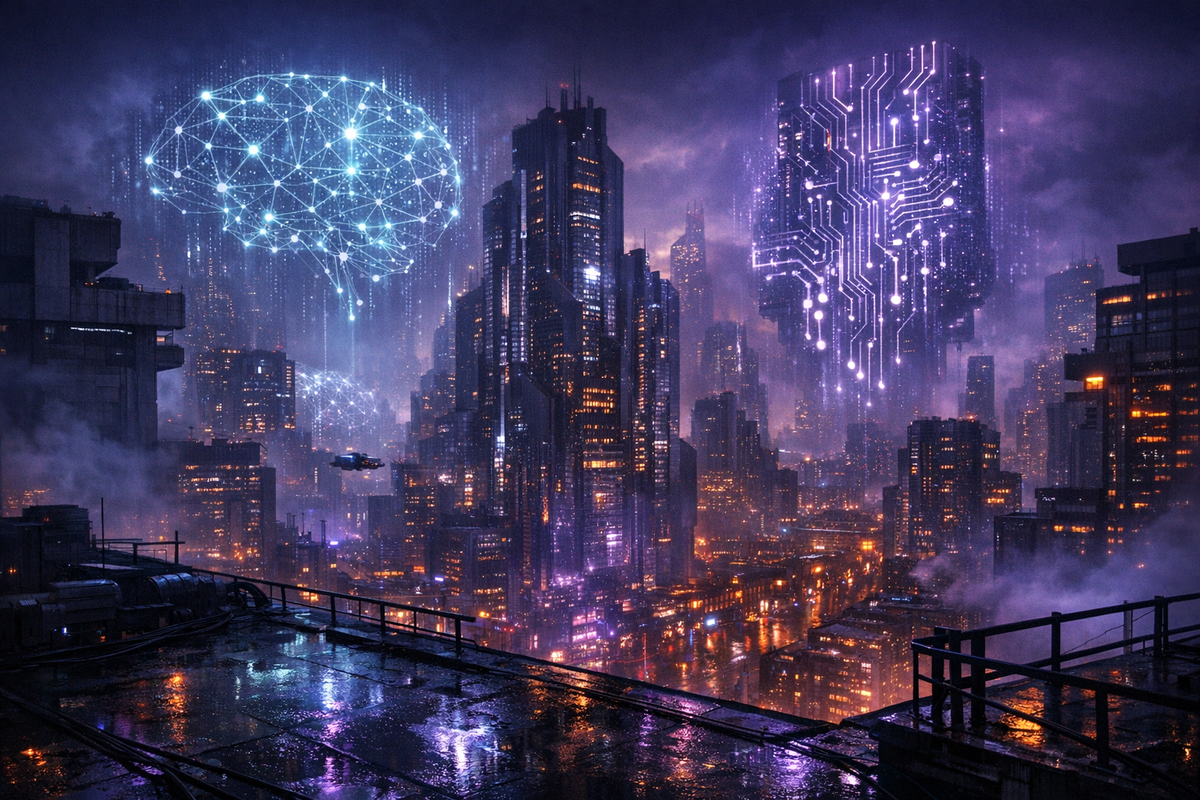
A scenario for the next decade: what could happen if AI capabilities and adoption advance quickly?
This is a speculative essay, not an academic forecast or a set of established future facts. Its year labels are narrative milestones. Outcomes depend on capability, deployment, economics, institutions and choices that remain uncertain.
The scenarios below explore uneven gains, displacement and adaptation. Precise future dates and quantities are assumptions for discussion, not measured results or predictions with calibrated probabilities.
Read this as a set of possibilities to test against new evidence. A useful scenario makes its assumptions visible and leaves room for slower progress, setbacks and different policy choices.
Scenario: 2026 — Year Zero: The Last Normal Year
The scenario begins with capabilities already available in AI tools, while treating their reliability and wider adoption as open questions.
AI tools can assist software development, large-context analysis and media generation. Practical reliability depends on the task, evidence available and workflow. A larger context window or a convincing generated image does not by itself establish dependable end-to-end performance.
The scenario focuses on a shift from answering questions to taking actions through tools. Coding agents can edit files and run tests; assistants can help with other workflows when suitable tools and permissions are available. How far supervision can replace direct operation remains task-dependent.
McKinsey’s 2023 US analysis estimated that activities accounting for up to 30% of hours then worked could be automated by 2030, with generative AI accelerating that adoption scenario. This concerns activities and hours, not a claim that current models can replace 30% of jobs immediately.
Synthetic media can complicate authentication and election reporting. Detection reliability varies, making provenance and independent corroboration important. This essay does not establish that one election year was the first to use synthetic media at scale.
A signal to watch is how entry-level knowledge work changes: which tasks are automated, which are augmented, and which training opportunities disappear. The extent of substitution will vary by job and organization.
Scenario: 2027 — The Acceleration
This is the year the exponential curve becomes visible to civilians.
Models achieve expert-level reasoning in law, medicine, finance, and engineering. Not "as good as a junior" — as good as a specialist with a decade of experience. The benchmarks stop mattering because the models are routinely beating the humans who wrote the benchmarks. Multimodal AI becomes the default. Systems see, hear, read, and reason across all modalities simultaneously. Your AI assistant watches your screen, understands your context, anticipates your needs, and acts before you ask.
The Labor Market Shifts
- In this scenario, some organizations reduce staffing as task automation expands; the size and timing remain uncertain.
- Creative work could divide between standardized production and work valued for distinctive human judgment.
- New roles could emerge, but their number and accessibility relative to displaced work are uncertain.
Education's reckoning: AI tutors that adapt to individual learning styles outperform classroom instruction in standardized assessments. The first wave of "AI-native schools" launches. Traditional universities face an existential question: what are you selling when knowledge is free and personalized?
Autonomous vehicles: Self-driving reaches Level 4 reliability in major US and Chinese cities. Waymo, Tesla, and Baidu operate large fleets. The trucking industry sees its first significant displacement. Ride-sharing transitions to mixed human/autonomous fleets.
Regulation: The EU AI Act is enforced but already outdated. The US still operates on executive orders and industry self-regulation. China sprints ahead with state-directed deployment. The regulatory gap between regions creates AI arbitrage opportunities and a fragmented global landscape.
Scenario: 2028 — The Great Displacement
This is the year the economic consequences become undeniable.
In this scenario, more tasks within jobs are automated, which changes hiring and work allocation. The magnitude is an assumption here; it is not a future estimate already issued by a consulting firm.
The Bifurcation Begins
- AI-amplified workers: Those who adapted early earn 2–3x their previous productivity. They are invaluable and well-compensated.
- AI-displaced workers: Those in automated-away roles face a retraining gap measured in years, not months. Government programs are overwhelmed and underfunded.
The creator economy inverts. When everyone has access to professional-grade tools for writing, design, video, and music, the bottleneck shifts from production to curation and taste. Algorithms surface content. Humans crave authenticity. The paradox: AI makes creation easy and makes standing out impossibly hard.
One possibility is that AI improves parts of drug discovery and clinical decision support. Candidate generation, clinical validation and regulatory approval are different stages; this scenario assigns no proven trial-success multiplier or guaranteed treatment outcome.
Growing demand for compute could intensify energy and infrastructure constraints. The scale depends on efficiency, deployment and electricity supply; no future electricity share is established by this essay.
Governments might experiment with income support or transition assistance as work changes. The countries, dates, scale and outcomes are open questions, not announced future programs.
Scenario: 2029 — The Cognitive Frontier
This is the year the conversation shifts from "what can AI do?" to "what should AI do?"
AGI claims: At least two major labs claim to have achieved Artificial General Intelligence. The AI research community is split on whether these claims are legitimate. The public does not understand the debate but senses its gravity. What is undeniable: AI systems can now learn new domains from minimal instruction, reason across disciplines, and improve their own performance without human intervention.
Brain-computer interfaces could develop further through research and clinical trials. Wider availability would depend on evidence, regulatory decisions, usability and long-term safety; consumer adoption and a particular typing speed are not assumed facts.
Synthetic biology meets AI: Machine learning designs novel proteins, materials, and organisms. The first AI-designed carbon capture organism is deployed at scale. The same technology that cures diseases can, in theory, engineer pathogens. Biosecurity becomes the new cybersecurity.
The authenticity crisis peaks. You cannot trust any digital media by default. Governments mandate cryptographic provenance for official communications. News organizations adopt blockchain-based verification. Ordinary people live in a fog of uncertainty about what is real. The psychological toll is immense and measurable.
Work Transformation
- The four-day work week becomes standard in knowledge economies — not from activism, but from productivity gains making five days unnecessary.
- "Human-verified" becomes a premium label on services: legal advice, therapy, art, education.
- The gig economy explodes as companies prefer AI plus human contractors over full-time employees.
Scenario: 2030 — The Midpoint: The Decade's Hinge
Welcome to the 2030s. Half the decade is gone. The world is unrecognizable to someone from 2020, but still navigable for someone from 2026. That gap says everything about the rate of change.
The Economic Landscape
- Productivity could grow while its gains remain unevenly distributed.
- Established professions could change substantially, with uncertain effects on employment and service quality.
- New services around governance, verification and human interaction might develop.
The Geopolitical Map Redraws
- The US and China are locked in an AI cold war. Compute access is the new oil. Export controls on advanced chips define alliances.
- Small nations that bet early on AI infrastructure — UAE, Singapore, Estonia — punch far above their weight.
- The EU remains the regulatory superpower but lags in deployment. The "Brussels Effect" on AI governance is real but slow.
Education is unrecognizable. AI tutors have proven superior to traditional instruction for knowledge transfer. Human teachers are revalued as mentors, socializers, and emotional supports. Universities pivot from information delivery to experience curation — labs, collaborations, networks, identity formation. Degrees matter less. Portfolios and demonstrated capability matter more.
The mental health reckoning: Rates of anxiety, depression, and existential distress are at all-time highs. The speed of change has outpaced human adaptation. AI therapy tools help, paradoxically — they are available 24/7, never judge, and never tire. But the deeper question remains: what is my purpose in a world that does not need my labor?
Biomedical research may benefit from AI, but this scenario does not establish an anti-aging treatment or a quantified lifespan benefit. Access and evidence would remain central questions if effective interventions emerged.
Scenario: 2031 — The Infrastructure Revolution
The physical world begins to catch up with the digital one.
Smart cities materialize. Urban infrastructure — traffic, energy, water, waste, emergency response — is AI-managed in major metropolitan areas. City-level digital twins simulate the impact of every policy decision before implementation. Urban life becomes measurably safer, cleaner, and more efficient. Also more surveilled.
More logistics tasks could become automated. Deployment costs, reliability, infrastructure and local working conditions will determine whether that lowers total costs and how the effects are distributed.
Energy transformation: Fusion power produces its first commercial electricity — small scale, but proven. AI-optimized solar and wind installations reach price points that make fossil fuels economically irrational in most markets. The energy transition accelerates, driven not by climate activism but by cold economics.
The surveillance question: In exchange for efficiency, safety, and convenience, citizens have surrendered nearly all expectation of anonymity in public spaces. Facial recognition, behavior prediction, and social scoring operate in various forms across most advanced economies. The Orwellian nightmare is not a totalitarian state — it is a thousand convenient services that each take a small piece of your privacy.
Generative architecture: AI-designed buildings optimize for energy efficiency, natural light, community interaction, and construction cost simultaneously. Generative architecture produces designs no human would conceive — and many of them are better. The construction industry, one of the last holdouts against automation, begins its transformation.
Scenario: 2032 — The Biological Frontier
AI does not just understand biology — it engineers it.
Precision medicine becomes the default. Your genome, microbiome, proteome, and lifestyle data feed an AI model that generates a personalized health plan. Disease prediction is accurate enough to be actionable: you know your risk of cancer, heart disease, or neurodegeneration decades in advance. Prevention replaces treatment as the primary healthcare paradigm.
AI-designed organisms: Engineered bacteria that eat plastic waste, produce biofuels, or sequester carbon are deployed at industrial scale. Synthetic biology is a trillion-dollar industry. The biosafety frameworks struggle to keep pace with the speed of innovation.
The materials revolution: AI discovers new materials — superconductors, batteries, structural composites — at a rate that would have taken centuries through traditional experimentation. The physical limitations of the 20th century begin to dissolve. Energy storage, computing hardware, and construction materials all leap forward simultaneously.
The Labor Market Reaches a New Equilibrium
- Some current jobs could change substantially rather than disappear outright.
- Employment outcomes would depend on demand, new tasks and policy as well as automation.
- Care, connection, creativity and community work could become more prominent.
- Income support, employment and independent projects could be combined in different ways.
- Career paths could become less linear, with substantial variation between people and places.
The philosophical question: If AI can write, paint, compose, diagnose, design, analyze, and build — what is uniquely human? The answer, increasingly, is: the desire to do these things. Purpose, meaning, connection, experience. The economy of the 2030s is slowly becoming an economy of meaning.
Scenario: 2033 — The Power Question
Who controls AI controls everything. This year, that question becomes unavoidable.
Corporate concentration: Three to five companies control the foundational AI models that the world runs on. Their power exceeds that of most nation-states. They set the rules for what AI can and cannot do, what it will and will not say, who gets access and who does not. The antitrust frameworks of the 20th century are wholly inadequate.
The open-source counterweight: A vibrant open-source AI ecosystem provides alternatives, but the compute required for frontier models is so enormous that only state-level actors or megacorporations can train them. Open-source thrives in applications and fine-tuning but struggles at the frontier.
AI in warfare: Autonomous weapons systems are deployed by major militaries. The ethical frameworks are debated endlessly in Geneva while the technology is deployed on battlefields. Drone swarms, AI-guided cyber operations, and autonomous decision-making in conflict zones are no longer theoretical.
Virtual economies rival physical ones. Digital worlds, powered by AI-generated content that is infinite and adaptive, command billions of hours of human attention. Virtual real estate, goods, and services constitute a meaningful share of economic activity. The question "is this real?" becomes philosophically moot — the economic effects are real regardless.
The trust infrastructure: After years of deepfake chaos, new systems emerge. Cryptographic identity verification is standard. AI-powered fact-checking operates at scale. But the damage to institutional trust is deep and may take a generation to repair. People retreating into information silos and tribal epistemologies is the norm, not the exception.
Scenario: 2034 — The Integration
The shock fades. A new normal crystallizes.
Human-AI collaboration is ambient. It is no longer remarkable. AI is woven into every tool, every surface, every decision. You do not "use AI" any more than you "use electricity." It is infrastructure. The generation entering adulthood has never known anything else.
A creative renaissance. Freed from the mechanical labor of production, a wave of human creativity emerges. Not despite AI — because of it. Musicians use AI to hear the sounds in their head. Writers use AI to explore narrative spaces they could not navigate alone. Scientists use AI to test hypotheses at the speed of thought. The output is extraordinary. The debate about whether it is "real" creativity continues and increasingly seems beside the point.
The post-work experiments. Several countries have moved beyond UBI to comprehensive "citizen dividend" programs funded by taxes on AI-generated productivity. Work is increasingly voluntary — something people do for meaning, status, and connection rather than survival. The results are mixed: some communities flourish with newfound freedom; others struggle with purposelessness and social decay.
Extended reality. AR glasses have replaced smartphones as the primary computing interface. The physical and digital worlds are seamlessly blended. Navigation, translation, information overlay, social connection — all happen through your visual field. You are never truly alone, never truly lost, never without context. Whether this is liberation or captivity depends on your perspective.
The geopolitical new order. AI capability, not military power or GDP alone, determines geopolitical influence. Technology alliances replace traditional ones. The "silicon curtain" between US-aligned and China-aligned tech ecosystems is nearly impermeable. The rest of the world navigates between them, choosing sides or building alternatives.
Scenario: 2035 — The Horizon
Ten years from where we started. A lifetime in AI years. An eyeblink in human ones.
What we got right: AI did transform everything. Work, creativity, health, cities, relationships, war, governance — nothing was untouched. The productivity gains were real. The scientific breakthroughs were extraordinary. Diseases that seemed intractable in 2026 are now manageable. The energy transition is happening. Human knowledge, accessible and personalized, is closer to universal than at any point in history.
What we got wrong: The transition was harder, more painful, and more unequal than the optimists promised. Millions of people experienced genuine economic suffering during the displacement years. Mental health deteriorated before it improved. Democracy, already strained, buckled under the pressure of synthetic media, algorithmic manipulation, and the concentration of unprecedented power in a handful of institutions. We are not in utopia.
What surprised us: The resilience of human desire for connection, meaning, and authentic experience. The way communities formed around shared purpose when traditional employment dissolved. The creative explosion that the pessimists said AI would prevent. The fact that the species, when confronted with its own obsolescence as a productive unit, began — slowly, unevenly, but unmistakably — to redefine what productivity means.
The Choice
We stand at 2035 with more power than any generation in human history. AI gives us the ability to solve problems that have plagued civilization since its inception — disease, scarcity, ignorance, environmental destruction. It also gives us the ability to surveil, manipulate, control, and destroy at scales previously unimaginable.
The technology does not choose. We do.
The next decade — 2036 to 2045 — will be determined not by what AI can do, but by what we decide it should do, who gets to decide, and whether the institutions we build are wise enough to match the tools we have created.
The Three Scenarios
An optimistic path: useful scientific progress, broadly shared productivity gains and institutions that help people adapt. This is a scenario, not an assigned statistical probability.
An adverse path: concentrated power, displacement without adequate support, intrusive surveillance and conflict over resources. This is also a scenario, not an assigned statistical probability.
An uneven path: gains and losses coexist across countries, organizations and communities. I consider that a useful planning scenario, but the judgment is subjective and not a calibrated forecast.
This is the path we are on. Not the one we choose in a single dramatic moment, but the one we stumble along through a million small decisions — to invest or hoard, to include or exclude, to regulate or abdicate, to prepare or deny.
The decade is zero. The clock is running. The blueprint is in your hands.
Reference: McKinsey: Generative AI and the future of work in America (2023) (documentation checked 20 September 2026).