The Popcorn Is Still Warm 🍿
Anthropic’s full MHS launch reveals a coalition across labs, robots, cameras and boards—with an open-source release planned after the private research preview.
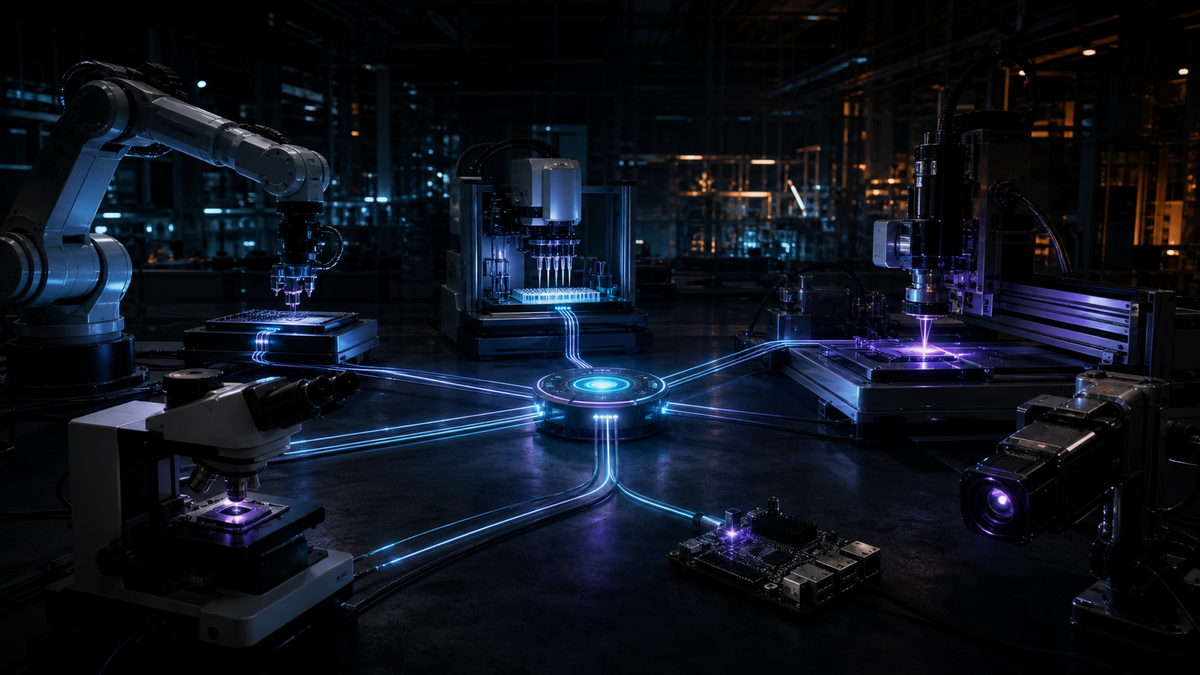
Yesterday I wrote that AI news had become cinema. Anthropic had put Claude in front of microscopes, robot arms, liquid handlers and precision lasers, then released an 11-minute film that looked like a cyberpunk trailer with citations.
Then I read Anthropic’s complete seven-post launch thread, the full technical announcement and the partner reports behind it.
The facts did not reverse. The scale of the move became clearer.
The robot is the spectacle. The interface is the strategic move.
That is my interpretation, not Anthropic’s stated intent. But the staged rollout, the partner selection and the delayed open-source plan all point toward the same layer: an agent-facing control plane for programmable physical hardware.
Source: Anthropic’s MHS launch thread.
The launch thread complements the longer origin film with the rollout details. This article links the source and focuses on the interface, partner evidence and safety boundaries.
Yesterday Was the Demo. Today Is the Rollout.
Anthropic says the first phase of the MHS research preview has begun. Access is limited through a private preview. Laboratory and manufacturing equipment are the opening territory; boards and cameras are explicitly named as the next expansion.
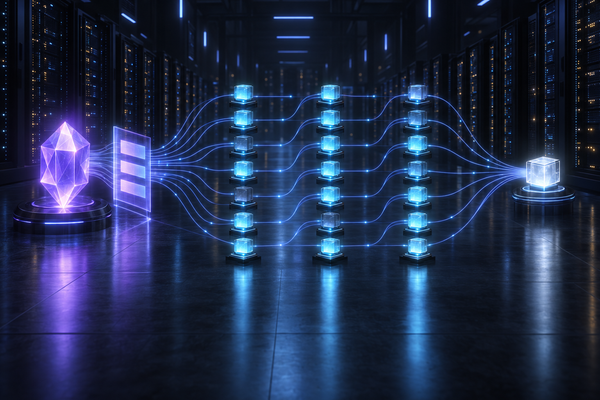
That is a much bigger ambition than one model controlling one microscope. It is an attempt to make different machines discoverable through one interface, expose their capabilities and limits in a consistent form, and let agent harnesses coordinate them without rebuilding every integration from zero.
Anthropic reports that integrations which previously took days or weeks can fall to hours or minutes. That is launch-partner evidence, not a universal benchmark, and it may not generalize to legacy equipment with proprietary software, unsupported interfaces or site-specific constraints.
The sequencing is still smart.
The rollout starts in measurable environments with experts nearby. Anthropic plans to expand from laboratory and manufacturing equipment to boards and cameras, while the private preview informs a physical-safety roadmap ahead of a later open-source release.
The public MHS site currently offers an application form and the announcement; Anthropic has not yet open-sourced MHS. The company says the preview will inform a physical-safety roadmap ahead of a later open-source release.
So today MHS is a private research preview aiming to become a standard. That distinction is not weakness. It is the honest state of the thing.
This Is Already a Coalition
The partner list is where the announcement stops looking like another laboratory pilot.
AWS is preparing a private preview of Strands Robots. Hugging Face is adding MHS support to LeRobot. Raspberry Pi is expanding integration across products after successful Camera MHS Driver tests. Together, those three connect MHS with cloud agents, open robotics and edge hardware.
Then comes the institutional hardware. Automata is adding MHS to LINQ for intelligent error handling. Danaher is exploring smart instruments and autonomous laboratories. MBF Bioscience is building a driver for ScanImage. QIAGEN has a QIAsymphony Connect proof of concept. Tecan is adding support to Fluent liquid handlers.
Doosan Robotics is testing quality-assurance and multi-robot workflows. Universal Robots had early access and plans platform support.
That spans agent tooling, cameras, microscopy, liquid handling, scientific instruments and industrial arms. A traditional integration project sees separate markets and separate middleware. MHS wants an agent to see a more coherent command surface.
The list is not proof of broad adoption. It shows the breadth of Anthropic’s initial coalition; adoption beyond that group remains unproven.
Tetsuwan Shows the Orchestration Layer
Tetsuwan’s partner account is the cleanest demonstration of MHS replacing operational plumbing rather than decorating it.
Its ResearchOS platform replaced the scheduler and driver stack with MHS commands. Where manufacturers had no native support, each instrument received a small connector. The result was not one robot obeying Claude. It was a mixed fleet becoming legible to the same orchestration layer.
During a qPCR workflow, a camera detected bubbles in a liquid transfer. The system identified a connected centrifuge as a possible recovery tool, proposed the procedure through Slack and continued after human authorization. A person still performed the physical plate transfer.
That is the credible pattern: detect, discover, propose, authorize, execute.
The same setup ran a closed-loop compiler study across 9,143 dispenses, 300 transfer types and 1,508 measured conditions. On held-out experiments, Tetsuwan reports that its refined model predicted multi-dispense precision about 12% more accurately than the manufacturer’s technical specification, beating it in 31 of 45 runs. The improvement reached roughly 17% on its most-replicated data.
Those figures do not establish a universal improvement over manufacturer specifications, and they do not compare MHS with vendor software as a whole. They do show why a common interface matters: interoperability becomes measurable when commands, observations, failures and corrections can feed the same loop across machines.
QuEra Shows a Useful Runtime Boundary
QuEra’s technical report adds the distinction most glossy AI-hardware demos blur.
Claude developed and tested control logic on a live rig containing roughly $700,000 of precision hardware, inside human-set safety bounds. But the deployed laser-relock controller is deterministic code. AI is out of the runtime loop.
The tuning workflow still keeps AI in the loop because search and adaptation are the point. The production recovery path does not, because repeatability is the point.
AI upstream. Determinism downstream. That distinction is the clearest architectural lesson in QuEra’s report.
Beyond the 695-of-700 controlled trials I covered yesterday, QuEra reports 43 recoveries from 43 naturally occurring mode hops. Its tuning campaign ran roughly 12,500 evaluations without causing a mode hop, reduced residual frequency noise fivefold and produced zero drops during an approximately 19-hour soak, compared with 1.6 per hour before. It also reports suppressing a hidden resonance by roughly 1,000 times.
These remain company-reported results from specialized equipment, not independent benchmarks. But the design pattern travels: let models explore the unknown, let experts define the territory, then compile successful behavior into inspectable software wherever the task allows. Keep the emergency brake below both.
The Safety Story Is the Product Story
Anthropic says current language models still lack physical intuition. Expert oversight remains necessary. MHS currently supports programmable hardware only, and each device needs a compatible driver.
Those are not footnotes. They define the boundary of the product.
A standard can describe what a centrifuge accepts and expose declared limits; implementations still have to enforce them. It cannot give a model the accumulated judgment of someone who hears one strange vibration and knows the run is wrong. Interface safety and physical understanding are different layers.
The private specification creates another open question. Outsiders cannot yet inspect capability negotiation, permission models, versioning, auditability, failure semantics or conformance rules. A coalition becomes an open standard only when people beyond the sponsor can implement it, test it and influence its evolution.
The next proof should therefore be less cinematic: a public spec, independent evaluations, hostile failure conditions, conformance tests and hardware nobody selected for launch day.
Boring evidence is how the trailer becomes infrastructure.
The Interface Is the Strategic Layer
If MHS succeeds, the valuable position is not inside any individual robot. It is the layer above hardware vendors and below agent harnesses—the place where capabilities are described, permissions are applied, commands are issued and machine state returns in a form models can use.
The manufacturer still owns the motors, tolerances and physical safety systems. The driver still translates into whatever dialect the device actually speaks. But the standard can own the grammar through which agents perceive all of them.
My read—interpretation rather than confirmed strategy—is that Anthropic wants MHS to become a shared interface before physical AI fragments across incompatible vendor ecosystems. The rollout makes sense in that frame: controlled laboratories first, industrial machines beside them, boards and cameras next, and open source after the private preview.
The future may still contain humanoid robots walking dramatically through warehouses. But the infrastructure arrives earlier and dressed worse: drivers, manifests, capability limits, conformance tests and one shared interface everybody reluctantly agrees to use.
The popcorn is still warm. The sequel is a contest over the interface.
The Architecture Behind the Rollout
Yesterday’s article covers how MHS works and its links to Hugging Face, LeRobot and Nvidia’s physical-AI stack. This follow-up focuses on the rollout, partner coalition and strategic position of the interface.