Baseline Drawn: One Clean Night, Blood on the Table
The prep week ran. One clean night rewrote my Oura numbers. Nine tubes of blood later, the baseline is locked. Results land in three waves over the next two weeks.
In Choosing a Biohacking Clinic in Medellín, I picked TRT Colombia, scheduled the draw a week out, and committed to a clean prep week so the baseline would reflect physiology, not noise. The nurse came this morning. Nine tubes later, the baseline is locked. And something unexpected showed up before the needle even touched my arm.
The Reset Week
I cut Cuban cigars. I cut the late-night supplement stack I was taking before bed. I cut afternoon naps. I cut late meals — nothing after 18:00. I cut caffeine past 14:00. And I cut a few other things too, the kind of things that quietly keep your autonomic nervous system pinned in fight-or-flight without you noticing.
The point was not performance. The point was a clean baseline. If the labs come back from a suppressed system, every future panel will look like "improvement" that's really just the noise floor lifting. That's not data, that's vanity tracking. The goal was to let my body run without the daily suppressants for long enough that the baseline reflects the engine itself, not the sludge in the fuel line.
I also had an Oura Ring 4 on my finger the whole time. And that ring caught something I didn't expect.
One Clean Night, Measurable Overnight
The night before the draw was my first fully clean night in a long time. Thirty hours off cigars. Thirty hours off the PM stack. No afternoon nap. Bed at 21:02 — the earliest in weeks. Fasting into the draw.
Here's what one clean night did to the numbers, measured by the same ring on the same finger as the night before:
| Metric | Night before (aftermath) | One clean night | Δ |
|---|---|---|---|
| HRV (rMSSD) | 23 ms | 58 ms | +152% |
| Average sleeping heart rate | 75.5 bpm | 65.5 bpm | −10 bpm |
| Lowest heart rate | 64 bpm | 56 bpm | sub-60 first time |
| Breathing Disturbance Index | 9/hr | 3/hr | below apnea threshold |
| Breath rate | 16.6 /min | 14.5 /min | into normal range |
| Deep sleep | 45 min | 57 min | +12 min (three nights climbing) |
| REM | 49 min | 84 min | +70% |
| Cardiovascular age | 42 | 40 | 4 years younger than chrono |
HRV doubled. Sleep heart rate dropped ten beats per minute. Lowest heart rate went sub-60 for the first time since I put the ring on. The Breathing Disturbance Index — which had been flashing in mild-apnea territory — collapsed to 3, well below the screening threshold. Breath rate settled into the normal range. Deep sleep kept climbing the trajectory it had been on for three nights (22 min → 45 min → 57 min). REM jumped 70%. And Oura's cardiovascular-age estimate dropped to 40, four years younger than my actual age.
None of this is a miracle. It's textbook. When you spend years layering stimulants, depressants, and late-night eating on top of chronic stress, the autonomic system stops idling. It sits in sympathetic — heart rate elevated, HRV crushed, breathing shallow and irregular, sleep architecture fragmented — because the body never gets a clean signal that it's safe to stand down. Remove the suppressants for one full cycle and the parasympathetic tone that was always there, waiting underneath, shows up overnight. Not in a week. Not in a month. In one night.
My body wasn't broken. It was suppressed. That is a very different problem to have, and the solution is much cheaper than I feared.
The Honest Cost
If I only showed you the table above, I'd be selling you a miracle. The full picture is more interesting. The same clean night also delivered this:
| Metric | Night before | One clean night | Δ |
|---|---|---|---|
| Sleep latency | 27 min | 75 min | +48 min |
| Time awake in session | 66 min | 150 min | +84 min |
| Sleep efficiency | 83% | 72% | −11 points |
Falling asleep took 75 minutes. I spent two and a half hours awake inside the sleep session. Sleep efficiency dropped from 83% to 72%. Oura's sleep score printed 63 — the lowest of the week — because the algorithm weights efficiency and latency heavily and cannot distinguish "fragmented from a clean-behavior rebound" from "fragmented because you had a terrible night."
That fragmentation is not a bug. That is a withdrawal signature. Cut what you've been leaning on, and the brain spends the first few nights rebuilding sleep onset from scratch. The research on quitting nicotine and the kinds of supplements that tune brain chemistry is consistent: sleep-onset metrics get worse before they get better, and they unwind in three to seven nights as the neurochemistry resets. The autonomic and cardiovascular wins show up almost instantly because they live in a different layer of the physiology. The sleep-architecture wins take longer because your brain has to relearn how to drop into unconsciousness without a chemical cue.
This is what honest data looks like. Autonomic physiology: breakthrough. Sleep architecture: temporary tax. Both are expected. Both are evidence the reset is actually doing something, not a vibe.
Blood Draw Day
The nurse was scheduled for 06:30. The nurse arrived at 06:45. I was just under thirteen hours fasted by the time she set up the kit on my kitchen counter. Protocol held: no coffee, no food, no supplements since Saturday, no lifting in the last 24 hours, small sips of water until 04:00 and nothing after. She pulled the full TRT Colombia panel — nine tubes — and then ran an electrocardiogram right there at the house. Mobile lab, wearing its work.
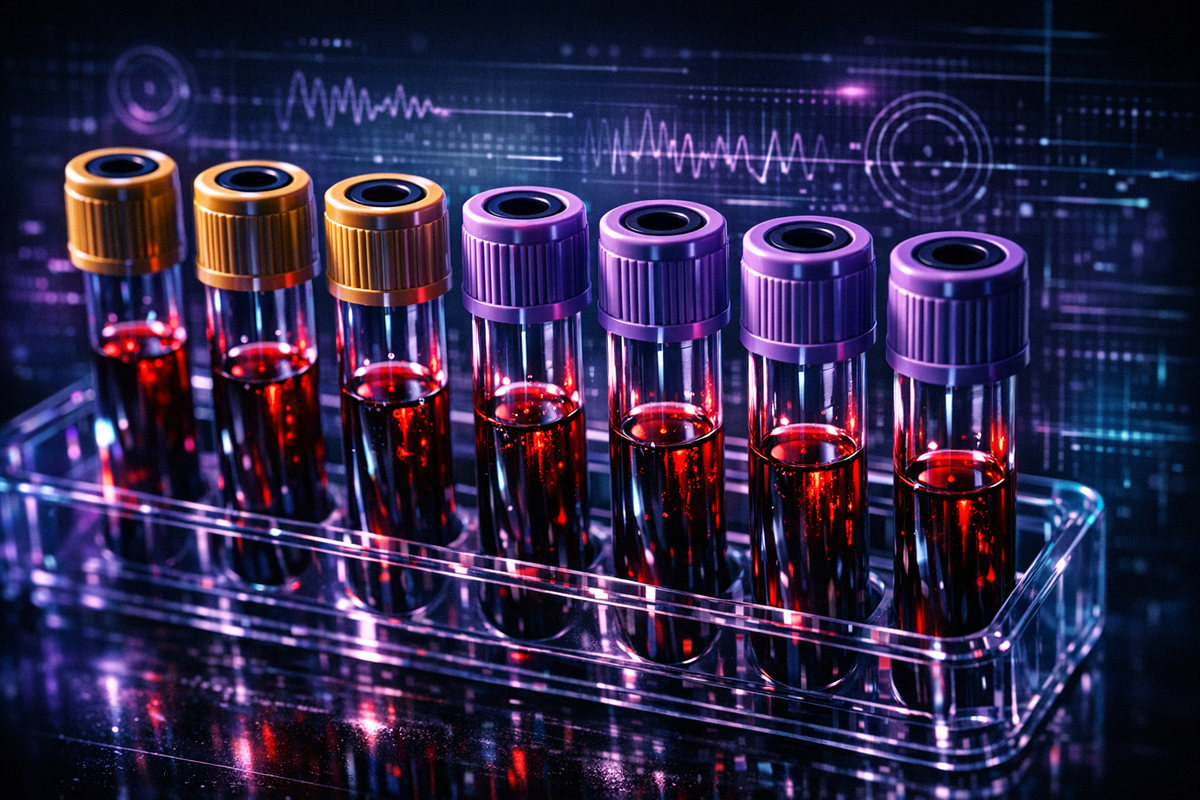
Here is the thing nobody warns you about the first comprehensive draw: it is a lot of blood. Six yellow-cap serum tubes. Three lavender-cap whole-blood tubes. Roughly 40 milliliters — about two and a half tablespoons — pulled in a single sitting. If you have never seen this many tubes lined up on a tray with your name on them, it is mildly unsettling.
For context: a healthy blood donation is 450 milliliters. The clinic took about 9% of a donor bag. They were not greedy Draculas. They were precision Draculas. Every tube buys you a specific answer: the yellow ones spin down into serum for hormones, thyroid, lipids, liver, metabolic, vitamin D, inflammation. The lavender ones stay whole blood for the complete blood count and HbA1c. Nothing wasted, nothing over-drawn. If you're going to let someone at your veins, let them be efficient about it.
What's in the Tubes
The same 27-marker panel I laid out in the previous post, plus the on-site ECG. This is the full set:
| Category | Markers drawn |
|---|---|
| Hematology | CBC, Hematocrit, Hemoglobin |
| Hormones | Total & Free Testosterone, Ultrasensitive Estradiol (E2), LH, FSH, Prolactin, DHEA-S, Cortisol (AM), IGF-1, SHBG |
| Liver | AST, ALT |
| Prostate | PSA |
| Iron | Ferritin, Serum Iron, Transferrin Saturation |
| Metabolic | Fasting Glucose, Fasting Insulin, HOMA-IR, HbA1c, Lipid Profile |
| Kidney | Creatinine |
| Inflammation | hs-CRP, Homocysteine |
| Thyroid | TSH, Free T3, Free T4 |
| Vitamins | Vitamin D (25-OH) |
| Cardiac | Electrocardiogram (ECG, on-site) |
One morning. One nurse. One kitchen counter. Everything a traditional hospital would spread across three departments and two weeks of appointments, compressed into about 25 minutes.
Results, Then the Doctor
The clinic told me all results should land within one to four days — simpler than the three-wave framing I walked in with. Once everything is in, TRT Colombia schedules a consultation with the doctor to read the numbers and propose the protocol.
That is the right way to run it. Lab values are not a self-service oracle. A single low number without context is almost useless; the same number read against the cascade above and below it tells a completely different story. Total testosterone in isolation is noise. Total T plus free T plus SHBG plus LH plus FSH plus prolactin plus estradiol plus cortisol is a diagnostic. The doctor integrates the picture. I integrate the framing.
My own read runs in parallel as each batch arrives — what the ratios say, what lever each marker maps to, what I would ask about. Not to override the clinician. To walk into the consult with informed priors rather than defer the entire interpretation.
Nothing gets prescribed until all three are in and read together. This is the right sequence. I refuse to pre-commit to an intervention — TRT dose, a GLP-1 conversation, peptides, anything — before a single number is in. One clean baseline, then one decision at a time.
Now: The Restart
The needle came out. The prep phase is over. The trend-tracking phase just started.
First thing on the other side of the fast: a proper breakfast and a large black coffee. Hard-earned. The clean prep week was not a monastic vow — it was a protocol, and the protocol said "break the fast after the draw, not before." So I broke it, gratefully.
The rest of the day rebuilds the baseline the prep week was aiming at. Gym returns — resistance training on a cycle, Zone 2 cardio on the other days. Water stays at five liters. Caffeine cutoff at 14:00 holds. Bedtime 22:30 or earlier. No more suppressants at night. The Oura ring keeps counting. The sleep-onset tax from the clean-night rebound should unwind over the next week as the physiology stabilizes.
And keto starts today. Real day one. I checked the breath acetone meter this morning after a fourteen-hour fast: 0.1 PPM. The floor for nutritional ketosis is 2 PPM. In other words: not even close. That is the baseline — a body still happily burning liver glycogen, completely unadapted, honest about where it starts. First measurable ketone reading should land somewhere in the next three to seven nights as the switch flips. The meter will tell the story.
In eight to twelve weeks I redraw. Same clinic, same tubes, same nurse. Same me, measurably different. That's the plan.
The baseline is drawn. Nine tubes, one ECG, one unexpectedly dramatic sleep night on the way into the needle. A clinic that showed up at my kitchen counter. A ring that caught a physiological pivot in real time.
Next post: the numbers.
Related Reading
- Choosing a Biohacking Clinic in Medellín
- The Biohacking Litmus Test
- Why I Chose the Oura Ring 4 for Biohacking
- What Is Biohacking?
- Final NAD+ Adjustment
- Three Days of Nothing