
Fable 5: Mythos on a Leash
Fable 5 exposed Mythos-class capability with additional safeguards. Understand retention, opt-in API fallback, model routing and the difference between launch terms and current access.

Fable 5 exposed Mythos-class capability with additional safeguards. Understand retention, opt-in API fallback, model routing and the difference between launch terms and current access.

Opus 4.8 made reliability and self-reporting part of the launch story. How to evaluate those claims alongside workflow orchestration, latency and cost.

A review comment can suggest work without authorizing it. How to distinguish scope errors from prompt injection and enforce an agent’s action boundary.
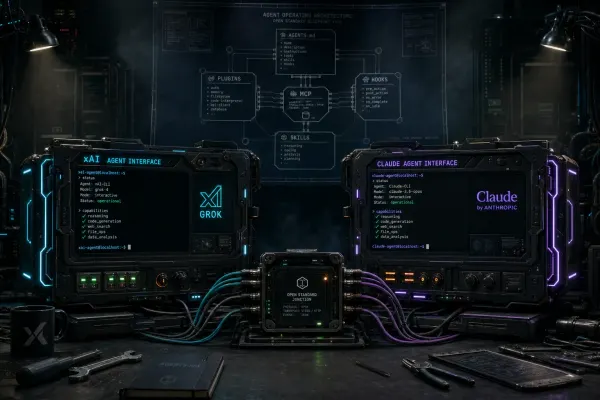
Evaluate Grok Build through model quality, native configuration, planning limits and parallel-task coordination. Shared file discovery does not prove identical behavior.

Use Codex remotely from a paired mobile device. Host-level access uses the selected environment’s tools and permissions; isolation depends on configuration.

Claude for Legal combines plugins, connectors and managed workflows. The engineering questions are source authority, enforced access, verification and professional review.

Sinapt’s proposed retrieval and API architecture before its PoC: authorization boundaries, derived-content permissions, MCP and REST choices, and QMD as an evaluation baseline.

AI agents change the build-versus-buy calculation for software workflows. The opportunity is customization; the hard part is owning the system after the demo.

Context, memory, tools, evaluation and independent verification shape agent quality alongside model capability. A practical framework and 90-day improvement plan.

Before MCP, every AI integration was its own pidgin — improvised, simplified, just enough to get one client talking to one tool. Five floors from the first shared word to a real protocol: what MCP is, when to use it, every server worth running, the failure modes teams hit.

Five floors of understanding: a beginner version, an engineer version, a tools-and-cases version, an advanced version, a PhD version. By the end you'll know what RAG is, when to use it, when to run, every tool worth caring about, and the hot takes most posts won't tell you.

A practical way to evaluate AI workflows: separate capability, value and permission, compare complete outcomes, and revise decisions as evidence changes.