Where Biology Meets Engineering
Building a real biohacking stack: ring, bloodwork, custom AI pipeline. Day 1 numbers published, reset begins tomorrow.
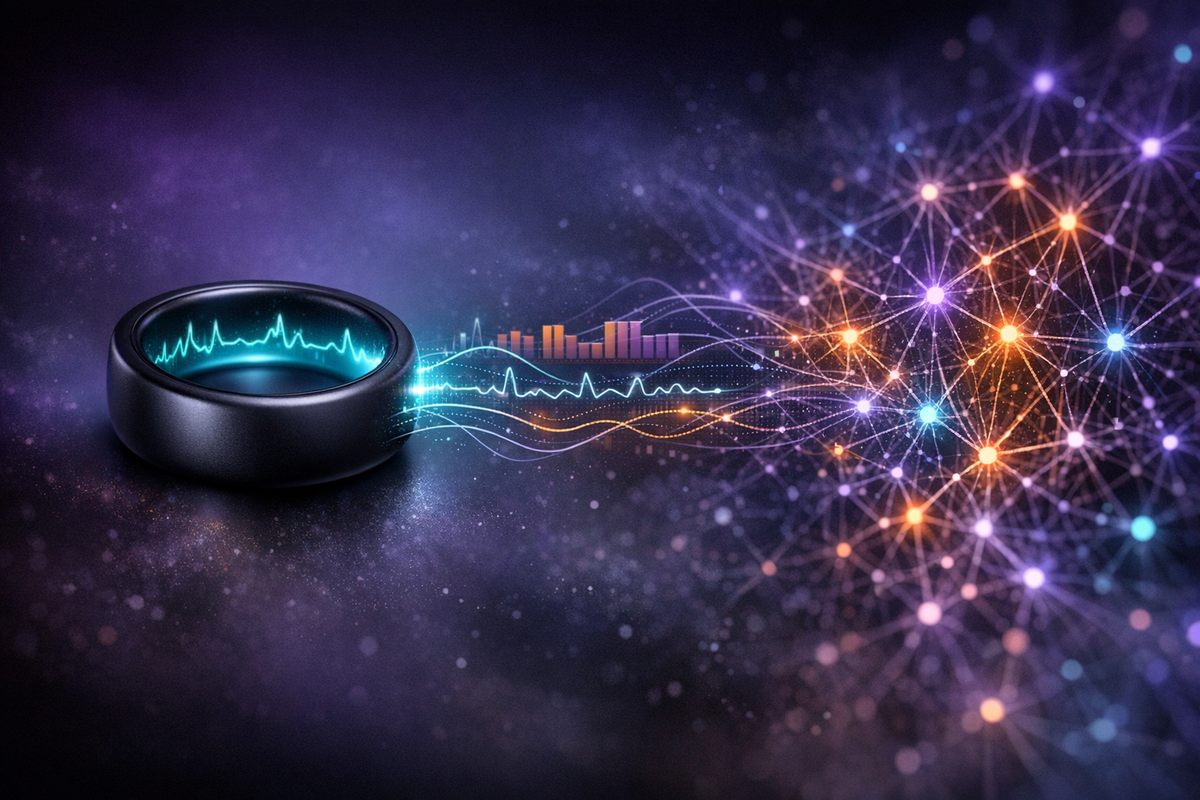
The Oura Ring 4 arrived yesterday.
I put it on before I even set up the app. The first full night's data synced this morning.
And while the ring itself is exactly the piece of engineering I expected — slim, invisible, 24/7 — the much more interesting story is what I built around it in the first 24 hours, and what it's about to be combined with.
The Setup (The Short Part)
Unboxing took five minutes. The ring fits. The app walked through the standard onboarding. I'm wearing it continuously — including in bed, which is the whole point.
I'm using the Oura app intentionally minimally right now. Not because the app is bad — it's actually well-designed — but because I don't want the app's interpretations to be the only voice in my ear. The one feature I am using aggressively is Tags: every time I have a coffee, a late meal, a Cuban cigar, a workout, or a busy block of work, I tag it in real-time with a timestamp and a short note. Without tagging the inputs, there's no way to correlate them with the outputs. Tags are the single highest-ROI feature in the app for anyone serious about extracting insight.
That's the app. Five minutes of setup, then tagging discipline from there. The ring does its job silently. No screen. No notifications. Just continuous measurement.
The Real Build: Oura + Claude Code + My Own Database
Here's the part I spent most of Day 1 on.
I wired the Oura API to Claude Code.
In a few hours of engineering:
- Generated a Personal Access Token from the Oura developer portal
- Wrote a Python client that pulls from twelve Oura API v2 endpoints: daily sleep, readiness, activity, stress, SpO2, resilience, cardiovascular age, detailed sleep sessions (with stages and HRV time-series), workouts, sessions, tags, heart-rate time-series
- Each fetch grabs a rolling 30-day window — enough for trend analysis and robust against late-syncing data
- Raw JSON lands in my repo as the source of truth, timestamped and archived by month
- A second script transforms the JSON into human-readable per-day markdown — one file per day, fully queryable
- Everything is versioned in git. My biology is now a repository.
Then the AI part:
- A Claude Code slash command called
/oura - I run it when I wake up
- It fetches, syncs the markdown database, then reads the last 30 days of daily files plus a profile document I maintain with my baselines and known context
- It produces a comprehensive analysis report: today's snapshot, short-term trends, long-term trajectory, body-systems view (recovery, sleep architecture, cardiovascular, autonomic tone, stress load, temperature), cross-metric correlations, red flags, and concrete actionable recommendations
- The report saves to my repo, commits, pushes, and is indexed by my local search engine — so six months from now I can query "every night where HRV dropped after a late meal" and actually get the answer
End-to-end pipeline: ring → phone → Oura cloud → my Python client → my markdown database → Claude Code analysis → daily report → git → searchable long-term memory.
Built in under a day.
Why Build My Own Pipeline Instead of Trusting the App?
Three reasons.
1. One model's interpretation isn't enough. Oura's algorithms are tuned for the general population. They're good. They're not going to get me to the edge. I want a second opinion that can bring all my data into one reasoning system — Oura output, bloodwork, training logs, context — and produce insights that no single-purpose app can. Biology is too important to outsource to a single opaque model.
2. Ownership. If Oura changes their data export policy tomorrow, if their business model pivots, if their AI Advisor moves behind a paywall, I've still got everything. My biology is in my repo. Forever. Self-hosted longitudinal health data is a non-negotiable for anyone playing this game seriously.
3. Compounding context. Month 1, Claude is reading 30 days. Month 6, 180 days. Year 3, a thousand days of sleep, HRV, temperature, and activity — cross-referenced against my bloodwork, my training, my diary. That's a level of longitudinal reasoning no consumer app can match, because no consumer app has access to the rest of your life. My pipeline does.
Day 1 Insights: The Full Numbers
Here's the honest state. I'm publishing the actual data because anonymized hand-waving is not biohacking. Day 1 numbers, measured by the ring, analyzed by the pipeline.
The context first. Recent months: busy season, too much coffee, a Cuban cigar habit, poor eating including late meals, around ten kilos of weight gained, minimal training. I know it. The ring now knows it. Let's see what the body says.
Cardiovascular — holding the line.
- Vascular age: 42 (chronological 44) — two years younger than expected
- Pulse wave velocity: 7.26 m/s — within normal range for 40-49
- Underlying cardiovascular hardware is still ahead of my age despite the accumulated abuse. This is the number that made me exhale.
Sleep architecture — intact but fragmented.
- Sleep score: 84
- Total sleep: 7h 28m in 9h 54m time in bed
- Efficiency: 75% (healthy target ≥85%)
- Sleep latency: 7 minutes — my body still falls asleep fast
- REM: 1h 42m (23%) — in the normal 20-25% band
- Deep sleep: 1h 11m (16%) — healthy
- Time awake: 2h 25m — this is the efficiency killer. Fragmentation, not architecture, is the problem.
Recovery + autonomic tone — depressed, exactly as expected.
- Readiness score: 81
- Avg HRV (rMSSD) during sleep: 31 ms — below the typical 35-55 ms range for a 44-year-old male
- Avg sleep heart rate: 70 bpm — elevated vs the 55-62 bpm healthy range
- Lowest sleep HR: 61 bpm
- Breath rate during sleep: 15.9/min — slightly elevated
- Temperature deviation: -0.07°C — effectively neutral
Respiratory — one flag worth tracking.
- SpO2 average: 96.25%
- Breathing Disturbance Index: 12 per hour — Oura's BDI loosely correlates with clinical AHI. 0-5 is normal, 5-15 is mild-apnea territory.
Not a diagnosis — one night isn't a pattern. But combined with the recent weight gain and the fragmented sleep signature, it's a signal worth observing for 14 nights. If the BDI stays elevated after I clean things up, a home sleep study is the cheap, one-night next step.
Activity — full hibernation mode.
- Steps: 375 / day
- Active calories: 21 out of a 550 target
- Activity score: 94 — which is Oura being generous. The high score comes from the "recovery time: 100" contributor, which is padding a sedentary week with a "you're resting well" label. Don't internalize it.
Related Reading
• Two Magnets and a Nose: First Hit With Intake Breathing — a reformed mouth-breather meets a $60 magnetic nasal strip and the Oura ring decides the verdict.
Related Reading
- Next Level Preps — instrumenting the body properly — BIA, DEXA and the delta.
- Three Days of Nothing — a clean sample beats a convenient one.
- Why I Chose the Oura Ring 4 — the wearable half of the instrumentation.
- I Scanned My Gym Into a Database — instrumenting the room, not just the body.
How to Read This Honestly
Every negative number above has a direct behavioral explanation. These aren't mysterious physiological markers — they're receipts from a specific lifestyle pattern.
- HRV 31 ms and elevated sleep HR 70 bpm → nicotine is a sympathetic activator, caffeine stacking compounds it, late meals keep the digestive system running during sleep when the body should be downshifting.
- Efficiency 75% and 2h 25m awake → classic fragmentation from late-night eating, caffeine half-life, and an inconsistent schedule.
- BDI 12/hr → mostly driven by the recent weight gain and late-meal reflux risk. Cigar-related airway irritation contributes.
- 375 steps → accurately reported.
The good news is that all of this is behavioral. None of it is disease. None of it is genetic. The body is sending receipts, not warnings — and the cardiovascular age of 42 against a chronological 44 says the hardware is still ahead of the abuse. There's margin. The margin is telling me it's time to use it.
Bloodwork Lands in 48 Hours
The ring is one half of the measurement stack. The other half is the labs. Two days from now the full bloodwork panel arrives from TRT Colombia — hormones, metabolic markers, inflammation, the full picture. The timing is deliberate: ring telemetry plus blood panel plus a clean lifestyle reset, all starting the same week.
That's the real move. Not a single intervention. A measurement stack plus a protocol, both kicking in together, so every change from here gets attributed to the right cause.
Ring: continuous, passive, everyday signals. Bloodwork: the deep slice. Lifestyle reset: the intervention. AI pipeline: the reasoning layer that joins all three. That's the bootstrap of a serious biohacking practice, and it's what Day 1 actually is.
The Reset Protocol
Starting tomorrow, the protocol:
- Training resumes — gym plus cardio, daily
- Diet: keto + intermittent fasting
- Less coffee
- Cigar habit ends
- Sleep hygiene locked in — consistent bedtime, cool dark room, screens off after 22:00
And the AI pipeline will watch it happen in real-time — morning by morning, night by night, week by week. Every day's /oura run is a quantified check against the previous day's behavior. Every tag I add during the day is a data point the system can correlate against tomorrow's sleep. The ring plus bloodwork plus AI pipeline plus a clean protocol is the feedback loop the original Oura post gestured at — now operational.
Next article in this series: the bloodwork numbers plus the ring trend after the first two weeks of the reset. What moves, what doesn't, and what the AI pipeline caught that the Oura app missed.
The Thesis: Biohacking 2.0 Is a Stack
Day 1 of biohacking, as I wrote in the previous post, is the ring. Day 2 is what you build around it.
A wearable alone is data. An app on top of a wearable is interpretation. But interpretation from a single source is a single perspective. The move in 2026 is to own the full stack:
- The sensor (ring, CGM, oximeter)
- The labs (hormones, metabolic, inflammation — a full panel, periodically)
- The cloud export (API access)
- The local database (your data, in your repo, forever)
- The AI layer (whatever model you bring — in my case, Claude Code)
- The analysis discipline (daily reports, honest tagging, long-term context)
- The protocol (training, diet, sleep, stimulants — the actual intervention)
This is where biology meets engineering. Not as a metaphor. As an actual stack you build, run, and own.
The ring is the doorway. The bloodwork is the floor. The AI pipeline is the room. The protocol is why you're there.
Day 1. Stack online. Reset begins.
Related Reading
- Baseline Drawn: One Clean Night, Blood on the Table
- Why I Chose the Oura Ring 4 for Biohacking
- Choosing a Biohacking Clinic in Medellín
- What Is Biohacking?