
Bushidō
They called it 'the way of the warrior.' Most translations stop there. The code is older, stranger, and more useful than the name suggests.
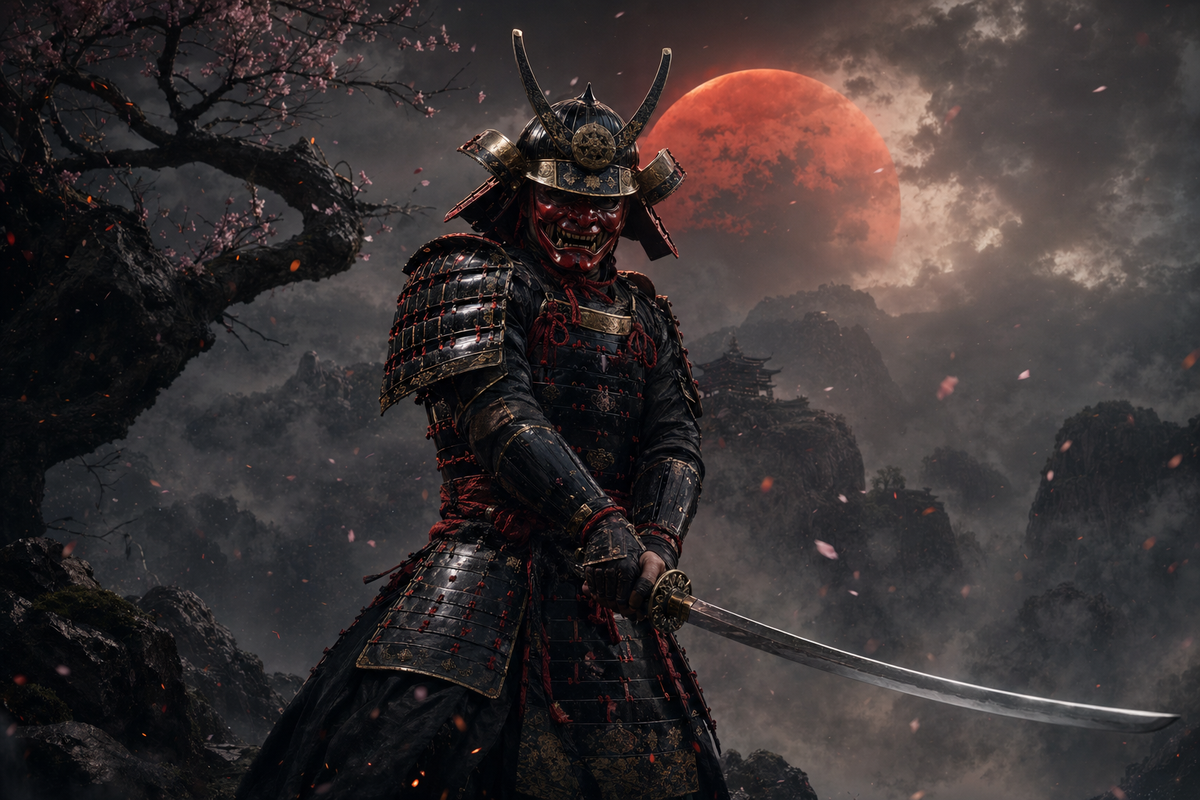
For centuries, an entire warrior class lived and died by a code most people today reduce to a movie cliché. Honor. Duty. Death before dishonor. Strip those phrases of their power and you get exactly what stays in modern memory — a postcard.
The actual code is stranger, older, and far more practical than the postcard suggests.
Bushidō (武士道) — literally the way of the warrior — was never a single doctrine. It was a way of being, distilled across seven hundred years from three philosophical rivers, codified late, romanticized later still, and somehow exported into the bloodstream of modern self-development without most people noticing.
It was never about violence. It was about what you do with the time between birth and your inevitable death.
What it actually is
Bushidō begins with a problem.
In feudal Japan, the bushi — the samurai warrior class — held disproportionate power. They carried two swords, served their daimyō, and could legally kill commoners under certain provocations (kiri-sute gomen). A class with that kind of license needs a leash, or it eats itself.
The leash they built was bushidō: an ethical operating system that turned the warrior's lethal capability into something disciplined, principled, and serviceable. It was less a religion than a set of standards a man imposed on himself, every day, until they became invisible.
The code wasn't formally written down until centuries after most samurai had already been living it. It existed first as practice — passed clan to clan, master to student, father to son — and only later got committed to paper.
The seven virtues
Most teachers list seven core virtues. Some lists add an eighth or ninth — discipline, refinement, fraternal duty. The seven are the canonical foundation.
Gi (義) — Rectitude
Doing what is right, especially when no one is watching and especially when it costs you. Not honor in the vague sense — a sharp inner blade that decides quickly between right and wrong without negotiation. Gi is the source of integrity. Without it, every other virtue collapses into performance.
Yū (勇) — Courage
Not the absence of fear. Acting in spite of it. The samurai distinguished between physical courage — facing death in combat — and moral courage — telling your lord he is wrong. The second was rarer and more valued. Most people will run into a burning building before they will tell power an uncomfortable truth.
Jin (仁) — Benevolence
The strong are obligated to protect the weak. Power without compassion is barbarism, and a warrior without compassion is a thug with a license. Jin is what separated the samurai from the soldier. The sword exists to serve, not to dominate.
Rei (礼) — Respect
Etiquette as a discipline of the soul. The deep bow, the precise gesture, the unbroken eye contact at the right moment — these were not formalities. They were how a man trained his interior. Rei taught that how you do anything reveals who you are. The tea ceremony, the calligraphy, the sword forms — same root.
Makoto (誠) — Sincerity
The samurai's word was inseparable from his action. To say a thing was to do it. There were no contracts because contracts implied the possibility of lying. A man whose speech and action diverged was already finished — socially dead before any blade arrived.
Meiyo (名誉) — Honor
Honor is not what others think of you — it is what you know about yourself. It is the inner record. The samurai believed that one shameful act could not be erased by a thousand good ones, and that the only way to restore honor after a grave failure was through ritual death. Western readers often mistake this for fanaticism. It was actually a system that made integrity literally non-negotiable.
Chūgi (忠義) — Loyalty
Loyalty to your lord, your family, your code. This is the most contested virtue in modern interpretations because loyalty without judgment becomes tribalism. The original meaning was layered: loyalty to the higher principle that made the lord worthy of loyalty in the first place. When the lord betrayed the principle, the warrior had a harder problem to solve.
The three rivers
Bushidō wasn't invented in a vacuum. Three philosophical traditions fed into it across centuries.
Zen Buddhism taught the samurai how to die. Not metaphorically — literally. Daily meditation on death loosened the grip of self-preservation. A warrior who had already accepted his death moved differently in combat — slower in mind, faster in body. This is also where mushin (無心 — "no-mind") came from: the unattached awareness that lets a master swordsman respond before he thinks.
Confucianism gave bushidō its ethical scaffolding — the hierarchy of relationships, the duty to family and lord, the cultivation of moral character through study. The Confucian Five Constants (rén, yì, lǐ, zhì, xìn) map almost perfectly onto half the seven virtues. The samurai were not just warriors; they were expected to be scholars. Brush and sword, the same hand.
Shintō anchored the warrior to land, ancestors, and ritual purity. The reverence for nature, for cleanliness, for the sacredness of place — this was Shintō. It also gave bushidō its cosmology: the warrior's loyalty to his lord wasn't arbitrary; it was an extension of his loyalty to a divine line going back through generations.
Three rivers, one current.
The practice
A samurai didn't read about bushidō. He lived it through daily structure. The structure mattered more than any belief.
Morning ritual — rising before dawn, washing, dressing in formal kimono, prayers at the family altar. Then physical training. Then weapons training. Then administrative duties. The day was architecture, not improvisation.
The arts — calligraphy, poetry, tea ceremony, ikebana, Noh theater. Not as hobbies. As mandatory practices for refining attention and aesthetic judgment. A warrior who could not see beauty was an animal with a sword.
The sword — kenjutsu (combat technique) and iaijutsu (the art of drawing the sword) practiced daily for decades. Not for combat — combat was rare. For the cultivation of presence under pressure. Ten thousand draws to make the eleven-thousandth draw automatic.
Death meditation — Hagakure famously begins: "The Way of the Samurai is found in death." Yamamoto Tsunetomo wasn't being morbid. He meant: contemplate your death every morning until it stops being abstract. A man who has accepted that today might be his last lives differently than one who hasn't. He moves faster, lies less, finishes things, says what needs to be said.
This is where bushidō diverges most sharply from modern self-help. Modern self-help avoids death. Bushidō built its entire architecture on it.
How it got written down
The two pillars of written bushidō came centuries after the practice itself.
Hagakure — "In the Shadow of Leaves" — was dictated by Yamamoto Tsunetomo, a samurai-turned-monk, between 1709 and 1716. By then the warring states were over and samurai were already becoming bureaucrats. Half the book is practical advice (how to compose yourself, how to drink, how to deal with rumors), half is fragments of pure philosophy. It's not a manifesto. It's the assembled wisdom of a man who watched his class become obsolete and wrote down what he wished he'd known.
Bushido: The Soul of Japan — Inazo Nitobe wrote this in 1900, in elegant English, partly to explain Japanese ethics to Westerners and partly to defend Japan's moral tradition in a modernizing world. He drew parallels to medieval European chivalry, organized the virtues into a clean framework, and gave the world the version of bushidō that became globally famous.
Nitobe's book is brilliant and partially fictional. The clean seven-virtue list, the romantic framing, the comparisons to knighthood — these were synthesized for a global audience. Real samurai life was messier. But Nitobe's version is the one that traveled, and it's the one that shapes most modern interpretations.
The historical truth and the romantic synthesis both matter. The truth tells you what was. The synthesis tells you what we needed it to be.
Where it lives now
Bushidō as a feudal institution died in the late nineteenth century, when the samurai class was formally dissolved during the Meiji Restoration. But the operating system survived in unexpected places.
Martial arts — judo, kendo, aikido, karate, iaidō — preserved the technical and ethical core. Show up to any traditional dōjō today and you are stepping into a direct lineage. The bow, the silence, the discipline, the seniority — all bushidō.
Japanese business culture absorbed it. Lifetime employment as honor. Kaizen (continuous improvement) as practice. Monozukuri (the art of making things) as a sacred craft. The Toyota Production System, in its purest form, is bushidō applied to manufacturing — relentless attention, deep accountability, refusal to ship something you would not put your name on.
Modern self-development has been quietly reading Hagakure for forty years. Every memento mori practice, every Stoic-style daily death meditation, every "discipline equals freedom" framework draws from the same well — sometimes consciously, often not.
Biohacking and physical training — the warrior body as temple, training as daily practice, pain as information, sleep as honor. The serious lifters and longevity practitioners are running a watered-down bushidō without naming it.
Software and operating — accountability for what you ship. Saying what you mean and meaning what you say. Not breaking the build. Not lying in retros. Code review as etiquette. Refusing to call something done that isn't done. Bushidō shows up wherever craft is taken seriously.
The operator's code
What does any of this matter to a person running a life — a household, a business, a body — in the year 2026?
Bushidō survives because the problem it was designed to solve hasn't changed: a person with capability and choice has to pick a code, or one will be picked for them by their fears. The samurai's solution still works.
A modern operator's bushidō, in seven lines:
Decide what is right before the situation arrives, not in the middle of it. (Gi)
Act in spite of fear, especially the social kind. (Yū)
Use power to protect, not to dominate. (Jin)
Treat small gestures as the practice ground for character. (Rei)
Make your word and your action one thing. (Makoto)
Keep the inner record clean. The outer record is noise. (Meiyo)
Be loyal to the principle that earned the loyalty in the first place. (Chūgi)
And underneath all seven, the engine: live as if today is the last day, train as if you have forty years, and refuse to outsource your standards to anyone — boss, system, partner, country, era.
The samurai are gone. The way of the warrior is not.