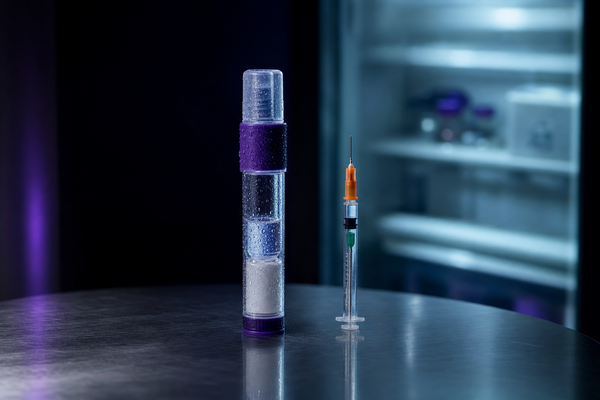
From CJC-1295 & Ipamorelin to HGH
I run peptides that make my body release its own growth hormone. HGH means injecting the hormone itself — stronger, less physiological, with a real glucose tax. The honest case, ELI5 to pharmacology, on a switch I'm weighing before my blood panel.

Full blood work is around the corner (I wrote about that exact fork in Three Months In), and bloodwork is a decision point: you read what three months did, then adjust. One adjustment I am weighing is the controversial one — trading my growth-hormone peptides for pure HGH. This is me thinking it through in the open, from plain-English to pharmacology.
1. I run CJC-1295 + Ipamorelin — peptides that tell my own pituitary to release my own growth hormone, in natural pulses. Secretagogues borrow.
2. HGH (recombinant somatropin) skips the middleman: you inject the hormone itself. Stronger, more direct — and your body stops making its own. HGH buys.
3. HGH is genuinely more powerful. It is also supraphysiological, pricier, and taxes your blood sugar in a way the peptides do not.
4. Proven in real deficiency. For healthy-adult "anti-aging," the evidence is thinner than the marketing.
5. Done safely = start low, watch IGF-1 and glucose like a hawk, stay medically supervised, no heroics.
6. I have not switched. The blood panel decides, not the hype. Below: simple to deep.
Two ways to raise growth hormone
The cleanest way to understand the choice: secretagogues borrow; HGH buys. Normal GH release is pulsatile — the hypothalamus alternates stimulatory GHRH with inhibitory somatostatin, ghrelin signaling adds another push, and the big pulses land during sleep.
CJC-1295 is a GHRH analog; Ipamorelin is a selective ghrelin-receptor (GHS-R1a) agonist. Together they stimulate complementary pathways and amplify your pituitary's own GH release (I broke the stack down in Borrowing the Pulse). Because the pituitary stays the source, the response is still governed by pituitary reserve, somatostatin tone, sleep, nutrition and IGF-1 feedback — a more physiological exposure than injecting GH directly.
One formulation detail matters: long-acting CJC-1295 with DAC (drug-affinity complex) raises basal GH and IGF-1 between pulses, while the short-acting molecule — technically modified GRF(1-29), often loosely called "CJC-1295 without DAC" — stays closer to pulse-based dosing. "CJC-1295" alone is not precise enough; know which molecule is in the vial.
Recombinant somatropin bypasses all of that. Injected HGH reaches circulation directly and activates GH receptors whether or not the pituitary would have pulsed. It is not a perfectly flat line — a daily shot gives a broad peak then a decline — but it is more sustained and less pulsatile than natural secretion, and it triggers IGF-1 and somatostatin feedback that dials your own pituitary down while treatment continues. That is physiological suppression, not necessarily permanent shutdown. The practical result: secretagogues depend on the capacity of your existing axis; HGH overrides it.
Those IGF-1 numbers are orientation points, not universal targets — reference ranges vary by age, lab and assay. A supervised protocol uses age-adjusted ranges, not one raw number treated as ideal for everyone.
What the benefits evidence actually supports
The strongest case for HGH is adult growth-hormone deficiency. In properly diagnosed patients, replacement reduces fat mass, increases lean mass, improves bone density over time, improves some lipids, and improves quality of life. Established outcomes — magnitude varies by person.
That evidence does not transfer cleanly to a healthy 44-year-old chasing recovery, sleep, skin or body composition. Studies in healthy older adults show reduced fat mass and small lean-mass gains; low-dose users report better sleep, skin and recovery. Plausible — but the trial base is small samples, short follow-up, inconsistent dosing and subjective endpoints. Meta-analyses generally find little improvement in strength or physical function, and measured "lean mass" can partly be fluid retention, not functional muscle.
- Strong: HGH replacement in confirmed deficiency.
- Moderate: changes in fat mass, lean mass, selected metabolic markers.
- Thin: broad anti-aging claims, big strength gains, longevity, durable performance in healthy adults.
HGH is more powerful than CJC-1295 + Ipamorelin at raising GH and IGF-1. It does not follow that every higher exposure buys a meaningful clinical benefit.
The tax — risks are mostly dose-related, and real
Common adverse effects reflect excess GH activity and fluid retention: edema, joint and muscle pain, stiffness, numbness, and carpal tunnel (reported in roughly 2% of treated adults). Most improve after a dose reduction — which is exactly why slow titration matters. Side effects are information, not obstacles to overpower with another drug.
Glucose regulation is the bigger concern. GH antagonizes insulin, drives lipolysis, and can raise hepatic glucose output; fasting glucose and insulin can climb even while body composition improves. In one dataset at ~1.6 IU/day, about a quarter of participants developed impaired glucose tolerance. "Low dose" is not the same as metabolically neutral.
Chronic excess can produce an iatrogenic acromegaly phenotype — progressive soft-tissue and bone changes in hands, feet and face — and contribute to hypertension and cardiac strain. IGF-1 is a growth and survival signal, so persistently high exposure raises a theoretical concern about feeding an existing malignancy. That is not evidence that properly dosed HGH causes cancer; it is reason enough not to chase supraphysiological IGF-1 without a medical indication.
Dosing — the whole game is "start low"
Adult replacement commonly begins around 0.45–0.9 IU/day (somatropin is quoted in both mg and IU: 0.2 mg ≈ 0.6 IU), then titrates gradually every four to eight weeks against symptoms, side effects, glucose, and age-adjusted IGF-1. Off-label anti-aging protocols often run 2–3 IU/day — common practice, not a universally safe target. Starting there skips the whole point: finding the lowest effective dose.
"Start low" is not ceremony. HGH effects accumulate, HbA1c moves slowly, and fluid symptoms can show up only after exposure is already excessive. A protocol that adjusts faster than its biomarkers can respond is flying partly blind.
Insulin, timing, and monitoring
Endogenous GH release is metabolically gated: high insulin, glucose and free fatty acids blunt a secretagogue-induced pulse — the reason pulse-oriented peptides are dosed fasted or before bed, away from a big carb load. Injected HGH is different: it does not need a pituitary pulse, so insulin cannot stop the dose from reaching the receptor. Bedtime dosing roughly mimics the largest natural pulse, but it does not restore minute-to-minute pulsatility or erase the drug's glucose effect.
At minimum, this decision needs before-and-after numbers on IGF-1, fasting glucose, HbA1c, fasting insulin, plus lipids, blood pressure and fluid symptoms. Fasting insulin matters because "normal" glucose can be propped up by rising insulin output — a warning the glucose reading alone hides.
Some advanced users stack HGH with injected insulin to offset hyperglycemia or push anabolism. That is a different risk universe — severe hypoglycemia, dosing errors, loss of consciousness, death. It is not a reasonable extension of an anti-aging protocol, and I do not endorse it.
Cycle it or run it?
Secretagogues are often cycled — roughly 8–12 weeks on, ~4 off — to limit receptor desensitization and re-check baseline. Common structure, not a validated universal schedule; long-acting CJC-1295 complicates it because sustained GHRH signaling is not the same as short, discrete stimulation. If the goal is preserving pulsatility, the exposure pattern matters as much as the label.
Exogenous HGH suppresses your own output through IGF-1 and somatostatin feedback — a reason to plan reassessment or cycling in an elective protocol. But cycling does not make excessive dosing safe: it does not erase insulin resistance, guarantee receptor recovery, or justify pushing IGF-1 higher during the "on" weeks. For genuine deficiency, replacement is continuous, not a recreational cycle. Either way, baseline and mid-cycle IGF-1 (plus IGFBP-3 for context) is the dial. Without it, cycling is a calendar ritual, not a controlled experiment.
What each option costs
Depending on product and dose, the peptides run roughly two to five times cheaper. Price cannot establish purity, potency or sterility — it only sets the threshold for whether a modest improvement is worth sustaining month after month.
The pharmacology beneath the trade-off
At the receptor level, the two peptides converge on secretion through different systems. The GHRH receptor is Gs-coupled: activation raises adenylyl cyclase, cyclic AMP and PKA signaling, promoting GH synthesis and release. GHS-R1a is mainly Gq/11-coupled: it activates phospholipase C, generates IP3, mobilizes intracellular calcium, and triggers exocytosis. Hitting both at once can produce a synergistic pulse rather than two identical signals added together.
Somatropin acts downstream of both. GH binding reshapes the receptor complex, activates JAK2, and drives STAT5 (especially STAT5b) plus MAPK and PI3K signaling; in the liver this raises IGF-1, IGF-binding-protein-3 and the acid-labile subunit, which together govern IGF-1's distribution and half-life. That is why serum IGF-1 is useful but incomplete — it integrates GH exposure better than a random GH draw, but it says nothing about pulse amplitude, interpulse GH, tissue sensitivity, or free IGF-1.
Pulsatility is not cosmetic: intermittent versus sustained receptor activation produces different signaling dynamics, feedback and hepatic transcription. Secretagogues preserve more of that architecture; daily HGH decouples receptor activation from the hypothalamus's timing. The glucose effect falls out of the same pharmacology — GH-driven lipolysis floods free fatty acids, GH signaling impairs insulin-mediated glucose disposal and raises hepatic output, and GH-induced SOCS proteins can interfere with insulin-receptor signaling. IGF-1's insulin-like actions do not reliably cancel GH's net diabetogenic pressure under sustained dosing. So a jump from IGF-1 230 to 380 ng/mL may read like a stronger anabolic signal and still be a bad trade if fasting insulin doubles, glucose drifts up, edema appears, and function does not change.
My verdict: the bloodwork decides
For my case, CJC-1295 + Ipamorelin stays the safer default: more physiological, cheaper, gentler on glucose, and it keeps the pituitary in the loop. HGH offers more potency and tighter dose control, but with nonphysiological exposure, endogenous suppression, higher cost and a heavier monitoring burden.
If the panel shows a healthy IGF-1 response, stable glucose and no unresolved problem, switching just to chase a bigger number is hard to justify. If it shows an underperforming GH axis alongside a real objective the peptides have not moved, a low-dose, slowly titrated HGH trial under supervision becomes defensible. The deciding question is not "are HGH's benefits real?" (they are) — it is "which documented problem am I solving, and what metabolic price am I willing to pay?"
That panel is days away. When the numbers land, I will show them and decide in the open.
Borrowing the Pulse: CJC-1295 + Ipamorelin — the stack I run now, in full.
Three Months In — the bloodwork fork this whole decision hangs on.
Better Than Ever: Seven Protocol Changes — the other adjustments already made.
MONSTER 2.0 — The Ask — pillar three in proposal form: the injectable protocol I am asking my clinic to sign off, with every dose, threshold and the order.