Five Tubes of Blood and a 688-Page Manual
This morning five tubes came out of my arm, closing ninety days on protocol. In six weeks Andrew Huberman publishes 688 pages of protocols. Both are called protocols — but only one of them knows anything about me. His science, his critics, his book, and what a blood panel does that a manual can't.
Five Tubes and a Cartoon Monkey
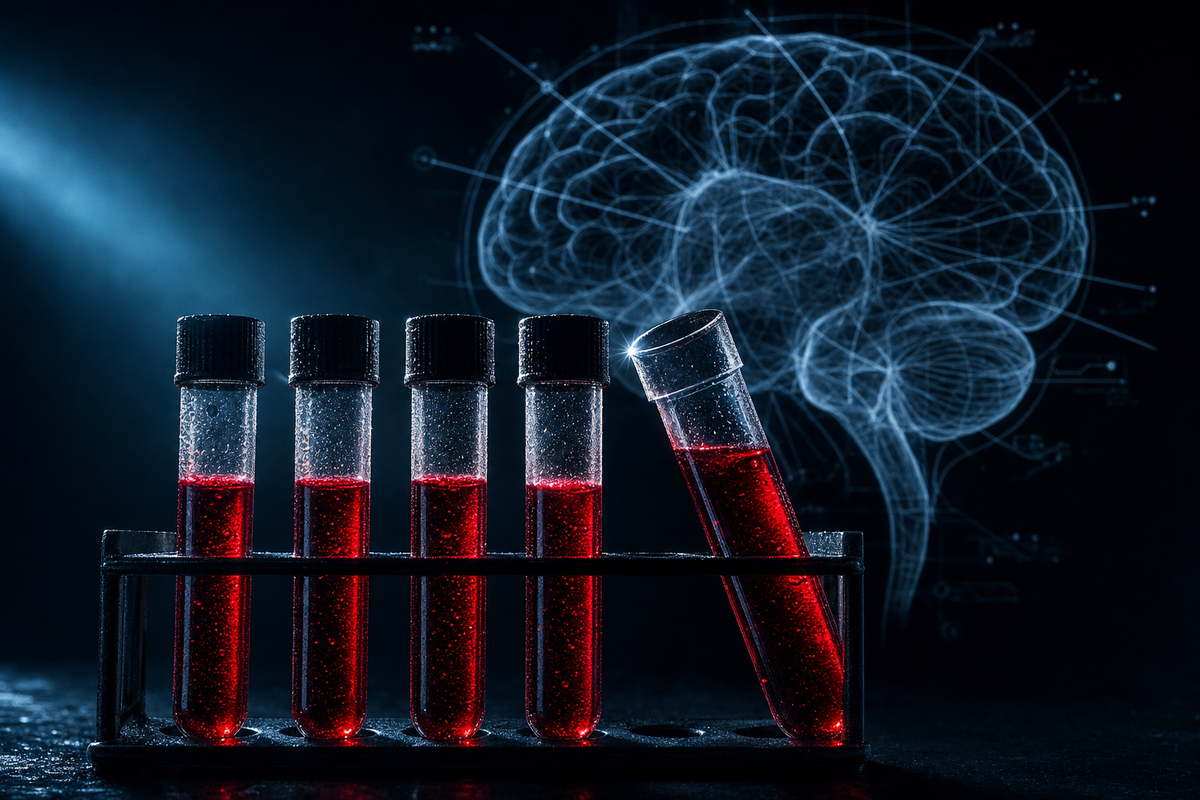
Seven in the morning. Twelve hours fasted. A phlebotomist at my kitchen table, a tourniquet, and five vacutainer tubes filling one after another — lavender top, then the yellows — while I watched ninety days of work drain out of my arm into glass.
Then a cotton pad, and a sticker with a cartoon monkey on it. Which is a nice touch after you've just handed over the entire evidentiary basis of the last three months.
That draw closes the first full block of the protocol I've been running since April. Results land in one to three days. Then we sit down with the panel and rewrite the whole thing — doses up where the numbers say up, compounds out where they didn't earn their place, new ones in where there's a gap.
And while I was sitting there with a needle in my arm, the news in my feed was that Andrew Huberman has a book coming out called Protocols.
The timing was too good to ignore. So let's talk about Huberman — the science, the podcast, the criticism, the book — and then about the thing that was actually happening in my kitchen, because they are two very different objects with the same name.
Six Weeks From Now, 688 Pages
Protocols: An Operating Manual for the Human Body publishes 15 September 2026 through Simon Element, at 688 pages, with an audiobook Huberman narrates himself.
Six hundred and eighty-eight pages. That is not a summary of the podcast — that's a reference volume. For scale, it's longer than most medical textbooks people actually finish.
The framing is right there in the subtitle, and it's the most revealing thing about the whole project: an operating manual for the human body. The body as a machine that shipped without documentation, and here at last is the manual. It's a good line. Hold onto it, because I'm going to come back to what's wrong with it.
The book organizes around seven areas — Sleep, Exercise, Stress Control, Nutrition, Light, Focus/Motivation/Learning, and Personal Growth — with the same two-tier structure the podcast uses: foundational behaviors that move your baseline, then targeted tools for specific problems or higher performance.
What Huberman Actually Does
Here's the part most people get wrong in both directions — the fans who think he's a generalist oracle, and the critics who imply he's a podcaster in a lab coat.
Andrew Huberman is a real scientist doing real work, in a field that has almost nothing to do with what he's famous for.
He's an associate professor of neurobiology and ophthalmology at Stanford School of Medicine, and his lab studies the visual system: how retinal ganglion cells — the output neurons of the retina, the ones that actually carry vision to your brain — wire themselves into precise maps in subcortical regions, and how those connections behave after injury.
The headline result from that work is genuinely remarkable. His lab has coaxed damaged optic nerve cells into regenerating and reconnecting to the brain, with blind mice recovering partial eyesight. In a field where "central nervous system damage is permanent" was the default assumption for a century, that matters. It's published in Nature Neuroscience. It is not podcast content.
So the honest framing: he's a legitimate vision neuroscientist whose actual expertise is in retinal circuitry and neural regeneration, who became globally famous for talking about sleep, dopamine, cold water, testosterone and supplements — none of which are his research area.
That doesn't make him a fraud. Plenty of good science communicators explain fields they don't personally research. But it does mean that when he tells you about a cold-exposure protocol, he is doing the same thing you or I would do — reading someone else's literature and summarizing it — just with a Stanford title attached and one of the largest audiences in the world on the other end. The credential is real. It's mostly pointed somewhere else.
The Podcast That Ate Health
Huberman Lab launched on 4 January 2021 and became, extraordinarily quickly, the most influential health show on earth. Audited download figures are private, but the public proxies are enormous — roughly 7.6 million YouTube subscribers, over half a billion channel views, and sixth place globally on Spotify's 2025 podcast chart. Long episodes, often two to three hours, built around a consistent structure: mechanism first, then "protocols," meaning specific actionable instructions with numbers and timing attached.
That structure is the whole reason it worked. Most science communication tells you *how something works* and then abandons you. Huberman tells you how it works and then says: *do this, for this long, at this time of day.* People are starving for the second part. The wellness internet had been running on vibes for a decade and he showed up with numbers.
It's also a substantial business — premium subscriptions, a newsletter, and a sponsor model built on long, personally-delivered reads for supplement and hardware brands. That last part matters for the criticism, so hold it too.
The Protocols, Graded Honestly
This is the part worth actually having. Here's how the signature protocols hold up when you look at what's underneath them — not whether they're *plausible*, but whether there's human evidence for the specific claim as stated.
| Protocol | What's claimed | Honest grade |
|---|---|---|
| Morning sunlight, 5–10 min within an hour of waking | Anchors circadian rhythm, sets cortisol peak, improves sleep onset that night | 🟢 Principle strong, the dose is a heuristic. Circadian entrainment by morning light is one of the best-established findings in chronobiology. But the specific numbers are rules of thumb, not validated thresholds — the classic human phase-response work used ~9,500 lux for 6.7 hours, not a ten-minute walk. Still the best thing on the list. |
| Delay caffeine 90–120 min after waking | Lets adenosine clear naturally, prevents the afternoon crash | 🟡 Plausible mechanism, thin evidence. The adenosine story is coherent, but the specific claim that delaying coffee prevents an afternoon crash is a reasonable hypothesis, not a demonstrated effect. Try it as an n=1. |
| Physiological sigh — double inhale, long exhale | Rapidly lowers arousal and improves mood | 🟢 Actually tested — and he's an author. See below. |
| NSDR / yoga nidra | Restores focus and dopamine, substitutes for lost sleep | 🟡 Low-risk, under-evidenced as a named practice. The underlying relaxation mechanisms are sound; the branded protocol has early and limited data. |
| Cold exposure, ~11 minutes per week | Resilience, mood, metabolic benefit | 🟡 The number is far firmer than the evidence behind it. The 11 minutes traces to a 2021 comparison of eight experienced winter swimmers against eight controls — not a dose-finding trial, and incapable of establishing a minimum. I went deep on this one here — and the biggest finding is that the celebrated immune effect belongs to the breathing, not the cold. |
| Zone 2 + the Foundational Fitness Protocol | Weekly template of cardio and resistance work | 🟢 Sensible and uncontroversial. It's a reasonable synthesis of mainstream exercise science. Nothing exotic, which is a compliment. |
| Tongkat ali / fadogia agrestis for testosterone | Supplement support for endogenous testosterone | 🔴 This is the weak one. Tongkat ali has small, heterogeneous human trials. Fadogia agrestis has none — the testosterone claims come from rats, and a separate rat study flagged liver and kidney toxicity signals. No human efficacy, dosing or safety data exists. If you care about your testosterone, measure it — see the entire rest of this article. |
Notice the shape of that table. The strongest items are the free ones — light, breathing, movement, sleep timing. The weakest are the ones you buy. That is not a coincidence and it's not unique to Huberman; it's the gravitational field every health platform operates in.
The One He Has Actual Data On
Credit where it's due, because this is the strongest thing in his applied catalogue.
The physiological sigh — two inhales through the nose, the second stacked on top of the first, then a long slow exhale through the mouth — was tested in a randomised Stanford trial published in *Cell Reports Medicine* in 2023, with Huberman as a co-author. 108 participants, 28 days, five minutes a day: cyclic sighing produced greater improvement in positive affect and a greater drop in respiratory rate than mindfulness meditation over the same period.
That's a real result on a free intervention that takes thirty seconds to learn and works inside a minute. It's the one protocol in the entire library where he isn't summarizing somebody else's literature — he helped generate it. The caveats belong here too: small groups, unblinded, several outcomes self-reported. Best-evidenced item on the list, not a settled fact.
If you take exactly one thing from this article and never think about Huberman again, take that one.
The Criticism, Stated Fairly
There are two separate criticisms of Huberman and they get blended constantly, which serves nobody. Let me split them.
The scientific critique is the one that should matter to you. In March 2024 *Slate* ran a piece by working scientists arguing that the podcast had drifted from research-backed advice toward speculative "tools" resting on small studies, in vitro work, or rodent data. Immunologist Andrea Love picked apart a much-cited sauna-and-immunity claim: twenty participants, and the study didn't directly measure immune response at all. Others flagged an ADHD episode as carrying unproven claims to an audience that includes people making real treatment decisions.
That critique is fair and it's structural, not personal. When you publish three hours a week on every organ system, you will inevitably run past the edge of solid evidence, and the confident protocol format is very good at hiding the seam. A listener cannot tell from the delivery whether they're getting a meta-analysis or a mouse study. In fairness, he does issue corrections — the show has walked back a mistaken claim about which testicular cells produce testosterone, and a fertility statistic that was mathematically impossible — but they sit scattered in episode notes rather than in a dated, searchable errata log, which is what a reference work actually needs.
The conflict-of-interest critique is narrower but sharper. He isn't merely sponsored by the greens-powder company AG1 — he's a compensated adviser to it. And not only to it: his own disclosure page lists him as a paid adviser to AG1, Eight Sleep, Function, Momentous, Reveri and WHOOP, and states that his media company holds investments in some sponsors. Credit where it's due — he discloses all of that publicly. But it means the sponsor reads and the evidence summaries arrive in the same trusted voice, from someone holding equity on one side of the sentence.
And then there's the 2024 New York Magazine profile, eight thousand words largely concerning his personal life and conduct in relationships. I'm not going to adjudicate that here — I don't know those people, and neither do you. For the record it was allegation-based reporting, his representatives disputed significant parts of it, several former partners spoke about him favourably in the same piece, and no misconduct finding followed. I mention it only because it's what most readers actually remember, and it has essentially nothing to do with whether morning sunlight regulates your circadian rhythm. Judge the protocols on the evidence. Judge the man in a separate proceeding, if at all.
So What's Actually in the Book
From what's public so far: seven domains, the two-tier structure of foundations plus targeted tools, and the protocols people already know from the podcast — morning light, the breathing pattern for acute stress, strength and body-composition work, learning-speed tools — collected and organized in one place with the mechanisms attached.
Which raises the obvious question: the podcast is free and exhaustive, so what are you paying for?
Structure and retrieval. Five years of episodes is not a reference system. You cannot search a podcast for "what do I do about afternoon energy" and get a straight answer in twenty seconds. A 688-page indexed volume you can. That's a genuine product, and it's the same value proposition as any technical handbook: the information was already free and scattered, and the organization is the thing worth money.
I'll buy it. I expect it to be good, well-sourced, and useful as a lookup table. And I expect it to be unable to do the one thing that actually matters most, which is the whole point of this article.
What a Panel Does That a Manual Can't
Here's the thing I kept turning over with the needle in my arm.
A protocol is a hypothesis about a population. A blood panel is a measurement of you.
Every protocol in that 688-page book — every protocol in every health book ever written — is a statement of the form *this intervention produced this average effect in these subjects under these conditions.* That is genuinely valuable. It's how you decide what's worth trying at all. It's the menu.
What it cannot tell you is what happened in your body. Not what should have happened. What did.
An operating manual assumes the machine is built to spec. Yours isn't. Your absorption is different, your baseline hormones are different, your liver clears things at its own rate, your genetics are doing something nobody wrote a chapter about. Two people can run the identical protocol with perfect discipline for ninety days and get opposite results — and without measurement, both of them will report that it worked, because that's what humans do with effort they've invested.
The five tubes that left my arm this morning will come back with numbers that don't care how disciplined I was, how good the protocol looked on paper, or how confident anybody sounded explaining the mechanism. Testosterone, free and total. Estradiol. Full lipid panel. Liver enzymes. Kidney function. Inflammatory markers. Complete blood count. Metabolic panel.
Some of it will validate what I've been doing. Some of it will tell me that something I've been doing religiously for three months has been doing nothing, or worse than nothing. That second category is the entire reason to draw blood at all. A protocol you never measure isn't a protocol. It's a belief system with a schedule attached.
So: read Huberman. Genuinely. Take the morning light, learn the physiological sigh, use the fitness template, treat the supplement recommendations with more suspicion than the free ones. It's the best-organized entry point that exists, and the book will make it better.
Then go get your blood drawn, because that's the part the manual can't do for you. The protocol is the hypothesis. The panel is the experiment.
One to Three Days
Ninety days. Injections most mornings, three or four compounds deep on the heavy days, sleep tracked every night, the sleep stack rebuilt twice, morning light taken seriously, cold added at the end because a water heater broke.
Results in one to three days. Then the rewrite — and this time it won't be built from a podcast, a book, or an article like this one. It'll be built from what came out of my arm at seven o'clock this morning, next to a cartoon monkey sticker.
I'll publish the numbers when they land.
Related Reading
- Next Level Preps — the 90-day block this draw closes.
- Three Months In — the mid-block report, before the blood.
- The Iceman Sent a Plumber — cold exposure, and why the famous result isn't the cold.
- Ten Minutes of Morning Sun — the one Huberman protocol with unimpeachable evidence.
- Hibernation Protocol — the sleep stack, built the same measured way.
- The Numbers Came Back — the panel came back - triglycerides -41%, liver spotless.
- These Are the Final Results. Nooot. — what those tubes eventually said, ninety-four days later.
- Twenty-One Markers and an ECG — the follow-up draw, four months on.