Sweet Potato: A Practical Bodybuilding Carb
Sweet potato does not build muscle by itself. Its job is more specific: measurable carbohydrate, food volume and micronutrients without turning lunch into a caloric ambush.
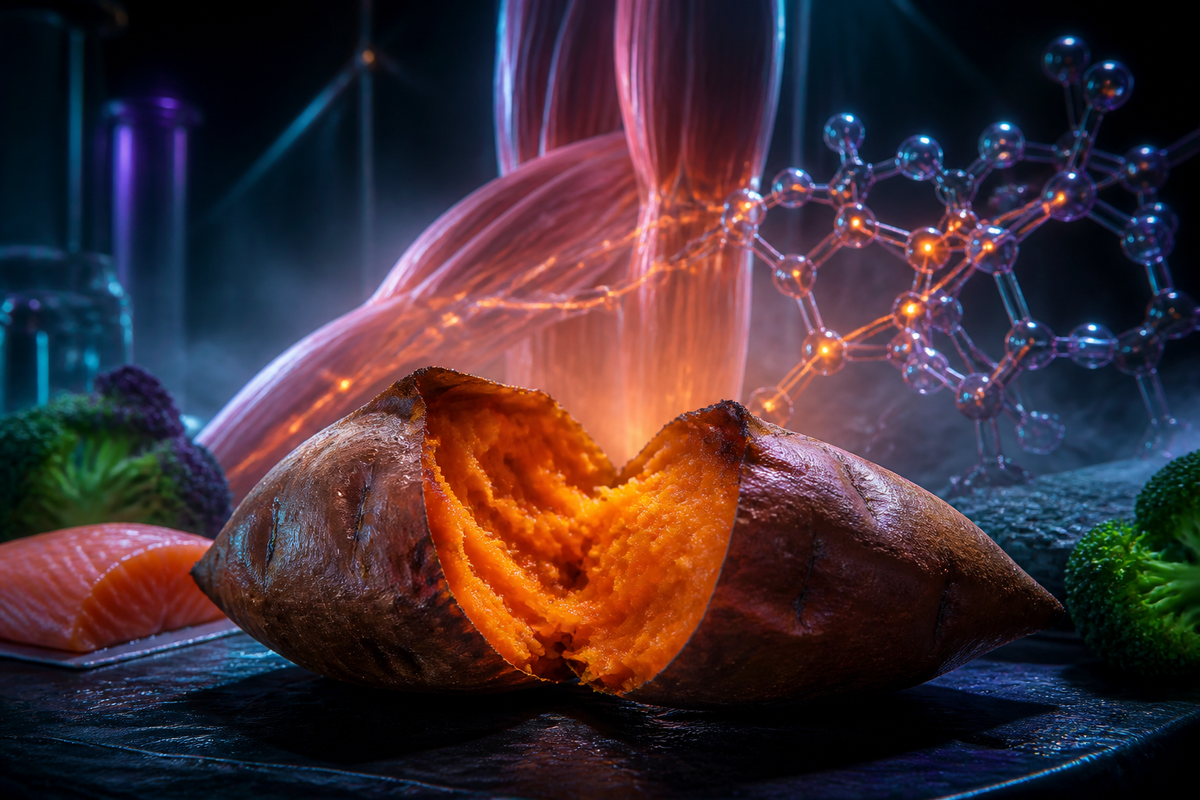
Today’s lunch is simple: salmon, broccoli, batata.
Salmon provides most of the plate’s protein and fat. Broccoli adds vegetable volume. Sweet potato supplies the carbohydrate portion.
Sweet potato often gets sold as a superfood. Its practical value is simpler: predictable carbohydrate, food volume and micronutrients.
The Performance Case
Resistance training uses muscle glycogen. A 2025 meta-analysis pooling 20 studies and 180 participants found that a lifting session significantly reduced glycogen in the vastus lateralis; depletion grew with more sets and longer sessions. Those results establish fuel use, not that an extra serving automatically improves performance. Carbohydrate may become more useful as training volume rises; sweet potato is one delivery vehicle.
A 2022 systematic review of 49 studies found acute higher-carbohydrate intake improved performance in only six of 19 trials. The wins clustered around fasted controls and sessions above ten sets per muscle group. In fed trainees doing up to ten sets per muscle group, extra carbohydrate was unlikely to improve performance by itself.
If breakfast and lunch already covered the need, another serving will not manufacture strength. The review suggests carbohydrate availability matters more when training is fasted or exceeds ten sets per muscle group.
A 2026 systematic review and meta-analysis of 11 trials found no significant independent effect of higher carbohydrate intake on muscle hypertrophy under isonitrogenous conditions. Certainty was low because of imprecision and moderate risk of bias, so this does not prove carbohydrate is irrelevant. It does reinforce the distinction between supporting training and directly causing muscle growth.
The International Society of Sports Nutrition’s nutrient-timing position stand puts the hierarchy in the right order: total daily protein remains primary, while carbohydrate strategies become more consequential as volume and recovery demands rise. Sweet potato is one practical way to supply it.
The Macro Ledger
USDA FoodData Central lists baked sweet-potato flesh without salt at 90 kcal per 100 g, with 20.71 g of carbohydrate, 3.3 g of fiber, 2.01 g of protein, almost no fat and 475 mg of potassium.
The numbers explain most of the bodybuilding appeal. Fifty-odd grams of carbohydrate arrive in a visibly substantial portion, with almost no intrinsic fat, plus fiber that may support fullness. This is not inherently superior to rice, oats, bread, pasta, fruit or ordinary potatoes. It is simply a useful set of properties.
For some people, a measured serving makes a carbohydrate target easier to follow. It occupies space on the plate, requires chewing and has a clear endpoint to the portion.
It is also easy to audit—if the database entry matches the weighing state. Raw weight needs raw nutrition data; cooked weight needs cooked data. Cooking changes water content and therefore the values per 100 g.
The Orange Advantage
Orange-fleshed sweet potato has a different micronutrient profile from white rice. The NIH Office of Dietary Supplements lists one whole baked-in-skin sweet potato at 1,403 mcg of retinol activity equivalents—156% of the adult Daily Value for vitamin A.
Most of that starts as beta-carotene, a provitamin A carotenoid. Vitamin A supports normal vision, immune function, cellular communication, growth and development. Those are real functions. “More vitamin A equals more muscle” is not one of them.
Two details keep the claim honest. First, flesh color and variety matter; the bright orange potato on this plate contributes beta-carotene, while pale, purple and white cultivars are not nutritionally identical. Second, a nutrient listed in food is not automatically a nutrient fully absorbed by the body.
The NIH notes that heat can improve beta-carotene bioavailability, while conversion and absorption still vary. Beta-carotene is fat-soluble, and the salmon provides dietary fat in this mixed meal. The exact effect on carotenoid absorption from this plate was not measured.
Potassium contributes to normal cellular and neuromuscular function, while fiber may support fullness for some people. Neither replaces protein, hydration, sodium or total dietary quality.
Preparation Changes Glycemic Index
Sweet potato does not carry one permanent glycemic-index value.
In a small human study of ten adults across ten Jamaican cultivars, reported glycemic-index values ran from the low 40s into the low 90s. Boiled samples landed at 41–50, baked samples at 82–94 and roasted samples at 79–93. In this small study, preparation produced the larger differences.
Sweet potato is not universally low GI. Any useful claim needs the variety, cooking method, portion and meal around it.
The lunch above is a mixed meal containing salmon and broccoli. Glycemic-index testing isolates a fixed amount of available carbohydrate under controlled conditions, so one GI value does not describe the full post-meal response or predict body composition.
Why It Can Work on a Cut
For some people, a filling whole-food carb makes a calorie deficit easier to follow. Sweet potato does four things well:
- It gives the training day a visible, measurable carbohydrate allocation.
- A 100 g baked portion provides substantial food volume at 90 kcal, with 3.3 g of fiber.
- It tastes good with minimal intervention: salt, heat, done.
- It pairs cleanly with lean or fatty proteins without demanding a sauce.
It also makes oil the obvious variable. Plain baked sweet potato is almost fat-free. Deep-fried sweet potato is not the same food in macro terms, and an unmeasured pour of oil can materially increase the meal’s calories.
Where Sweet Potato Loses
It also has clear limits.
A 250 g serving provides about 5 g of protein, so it should not be treated as the meal’s primary protein source. The salmon carries that job on today’s plate.
It can be too bulky. During a cut, 52 g of carbohydrate spread across 250 g of food can be an advantage. During a mass-gain phase, or when appetite is the bottleneck, it can become a drawback. Rice, pasta, bread or a liquid carbohydrate can deliver more energy with less chewing and less fullness.
It can also be inconvenient close to training for anyone who handles fiber or food volume poorly. That is not an indictment of fiber. It is a timing problem. A food can be excellent at lunch and uncomfortable close to training.
It is not immune to calories or automatically superior to white potato or rice. The best carb is often the one you digest well, can weigh reliably, can afford and will keep eating. Sweet potato is one good option among several.
Three Foods, One Meal
Today’s plate works as a combination: sweet potato supplies most of its carbohydrate and carotenoids; salmon supplies most of its protein and fat; broccoli expands the vegetable portion. Their nutrient profiles overlap, but their main contributions complement one another.
No ingredient does everything, and none needs to. Choose the carbohydrate you digest well, measure it consistently, and build the meal around the full day’s protein, energy and training demands.
Carbs Are Back, and It's Fucking Awesome
MONSTER 2.0 — The Kitchen
The Bar Doesn't Lie
Blue Blood, Narrow Window — the protein half of the plate, graded the same way: B12, selenium, copper, cadmium, and a cook with two failure modes.