The Last Interface
We went from typing commands to talking to AI to controlling it from our phones. The next step is thinking. And it's closer than we realize.
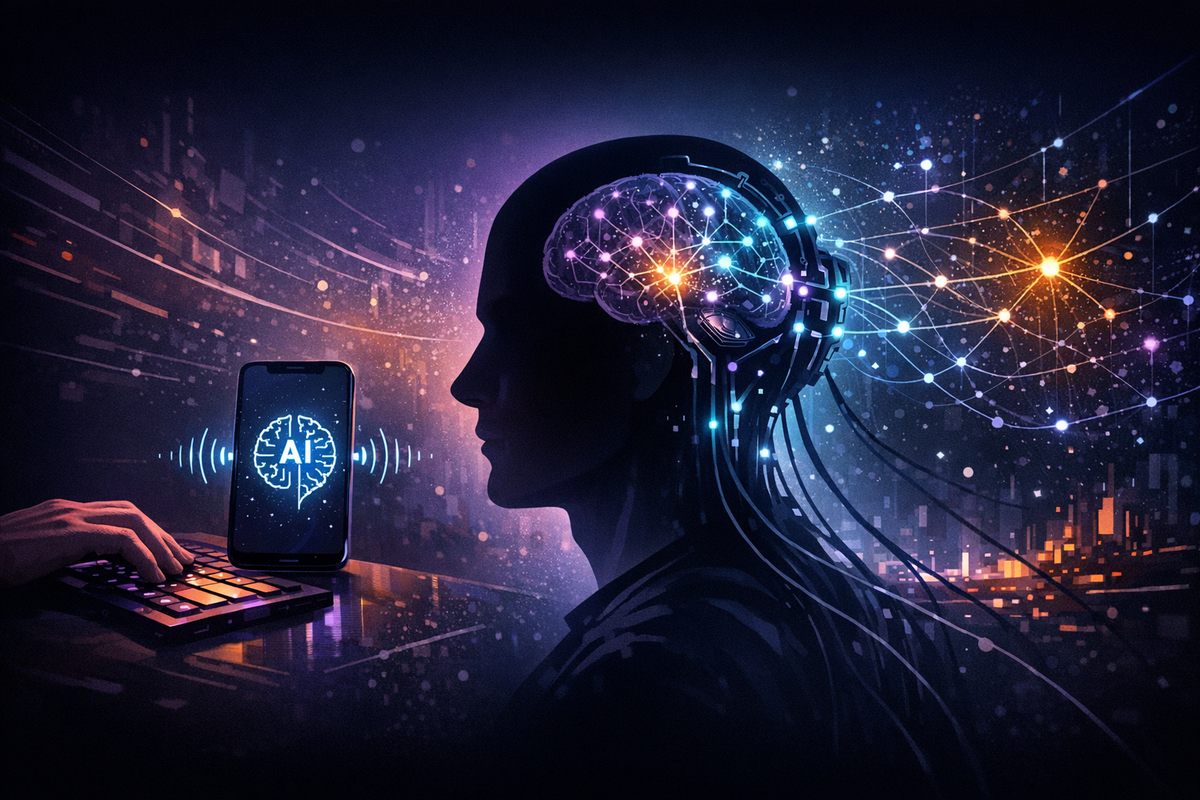
Yesterday I wrote a blog post from my iPhone while lying on a couch, chatting with an AI coding agent running on my Mac across the room. A year ago that would've sounded ridiculous.
The interface between human intention and machine execution keeps getting thinner. We typed commands into terminals. Then we talked to assistants. Then we tapped a link on a phone and controlled a coding agent from another room. Each step removed friction. Each step brought the machine closer to the thought.
There's one step left.
The Progression
2023: Copy-paste code from ChatGPT into your editor. Hope it compiles.
2024: AI assistants autocomplete your lines. You're still typing.
2025: Claude Code runs in your terminal. You describe what you want. It reads the codebase, writes the code, runs the tests. You review.
2026: You type /rc and control your AI agent from your phone. You build from anywhere.
202X: You think it. It builds.
That's not a metaphor. That's where brain-computer interfaces are headed.
The Bridge
Neuralink and BCIs aren't science fiction anymore. They're FDA-approved clinical trials. Patients are moving cursors with their thoughts, typing without keyboards. The bandwidth is low — for now — but the trajectory is clear.
Right now, the bottleneck in AI-assisted development isn't the AI. It's me. I can only type so fast. I can only articulate intent so precisely through language. My fingers are the slowest part of the system.
Remove the fingers, and you get something interesting. You think about a data structure and the AI sees the shape. You don't describe the architecture — you conceive it. Implementation flows from intention without the lossy compression of human language.
Pure creative flow. No translation layer. The ultimate pair programming.
Sounds amazing. And that's exactly what worries me.
The Part That Keeps Me Up
Who owns your thoughts? If your neural interface streams cognitive data to an AI service, who stores it? Who trains on it? Today we worry about companies reading our emails. Tomorrow it's our prefrontal cortex. And unlike an email, you can't unsend a thought.
The consent problem. If the AI acts on subconscious impulses — the half-formed ideas, the intrusive thoughts, the things you think but don't mean — where's the boundary between intention and action? You didn't say "delete the database." You just thought about it for a second. That distinction matters enormously, and we have no framework for it.
The opt-out tax. We already see this. Engineers who refuse to use AI tools are falling behind. It's a career choice now. What happens when the interface moves into your skull? Does choosing not to augment become a professional disability? "Unplugged" as the new "unqualified"?
The death of contemplation. This one bothers me most. When there's zero gap between thought and execution — when every idea is instantly materialized — do we lose the space where ideas actually mature? The shower thoughts. The walks where solutions crystallize. The productive struggle of wrestling with a problem until it clicks. Some of my best engineering decisions came from not acting on my first thought. What happens when every first thought becomes an action?
The dependency. I notice it already. I think differently when I know Claude Code is available. I take on bigger tasks. I sketch less carefully because I know the AI will catch the gaps. Now scale that to a neural link. If the AI is woven into your cognition, what happens when it goes down? Not your tools — your thinking degrades. That's a dependency we've never had to reckon with before.
Both Futures, Same Timeline
The thing is, I'm not a pessimist. I genuinely believe neural-AI interfaces will let us build things we can't currently imagine. The creative potential is staggering.
But the utopian and dystopian outcomes aren't competing timelines. They're the same one. The same technology that lets a paralyzed person write with their mind will let a corporation read cognitive patterns. The same interface that makes you a 100x engineer makes you dependent on infrastructure you don't control.
Every technology in history has been this way. Fire warms and burns. The internet connects and isolates. AI creates and displaces.
The brain-machine interface will just be the most intimate version of that trade-off. And unlike a phone, you can't put your brain in a drawer at the end of the day.
The last interface isn't a device. It's a question we haven't answered yet.
Related Reading
- The Verification Gap
- The Last Machine
- Claude Code Remote Control: Your AI Coding Agent in Your Pocket
- The AI Native Software Engineer
- The Architect's Protocol
- Decade Zero: A Realistic Blueprint for 2026–2035
Related Reading
Human Language Is the Best Programming Language