The Last Machine
The Last Interface removed the keyboard. Now remove the computer. Brain connected to cloud. No device in between. Game over.
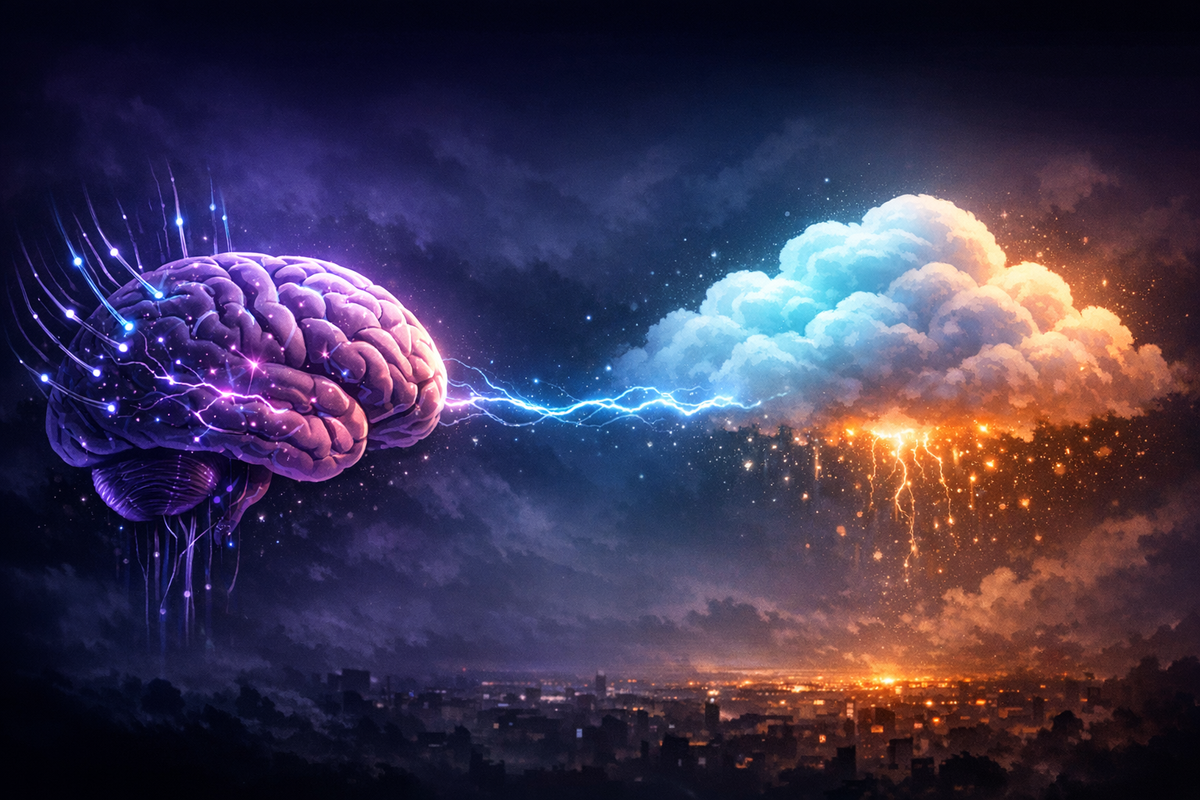
In the previous article, I explored one side of the equation — the interface between you and the machine getting thinner until it disappears entirely. Brain-computer interfaces replacing keyboards, voice, screens. Thought as input.
But there's another side nobody's talking about.
The machine itself is disappearing too.
Two Sides of the Same Coin
Right now I have a MacBook Pro. It's powerful, it's local, it's mine. My Claude Code sessions run on it. My files live on it. When I typed /rc and controlled it from my phone, the Mac was still the engine. The phone was just a remote.
But why does the engine need to be on my desk?
The Vanishing Machine
We've been watching this happen for years, just slowly enough that we don't notice.
Your photos aren't on your phone. They're on iCloud. Your documents aren't on your laptop. They're on Google Drive. Your code isn't on your machine. It's on GitHub. Your dev environments are moving to Codespaces, Gitpod, cloud VMs.
The local machine is becoming a window. A thin client with a nice screen and a good keyboard, pointing at compute that lives somewhere else.
Now remove the screen. Remove the keyboard. We already did that in the last article.
If you haven't read it: The Last Interface.
What's left?
Your brain. Connected to the cloud. Nothing in between.
The Architecture
Think about it as a system diagram.
Today: Brain → fingers → keyboard → local machine → cloud (sometimes)
Near future: Brain → voice/phone → local machine → cloud
Further: Brain → neural interface → cloud
The local machine drops out of the architecture entirely. It doesn't thin out or get smaller — it just becomes unnecessary. Why would you need a $3,000 laptop when the compute is elastic, infinite, and a thought away?
Your "machine" becomes a resource allocation in someone's data center. Scaled up when you're working, scaled down when you sleep. No fans, no battery, no storage limits. Just raw compute, on demand, streamed directly to your consciousness.
Why This Is Different
Cloud computing isn't new. We've had it for twenty years. But there's always been a local device mediating the connection. A laptop, a phone, a tablet. Something you own, something you control, something that works when the WiFi goes out.
Remove that mediator and the relationship changes fundamentally.
You own nothing. Not the compute, not the storage, not the interface. Your entire digital existence — your work, your tools, your AI pair programmer, maybe your augmented cognition itself — lives on infrastructure controlled by someone else. You're a tenant in every sense.
The single point of failure is everything. When your laptop crashes today, you grab your phone. When your phone dies, you use your laptop. When the cloud goes down, you work locally for a bit. What happens when the cloud goes down and there is no local? When the only machine in the architecture is the one you don't control? Your brain is connected, your work lives there, your AI co-pilot runs there — and someone else's infrastructure decision just severed the link.
Latency becomes cognitive. Today, cloud latency means a page loads slowly. Annoying, but manageable. When the cloud is directly wired to your neural interface, latency means your thinking lags. A network hiccup doesn't freeze your browser — it freezes you. That's a dependency we've never had to consider.
Geography becomes destiny again. You'd think cloud computing erases geography. It doesn't — it just makes us forget about it. Data centers have locations. Locations have jurisdictions. Jurisdictions have laws. Your "brain in the cloud" will be subject to the regulations of wherever that data center sits. Move countries, and your cognitive infrastructure might not follow.
The Business Model Writes Itself
Here's what keeps me thinking. Every trend in tech for the last decade has pointed toward the same model: you don't own the thing, you subscribe to it. Software, music, movies, storage, compute. Ownership is out. Access is in.
Now apply that to your development environment. Your AI agent. Your augmented cognition.
A monthly subscription to think at full capacity. Tiered pricing for cognitive bandwidth. A free tier that's just slow enough to make you upgrade. Enterprise plans for companies that want their engineers' neural links running on dedicated hardware.
Sound dystopian? It's literally the business model of every cloud provider and SaaS company today. Just applied one layer deeper.
The Sovereignty Question
This is where both articles converge.
The Last Interface asked: who owns your thoughts when the input is neural?
The Last Machine asks: who owns the compute when there's no local device?
Put them together: who owns you when your brain is connected to someone else's cloud, running someone else's AI, with no local fallback?
Digital sovereignty isn't an abstract policy debate anymore. It's personal. It's architectural. And the architecture we're building — enthusiastically, eagerly, because it's genuinely better in every measurable way — that architecture has a single point of failure that happens to be someone else's business decision.
I'm not saying we shouldn't build it. We will. It's inevitable and in many ways wonderful.
I'm saying we should notice what we're trading away before we forget we ever had it.
Related Reading
- The Verification Gap
- The Last Interface
- Claude Code Remote Control: Your AI Coding Agent in Your Pocket
- The AI Native Software Engineer
- Decade Zero: A Realistic Blueprint for 2026–2035