The Robots Are Coming, and My Kids Can’t Wait
Everyone keeps asking whether AI will take their kids’ jobs. Wrong question. The kids growing up now won’t compete with AI — they’ll speak it natively, and a head start on that fluency is the best investment I know of.
Every few weeks someone asks me, half-joking, whether I’m worried about what AI means for my kids. Will there be any jobs left? Should they even bother learning to code?
I get the worry. I just think it’s aimed at the wrong end of the telescope.
The kids growing up right now are not going to spend their lives fighting AI for scraps. They’re going to grow up with it — the way I grew up with the internet and my parents grew up with the telephone. As furniture. Ordinary. Assumed. The generation that treats a technology as magic is always followed by the generation that treats it as Tuesday.
So no, I’m not scared. If anything, I’m a little jealous.
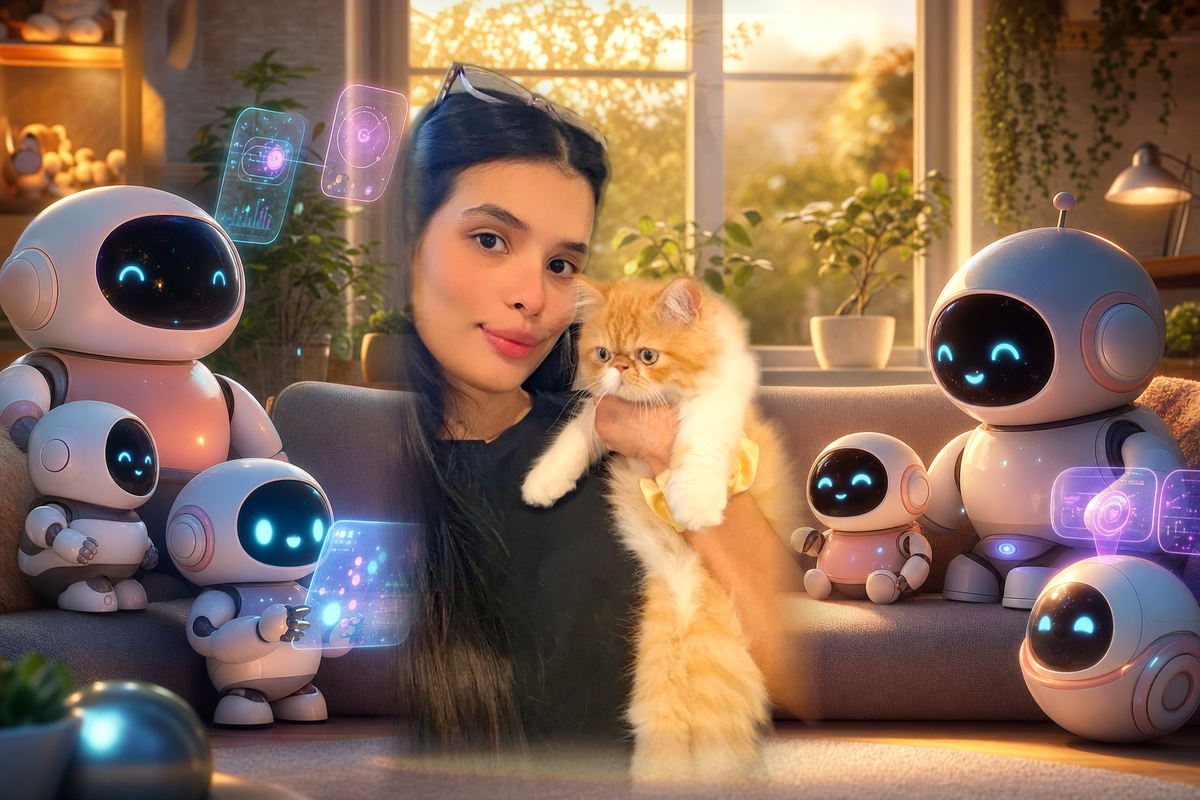
And none of it is left to chance. I’m deliberately building a little crew around my kids — curious, health-and-tech-minded people for whom learning is a default setting, not a chore. The newest is their nanny: a medical background, the same health-and-tech obsession I run on, and the one up top holding the magnificently unimpressed Persian. (The robots I added.) Put a kid among people like that and curiosity stops being something you teach them — it just becomes the air in the house.
The scary question — “will AI take my kid’s job?” — misreads the whole thing. Today’s kids won’t fight AI for scraps; they’ll grow up fluent in it, the way we did with the internet.
And it isn’t a wave still out at sea for them to face later — agentic and embodied AI is already here, already ordinary.
The highest-return investment I have access to isn’t a token or an index fund. It’s a curious kid, compounding for 80 years.
Don’t teach the tool — teach the taste: judgment, good questions, verification, direction. The tool churns; the meta-skill doesn’t.
Expose, don’t impose. And measure success the way a master does: you’ve won when the student surpasses you.
AI isn’t the future. It’s the water.
The mistake underneath most AI-and-kids anxiety is temporal. People picture AI as a wave still out at sea — something their children will have to brace for later, once they’re grown. It already made landfall.
Agentic AI — software that doesn’t just answer but plans, acts, and executes on your behalf — was worth roughly $7.5 billion in 2025 and, by one widely-cited forecast, reaches somewhere near $200 billion by 2034, compounding north of 40% a year. Analysts disagree on the exact number — estimates for 2034 run from about $70B to past $200B — which tells you nobody’s sure of the size, but everyone agrees on the shape: straight up.
And it isn’t staying on screens. The same kind of models that write code and draft contracts are being wired into humanoid robots that walk, grip, and learn from demonstration — moving out of research labs onto real factory floors and into pilot deployments. The border between “AI” and “the physical world” is dissolving in real time.
For a kid who’s a schoolchild today, none of this is a forecast. It’s the environment. They will not remember a world without machines that talk back — and increasingly, that reach back.
The best asset class is a curious kid
I spend a lot of my life deciding where to put capital — time, money, attention. And I’ve landed on a boring, unshakable conclusion: the highest-return investment I have access to isn’t a token, a property, or an index fund. It’s my kids.
Not in the trophy-parent sense. In the literal compounding sense. A unit of curiosity invested in childhood, at the start of a decade about to be defined by human-machine collaboration, compounds for the next eighty years. Nothing on any exchange does that.
And unlike most assets, this one’s moat keeps widening. Every year AI gets more capable, the premium on people who know how to wield it goes up, not down. Teaching a kid to think alongside these systems now is buying the most important skill of their lifetime while it’s still cheap. You don’t need to mint a machine-learning researcher. You need a kid who grows up fluent — comfortable, unintimidated, playful — with tools most adults are still nervous to open.
Native speakers
Here’s the part that flips me from anxious to optimistic.
I’m good at this. AI-native engineering is my actual craft — I spend my days orchestrating agents, and I’m genuinely fluent at it. But I’ll always have an accent. I learned this language as an adult. I remember the before.
My kids won’t. To them, an AI that can see, reason, write, and act isn’t a breakthrough — it’s just how computers have always worked. They’re native speakers. The rest of us are immigrants who studied hard and still fumble the grammar. That’s not a threat to them; it’s the one advantage I can’t hand myself no matter how much I practice. The best I can do is not stand in front of it — and give them sharper tools than I had.
Native exposure isn’t the same as competence, though — growing up around cars doesn’t make you a mechanic. Comfort is the starting line, not the finish; the job is to turn that comfort into fluency. Which raises the obvious question: fluency in what, exactly?
Prepare them for AI that does things
Teaching a kid to chat with a model is fine, but it isn’t the destination. The real AI space is going agentic and embodied — systems that plan, call tools, coordinate, and act in the world. And that raises the stakes in a very specific way: a chatbot can hand you a confident wrong answer; an agent can take a confident wrong action.
So the skills that matter aren’t about barking commands. They’re about directing capability responsibly — turning a fuzzy intention into a clear goal, naming the constraints, asking what could go wrong, deciding which calls still need a human in the loop. AI systems aren’t vending machines for truth; they’re collaborators with strange strengths and very real failure modes, fast without always being right. A kid who internalizes that early is starting from somewhere it took the rest of us years to reach.
Teach the taste, not the tool
So what do you actually teach? Not “how to use this week’s chatbot.” Any specific app is a moving target — the one they’ll lean on at twenty-five hasn’t been named yet.
The World Economic Forum’s 2025 Future of Jobs report estimates that 39% of workers’ core skills will change by 2030. Read that as a promise: a big chunk of today’s specific know-how has a short shelf life. Betting a childhood on any single tool is a bad trade.
What doesn’t churn is the meta-layer — and it’s all teachable to a kid:
- Taste — knowing what “good” looks like, so you can tell when the machine hands you slop.
- Questions — the whole game with AI is asking the right thing, well. Prompting is just curiosity with better aim.
- Verification — trusting nothing blindly, checking the model’s work, learning how it fails.
- Direction — treating AI as something you manage, not something you obey.
None of that is a piece of software. All of it is easier to plant young than at forty, before the fear sets in. I’m not raising my kids to memorize an interface. I’m raising them to have good taste and stubborn curiosity, and to point both at whatever tool exists when they’re grown.
In an AI world, “learn to code” is almost beside the point. Learn to judge. The syntax is getting cheaper by the month; the judgment is the scarce, priced, human part.
Expose, don’t impose
One thing I watch myself on, because it’s easy to get wrong.
My kids, when you ask them, say they want to be “an engineer like dad.” I won’t pretend that doesn’t make me grin. Technology is what bought me my freedom — work from anywhere, build what I want, structure life on my own terms — and some animal part of me lights up when they reach for the same thing.
Which is exactly why I keep myself honest. The goal was never to flash my ambitions onto them like firmware. The job is to expose, not impose — lay out a wide table of interests (code, sure, but also biology, building, art, movement) and then follow their curiosity wherever it actually runs. If one of them pivots hard into music or medicine, the AI fluency still pays off: every field is about to be an AI field. The tools are universal even when the passions aren’t.
So I build the environment, not the outcome — a home where questions are cheap, experiments are encouraged, screens are tools and not pacifiers, and the adults nearby are as curious as the kids. Make discovery the default and you never have to sell it; they chase it on their own.
And yes — boundaries still matter. There’s still boredom, physical play, friendships, and long stretches where no algorithm is trying to help. Real AI fluency includes knowing when to close the machine.
Locking kids away from AI entirely feels protective, but it mostly leaves them worse at spotting bad output. Supervised practice builds sharper instincts than enforced innocence.
The master’s real win
There’s an old idea in the martial-arts and craft traditions I keep circling back to: a master hasn’t truly succeeded until the student surpasses him. Not equals him. Surpasses him.
It sounds like humility. It’s actually the entire point. If everything I know is the ceiling for my kids, I’ve failed — I’ve just made smaller copies of myself. The win condition is that they take the head start, stand on it, and reach things I can’t. That someday they look at how I work with these systems the way I look at a rotary phone: fondly, and with mild disbelief that anyone got by like that.
That’s what “investing in your kids and AI” actually means. Not future-proofing them against the machines. Handing them the keys early, teaching them taste and nerve, and then stepping out of the way so they can go further than I ever will.
The robots are coming. My kids can’t wait. Honestly — neither can I.
Decade Zero: A Realistic Blueprint for 2026–2035 — why AI is present tense, not future tense.
The AI Native Software Engineer — the craft my kids see me practice every day.
The Last Interface — the agentic future they’ll grow up directing, not just chatting with.
Meta Ray-Ban Display: $799, One Eye, and a Wristband That Reads Your Nerves — ambient AI you wear rather than watch.