
Envigado
You catch a good wave, you keep riding it. After years in Poblado the house is full — five or six people every day, cats, dogs, a family growing in about five directions at once. So I spent a couple of quiet months buying a house in Envigado.
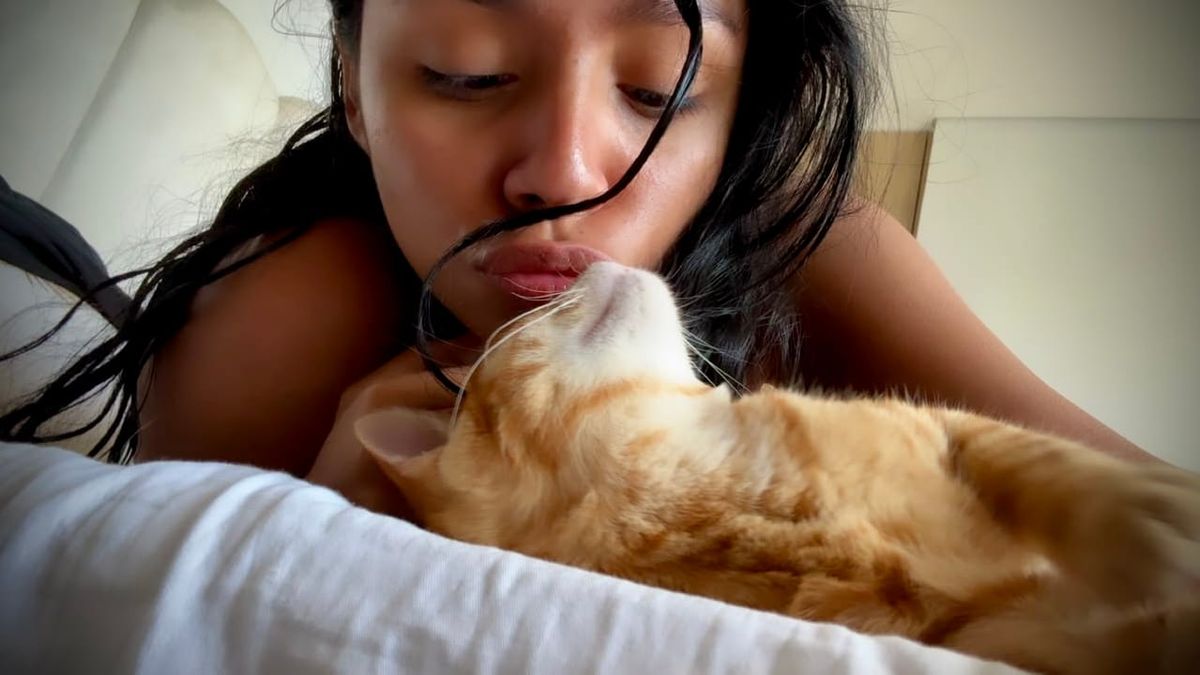
Coffee, Banana, Honey, Cinnamon
This is a direct sequel to What a Day!, and the logic is simple: when you catch a good wave you don't get off it. You ride it until it puts you on the sand.
So — morning. Coffee. A banana with raw honey and cinnamon. Sofi's cat Mango has determined that the banana is partly his and is negotiating accordingly. The valley is outside the window doing its usual thing, which is being unreasonably green at seven in the morning.
And I'm sitting there thinking about the thing I've been working on quietly for a couple of months, which I can finally talk about.
We bought a house. In Envigado.
The House Got Full
I've spent most of my time in Medellín in El Poblado, and I have nothing bad to say about it. It was a blast. It's where the Colombian chapter of my life started, where I learned the city, where I met most of the people I now can't imagine not knowing.
But something happened while I wasn't paying attention: the family grew. Not in one direction — in about five at once.
On any given day there are now five or six people in the house. The kids. Kelly. Sofi. Cristina. Work. Cats, dogs, and the permanent low-grade diplomatic incident between them. Homeschooling in one room while a call across three time zones happens in another. Someone cooking, someone training, someone doing homework at the same table where someone else is shipping code.
And it will keep growing, because we are going to keep building great things — and building great things is not something you do alone in a quiet apartment. It needs room.
At some point you stop rearranging furniture and admit the actual problem: the container is too small. We didn't need a bigger apartment. We needed a bigger, better, *different kind* of place.
What Poblado Is, Honestly
El Poblado is Comuna 14 of Medellín, and for a certain phase of life it's close to perfect. Provenza, Manila, the Milla de Oro. Everything walkable, everything open late, everyone speaks some English, a coworking space or a specialty coffee bar every two hundred meters.
It has also become the most concentrated expression of Medellín's tourism boom. A 2025 city planning document counted roughly 14,200 short-term rental units inside El Poblado — about 41% of Medellín's entire offered inventory, in a comuna of around 130,000 residents. The city has since been tightening controls on short-let apartments in residential buildings there, after a steady stream of coexistence complaints.
That's not a complaint, it's a description. What that density buys you is energy. What it costs you is quiet, parking, traffic, and a building where a meaningful share of your neighbors are on day four of a ten-day trip. Poblado is optimized for arriving. I'm a long way past arriving.
And to be fair to it: the quiet hills of Poblado — Los Balsos, San Lucas, parts of El Tesoro — are nothing like Lleras and shouldn't be lumped in with it. The problem was never Poblado. The problem was that what I need now is a different shape.
Envigado Is Not a Neighborhood
This is the part most foreigners get wrong, and it's the part that made the decision for me.
Envigado is not a district of Medellín. It's its own city. Its own municipality, its own mayor and council, its own planning department, treasury, property-tax administration and traffic authority. It borders El Poblado to the north — ten minutes by car — but crossing between them means crossing an actual municipal line, not a neighborhood boundary.
It kept that autonomy for the least dramatic reason possible: it was simply never annexed. It stayed outside Medellín's metropolitan area entirely until residents voted to join in 2016 — and joining didn't dissolve anything. It still runs itself.
The conventional founding date is 1775, which made last year its 250th, though local historians will tell you the surviving parish document is dated 1776 and the official date is tidier than the archive. Its 2024 municipal plan projects around 248,000 residents across roughly 79 square kilometers — most of which, and this surprised me, is rural.
They call it la Ciudad Señorial, and locals describe it as *un pueblo con sabor a pueblo* — a town that still tastes like a town. That reads like tourism-board copy until you stand in the Parque Marceliano Vélez on a Sunday, in front of the Santa Gertrudis church, surrounded by families and an aggressive quantity of pigeons, and notice that nobody there is performing for anybody.
Some things I didn't know before I started looking seriously:
- It has money of its own. Envigado hosts the Sofasa vehicle assembly plant and the headquarters of Grupo Éxito, Colombia’s largest supermarket chain. An industrial tax base is a boring fact with very unboring consequences — it is a large part of why the parks, libraries and sports facilities are as good as they are.
- It is genuinely safe, by the numbers. Envigado recorded about 3.7 homicides per 100,000 residents in 2023 — a figure that would be unremarkable in Western Europe and is extraordinary in Latin America. Ordinary property crime still exists. This is not a gated fantasy.
- It has a philosopher. Fernando González — el filósofo de Otraparte — lived and wrote here. His house became a museum in 1987 and a national cultural asset in 2006, and the Otraparte complex still runs talks, films and literary programming. There is also the Débora Arango library and cultural park. A town of 250,000 with a working literary institution at its center tells you something about the town.
- It has a forest and a mountain. Parque Ecoturístico El Salado sits in the hills right above town. The municipal seat is on the valley floor, but Envigado’s territory climbs to 2,500–2,900 metres toward Las Palmas — average temperature drops from about 22°C downtown to 18°C up top. You can change climate without leaving the municipality.
- It produces footballers. Envigado FC plays in the first division and its academy is a national institution: James Rodríguez debuted for the first team at fourteen, in May 2006. Juan Fernando Quintero and Jhon Córdoba came through the same cantera.
- It has a street just for eating. The Calle de la Buena Mesa, in Jardines, is pedestrianized and packed with restaurants — a real gastronomy strip with no club district attached to it.
My favorite piece of local trivia, and a good illustration of how confusing this is from the outside: the metro station called Envigado isn't in Envigado. It sits in Itagüí. The one station on Line A actually inside Envigado's jurisdiction is Ayurá. You can live here for a while before anyone mentions that to you.
And every year the town throws the Fiestas del Carriel, a week built around the leather satchel that is the emblem of the Antioqueño countryman. An entire municipality celebrating a bag, completely unironically, because of what the bag means. I find that wonderful.
The Numbers, Since You'll Ask
Here I have to correct the thing everybody repeats, including what I believed going in. Envigado is not dramatically cheaper than Poblado per square meter. A mid-2026 crawl of listing portals put median asking prices at roughly 8.1 million pesos per square meter in Poblado against 7.8 million in Envigado. That's a rounding error. Prime Envigado is not cheap and hasn't been for years.
The gap shows up in two other places, and they're the ones that matter:
New construction. Around 15 million pesos per square meter in Poblado versus about 9.9 million in Envigado — roughly a third less for a comparable new build.
Land. This is the real story. Poblado above a certain price point is towers — beautiful towers with forty square meters of balcony. In Envigado's Escobero, Las Brujas, El Chocho and Las Palmas sectors, houses of 300 to 500 square meters on lots of 500 to 2,000-plus are a normal listing rather than a unicorn. That kind of outdoor space in built-out Provenza or Manila is scarce and priced accordingly.
So the honest framing isn't "Envigado is the cheap option." It's that for the same money you buy a fundamentally different asset — ground instead of altitude. And ground is exactly what a household with kids, dogs, cats and a permanent open-door policy needs.
Ours has a big outdoor area. Room for the kids to be loud in. Room for the animals. Room to put a long table outside and feed ten people without anyone eating standing up.
The Honest Downsides
It'd be a bad article if I only gave you the good half.
It's hilly. Same as Poblado. If your dream is a flat, walkable grid, this isn't it — that's Laureles.
Downtown Envigado is loud. Buses, taxis and motorbikes, all day. The calm is in the residential lomas, not around the plaza.
Fewer laptop cafés and coworking spaces. Poblado has dozens. Envigado has a handful. If your working life depends on rotating between third places, price that in.
You're at the south end of everything. Most trips start with a drive. Lower Envigado to Poblado is 15 to 30 minutes off-peak and 30 to 60-plus at peak; a cross-loma run from Escobero to El Tesoro can hit 45 to 90 minutes on a genuinely bad day.
The air is not cleaner. This one gets romanticized constantly and it's just false. Envigado sits in the same closed valley as Medellín and shares the same seasonal particulate episodes, worst around March and again in October and November. Altitude helps; the valley doesn't care which municipality you pay taxes to.
Less English. Which I'd personally file under advantages, but it belongs on the list.
And one that's specific to how I work: if you run a distributed team from your house, verify connectivity at the exact address before you sign anything. Fiber availability, a viable second provider, mobile failover, backup power. Up on the lomas this is a real variable, not a formality. A beautiful house with one fragile uplink is a liability when there are people in three countries waiting on you.
Every one of those is a fair price for what you get back. But you should know you're paying it.
Quietly, For Months
Here's the part I'm actually proudest of, and it isn't the house.
I ran the whole thing quietly for months. No announcements, no posts, nobody told what I was *about* to do. Just the work: finding the right place, getting the structure right, getting the right professionals around the table, taking the time to do it properly instead of fast.
Buying property in a country that isn't the one you were born in is not a transaction. It's a project — with legal, tax and structural questions that deserve real attention and real specialists, and that reward patience enormously. I took the slow route deliberately. It's done, and it's done right.
There's a lesson in there with nothing to do with real estate. The things that actually change your life get built in silence. You talk about them once they're real. The announcement isn't the milestone. It's the receipt.
What Comes Next
Now the good part: planning and organizing to turn it into something genuinely spectacular. Layout, work spaces, spaces for the kids, spaces for the animals, the outdoor area, the kitchen, a corner for training. All of it designed around how this household actually lives instead of how a floor plan assumes it does.
We move soon. There will be chaos, there will be boxes, and there will be at least one cat who takes the whole thing personally.
The Same Project
I keep circling the same idea, so I'll just say it plainly.
Building good things and building a good life aren't two projects competing for the same hours. They're one project. The product, the protocol, the house — those are outputs. The actual thing is being surrounded by people who are good at what they do and good to be around, doing the work alongside them, in a place with enough room for everybody.
Sofi. Kelly. Cristina. My kids. The team across three countries. The friends here who showed up for this without being asked. None of that is an accident, and none of it is solo. The best decision I ever made was choosing this city. The second best was choosing the people in it.
You catch a good wave, you ride it. Then you go find a bigger board.
Universo es bello! 🧙🏻♂️
Related Reading
- What a Day! — the wave this one is riding.
- The City of Eternal Spring — why Medellín in the first place.
- Blood-Gold in a Jar — the honey on that banana.
- Longevity — Good Company — the people you surround yourself with, as a health variable.
- Money Maker — the building thesis underneath all of it.
- Krv Nije Voda — Blood Is Not Water — the house it needed, and the thing it is for.