
Fitness Is Infrastructure
Preparedness gets sold as objects — go-bags, water drums, generators. On Monday morning a magnitude 7.4 earthquake asked my family for none of them. It asked for twenty-nine flights of stairs.
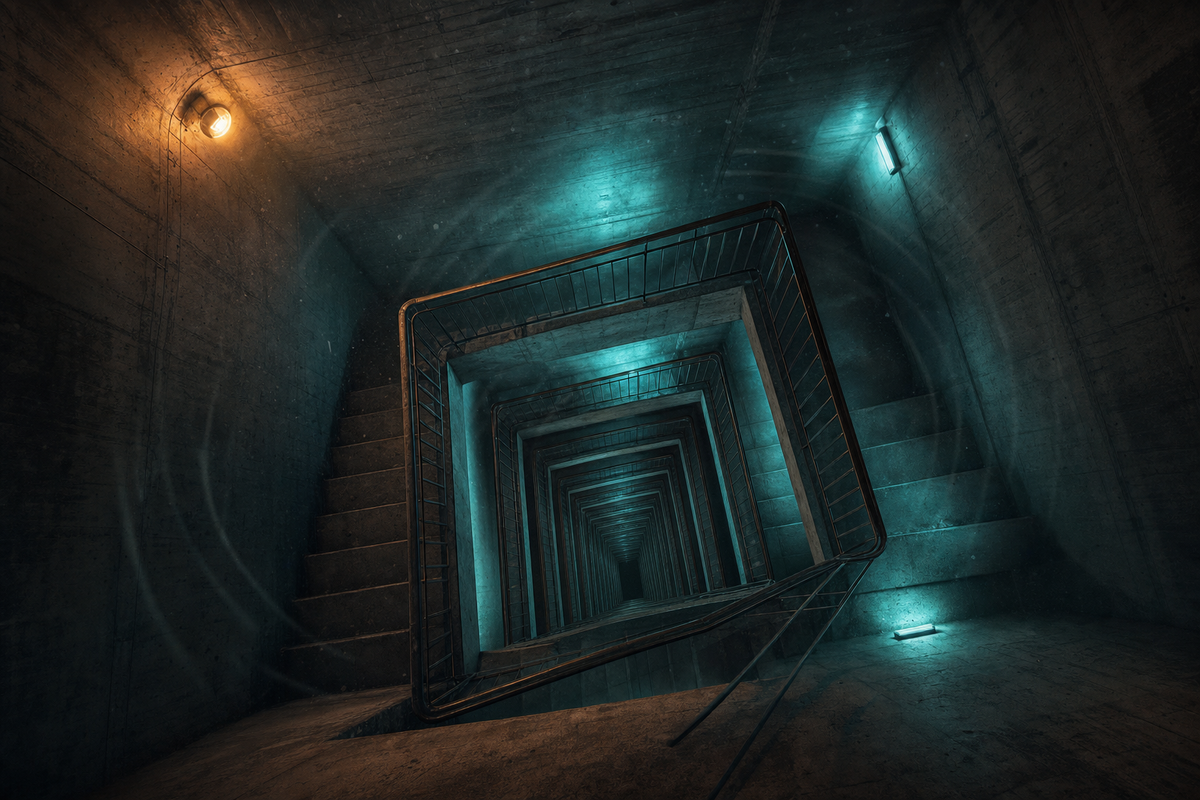
At 07:34 local time on Monday morning, a moment-magnitude 7.4 earthquake struck western Colombia. I live on a high floor in Medellín, 172 kilometres from the epicentre. When the building started moving, my two kids and I took the emergency stairs and walked down twenty-nine floors.
We got to the bottom without stopping and without anyone being winded. That is the entire story. It is also the point.
The easy version of a hard morning
Before anything else: we got the easy version.
By Monday afternoon the reported toll was at least twenty dead — most of them in Pereira, some in Manizales — with further fatalities and injuries in Chocó, closest to the rupture. Cali's mayor reported around twenty collapsed structures with people trapped. Facades came down in Cali and Manizales, a cathedral tower in Manizales was damaged, and civil aviation suspended operations at six airports. Those numbers were still moving as I wrote this. Distance, depth, construction and luck did far more for my family that morning than fitness did.
What fitness did was smaller and much more specific. It turned the one physical task that actually landed in front of us into an ordinary walk. That is worth writing about, because it is the part of preparedness that almost nobody buys.
What happened about a hundred kilometres underground
The epicentre was 5 km south of San José del Palmar, Chocó. The USGS put the depth at 110 km; the Servicio Geológico Colombiano put it at 96 km. Either way this was an intermediate-depth intraslab earthquake — a rupture inside the subducting Nazca plate rather than a shallow break in the crust. Per the USGS it was the largest earthquake in Colombia in a decade, drew an orange PAGER alert, and had collected 673 felt reports by that afternoon.
Depth trades intensity for reach. At the same magnitude and all else equal, a rupture a hundred kilometres down produces lower shaking near the source and a much wider felt area than a shallow one, because even the town directly above it is already a long way from the hypocentre. This one was felt in Pereira at 61 km, Manizales at 84, Quibdó at 105, Cali at 158, Medellín at 172, Bogotá at 241, and onward into Panama and Ecuador.
Medellín reported no structural damage — the fire department ran verification patrols and found nothing. The city sits in Colombia's intermediate seismic hazard zone, and towers here are designed under a code that expects them to move. So across half a dozen cities the event resolved into the same mundane physical task for a lot of people at once: get down the stairs.
Twenty-nine floors is not "walking down"
Call it 2.9 metres per floor — an estimate, not a survey. Twenty-nine floors is then roughly 85 metres of vertical drop and somewhere around five hundred individual steps.
For a 105 kg body, dropping 85 metres releases about 87 kilojoules of gravitational potential energy. That is energy the body has to absorb, not energy it burns — the two are different, and conflating them is where most stair math goes wrong. Spread across five hundred steps it is roughly 175 joules per step, much of it taken by whichever quadriceps happens to be landing.
Metabolically the whole descent is cheap. Structurally it is not. Going down twenty-nine floors is not an energy problem, it is a braking problem. The quads never lift anything — they lengthen under load to stop you falling, five hundred separate times. That is eccentric contraction, and it is the single most misunderstood thing about stairs.
Descent is the deceptive direction
Everybody assumes up is the hard one. Metabolically, yes. But descent is the direction that leaves a mark, and it does it quietly.
The MET figures are reference estimates for defined activities, not fixed properties of a direction — but the gap between them is the point. Descent runs at roughly the intensity of a purposeful walk while doing something a walk never does.
The contact-area row is the one to sit with. In the cadaveric and imaging work on stair mechanics, the patellofemoral joint engages a smaller contact area in descent than in ascent — around 249 mm² against 434 — and measured contact pressures at that flexion angle land near 2.6 megapascals. Less surface sharing the load is a large part of why descending stairs is the movement that finds a bad knee first.
Eccentric contractions also produce high force at unusually low metabolic cost. That efficiency is why your lungs stay quiet on the way down. It is also why soreness and temporary force loss can show up 12 to 24 hours later and peak somewhere in the 24-to-72-hour window, in people who felt fine at the bottom.
Real occupants are much slower than the models
Building egress models start from clean assumptions: known route, working lights, orderly flow, everybody moving at a standard pace. Then real people show up with real bodies, in real conditions.
The NIST investigation of the World Trade Center evacuation (NCSTAR 1-7) reconstructed the stairwells from survivor accounts. The average surviving occupant spent 48 seconds per floor — roughly half the speed previously reported for non-emergency evacuations — and stairwell doors discharged about 37 people per minute, comparable to the slowest rate on record for an ordinary drill.
Those are not the same measurement and should not be treated as one. The NIST figure is a crowded emergency evacuation — congestion, counterflow, pauses, injuries, enormous variation in physical capacity — not a free descent by a fit person in an empty stairwell. That is precisely why it matters. Buildings evacuate populations, not test subjects. At that rate twenty-nine floors takes twenty-three minutes.
One correction to something you will see repeated: the well-documented "deceleration after about twenty floors" finding comes from stair ascent, not descent. In 50-storey descent trials there was no comparable collapse in pace, though about half the participants did slow measurably over the back half. And at least one study found no significant relationship between body mass index and stair walking speed at all. The physics of moving more mass down 85 metres is not in dispute. The claim that it makes you visibly slower in a stairwell is weaker than people assume.
Adrenaline edits the dashboard
Something else is running during an event like this, and it corrupts your own read of how hard something was.
Within seconds of a threat, sympathetic activation can push epinephrine and norepinephrine sharply. Heart rate climbs, contractions strengthen, breathing deepens, blood flow redistributes, stored glucose becomes easier to reach. Cortisol follows more slowly. The result can be a strange pairing: a high pulse alongside a modest sense of effort, because some of that heart rate is threat rather than oxygen demand. Stress-induced analgesia can dampen what reaches you, though it varies a lot between people and situations.
None of that creates energy. It edits what you notice. Which is the honest asterisk on "nobody was winded" — some of that was conditioning and some was chemistry, and the chemistry can send its invoice afterwards, as shaky hands or abrupt fatigue once the threat is gone.
High arousal tends to cost something else too. Working memory narrows. Fine motor control degrades. People are more likely to fixate on one cue, repeat an action that is not working, or fumble an unfamiliar lock. Mass panic is rarer than films suggest, but novel decision-making under that much adrenaline is genuinely worse.
If you already know the route, already know which door, already know where the stairwell lets out — you are running a sequence instead of solving a puzzle. Under stress that is worth more than strength is.
The kids were solving a different problem
Children are not scaled-down adults. They carry far less mass, so each landing contains a fraction of the energy mine did. Kids who move a lot also accumulate balance practice through ordinary play that most adults have quietly deleted from their lives.
But shorter legs make each riser relatively taller. Step frequency goes up, the range of motion per step is larger, and depending on age the binding constraint often is not force at all — it is coordination and attention. Regulate speed, place the whole foot, handle the landings, do not bunch up behind an adult, stay balanced while every adult around you is behaving abnormally.
Worth saying plainly, because it cuts against my own story: kids thermoregulate differently from adults, so "they did not sweat" is not a measurement of anything. What it was — combined with normal breathing, steady movement and no need to stop once — is decent evidence the task stayed inside their reserve. That reserve mattered more to me on Monday than any number I have ever put on a bar.
What ordinary training actually transfers
This is the actionable part, because not everything in a training program shows up when a building moves.
The last two rows are the uncomfortable ones. Muscle is genuinely useful here — it is what does the braking. But on a staircase, strength has to be counted per kilo of the body doing the descending, because every extra kilogram is more energy to absorb at each of five hundred landings.
Build the stairwell into your legs before you need it
Concrete, cheap, and almost nobody does it.
Walk your actual emergency route. Start at the door you would really use. Find both stairwells if there are two. Learn whether the re-entry doors lock behind you, where the stairs let out, whether that exit is the lobby or somewhere else entirely, and where the lighting changes. A route your feet have actually been on beats a floor plan you glanced at on a wall.
Timing is not mine to prescribe. Standard guidance during active shaking is drop, cover and hold on — not sprint through a moving building. Stairs are for after it stops, or when evacuation is actually called for, and that call depends on damage, aftershocks, your building and what the authorities say. What my family did in one building on one morning is a story, not a protocol.
Assume the elevator is gone. Power fails, safety systems recall the car, rails go out of alignment, the shaft takes damage. Until somebody has inspected it and released it, an elevator is not an evacuation plan.
Train the descent on purpose. Step-downs, three sets of six to ten per leg, three or four seconds to lower. Split squats with the same slow eccentric. Downhill walking. Build load and height gradually — the first real eccentric session produces soreness out of all proportion to how hard it felt, and then the repeated-bout effect kicks in and later sessions cost much less. It reduces the damage; it does not abolish it.
Keep shoes you can actually descend in within reach. Five hundred steps in loose sandals or socks is a different activity. Closed, secure heel, predictable grip. Though an emergency is not the moment to stand in a hallway hunting for the perfect pair.
Test the go-bag on the stairs. A bag that feels fine for thirty seconds in a kitchen changes your posture and your balance by floor twenty. A front-carried load blocks your view of the next tread. Keep one hand free for the rail.
And do not race. Racing costs you spacing, attention and margin for error, and it buys almost nothing. The goal is not the fastest theoretical descent. It is arriving with control and with something left.
What was available at 07:34
Most preparedness spending buys conditional assets. The water drum helps if you are home. The go-bag helps if you can reach it. The generator helps if the building is still standing and accessible. Every one of them is contingent on where you happen to be standing when it starts. They are all worth having — I am not arguing against any of them.
A trained body is the one that comes with you into every office, hotel, airport, parking garage and stairwell you will ever walk into. And you cannot acquire it in the ninety seconds after the shaking starts. It is the slowest thing on the list to build and the only one you never have to remember to bring.
It is also not sufficient, and I want to be exact about that. A body can be injured or ill or carrying somebody else. We were 172 kilometres out, in a city that took no structural damage, in a building designed to move. People closer to the rupture faced things no training program touches. Fitness is one layer. It is not the answer.
But the task that did land on us — 85 vertical metres, five hundred controlled landings, two kids — was an ordinary Monday for our legs. And because it was ordinary, none of my attention had to go to my own breathing or my own knees. All of it went to them.
That is the return. Not a number on a bar, not a lab marker, not a longevity curve thirty years out. A morning where the building moved, and the three of us walked down twenty-nine floors together and came out the bottom with plenty left.
Event data: USGS event us6000tjl2 and the Servicio Geológico Colombiano bulletin.
Evacuation behaviour: NIST NCSTAR 1-7, Occupant Behavior, Egress and Emergency Communications; and Choi, Galea & Hong, Individual Stair Ascent and Descent Walk Speeds Measured in a Korean High-Rise Building, Fire Technology.
Intensity values: Compendium of Physical Activities. Knee mechanics: Contact area and pressure changes of the patellofemoral joint during stair ascent and descent, BMC Musculoskeletal Disorders.
Addicted to the Gym — why Friday-night rows become a rewarding, measurable habit.
MONSTER 2.0 — The Blueprint — the training block that built the legs this article is about.
Three of Six — the most recent session log, two days before the earthquake.
Sunday Is Part of the Program — the quieter recovery work that makes the next hard session possible.