Roblox, Legs, Sushi
Legs are the biggest lever you own — the most muscle, the most systemic stress, the strongest tie to metabolism, circulation, and how long you stay on your feet. So why is leg day the one everyone skips? A day in three beats — rest, train, refuel — and the case for the muscles you least want to
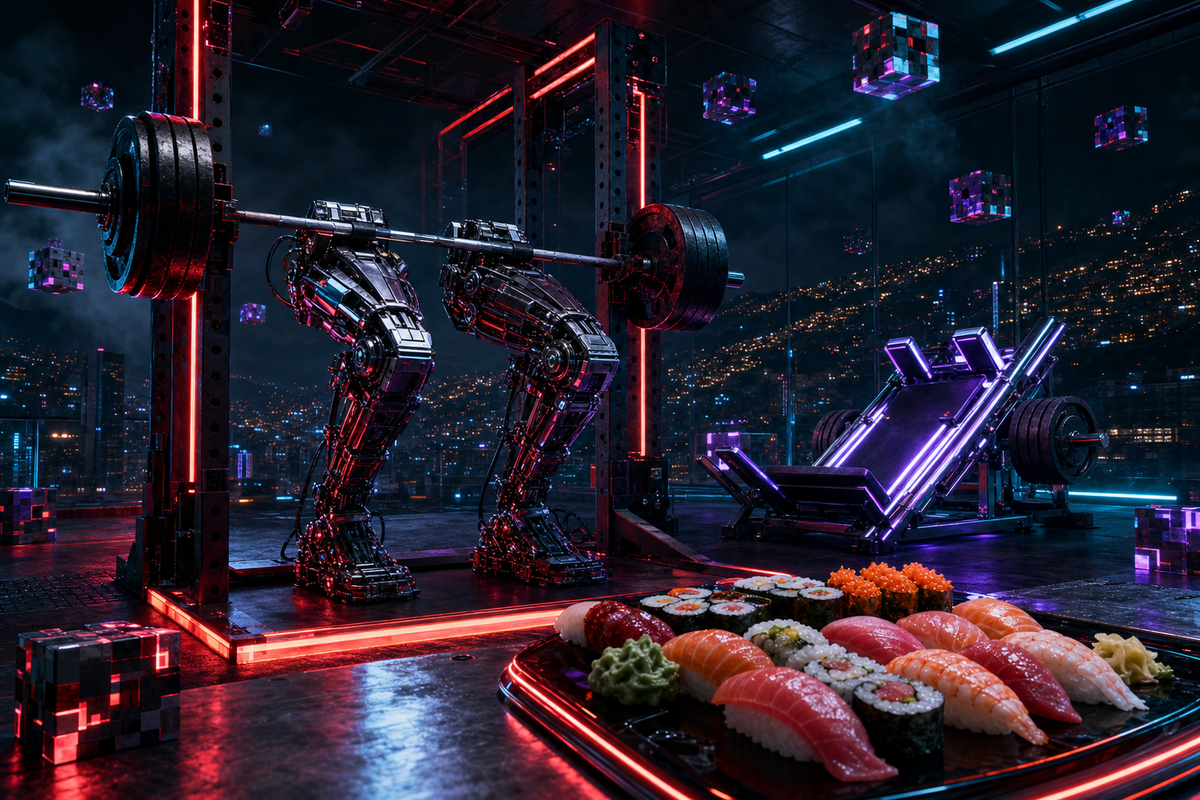
Three things happened, in this order, and the order is the whole point. First I was flat on my back in bed getting destroyed at Roblox by my kids — who are, for the record, better teachers than most adults I've paid. Then I went and trained legs until walking felt optional. Then I sat down in front of two full portions of sushi and made them vanish.
Rest, work, reload. Most people think the middle bit is the workout and the other two are just life happening around it. On leg day that's backwards. The rest and the refuel aren't separate from the session — they're part of it, the part where the adaptation actually happens. Leg day is the most systemically demanding thing you can do in a gym, and if you treat recovery as optional, you leave a lot of the result on the floor.
Legs are the biggest engine you own
Quads, hamstrings, glutes, adductors, calves — together the largest muscle compartment in the body by a wide margin. Skeletal muscle makes up a large share of your body mass, and the lower body holds the biggest chunk of it. Training legs recruits more muscle, moves more load, and demands more from every system than anything else you can do.
That's why it's the biggest lever, and why it hurts the most. A hard set of squats is a full-body event — lungs, heart, spine, nervous system, all of it. A hard set of curls makes your biceps burn; a hard set of squats makes your whole bloodline reconsider its choices. A curl is a rounding error. If you only have time to train one thing well, it was never going to be arms.
The hormone story — the real one, not the bro one
You've heard the claim: heavy leg work spikes testosterone and growth hormone, so training legs grows your whole body. The first half has truth in it. A hard, high-volume compound leg session often produces a larger acute rise in testosterone and growth hormone than a small-muscle session like an arm day.
Here's the honest part the memes skip: the research on whether those transient post-workout spikes directly build more muscle elsewhere is mixed at best (the evidence is weaker than the bro-science). The hour-long hormone bump probably isn't secretly inflating your arms.
So why does it still matter? Because the value was never the transient spike — it's that you're training the biggest muscles hard, driving a real systemic stress-and-adaptation signal, and building the tissue that actually moves your body composition. Train legs for the legs and the whole-body stimulus, not for a hormonal cheat code that doesn't cash out the way the internet promised.
Hot take: if someone sells you squats mainly as a testosterone hack, they're underselling the squat and overselling the hack.
Your legs are your second heart
The calf muscles get nicknamed the second heart for the calf pump: each contraction squeezes the veins and helps push blood back up against gravity. That mechanism is real, and staying strong and active supports it. Don't overclaim it, though — big legs don't automatically buy you lower blood pressure; it's regular resistance training over time that earns the broader cardiovascular benefits.
And a hard set of squats is genuinely taxing on the cardiovascular system — heart rate climbs hard because a huge amount of tissue is demanding oxygen and fuel while you brace under load. Anyone who says lifting isn't cardio has never finished a real set of legs. It's not a replacement for actual conditioning — you still need to walk and build an aerobic base — but it's a long way from nothing.
The biggest metabolic tissue you can grow
Skeletal muscle is the body's largest site of insulin-stimulated glucose disposal, and the lower body holds a major share of it. More trained muscle means a bigger glucose sink, which supports insulin sensitivity and steadier blood sugar. Muscle contraction also pulls glucose out of the blood independent of insulin, and that insulin-sensitizing effect lingers for hours after you rack the bar.
Your legs aren't just movers — they're metabolically active tissue you can build. If you ever stare at a blood panel wishing your glucose and insulin numbers were better, building and keeping muscle is one of the few levers that genuinely helps move them. Chasing tiny biohacks while skipping legs is polishing the silverware while the castle burns.
The one that should scare you: legs and how long you live
This is the argument that ends the debate. Lower-body strength is consistently associated with how well people age — fall risk, independence, and all-cause mortality. In some cohorts of older adults, weaker lower-body strength has tracked with markedly higher mortality, even after adjusting for age, size, activity, and inflammation (the science on why you shouldn't skip leg day). It's association, not proof — but the direction is relentless.
Sarcopenia — age-related muscle loss — tends to hit lower-body strength and power especially hard. And it compounds: weak legs mean you move less; moving less means they weaken faster; stairs turn threatening, a chair needs momentum, a small trip becomes a real fall — and independence leaks away through the floorboards. That's why sit-to-stand and walking speed are such useful markers of physical function and frailty risk: they fold strength, balance, coordination, and nerve into one number. You don't get old and then lose your legs. You lose your legs and then you get old.
Every hard leg session is a deposit into the account that decides whether the back half of life is spent independent or assisted. No supplement, no peptide, no protocol competes with still being able to rise from a chair, climb the stairs, and catch your own balance at 70.
So why does everyone skip it?
Because legs are the go muscles, and the mirror only shows the show muscles. The entire aesthetic ideal men chase — big chest, big arms, the V-taper — lives above the waist. Nobody flexes a quad sweep in the bathroom selfie.
And because it's the hardest, most humbling work in the building. Legs move the most load, so leg day hurts the most, and the soreness afterward turns a flight of stairs into a negotiation for two days. “Never skip leg day” is a meme precisely because skipping it is the default. Chicken legs under a big upper body is the universal tell — you've seen the guy.
Hot take: a man who trains upper body four days a week and dodges hard lower-body work isn't optimizing his physique — he's decorating half a body.
Yes, there are real reasons to modify leg training — knees, hips, old injuries, training history. But modify isn't skip. Machines, supported split squats, step-ups, hinges, leg press, sled work — there's almost always a variation that fits. “Squats hurt my knees” starts a useful conversation about exercise selection. “I just hate legs” is not a medical condition.
The reload: why two portions of sushi is training, not cheating
A hard leg session can use a lot of glycogen and leaves a real recovery demand behind it. That recovery is where the muscle actually gets rebuilt — and it runs on fuel and rest, not vibes.
Sushi after legs is a genuinely practical refuel: rice is easy carbohydrate to help restock glycogen, fish is high-quality protein to rebuild, and if you lean toward the fattier fish, some omega-3s on top. Two full portions after a brutal session isn't a blowout — it's the food doing its job. What actually moves the needle over time isn't one perfect meal, it's hitting your total carbs, protein, and calories across the day — and sleeping.
And the rest. The Roblox-in-bed part wasn't laziness before the gym — recovery is where adaptation happens, and you cannot out-train a body you never let recover. Getting schooled at a video game by your kids, flat on your back, is a legitimate line item in a training program. The stimulus is the barbell; the growth is the bed and the plate. Recovery isn't the absence of training — it's the phase where the training finally cashes the cheque.
Train the thing that hurts
The whole thing in one line: the muscles you least want to train are the ones that pay the most. Legs are hard, ugly to train, brutal to recover from, and invisible in the mirror — and they're the biggest lever you own for strength, metabolism, circulation, and how long you stay on your feet. Skip them for a bigger bicep and you've optimized the small thing while ignoring the engine.
So rest like you mean it, train the thing that hurts, and eat like the session earned it. Roblox, legs, sushi — in that order.
Related Reading
- No Day Off — training when there are no rest days.
- The Recharge Protocol — recovery treated as a discipline.
- 678 Korean BBQ — the refuel, done right.
- Longevity — Good Company — training for the decades, not the mirror.
- Even If You Are Tired, Keep Moving Forward — the late leg session I had already talked myself out of.