The NAD+ Rush
Day 2 of the protocol. Mixed and injected all five compounds solo. Then NAD+ hit. Burning, sweating, dizzy, pulse accelerated. Lasted ninety minutes.

Day 2 of the protocol started uneventfully. Five compounds laid out on the counter. Four new vials to reconstitute. Nurse arrived at 10:30 sharp.
This time I did everything myself. Mixed every vial. Drew every dose. Stuck every needle. The nurse stood by, supervised, corrected nothing because there was nothing to correct. Day 1 was nurse-led; Day 2 was solo-with-supervision; from Saturday onwards it is fully solo. The handover happens fast.
And then, two minutes after the last injection — the NAD+ one — the rush hit. I'd been warned this might happen. I was not prepared for what "this might happen" actually feels like.
The solo handover
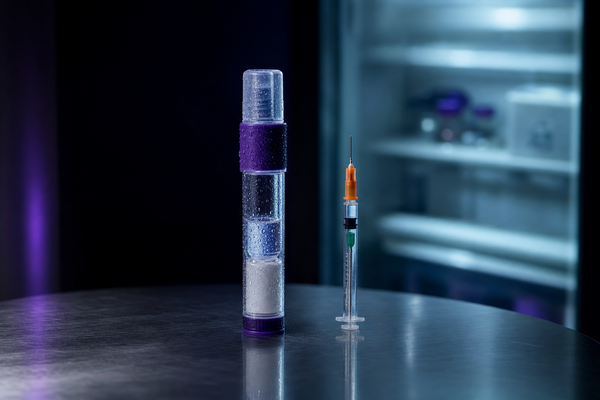
If you read Day 1's writeup, the workflow is the same — alcohol pads first, draw bact water with a 3 mL regular syringe, push gently into the powder vial against the inner wall, swirl in slow palm circles until clear, label, fridge. Then for the dose: tap to dislodge bubbles, push to expel air, pinch a fold of skin, ninety degrees, slow plunger, hold five seconds, withdraw, sharps container.
On Day 2 I did all of it without anyone touching the syringe except me. Five vials. Five sticks across four abdomen quadrants. The whole session ran maybe forty minutes including mixing. Slightly longer than Day 1 because I was reconstituting four new vials from scratch — HCG with its sterile solvent ampoule, NAD+ with five milliliters of bact water, CJC and Ipamorelin each with two milliliters. After the session those four vials sit in the fridge for the next two to four weeks. The next time I touch them is just to draw a dose.
The nurse's role on Day 2 was the role she will play less and less of: she stood next to me, watched my technique, told me my swirl was a touch fast on the NAD+ vial (slowed it down), confirmed my draw volumes, and that was it. By Day 4 with the next nurse visit Friday, I'll be doing this without thinking. By the following Sunday I am operating completely solo for the next six months.
The needle chemistry — a small detail with big consequences
Day 1 ended with a tidy mental model: insulin syringes for everything subQ, one larger 3 mL syringe with a 21-gauge needle for mixing only. Day 2 broke that mental model in a small but important way.
NAD+ comes as a 1,000 mg powder. The dose is 500 mg. Reconstituted in 5 mL of bact water, that's 200 mg per milliliter, so the dose volume is 2.5 milliliters. A standard 1 mL U-100 insulin syringe holds — surprise — 1 milliliter. The math doesn't fit. NAD+ requires the larger 3 mL syringe.
The 3 mL syringe ships with a default 21G × 1.5" needle — the same needle you'd use to draw bact water during mixing. That's a thick, long, intramuscular-grade needle. Pushing it into your abdomen for a subcutaneous injection works mechanically, but it is unpleasant. Insulin needles are 29-31 gauge and eight millimeters long. A 21-gauge needle is roughly twice as thick and four times as long. The difference between the two on bare abdominal skin is the difference between a mosquito bite and a bee sting.
The nurse's solution, which I now adopt as the standard going forward: screw a 30G × 1/2" hypodermic needle onto the 3 mL syringe in place of the 21G. In Spanish: aguja hipodérmica 30G × 1/2". A 30-gauge needle is even thinner than a typical insulin needle. Half an inch is short — perfect for subcutaneous tissue depth. The 3 mL barrel keeps the volume capacity. The result is insulin-needle fineness on a syringe that holds two and a half times the volume.
I don't have these needles in stock; the nurse used her own. Camel will deliver thirty units this Friday — enough for about twenty-six weekly NAD+ doses, with a small surplus, covering the full six-month protocol horizon.
The full needle landscape now looks like this:
| Tool | What it does | Used for |
|---|---|---|
| 1 mL U-100 insulin syringe Fixed 29-31G needle, ~8 mm |
Draw + inject in one motion. Painless, short, thin. | All peptides + Testosterone (40u dose). 6 of 8 compounds. |
| 3 mL syringe + 21G × 1.5" needle Default needle that ships with the syringe |
Draws solvent volumes too large for an insulin syringe. | Mixing only. Drawing 2-5 mL of bact water out of the bottle and pushing into the peptide vial. |
| 3 mL syringe + 30G × 1/2" hypodermic needle Aguja hipodérmica 30G × 1/2" — screws onto the 3mL syringe in place of the 21G |
Insulin-needle thinness on a 3 mL barrel. Painless subQ for big-volume doses. | NAD+ injection only, split-site (1.25 mL × 2 quadrants). |
Two syringes, three needle setups. Insulin syringes have fixed needles. The 3 mL syringe accepts swappable needles — that is what the NAD+ trick exploits.
Split-site NAD+ — and why
Two and a half milliliters is a lot of fluid to push into one subcutaneous spot. Even with a 30-gauge needle, that volume creates a noticeable depot under the skin and a noticeable burn during the slow push.
The technique the nurse demonstrated and which I will use weekly going forward: split the 2.5 mL into two equal halves of 1.25 mL each, into two different abdomen quadrants. One side, then the other. Slow push thirty to sixty seconds per side. Withdraw between sites, walk to the second quadrant — usually opposite-corner from the first — repeat the slow push.
Why split: distributes the volume so each site only carries 1.25 mL of fluid load, which absorbs faster and produces less local burning. The total drug delivered is the same; the local tissue stress is roughly halved per site.
This is now the canonical NAD+ technique for the rest of the protocol.
The rush
And here is the part nobody warned me hard enough about.
Two minutes after I withdrew the second NAD+ needle, the burning at both injection sites — which had felt like a normal slow-push warmth during the injection itself — intensified. The heat radiated outward across the lower abdomen and started climbing up my torso. Within five minutes I was sweating. Within seven I could feel my pulse climbing — not pounding, but accelerated, the way it accelerates when you stand up too fast. Energy surged. My legs felt heavy. I was lightly dizzy. The whole thing landed like an unexpected shot of espresso plus a sauna session, all at once.
"What the fuck is going on bruh." — internal monologue, verbatim, between minute eight and minute fifteen.
Then it peaked. Then it settled. Total duration ninety minutes from the first burning sensation to fully back to baseline. Here is the timeline:
| Time post-injection | What I felt |
|---|---|
| T+0 to T+2 min | Nothing. Routine subQ stick. |
| T+2 to T+15 min | Burning at both injection sites. Stomach on fire. Heat moving up the body. Sweating starts. Pulse climbs. Energy surge. Heavy legs. Dizzy. Internal monologue: "wtf is going on bruh." |
| T+15 to T+45 min | Settling but still warm + activated. HR easing back toward baseline. Energy still high but less spiky. |
| T+45 to T+90 min | Mostly resolved. Residual mild warmth, calm. |
| T+90 min | Back to baseline. Full reset. |
Total duration: ninety minutes. The first fifteen are the loud part.
It is — I now know — the textbook NAD+ rush. Every operator I've talked to in the biohacking community since reports a version of it on first dose. The mechanism is a stack of four things firing at the same time:
(1) Niacin-pathway flush — NAD+ partially converts to nicotinamide and then to niacin, which is a vasodilator. Blood vessels open up, skin warms, sweating starts. Same family of reaction as a niacin flush from a 500 mg vitamin pill, just dressed up in injectable clothing.
(2) Mitochondrial activation — NAD+ is the redox coenzyme that powers the electron transport chain. Suddenly flooding the cellular pool with NAD+ ramps up ATP production. Mitochondria physically produce heat as a byproduct of ATP synthesis (this is what thermogenesis literally is). Cells running faster equals heat from the inside out, plus the energy surge sensation.
(3) Mild histamine release — explains the dizziness and slight sweat component. NAD+ infusions are well-documented to cause this in a subset of patients.
(4) Reflex tachycardia — vasodilation drops blood pressure briefly, the body compensates with a faster heart rate. Net effect: ten to twenty beats per minute above resting baseline for the first fifteen to thirty minutes.
All four are real and all four are normal at this dose. The clinic was informed; we will monitor next week to see whether the magnitude is consistent or attenuates. No protocol adjustment needed.
What I will do differently next week
Three small operational tweaks for NAD+ #2 next Wednesday:
Sit down before the second injection. I was standing during both pushes on Day 2. The dizziness phase would have been more comfortable seated. Next week the second push happens with me already on a chair.
Pre-hydrate. I had not specifically loaded water before the session. Half a liter in the hour before injection probably reduces the dizziness and the sweat-loss recovery time.
No driving for thirty minutes after. The lightheadedness in the first ten to fifteen minutes is real. Whatever I'm doing right after the session, it should not require a car or a stairwell.
None of these are protocol changes. They are operator-experience changes — tuning the human running the protocol, not the protocol itself.
What happens next: Day 9 retest
Right after writing the previous section, I sent the clinic a quick question — does it make sense to repeat 500 mg next Wednesday and use that second data point to decide? Camel's reply (verbatim):
"Yes, NAD+ can be used twice per week. However, if the client is injecting it (not IV), I would recommend lowering the dose per injection to around 100–200 mg twice a week, to avoid burning and discomfort. If they want to use 500 mg, the best option is IV infusion, as it's much better tolerated. NAD 500 mg is a more effective dose, but it can be divided into two or three doses per week so that he reaches 500 mg per week."
Translated into the menu Camel was offering:
| Path | Per-session dose | Frequency | Weekly total | Per-session rush |
|---|---|---|---|---|
| A — Current | 500 mg | 1× / wk subQ | 500 mg | The 90-min rush above |
| B — Lower dose | 100–200 mg | 2× / wk subQ | 200–400 mg | Mild flush, possibly nothing |
| C — Split same total | 250 mg ×2 | 2× / wk subQ | 500 mg | ~half the bolus → ~half the rush |
| D — IV infusion | 500 mg | 1× / wk IV | 500 mg | Best tolerated, clinical-only |
Four ways to deliver NAD+. Path A is the most aggressive subcutaneous option. Path D is the gold standard but requires a clinical IV setup. Path C is the elegant compromise: same total weekly dose, smaller per-session bolus, milder per-session rush.
The clinic-favored ladder is roughly D > C > B > A. I am currently at A — the most aggressive option for a subQ user. Two real considerations:
The rush often attenuates. Operators commonly report 30-50% milder rush by sessions 2-3 — the niacin pathway downregulates with repeat exposure. My body might just adapt. If it does, A stays the optimal choice: single weekly stick day, full 500 mg, slightly less drama week by week.
The cost of trying once more is bounded. I already know what 500 mg subQ feels like. One more session at the same dose, with operational tweaks (pre-hydrate, sit down before the second push, no driving for thirty minutes), gives me a clean A/B comparison against Day 2.
So the strategy I sent back to Camel:
Day 9 (next Wednesday) — repeat 500 mg, same split-site technique. If the rush attenuates by 30% or more → stay on weekly 500 mg. If it is the same or worse → switch to Path C, 250 mg twice per week. Decision after Day 9.
Her reply:
"You can absolutely try a 500 mg NAD dose for your next injection so we can see how your body responds. That's a great plan — you can then decide on the most suitable dose based on how you feel after the second dose. Whatever the outcome, we're here to support and guide you."
So the plan is locked. Next Wednesday is the deciding session. I will be measuring eight things to compare cleanly against Day 2 — time to first burning, peak intensity, heart rate during peak (via Oura), sweating, dizziness, energy surge, total duration, time to baseline. Side-by-side at the same dose, same technique, plus pre-hydration and seated execution.
That is the actual purpose of these first two NAD+ sessions: not therapeutic exposure (that comes later), but calibration data to lock in the right dose strategy for the next six months.
If you read another one of these writeups in two weeks, you will know which path won.
The other four compounds — silent
Worth noting: the other four compounds today (HCG, CJC-1295, Ipamorelin, BPC-157) produced exactly zero acute sensation. HCG was a full insulin syringe of clear solution, painless on the push. CJC and Ipamorelin will go in tonight at twenty-two hundred sharp — eight units each in opposite abdomen quadrants — and the sleep-architecture effects start tomorrow morning. BPC-157 was 7.5 units, a tap on the syringe to dislodge bubbles, a moment, done.
NAD+ is the loud one of this stack. Everyone else operates quietly.
Today's session, on video
Sixty seconds of the Day 2 morning session — five compounds, mix-then-draw-then-stick, real time:
And the fridge arrived
Tangentially: the AstroAI mini fridge that will hold the protocol supplies for the next six months landed today. Six liters, dual voltage, thermoelectric cooling, holds 2-8°C. Cute as hell.
All the peptides, NAD+, HCG, and the bact water bottle live in there now. Testosterone and the empty storage vial stay at room temperature in the Pelican case — oil crystallizes if cold. The cold-chain layer of the protocol is fully operational.
Travel certificate + what's left this week
Dr. Barrera also signed and sent the international travel certificate today. Full medical letter, all eight compounds listed, medical supplies authorized, explicit "personal use only / not for commercial distribution" framing for the customs reading flow. Signed and stamped from Bogotá, dated April 29, 2026. The protocol is now travel-portable. I can fly internationally with the full kit and a defensible documentation trail.
What is left in Day Zero week:
- Tonight: CJC-1295 + Ipamorelin pre-bed, solo. First night of the five-night-per-week pre-bed cycle.
- Thursday (tomorrow): three compounds — BPC + CJC + Ipa — solo all day. No nurse visit. The nurse schedule revised — Thursday is now a full solo day.
- Friday: nurse check (and delivery of the thirty 30G hypodermic needles for NAD+).
- Saturday: last nurse check. Sign-off for full solo execution from Sunday onwards.
- Sunday and Monday: entirely solo. Sunday is CJC + Ipa pre-bed only. Monday is the protocol rest day — zero injections.
- Tuesday next week: Retatrutide + Testosterone + BPC + TB-500. The first weekly Tuesday at full solo.
Day 2 verdict
Solo-with-supervision is harder to articulate than nurse-led was. It is mostly muscle memory plus one small new piece of needle chemistry plus one big new sensory experience. The hard parts of the protocol are still upstream and downstream — the planning, the dosing, the eventual interpretation of week-twelve bloodwork.
The middle part — the daily execution — is rapidly becoming routine. With one exception. NAD+ is going to be the loud weekly event for at least a few more rounds. I am here for it.
Day 2 — five compounds. Five sticks. Ninety minutes of NAD+ rush. All clean. Rock and roll, baby.