Three Days of Nothing
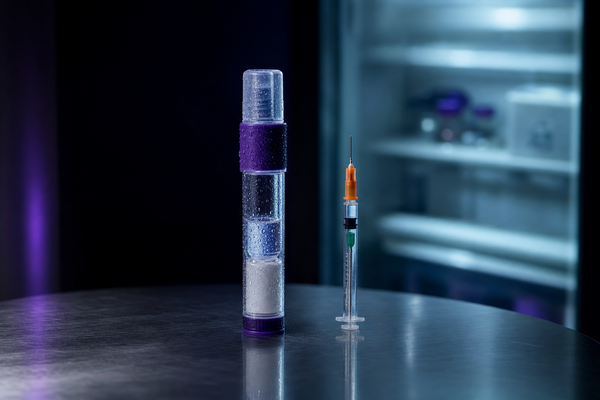
A blood test is only worth as much as the blood you hand it. Before the second panel — three months into the protocol — comes the boring, load-bearing part: a three-day washout, a 12-hour fast, no lifting, no sex. The science of a clean draw.

The second blood panel is set for July 30 — about three months after the baseline draw, and three months into the hormone-and-peptide protocol. It's the first honest look at the delta: what moved, what didn't budge, what the system looks like now. I can't wait to see the numbers.
But first, the unglamorous part. Starting Monday, the washout: no injections, no supplements for three days. Then the day before — no lifting, no sex — and a 12-hour fast before the nurse arrives. None of it is discipline for its own sake. It's about stripping out variables, because a blood test is only useful when it measures what you think it measures.
The three-day washout
Injected compounds and supplements have absorption curves and half-lives. Draw too close to a dose and the panel can catch an acute post-dose peak instead of the protocol's day-to-day baseline — pharmacology in stage makeup.
Hormones are where timing matters most. Where you sit in the dosing cycle changes the number, so the convention is to draw near the trough — the low point before the next dose — for an honest read of the floor. Three days won't clear every molecule (some compounds linger far longer), and how much it helps depends on each compound's kinetics — but it removes the immediate dosing spike and keeps the timing consistent from draw to draw.
Supplements can move their own markers too — glucose, lipids, liver enzymes, minerals, even the lab assay itself, depending on the product. Pulling them for the same window before every panel reduces the short-term confounders. The goal isn't to prove the protocol looks spectacular the morning after a shot. It's to see the system without yesterday's fireworks.
The 12-hour fast
Food rewrites blood chemistry fast. A recent meal pushes triglycerides up for hours — the body turns excess calories into triglycerides and dumps dietary fat into the blood as chylomicrons — and carbohydrates lift glucose and insulin (Cleveland Clinic).
A 12-hour fast pins down the big food-driven movers, so fasting glucose and the lipid panel reflect my physiology instead of last night's dinner. Otherwise a late carb raid reads like a metabolic shift when it's really just dinner refusing to leave the building. Water's fine — food isn't.
No exercise
Hard training is controlled damage — great for adaptation, bad right before a lab. A heavy or eccentric session can elevate creatine kinase for days as muscle repairs, and it can drag AST and ALT up with it — those “liver” enzymes leak out of stressed skeletal muscle too, so a big session can fake liver trouble that isn't there (case data).
It can also transiently move CRP (inflammation), cortisol, and testosterone. All noise in a comparison panel — so no lifting the day before.
No sex
Sexual activity moves hormones on a short timescale. Prolactin is the sensitive one — it rises after orgasm and takes a while to come back down. Testosterone is murkier: the evidence is mixed (one study found a peak after about a week of abstinence, but it's not a reliable rule) (Examine).
That inconsistency is exactly why you standardize instead of guess. I want a clean, consistently-timed testosterone number, and I don't want sexual activity nudging it either way. Abstaining before the draw removes one more variable. Lab discipline, not monastic philosophy.
What the panel checks
Same prep, same markers as the baseline, so the comparison is apples-to-apples — markers across blood, hormones, liver, kidney, iron, metabolism, and the prostate, in a single draw:
Fixed price for the home draw: COP 710,000 (~US$175). The nurse handles it at home, pulls the tubes, and the morning moves on.
Control the variables
Every rule serves the same idea: control the variables. The baseline and the July 30 panel are two snapshots; if the conditions around them differ — a fresh injection, a supplement, a big meal, a deadlift session, post-orgasm prolactin — the delta is part signal, part noise, and every decision downstream gets weaker.
A clean draw buys a trustworthy comparison — a real read on what changed over three months, where the protocol needs tuning, and which more advanced steps are worth taking next.
Biohacking loves to be a circus of compounds and dashboards. The unglamorous half is measurement discipline: same conditions, defined timing, fewer confounders, honest numbers.
Three days of nothing. Then the blood speaks.
Related Reading
- Baseline Drawn in Medellín — the first panel, and the prep that went into it.
- Panel Results — what the baseline numbers actually said.
- From Panel to Protocol — turning bloodwork into an 8-compound plan.
- Choosing a Biohacking Clinic in Medellín — how the home-draw setup came to be.
- Next Level Preps — the second washout, and the body-composition baseline I never took.