Just Warming Up
Day 4 of the protocol. Three days of compounds. Daily training. Clean fuel. The body is responding faster than the manual said it would — HRV climbing, heart rate dropping, sleep onset cut by 71 minutes, gym strength returning, head clear. This is the floor. Not the ceiling.

Day 4. Friday morning. Four sticks ahead of me — TB-500, BPC-157, CJC-1295, Ipamorelin. The first three days are already in the books and the body is reporting back faster than the manual said it would.
Here is what the data is showing.
Day 4 stack — Friday
Four sticks. Twenty minutes from the kitchen counter to the sharps container. Same drill as Tuesday — except Tuesday the home nurse was running it. Today I run it solo for the third day in a row.
Today the missing piece arrives
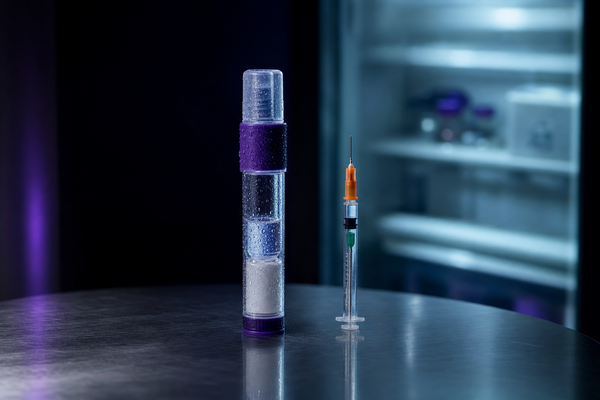
The nurse comes by today with a small but operationally critical delivery — thirty 30-gauge × 1/2-inch hypodermic needles.
Easy to miss in the protocol. Easy to underestimate. Until you understand what they replace.
The full kit ships with two needle types: U-100 insulin syringes (29-31G, ultra-fine) for the small-volume compounds, and 3 mL syringes with 21G × 1.5" needles for the higher-volume ones. Insulin needles for BPC, TB, CJC, Ipa, HCG, Test. The 3 mL / 21G combo for NAD+.
Problem: NAD+ at 500 mg dose translates to 2.5 mL volume — too much liquid to fit in a U-100 insulin syringe. So the 3 mL barrel is mandatory. But the 21G needle is IM-grade thickness — designed for intramuscular injection deep into glute or thigh. Driving a 21-gauge needle into the abdomen for a subQ shot is, technically, fine. Functionally, brutal. Felt like getting stabbed with a pencil.
The fix is to unscrew the 21G off the 3 mL syringe and screw on a 30G × 1/2" hypodermic instead. Keeps the 2.5 mL volume capacity. Switches the delivery end from IM-grade to insulin-grade fineness. The result: a NAD+ stick that feels like the rest — a barely-there pinch instead of a stab.
The nurse used her own 30G needles improvising on Day 2 (The NAD+ Rush) when this gap surfaced — that was the day the now-famous NAD+ rush hit anyway, but at least the entry was painless. Today's delivery closes the operational loop. Thirty needles, one per week, six months covered.
This is what protocol maturity looks like — the unsexy logistical detail that determines whether you actually keep doing the thing for six months. Painful sticks compound into avoidance. Painless sticks compound into discipline.
Reset day moves to Monday
The other piece of operational maturity that landed today: shifting the weekly reset.
The original cadence locked Day Zero on a Tuesday because that was when the home nurse could come for the first 4-visit training week. Tue-Wed nurse-led, Thu onwards solo. Mon = rest. That worked perfectly for the onboarding week.
But the protocol is now executing solo, three days deep, with the body adapting faster than the manual said it would. The Tuesday anchor was an artifact of clinic logistics, not biology. Time to move it.
New locked weekly cadence (effective next week):
Monday becomes the heavy reset day — Retatrutide, Testosterone, BPC-157, TB-500. Sunday becomes the full rest day. Total injections per week unchanged. Compound spacing maintained.
Why? Because the calendar runs Monday-to-Sunday everywhere else in life. Kids' school week. Work week. Social rhythm. A protocol that fights the calendar adds friction. A protocol aligned to the calendar disappears into the rhythm.
This week is the transition cycle:
• Sun May 3 = REST (skip the 2 originally-planned sticks)
• Mon May 4 = first heavy day under the new structure (Reta + Test + BPC + TB)
One-time 6-day gap on every weekly compound (vs the standard 7). Testosterone enanthate's half-life is 10 days, so 6 vs 7 is invisible. Same for Retatrutide, HCG, NAD+. Biology absorbs the shift. Operations get cleaner.
Day 9 NAD+ retest moves from Wed May 6 to Tue May 5. The brand new 30G hypodermic needles get their first deployment that day — closing the operational loop on Day 9 instead of Day 10.
Six months is a long time. Every operational detail that reduces friction adds days of compliance at the back end. The biology is the engine. The logistics are the road. Smooth roads, faster engine.
What the data is doing
Three nights of complete-data sleep under the protocol. The trajectory is sharper than the protocol assumes possible.
Vascular age 40 — four years younger than my chronological 44.
The protocol's standard prediction was: body protests for five to seven days while it figures out what is happening, sleep gets worse, HRV crashes, you feel weird, then it slowly stabilizes by week two.
What actually happened was Day 1 the body sputtered, Day 2 it recalibrated, and by Day 3 sleep latency dropped from 93 minutes to 22 minutes on a heavy training day. Twenty-four-hour adaptation when the textbook says five to seven days.
What I am feeling
The data is one thing. The subjective layer is another. Both matter.
Heat. Real, visible flush in the face during the afternoon — body announcing the protocol is biologically active. Test enanthate plasma climbing, GH peptides cumulative, vasodilation across the skin. Not uncomfortable. Just present.
Energy. Not coffee energy. Foundational energy. Wake up and go. The kind that does not crash at 14:00.
Sleep. Twenty-two minute onset on Day 3 versus ninety-three minutes the night before. The body said yes to the cycle. I am asleep before the activation phase finishes complaining.
Gym. Back in. First real strength session landed clean. No grinding through the warm-up sets, no waiting for the body to wake up — the warm-up was the warm-up, and the working sets felt like they should. Twelve thousand steps in a single day for the first time in a while. Including kids' fútbol practice.
Focus. Clear head. No fog. The compounding effect of clean fuel plus active protocol is showing up cognitively — you can feel the signal-to-noise ratio change.
The multipliers
The protocol alone does not produce this curve. Three things stacked at once make it.
Clean diet. Strict ketogenic. No insulin spikes, no glucose chaos. The compounds land on a stable metabolic platform instead of a chaotic one.
Daily training. Gym + walking + kids' fútbol. Movement re-engaged after a sedentary stretch. The training day on Day 3 is the one that pushed sleep pressure high enough to override the GH peptide activation phase. The body welcomed the load.
Coordinated protocol. TRT base + Retatrutide weekly + healing peptides BPC and TB-500 + GH peptides CJC and Ipamorelin pulsed nightly. Every compound has a job. The combination is the multiplier.
Take any one of those out and the curve flattens.
Just warming up
Day 4 of 168.
The first bloodwork retest is in 12 weeks. The visible body-composition shift typically arrives at 6-8 weeks. The neurochemical adaptation keeps developing for 6 months.
Day 4 looking like this means Day 28 is going to be loud.
The body is in sponge mode right now — it wants the input and it is responding faster than the protocol expects it to. The flush in the face is biology working as designed. The energy is the system rebooting on cleaner fuel. The sleep is the cycle locking in.
This is the floor. Not the ceiling.
The operator is online. The trajectory is up. We are just warming up.