Sleep: The Free Biohack Everyone Keeps Underestimating
A real night of my own Oura sleep, what the stages actually do, the honest version of Why We Sleep, and the only method that works: debug one variable at a time until your nights are dialed.
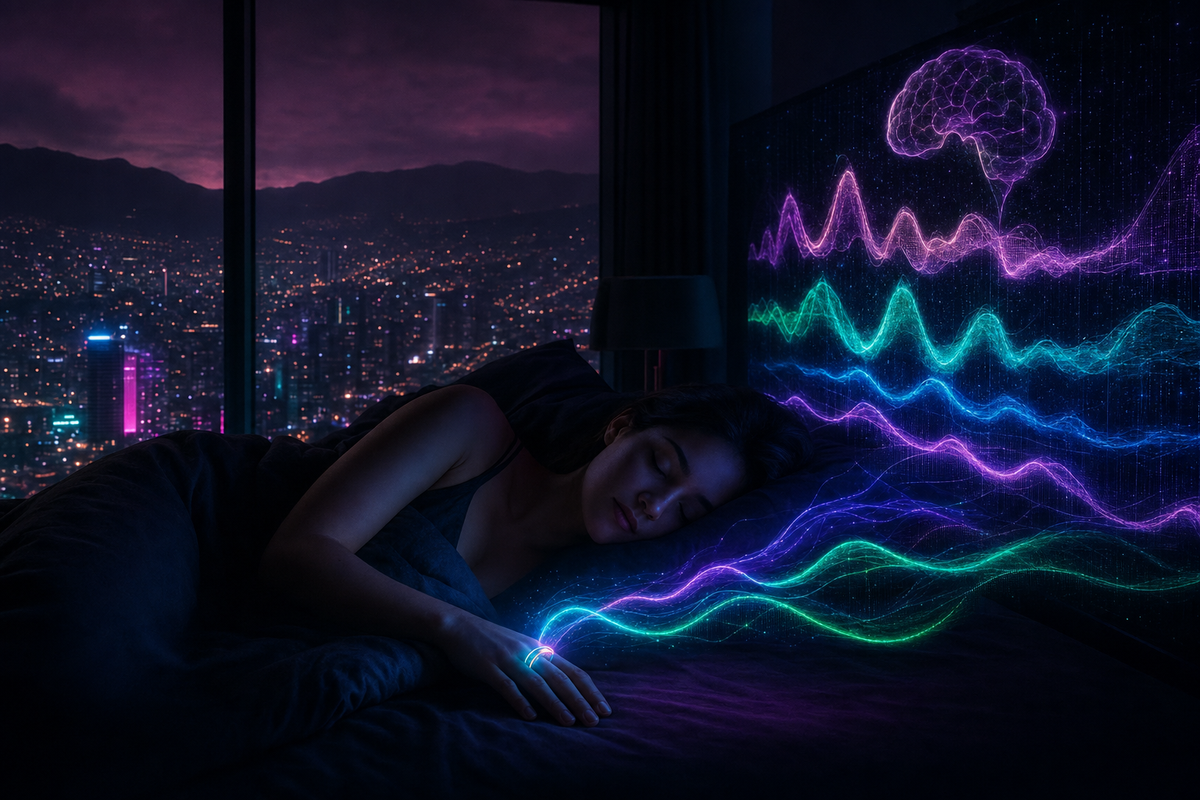
That hypnogram up there is a real night of mine.
Not a perfect influencer sleep score. Not some monk-mode, blue-blocker, mouth-taped, mineral-salted fantasy. A real night from a 44-year-old biohacker in Medellin, running TRT, peptides, training, diet experiments, and tracking the whole circus with an Oura Ring 4.
And that is exactly why it is useful.
Sleep is the most underrated, highest-ROI biohack on the board. It is free, boring, and brutally upstream. TRT depends on it. Peptides depend on it. Training adaptation depends on it. Fat loss, glucose control, libido, mood, immune function, memory, and whether you behave like an adult or a malfunctioning vending machine all depend on it.
Wreck your sleep and every other biohack becomes bailing water from a boat with a hole in it.
What You're Looking At
A sleep chart looks like a nightclub barcode until you know what the stages mean.
Light sleep is mostly N1 and N2. N1 is the little hallway between awake and asleep. N2 is real sleep: heart rate drops, body temperature dips, muscles relax, and the brain starts doing maintenance work. Biohackers disrespect light sleep because it sounds cheap. It is not cheap. It is the connective tissue of the night.
Deep sleep is N3, also called slow-wave sleep. This is the heavy physical repair stage. Tissue repair, immune recalibration, growth hormone release, nervous system downshifting. It is also when the glymphatic system, the brain's overnight waste-clearance plumbing, appears to be most active, including clearing metabolic byproducts and proteins such as amyloid-beta. The human evidence is still emerging — it's an association, not a settled prevention story — but it's why deep sleep keeps showing up in brain-aging and Alzheimer's research. Less magic, more plumbing.
REM sleep is the vivid-dreaming, memory-consolidating, emotion-processing stage. Your brain is highly active, your body is mostly paralyzed, and your internal movie studio starts generating bizarre content with a budget of zero pesos. REM helps learning, emotional regulation, creativity, and memory integration.
Wake is not failure. Brief wakes are normal. You often do not remember them. Your wearable does.
A normal night runs in roughly 80- to 110-minute cycles, usually four to six per night. Deep sleep is front-loaded in the first part of the night. REM is back-loaded toward morning. This matters because if you cut sleep short, you do not steal evenly from every stage. You usually rob REM specifically.
Here was my night:
The good: REM was respectable. The not-good: deep sleep was low, total sleep was short, latency was sloppy, and bedtime was dumb. That is not moral failure. It is data.
Also: Oura, Whoop, Apple Watch, Garmin, whatever. These are not EEG sleep labs. They estimate. But if you use the same device consistently, the trends are valuable. You are not looking for divine truth. You are looking for signal.
Sleep-Stage Cheat Sheet
The Useful Version of Why We Sleep
Matthew Walker's Why We Sleep did something important: it made sleep feel non-optional to millions of people. Good. Most humans needed the slap.
The solid consensus is clear: chronic short sleep is associated with worse metabolic, cardiovascular, immune, and cognitive outcomes. Deep sleep is tied to brain-waste clearance research and long-term brain health. REM matters for learning and emotional regulation. And the International Agency for Research on Cancer, the WHO's cancer agency, classifies shift work involving circadian disruption as probably carcinogenic to humans (Group 2A, on limited human evidence plus animal and mechanistic data). Circadian disruption is not just "a tough schedule" — it is biology getting punched in the clock.
But let us not fact-launder.
Why We Sleep is a fantastic motivator, and it also has well-documented overstatements and errors. Alexey Guzey's critique pointed out problems with some claims, figures, and framing. The dramatic "sleep under six hours and prepare your early grave" vibe is stronger than the evidence can honestly carry.
The defensible version is already strong enough:
Bad sleep does not guarantee disease. Good sleep does not make you immortal. But chronically short, fragmented, circadian-wrecked sleep reliably moves the odds in the wrong direction. You do not need mythology. The boring version is scary enough.
The Method: Debug, Don't Checklist
Here is where people screw up sleep optimization.
They panic, buy magnesium, glycine, blackout curtains, mouth tape, a chili pad, blue blockers, lavender spray, a meditation app, and some mushroom powder named after a Viking emotion. Then their sleep improves and they have no idea why. Or it gets worse and they have no idea why.
That is not biohacking. That is throwing darts during an earthquake.
Sleep optimization is debugging.
Change one variable at a time. Hold it for several nights. Watch the device-estimated trends: deep sleep, REM, HRV, resting heart rate, latency, awakenings, respiratory rate, temperature deviation. Keep what moves the needle. Discard what does not. Then test the next variable.
Over weeks, you converge on your sleep system. Not the internet's system. Yours.
Here is the method in one concrete example. Say cannabis is the suspect — plenty of people lean on it to get to sleep. You do not quit everything at once. You change one thing: a high-THC sativa swapped for a CBD-dominant option, with the room, the routine, the bedtime window, and the ring all held constant. Several nights later, you read the data.
The pattern that usually shows up: deep sleep and HRV recover, latency tightens, and the difference is not subtle — because high-THC sativa tends to hit deep sleep and REM harder than a CBD-dominant profile does. That is not "cannabis is evil" or "CBD is magic." It is one variable, isolated and measured.
Your worst wrecker might be alcohol, late caffeine, heat, doom-scrolling, late meals, or training too late. You find it the same way: change one thing, hold the rest, read the data, stop guessing.
Sleep Wreckers, Roughly Ranked
The Levers
Test these one at a time. Not all tonight. You are debugging, remember?
Consistency
Fixed wake time is the highest-leverage sleep lever. Not bedtime. Wake time.
Wake at the same time every day, even weekends. This anchors your circadian rhythm. Bedtime becomes easier when your wake time is stable. Yes, this is annoying. So are glucose spikes and looking like a tired accountant during leg day.
Light
Get bright outdoor light within 30-60 minutes of waking. In Medellin, with this sun, that is the easy part. Morning light tells your circadian clock, "Start the day."
At night, do the opposite. Dim, warm lights. Screens off or heavily reduced in the last hour. Blue light late can suppress melatonin and delay sleep timing. Your phone is not evil. It is just a tiny casino with a flashlight.
Temperature
A cool room helps because sleep onset requires a drop in core body temperature. Aim around 18C / 65F if you can tolerate it.
A hot shower or bath 60-90 minutes before bed can help paradoxically. It warms the skin, triggers vasodilation, and then your body dumps heat. You feel sleepy because your core temperature drops. Biology loves a rebound effect.
Caffeine
Caffeine blocks adenosine, the sleep-pressure molecule that builds throughout the day. Its half-life is roughly 5-6 hours for many people, and the quarter-life can be around 12 hours.
That afternoon coffee is still working long after you stopped noticing it. Cut caffeine by early afternoon. If you are sensitive, cut it earlier. If you are a slow metabolizer, congratulations, your 2 p.m. espresso is now a bedtime supplement.
Alcohol
Alcohol is not sleep. Alcohol is sedation with paperwork.
It may help you fall asleep faster, then fragments the night, raises heart rate, lowers HRV, worsens breathing in some people, and suppresses REM. Your Oura will often show this as a fake pass: unconscious for hours, recovery score in the trash.
Cannabis and THC
THC can knock you out quickly. That does not mean it gives you recovered sleep.
High-THC cannabis tends to suppress REM, can reduce sleep quality over time, and builds tolerance. A high-THC sativa is usually the worst offender; a CBD-dominant profile tends to be less disruptive. But none of it is "recovered" sleep by default.
If you use cannabis, test it like an adult: same bedtime, same room, same routine, only change the cannabinoid profile or remove it. Watch REM, deep sleep, HRV, and latency.
Bedtime
Deep sleep is front-loaded into the first hours of whenever you fall asleep, so a late bedtime mostly bites when it also shortens your total sleep or fights your circadian timing. A 01:39 night that still gets cut short at 8am, like mine, does both: less early-night deep, and a body clock that wanted lights-out hours ago.
You cannot always "make it up" by sleeping later. The first cycles carry most of your deep sleep, and a short, time-shifted night does not rebuild them evenly.
Naps
Naps are a tool. Misused, they are theft.
A 15- to 25-minute nap early in the day can improve alertness without wrecking nighttime sleep. A 60-minute nap at 5 p.m. steals sleep pressure and then you act surprised when you are awake at midnight negotiating with your ceiling.
Exercise and Movement
Training builds sleep pressure. Movement improves glucose handling, mood, and circadian rhythm. But hard training right before bed can keep temperature, adrenaline, and sympathetic tone elevated.
Lift. Sprint. Walk. Just avoid turning bedtime into the cooldown period for your nervous system's civil war.
Meal Timing
Heavy late meals fragment sleep. Digestion raises metabolic activity and can increase core temperature. Big late meals can also worsen reflux and breathing.
Finish eating a few hours before bed when possible. Protein at dinner is fine. A giant late meal that needs its own construction permit is not.
Supplements
Supplements are fine-tuning, not foundations.
The usual suspects: magnesium glycinate, glycine, L-theanine, apigenin, and low-dose melatonin. Magnesium and glycine may help some people relax and lower sleep friction. L-theanine can take the edge off. Apigenin is interesting but not a miracle. Evidence is modest, individual response varies.
Melatonin is best treated as a timing signal, not a hammer. I prefer low dose: around 0.3-0.5 mg. The 5-10 mg bombs many people take can cause grogginess, vivid dreams, and a next-day fog that makes you wonder if you slept in a server room.
Tracking
You cannot optimize what you do not measure.
Track sleep duration, deep sleep, REM, HRV, resting heart rate, latency, and awakenings. Look at trends over weeks, not one dramatic night. One bad sleep score is data. Five bad sleep scores are a pattern.
Also avoid orthosomnia: anxiety about sleep data that makes sleep worse. The ring is a tool. Do not let it become your tiny judgmental priest.
The Close
Sleep is free. It is the highest-ROI biohack on the board — the foundation every other lever quietly stands on, and the difference between a brain that works and one running 47 tabs.
You do not buy great sleep.
You debug it.
One variable at a time. Several nights per test. Keep what works. Kill what does not. Repeat until your nights are dialed and everything else in your stack finally has a foundation worth standing on.
Why I Chose the Oura Ring 4 — the tracker behind every chart in this post.
What the Intake Strip Did to My Sleep Data — one-variable-at-a-time, the airway edition.
Borrowing the Pulse: CJC-1295 + Ipamorelin — GH peptides and the pre-bed ritual that moved my nights.
Sleep Smart — positioning yourself for pain-free rest.
Better Than Ever: Seven Protocol Changes That Compounded — seven recent changes that compounded into the best the system has felt.
Yoga: The Downshift — training the parasympathetic system that runs your sleep.
The Recharge Protocol — recovery, made a deliberate weekend practice.
Samurai — the recharge weekend, concluded: the 7 virtues of Bushido read as a biohacker’s code.
Longevity: Good Company — why the people around you are a longevity variable worth curating.
Ten Minutes of Morning Sun — the cheapest daily circadian anchor: ten minutes of morning light.
Hibernation Protocol — the supplement layer on top of the fundamentals — ranked, with the one I refuse.